Slender Brake 'Victoriae'
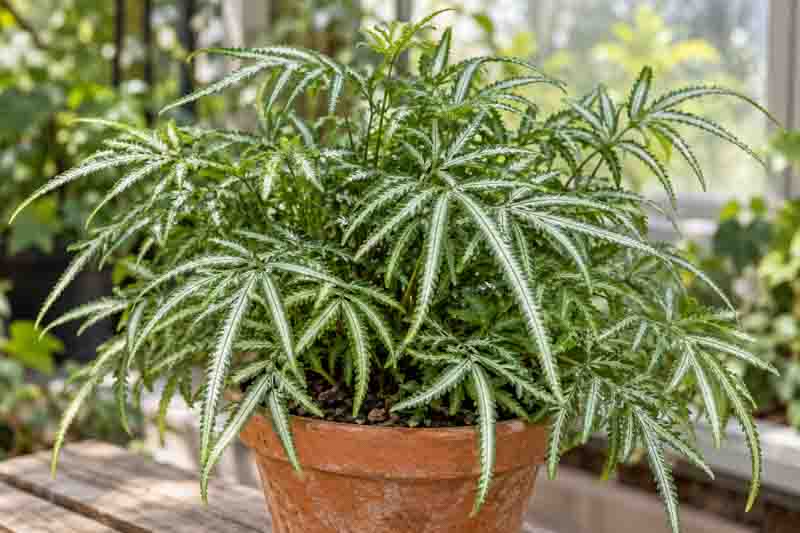


With finely cut fronds patterned in white and green, Pteris ensiformis ‘Victoriae’ is one of those ferns that rewards a closer look. Its delicate, triangular foliage has an almost lace-like quality, bringing intricate texture to a bright bathroom, shaded windowsill, or collection of tropical houseplants.
This variegated Slender Brake Fern prefers filtered light, moist but well-drained soil, and humid air. Its care is fairly straightforward, but identifying it can be less so: horticultural sources disagree over the markings that distinguish ‘Victoriae’ from the similar ‘Evergemiensis’. Knowing what to look for helps gardeners choose the right fern and recognize normal changes in its foliage.
Summary: Frost-tender, semi-evergreen fern with delicate, white-and-green variegated fronds.
Use: Ideal for indoor plant collections, bright bathrooms, conservatories, and sheltered containers.
Highlight: Finely divided, triangular foliage with contrasting pale and dark green markings.
Botanical interest: A historically named selection whose identification has been complicated by differing horticultural descriptions.
| Botanical Name | Pteris ensiformis ‘Victoriae’ |
|---|---|
| Historical Botanical Name | Pteris ensiformis var. victoriae; treated by Kew as a synonym of P. ensiformis var. ensiformis |
| Family | Pteridaceae |
| Common Names | Variegated Slender Brake Fern, Slender Brake ‘Victoriae’ |
| Origin | Cultivated selection of an Asian-Pacific species; precise horticultural origin uncertain |
| Plant Type and Habit | Semi-evergreen perennial fern; clump-forming, upright to arching |
| Hardiness | USDA Zones 10-13. RHS H1C; frost-tender and best grown indoors or under protection. |
| Size | Up to 20 in. (50 cm) tall and potentially 20-40 in. (50-100 cm) wide at maturity (RHS) |
| Exposure | Bright indirect light indoors; partial to full shade outdoors |
| Soil | Humus-rich, moist but well-drained; acidic, neutral, or alkaline pH |
| Foliage | Finely divided, triangular, white-and-green variegated fronds |
| Flowers | None; fertile fronds may develop spore-bearing margins |
| Pet Safety | No verified cultivar-specific ASPCA classification; discourage ingestion |
‘Victoriae’ is a variegated horticultural selection of Pteris ensiformis, a fern native to tropical and subtropical Asia and the Pacific. Its exact cultivar origin is uncertain. The historical botanical name P. ensiformis var. victoriae was published in the nineteenth century, but Kew now places it in synonymy under P. ensiformis var. ensiformis. Horticultural references continue to use the cultivar name ‘Victoriae’. These naming histories are related, but should not be assumed to establish that every plant sold as ‘Victoriae’ represents an identical, verified clone.
Fronds emerge in clumps from a short rhizome, standing upright when young and arching gently with age. It has a maximum height around 20 in. (50 cm) and a possible mature spread of 20-40 in. (50-100 cm). Plants grown indoors in smaller containers often remain more restrained.
The triangular fronds are divided into numerous narrow segments, giving the plant a delicate, feathery outline. RHS describes silvery-white centers with dark green margins, while Royal Botanic Gardens Victoria describes white-edged segments with green centers. Because these accounts conflict, the position of the white markings alone is not a reliable identification test.
Like all true ferns, ‘Victoriae’ produces no flowers or seeds. The species can develop broader sterile fronds and narrower fertile fronds, with spores produced along the margins of fertile segments. These differences are normal and can make fronds on the same plant look surprisingly different. Division is preferable when gardeners want to preserve the appearance of a named selection.
RHS rates ‘Victoriae’ H1C, indicating a frost-tender plant suitable for protected cultivation or sheltered outdoor use during warm weather. Its foliage is semi-evergreen, retaining its appearance in favorable conditions but potentially declining with cold or environmental stress.
This ornamental fern produces no nectar or pollen. Specific wildlife relationships for ‘Victoriae’ are poorly documented, although outdoor fronds may provide limited shelter for small organisms.
Reliable deer- and rabbit-resistance assessments specific to ‘Victoriae’ are unavailable. Protect outdoor containers where browsing animals are active.
‘Victoriae’ is not suited to prolonged drought. Its finely divided fronds can develop brittle edges when the root ball dries excessively. Steady moisture is important, but permanently saturated soil may damage the roots.
A verified cultivar-specific ASPCA toxicity classification has not been established for Pteris ensiformis ‘Victoriae’. Avoid claiming it is definitively toxic or non-toxic to cats, dogs, horses, or humans without supporting evidence. Treat it as ornamental and discourage ingestion.
The parent species has established populations outside parts of its native range, but invasive behavior specific to ‘Victoriae’ has not been established. Avoid releasing unwanted ornamental ferns into natural habitats.
These variegated ferns can look similar in nursery displays, but there are useful differences. Start with frond shape, then examine the markings and botanical name.
| Fern | Frond Structure | Identification Clue |
|---|---|---|
| P. ensiformis ‘Victoriae’ | Finely divided, triangular | White-and-green variegation; published descriptions disagree on stripe placement |
| P. ensiformis ‘Evergemiensis’ | Finely divided, delicate | Silvery-white central stripes described by Royal Botanic Gardens Victoria |
| P. cretica var. albolineata | Longer, simpler, ribbon-like pinnae | Broad creamy-white center with green margins |
Royal Botanic Gardens Victoria describes ‘Victoriae’ with white-edged segments and green centers, while ‘Evergemiensis’ has silvery-white central stripes. RHS, however, describes ‘Victoriae’ with pale centers and dark green margins.
For a more reliable identification, compare mature fronds, examine both fertile and sterile foliage, and check the plant’s documented provenance. White markings alone cannot conclusively distinguish these names.
Bright indirect light indoors is ideal. Outdoors, choose partial to full shade. Harsh afternoon sunlight can scorch pale leaf tissue, while very dim light may weaken growth.
Use a humus-rich potting mix that retains moisture while allowing excess water to drain. RHS accepts acidic, neutral, or alkaline pH and recommends chalk-free, leaf-mould-enriched soil outdoors. Water when the surface begins to dry, keeping the root zone moist without leaving the pot standing in water.
Temperatures around 60-75°F (16-24°C) suit indoor cultivation. Humid air helps prevent crisp leaf edges, particularly during winter heating. A humidifier is useful, provided the plant also receives gentle air circulation.
Narrower fertile fronds can look unlike the broader sterile fronds on the same plant. Check for normal marginal sori before assuming distorted growth. Brown, papery patches within the pale foliage, however, may indicate excessive sunlight.
Use a container with drainage holes and repot in spring when roots become crowded. Keep the rhizome at its original planting depth and avoid oversized pots that remain wet for too long.
Remove dead fronds close to the base. Feed lightly with diluted balanced fertilizer during active growth, reducing feeding in winter. Rotate containers periodically for even growth.
Divide healthy rhizomes in spring, ensuring each section has roots and growing points. Spores may also be sown when ripe, as RHS suggests, but resulting plants may differ from the parent. Division is the more dependable choice for maintaining the variegated appearance.
Examine the pattern of damage before changing watering or treating pests. Sun scorch, dry soil, and normal spore structures look different.
| What You See | Possible Cause | Check First |
|---|---|---|
| Papery brown patches | Excessive sunlight | Window exposure |
| Crispy tips | Dry soil, low humidity, or salts | Pot moisture and fertilizer |
| Yellow, limp fronds | Possible root stress or waterlogging | Drainage and roots |
| Raised bumps, sticky residue | Scale insects | Stalks and undersides |
| Regular marginal brown lines | Normal sori on fertile fronds | Symmetry and position |
Plants grown under glass may attract scale insects or eelworms, with sooty mold sometimes appearing on affected foliage.
Regular dark lines along fertile leaflet margins: Usually normal sori.
Irregular raised bumps or sticky deposits: Investigate scale insects.
Dry brown patches on exposed foliage: Check direct sun and moisture stress.
Choose companions that appreciate filtered light and moist but well-drained growing conditions. Separate containers make it easier to accommodate differences in mature size, soil preferences, and watering.
Place ‘Victoriae’ in front of a larger Bird’s Nest Fern, using separate pots. The broad green leaves make the smaller fern’s intricate markings easier to appreciate while allowing each plant to receive appropriate care.
‘Victoriae’ is a horticultural cultivar name, while Pteris ensiformis var. victoriae is a historical botanical name now treated by Kew as a synonym of Pteris ensiformis var. ensiformis. Horticultural usage has not always been consistent.
Royal Botanic Gardens Victoria describes ‘Victoriae’ with white margins and green centers, and ‘Evergemiensis’ with white central stripes. RHS, however, describes ‘Victoriae’ with pale centers. Confirm identification using verified plant material, not stripe placement alone.
Pteris ensiformis can produce broader sterile fronds and narrower fertile fronds bearing spores along their margins. The two frond types may look noticeably different on the same healthy plant.
RHS rates ‘Victoriae’ H1C, indicating a frost-tender fern suitable for sheltered outdoor use during warm weather. Grow it indoors or under protection during cold seasons.
No verified cultivar-specific ASPCA assessment has been established. Avoid assuming it is definitively non-toxic and keep it away from pets that chew plants.
Royal Horticultural Society – Pteris ensiformis ‘Victoriae’.
Royal Botanic Gardens Victoria – Pteris ensiformis and Variegated Cultivars.
Royal Botanic Gardens, Kew – Pteris ensiformis var. victoriae: Taxonomic Synonymy.
Royal Horticultural Society – How to Grow Ferns.
Updated: October 2026
| Hardiness |
10 - 13 |
|---|---|
| Plant Type | Houseplants, Ferns |
| Plant Family | Pteridaceae |
| Common names | Fern |
| Exposure | Partial Sun, Shade |
| Season of Interest | Spring (Early, Mid, Late), Summer (Early, Mid, Late), Fall, Winter |
| Height | 1' - 2' (30cm - 60cm) |
| Spread | 1' - 2' (30cm - 60cm) |
| Spacing | 12" - 24" (30cm - 60cm) |
| Maintenance | Low |
| Water Needs | Average |
| Soil Type | Loam, Sand |
| Soil pH | Acid, Neutral, Alkaline |
| Soil Drainage | Moist but Well-Drained |
| Characteristics | Showy, Semi-Evergreen |
| Garden Uses | Hanging Baskets, Patio And Containers |
| Garden Styles | City and Courtyard, Woodland Garden |
| Toxic to Humans | No known toxicity |
| Toxic to Cats | No known toxicity |
| Toxic to Dogs | No known toxicity |
| Toxic to Horses | No known toxicity |


| Hardiness |
10 - 13 |
|---|---|
| Plant Type | Houseplants, Ferns |
| Plant Family | Pteridaceae |
| Common names | Fern |
| Exposure | Partial Sun, Shade |
| Season of Interest | Spring (Early, Mid, Late), Summer (Early, Mid, Late), Fall, Winter |
| Height | 1' - 2' (30cm - 60cm) |
| Spread | 1' - 2' (30cm - 60cm) |
| Spacing | 12" - 24" (30cm - 60cm) |
| Maintenance | Low |
| Water Needs | Average |
| Soil Type | Loam, Sand |
| Soil pH | Acid, Neutral, Alkaline |
| Soil Drainage | Moist but Well-Drained |
| Characteristics | Showy, Semi-Evergreen |
| Garden Uses | Hanging Baskets, Patio And Containers |
| Garden Styles | City and Courtyard, Woodland Garden |
| Toxic to Humans | No known toxicity |
| Toxic to Cats | No known toxicity |
| Toxic to Dogs | No known toxicity |
| Toxic to Horses | No known toxicity |
How many Pteris ensiformis ‘Victoriae’ (Slender Brake Fern) do I need for my garden?
| Plant | Quantity | |
|---|---|---|
| Pteris ensiformis ‘Victoriae’ (Slender Brake Fern) | N/A | Buy Plants |
Create a membership account to save your garden designs and to view them on any device.
Becoming a contributing member of Gardenia is easy and can be done in just a few minutes. If you provide us with your name, email address and the payment of a modest $25 annual membership fee, you will become a full member, enabling you to design and save up to 25 of your garden design ideas.
Join now and start creating your dream garden!