Set a summer border ablaze with fiery orange Tiger Lilies rising above rosy-purple Echinacea and metallic-blue Sea Holly. Bold color contrasts, distinctive flower shapes, and varied heights create a planting that feels exuberant without becoming chaotic - an irresistible combination for sunny borders, cottage gardens, and pollinator-friendly landscapes.
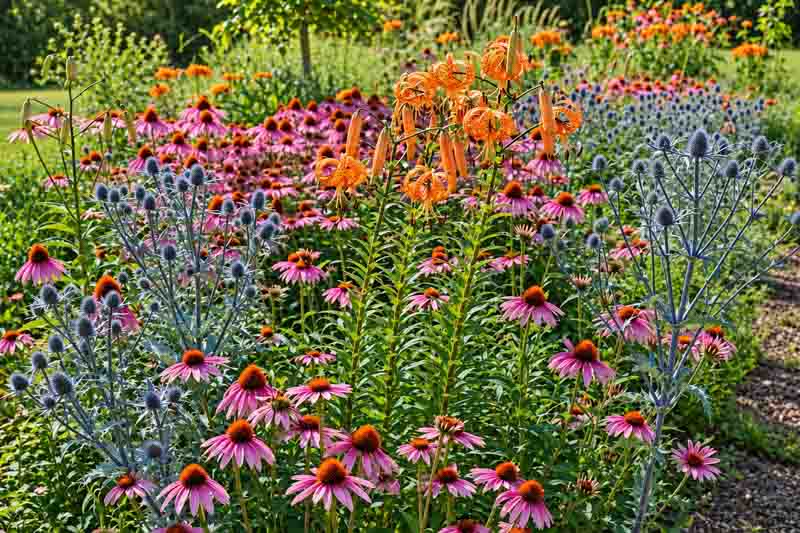


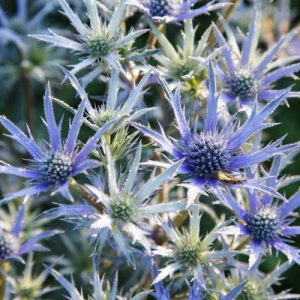
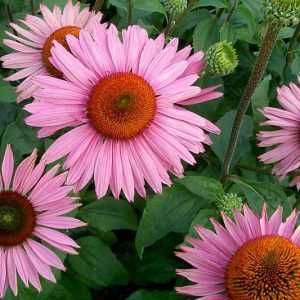
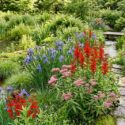
This exuberant summer border combines three plants with very different forms but an unusually strong visual connection. Brilliant orange Tiger Lilies (Lilium lancifolium) rise above broad drifts of rosy-purple Echinacea purpurea, while the steel-blue stems and spiny flower heads of Eryngium planum thread cool color through the planting.
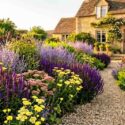
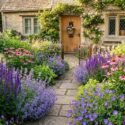
The effect is lively rather than formal. Echinacea provides the broadest mass of flowers, Sea Holly repeats through the planting as a silvery-blue counterpoint, and the lilies emerge above both in scattered vertical groups. Orange, pink, and blue could easily compete, but the colors are separated by differences in height, texture, and flower shape, giving the border energy without making it chaotic.
Main plants used: Lilium lancifolium (Tiger Lily), Echinacea purpurea (Purple Coneflower), and Eryngium planum (Sea Holly)
Keep the Echinacea relatively abundant, repeat Sea Holly through the border, and use Tiger Lilies as taller accents rather than forming a continuous orange row.
The strongest feature is the color contrast. Tiger Lilies provide vivid orange, Echinacea contributes deep pink to purple-pink, and Sea Holly introduces a cool blue-gray that visually separates the warmer shades. Because the blue is repeated in several places, it acts almost like a neutral and keeps the planting from becoming overwhelmingly hot in color.
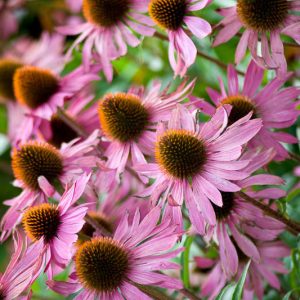
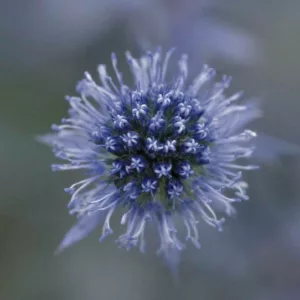
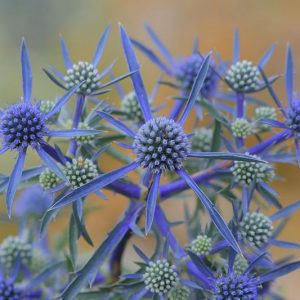
The flower shapes are equally important. Echinacea has broad daisy-like blooms with prominent central cones, Tiger Lilies carry strongly reflexed petals on taller stems, and Eryngium planum produces small rounded flower heads surrounded by spiny bracts. Even at peak bloom, the three plants remain easy to distinguish.
Height adds another layer of interest. The lilies rise above the denser perennial layer, but their relatively narrow stems allow views through the planting. Echinacea fills the middle ground, while the branching stems of Sea Holly create a more transparent structure that helps connect the different groups.
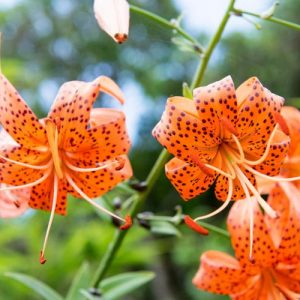
Lilium lancifolium supplies the height and the brightest color. Its nodding orange flowers have strongly recurved petals covered with dark purple-black spots. Position the lilies in small, irregular groups through the middle and rear of the border, allowing some to appear between the Echinacea rather than lining them all up at the back.
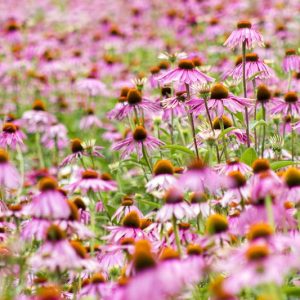
Echinacea purpurea forms the main flowering body of the planting. Its rosy-purple daisies create generous blocks of color beneath the lilies and are most effective when planted in noticeable groups. Leaving some seed heads standing later in the season can also extend structural interest and provide food for seed-eating birds.
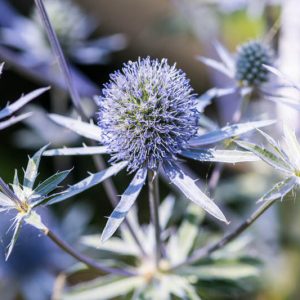
Eryngium planum provides the cool contrast. Its metallic blue-green stems and small, spiny flower heads have a very different texture from either the lilies or coneflowers. Repeat it through both sides of the planting so the blue acts as a visual thread rather than a single isolated patch.
Create a colorful midsummer border with a broad layer of Echinacea, cool architectural Sea Holly, and brilliant orange lilies rising above the planting.
Think of these as visual proportions rather than rigid quantities. The lilies have greater impact per plant because their flowers rise above the rest of the border.
Spacing varies with cultivar and growing conditions, so allow enough room for each plant to develop without crowding its neighbors.
Vary both group size and position. One substantial drift of Echinacea with several smaller repetitions usually looks more natural than many identical clumps.
Start with broad, irregular groups of Echinacea through the front and middle of the border.
Repeat Sea Holly between and slightly in front of some Echinacea groups so the blue-gray stems appear at several depths.
Place Tiger Lilies mostly through the middle and rear, with an occasional group slightly farther forward to avoid a rigid back row.
Keep the orange accents separated. The eye should move from one group of lilies to another through a continuous field of pink, blue, and green.
In early summer, foliage establishes the framework of the border while Sea Holly begins developing its distinctive branched stems and flower heads. As summer advances, Echinacea opens in broad waves of rosy-purple and quickly becomes the dominant flowering layer.
The Tiger Lilies then add their spectacular orange flowers above the planting. Their arrival changes the character of the border almost instantly, turning a predominantly pink-and-blue scheme into a much more dramatic composition.
Later in the season, Echinacea seed heads and the persistent architecture of Sea Holly continue to provide texture after the lilies have finished flowering. Leaving some stems standing can extend interest well beyond the main bloom period.
This combination is visually bold, so restraint matters. Too many Tiger Lilies can overwhelm the pink and blue planting beneath them. Use them as punctuation marks, with Echinacea providing the broader sweep of color and Sea Holly cooling the composition.
It is also better not to describe this planting as completely pest-free, disease-free, or deer-proof. Sea Holly is generally unappealing to deer, but Echinacea and lilies can sometimes be browsed, and lilies have several potential pest and disease problems. Local pressure varies considerably.
Most importantly, avoid arranging the three plants in separate blocks. Allow their groups to overlap visually, repeat Sea Holly across the planting, and let individual Tiger Lilies emerge unexpectedly above the coneflowers. That interweaving is what gives the border its abundant, established character.
| Hardiness |
4 - 8 |
|---|---|
| Heat Zones |
1 - 7 |
| Climate Zones | 2, 3, 4, 5, 6, 7, 8, 9, 14, 15, 16, 17, 18, 19, 20, 21 |
| Exposure | Full Sun |
| Season of Interest | Summer |
| Maintenance | Low |
| Water Needs | Average |
| Soil Type | Chalk, Loam, Sand |
| Soil pH | Acid, Alkaline, Neutral |
| Soil Drainage | Well-Drained |
| Characteristics | Cut Flowers, Showy |
| Tolerances | Deer |
| Attracts | Birds, Butterflies, Hummingbirds |
| Landscaping Ideas | Beds And Borders |
| Garden Styles | Informal and Cottage, Traditional Garden |

| Hardiness |
4 - 8 |
|---|---|
| Heat Zones |
1 - 7 |
| Climate Zones | 2, 3, 4, 5, 6, 7, 8, 9, 14, 15, 16, 17, 18, 19, 20, 21 |
| Exposure | Full Sun |
| Season of Interest | Summer |
| Maintenance | Low |
| Water Needs | Average |
| Soil Type | Chalk, Loam, Sand |
| Soil pH | Acid, Alkaline, Neutral |
| Soil Drainage | Well-Drained |
| Characteristics | Cut Flowers, Showy |
| Tolerances | Deer |
| Attracts | Birds, Butterflies, Hummingbirds |
| Landscaping Ideas | Beds And Borders |
| Garden Styles | Informal and Cottage, Traditional Garden |
Recreate this garden. Specify the percentages you would like to have of each plant and input the dimensions of your garden space.We'll give you a shopping list so you know how many plants you need.
| Plant | Quantity | |
|---|---|---|
| Lilium lancifolium (Tiger Lily) | N/A | Buy Plants |
| Echinacea purpurea 'Magnus' (Coneflower) | N/A | Buy Plants |
| Eryngium planum 'Blue Hobbit' (Sea Holly) | N/A | Buy Plants |
Create a membership account to save your garden designs and to view them on any device.
Becoming a contributing member of Gardenia is easy and can be done in just a few minutes. If you provide us with your name, email address and the payment of a modest $25 annual membership fee, you will become a full member, enabling you to design and save up to 25 of your garden design ideas.
Join now and start creating your dream garden!
Create a membership account to save your garden designs and to view them on any device.
Becoming a contributing member of Gardenia is easy and can be done in just a few minutes. If you provide us with your name, email address and the payment of a modest $25 annual membership fee, you will become a full member, enabling you to design and save up to 25 of your garden design ideas.
Join now and start creating your dream garden!