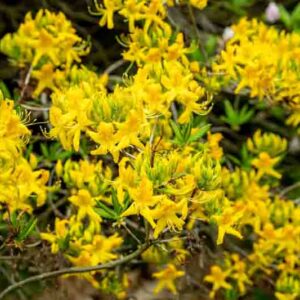
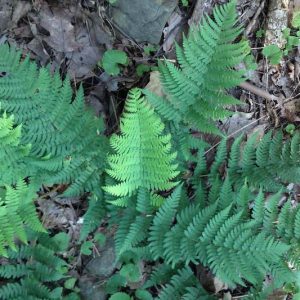
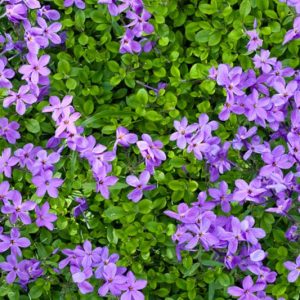
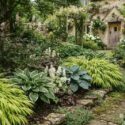
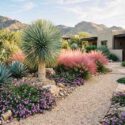
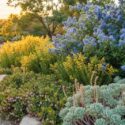
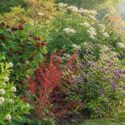
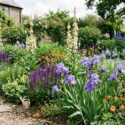
A captivating woodland garden featuring Flame Azalea (Rhododendron calendulaceum), a deciduous shrub blooming in late spring, with spring-flowering Woodland Phlox (Phlox divaricata) and Foamflower (Tiarella cordifolia). Evergreen Christmas Fern (Polystichum acrostichoides) adds year-round texture, while fiery orange, lavender-blue, and white flowers create a spectacular display along a winding stone path.
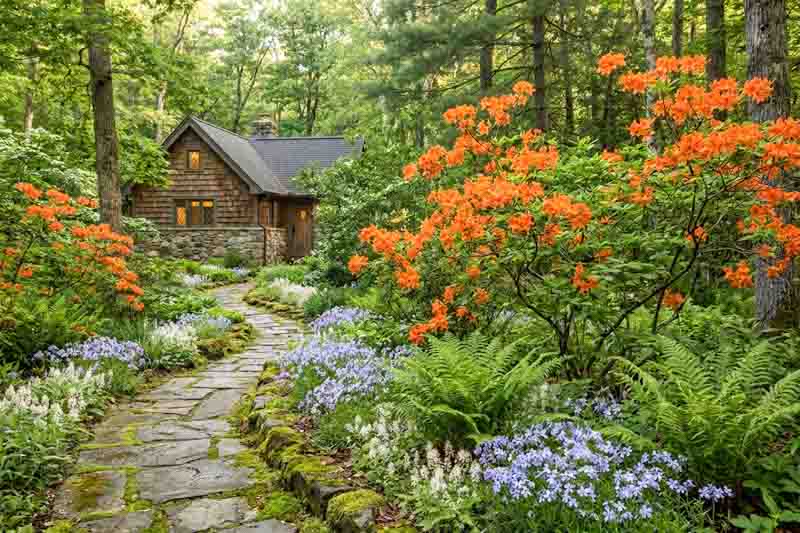


This woodland garden comes alive in spring, when the brilliant orange flowers of Rhododendron calendulaceum glow beneath the leafy canopy. At their feet, Phlox divaricata creates soft pools of lavender-blue, while the airy white flower spikes of Tiarella cordifolia brighten the path edges. Between them, Polystichum acrostichoides unfurls rich green fronds among moss-covered stones.
The colors may be striking, but the garden still feels wonderfully natural. The tall, open azaleas form the upper flowering layer, ferns fill the middle ground, and phlox and foamflower spread close to the woodland floor. A winding stone path leading toward the cottage gives the planting structure without making it feel formal.
Main plants used: Rhododendron calendulaceum, Polystichum acrostichoides, Phlox divaricata, and Tiarella cordifolia.
The drama comes from contrast. The intense orange flowers of Rhododendron calendulaceum immediately draw the eye, but they are softened by the cooler lavender-blue flowers of Phlox divaricata below. White Tiarella cordifolia adds a lighter note and helps brighten the shaded ground.
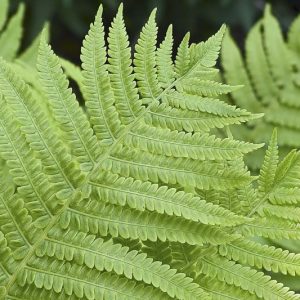
Polystichum acrostichoides ties everything together. Its substantial green fronds provide a calm backdrop for the flowers and remain attractive after the spring display has passed. Repeating all three lower-growing plants along the path makes the composition feel connected rather than like a collection of individual plants.
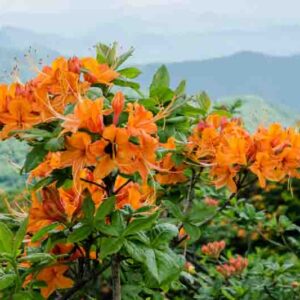
Rhododendron calendulaceum, or Flame Azalea, is the star of the garden. This eastern U.S. native deciduous azalea produces spectacular yellow, orange, or red-orange flowers in late spring to early summer. Its loose, upright habit looks particularly at home in a naturalistic woodland setting.
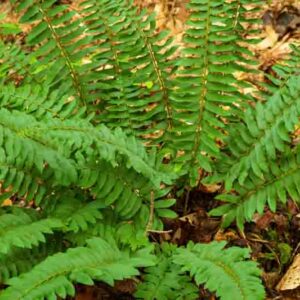
Polystichum acrostichoides, the Christmas Fern, provides year-round structure. Its leathery evergreen fronds form handsome clumps and contrast beautifully with the finer flowers around them.
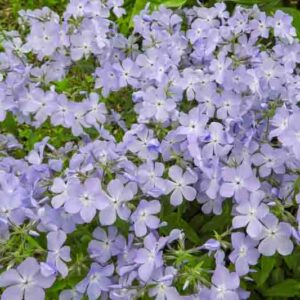
Phlox divaricata, or Woodland Phlox, creates low drifts of fragrant lavender-blue to violet-blue flowers in spring. Allow it to spread between ferns and along the path rather than planting it in rigid groups.
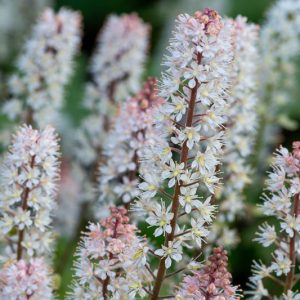
Tiarella cordifolia, or Foamflower, brings delicate spikes of small white to pinkish-white flowers above attractive foliage in spring. It is particularly useful near path edges and beneath the taller plants.
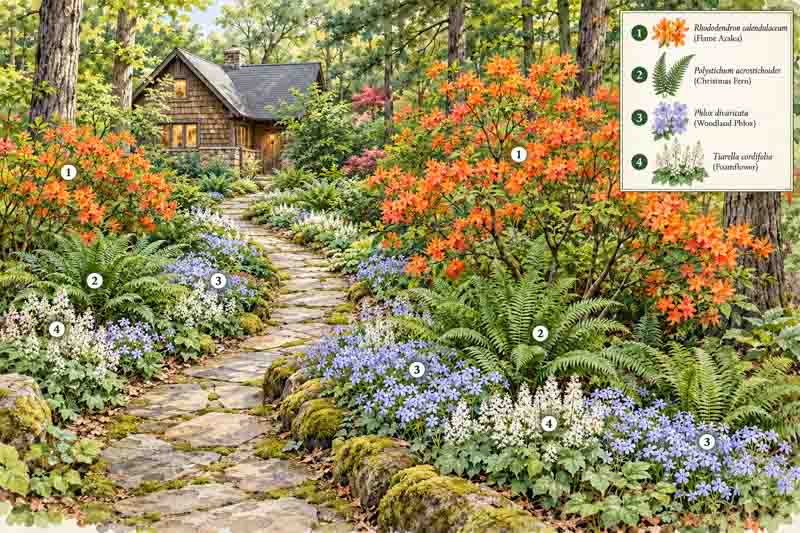
Create a colorful but natural-looking woodland garden, using Flame Azalea as the dramatic upper layer and weaving ferns, blue phlox, and white foamflowers across the woodland floor.
Avoid alternating plants in a predictable pattern. Let the ground layer flow around the ferns and shrubs.
Place Rhododendron calendulaceum toward the middle and back of the planting, repeating it at intervals rather than creating a solid wall. Use Polystichum acrostichoides around and between the shrubs. Let Phlox divaricata form broad pools of blue beside the path, then weave smaller drifts of Tiarella cordifolia through the phlox and ferns for flashes of white.
Spring begins quietly as the Woodland Phlox and Foamflower cover the ground with blue and white flowers. The display becomes much more dramatic when the Flame Azaleas open, sending brilliant orange through the woodland.
As flowering subsides, foliage becomes the focus. The azaleas form leafy green shrubs, while Christmas Fern provides strong evergreen texture. Phlox and Foamflower continue to soften the ground, leaving the garden lush and restful through summer.
The Flame Azalea needs enough light to flower well, so avoid planting it in dense, year-round shade. A high deciduous canopy or woodland edge provides a better balance of light and shelter.
Resist the urge to make the ground layer too orderly. Allow the phlox and foamflower to spread between fern clumps and toward the path, leaving occasional mossy stones visible. That mixture of exuberant spring color and relaxed woodland structure is what gives this garden its charm.
| Hardiness |
5 - 8 |
|---|---|
| Heat Zones |
4 - 7 |
| Climate Zones | 2, 2A, 2B, 3, 3A, 3B, 4, 5, 6, 7, 8, 9, 14, 15, 16, 17 |
| Exposure | Partial Sun |
| Season of Interest | Spring (Late), Summer (Early) |
| Maintenance | Low |
| Water Needs | Average |
| Soil Type | Clay, Loam |
| Soil pH | Acid, Neutral |
| Soil Drainage | Moist but Well-Drained |
| Characteristics | Showy |
| Native Plants | Alabama, Georgia, Kentucky, North Carolina, Northeast, Pennsylvania, South Carolina, Southeast, Tennessee, United States, Virginia, West Virginia |
| Tolerances | Clay Soil |
| Attracts | Bees, Butterflies, Hummingbirds |
| Landscaping Ideas | Beds And Borders |
| Garden Styles | Informal and Cottage, Pollinator Garden, Woodland Garden |


| Hardiness |
5 - 8 |
|---|---|
| Heat Zones |
4 - 7 |
| Climate Zones | 2, 2A, 2B, 3, 3A, 3B, 4, 5, 6, 7, 8, 9, 14, 15, 16, 17 |
| Exposure | Partial Sun |
| Season of Interest | Spring (Late), Summer (Early) |
| Maintenance | Low |
| Water Needs | Average |
| Soil Type | Clay, Loam |
| Soil pH | Acid, Neutral |
| Soil Drainage | Moist but Well-Drained |
| Characteristics | Showy |
| Native Plants | Alabama, Georgia, Kentucky, North Carolina, Northeast, Pennsylvania, South Carolina, Southeast, Tennessee, United States, Virginia, West Virginia |
| Tolerances | Clay Soil |
| Attracts | Bees, Butterflies, Hummingbirds |
| Landscaping Ideas | Beds And Borders |
| Garden Styles | Informal and Cottage, Pollinator Garden, Woodland Garden |
Recreate this garden. Specify the percentages you would like to have of each plant and input the dimensions of your garden space.We'll give you a shopping list so you know how many plants you need.
| Plant | Quantity | |
|---|---|---|
| Rhododendron calendulaceum (Flame Azalea) | N/A | Buy Plants |
| Phlox divaricata (Woodland Phlox) | N/A | Buy Plants |
| Tiarella cordifolia (Foam Flower) | N/A | Buy Plants |
| Polystichum acrostichoides (Christmas Fern) | N/A | Buy Plants |
Create a membership account to save your garden designs and to view them on any device.
Becoming a contributing member of Gardenia is easy and can be done in just a few minutes. If you provide us with your name, email address and the payment of a modest $25 annual membership fee, you will become a full member, enabling you to design and save up to 25 of your garden design ideas.
Join now and start creating your dream garden!