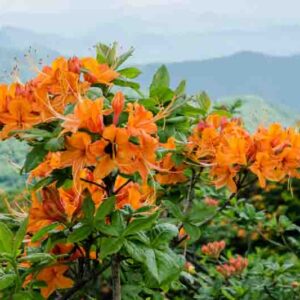
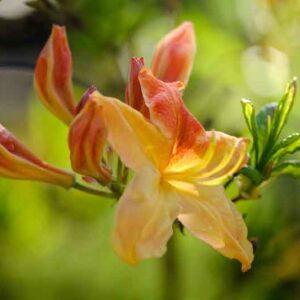
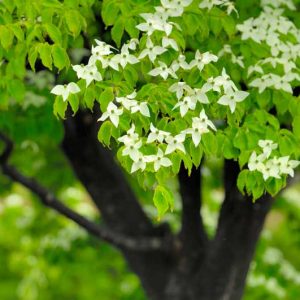
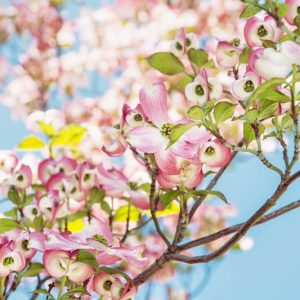
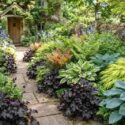
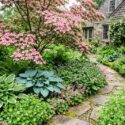
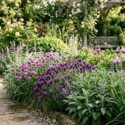
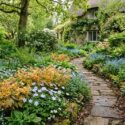
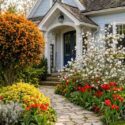
A romantic spring garden pairing Dove Tree (Davidia involucrata), a deciduous tree flowering in late spring, with fragrant Yellow Azalea (Rhododendron luteum), orange 'Gibraltar' Azalea, and mid-to-late-spring English Bluebells. White, yellow, orange, and violet-blue flowers create spectacular layers of color along a winding stone path beside a cottage.
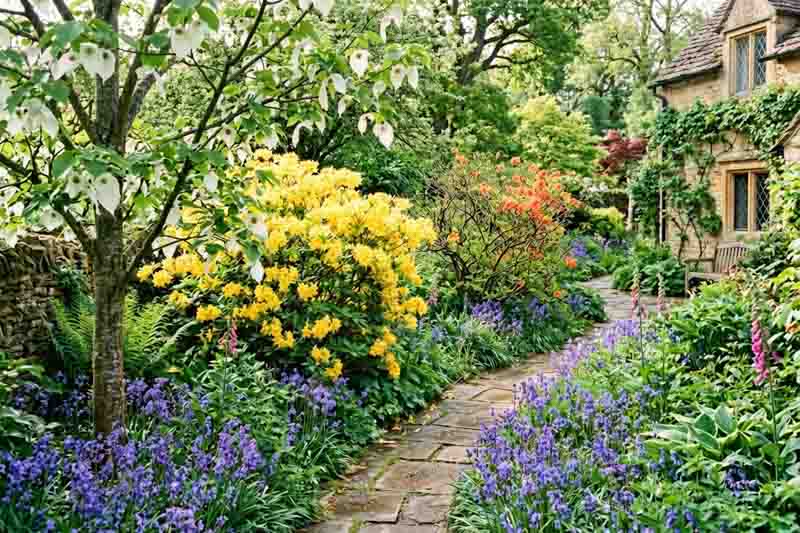


This enchanting spring garden feels perfectly at home beside an old stone cottage. A graceful Davidia involucrata spreads its branches above the path, its extraordinary white bracts fluttering among fresh green leaves. Beneath it, fragrant yellow Rhododendron luteum and fiery orange Rhododendron ‘Gibraltar’ bring warm color to the shrub layer, while English bluebells create cool violet-blue drifts along the ground.
The contrast is what makes the scene memorable. White, yellow, and orange flowers glow above a carpet of blue, while the winding stone path draws you through the planting toward the house. Nothing feels rigidly arranged – shrubs lean toward the path, bluebells weave between larger plants, and the tree canopy gives the whole garden a sheltered, established character.
Main plants used: Davidia involucrata, Rhododendron luteum, Rhododendron ‘Gibraltar’, and Hyacinthoides non-scripta.
The planting is built in clear layers. Davidia involucrata provides height and an airy canopy, with large white bracts that make a spectacular display in late spring. Below it, Rhododendron luteum introduces luminous yellow flowers and wonderful fragrance, while ‘Gibraltar’ deepens the palette with brilliant orange.
English bluebells provide the finishing touch. Their violet-blue flowers are the perfect cool counterpoint to the warm azaleas. Repeated along both sides of the path, they also connect the individual shrubs and tree into one flowing composition.
Davidia involucrata, the Handkerchief Tree or Dove Tree, is the architectural centerpiece. This deciduous tree is famous for the large white bracts surrounding its small flower heads in late spring. Give it room to develop its broad, graceful canopy.
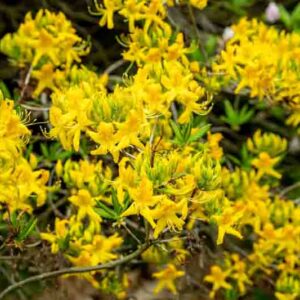
Rhododendron luteum, the Yellow Azalea, is a deciduous shrub with intensely fragrant yellow flowers in late spring. Its loose habit and brilliant color make it especially effective near a path, where its perfume can also be appreciated.
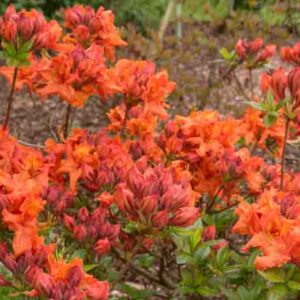
Rhododendron ‘Gibraltar’ is a deciduous Exbury Azalea producing showy clusters of vivid orange flowers in late spring. Use it separately from the yellow azalea rather than mixing the two evenly, so each color reads as a distinct pool.
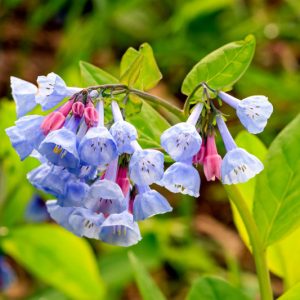
Hyacinthoides non-scripta, the English Bluebell, forms colonies of nodding violet-blue flowers in mid to late spring. Plant the bulbs in informal drifts rather than rows and allow them to spread where conditions suit them.
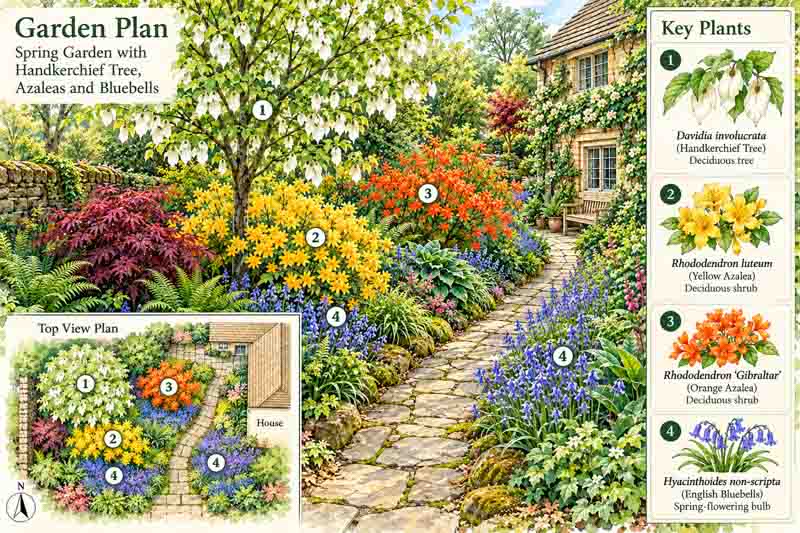
Create a romantic spring garden with a flowering tree overhead, glowing azaleas through the middle layer, and broad drifts of bluebells flowing naturally along a winding path.
Treat these as visual proportions rather than plant counts. One mature Davidia can provide the upper layer, while dozens of bluebell bulbs create the broadest repeated element.
Position Davidia involucrata beside the path where its canopy can eventually spread overhead. Place Rhododendron luteum nearby but outside the densest shade, then use ‘Gibraltar’ farther along the path to create a second burst of warm color. Weave English bluebells around the tree, beneath the azaleas, and along the path edges to connect the entire planting.
Spring begins at ground level as the bluebells create pools of violet-blue. The azaleas follow with yellow and orange flowers, while the Davidia’s remarkable white bracts make the upper canopy part of the display. The flowering periods can overlap without needing to peak on exactly the same day.
By summer, the bluebells retreat and the garden becomes predominantly green. The Davidia canopy and leafy azaleas provide structure, allowing the garden to shift naturally from exuberant spring color to a quieter woodland character.
Give the Davidia plenty of room. It will eventually become a substantial tree, so it should not be treated as a small ornamental tucked permanently between shrubs. The azaleas also flower best with good filtered light rather than dense shade.
Finally, resist making the bluebells too orderly. Broad, uneven drifts winding around the shrubs and path are what give this garden its romantic character. When the bluebells, yellow and orange azaleas, and white Davidia bracts appear against the old stonework, the effect is wonderfully exuberant without feeling overdesigned.
| Hardiness |
6 - 8 |
|---|---|
| Heat Zones |
6 - 8 |
| Climate Zones | 4, 5, 6 |
| Exposure | Full Sun, Partial Sun |
| Season of Interest | Spring (Mid, Late), Summer (Early) |
| Maintenance | Low |
| Water Needs | Average |
| Soil Type | Clay, Loam, Sand |
| Soil pH | Acid |
| Soil Drainage | Moist but Well-Drained |
| Characteristics | Showy |
| Tolerances | Clay Soil |
| Attracts | Bees, Butterflies |
| Landscaping Ideas | Beds And Borders |
| Garden Styles | Informal and Cottage, Pollinator Garden, Woodland Garden |




| Hardiness |
6 - 8 |
|---|---|
| Heat Zones |
6 - 8 |
| Climate Zones | 4, 5, 6 |
| Exposure | Full Sun, Partial Sun |
| Season of Interest | Spring (Mid, Late), Summer (Early) |
| Maintenance | Low |
| Water Needs | Average |
| Soil Type | Clay, Loam, Sand |
| Soil pH | Acid |
| Soil Drainage | Moist but Well-Drained |
| Characteristics | Showy |
| Tolerances | Clay Soil |
| Attracts | Bees, Butterflies |
| Landscaping Ideas | Beds And Borders |
| Garden Styles | Informal and Cottage, Pollinator Garden, Woodland Garden |
Recreate this garden. Specify the percentages you would like to have of each plant and input the dimensions of your garden space.We'll give you a shopping list so you know how many plants you need.
| Plant | Quantity | |
|---|---|---|
| Rhododendron 'Gibraltar' | N/A | Buy Plants |
| Rhododendron luteum (Pontic Azalea) | N/A | Buy Plants |
| Davidia involucrata (Dove Tree) | N/A | Buy Plants |
| Hyacinthoides non-scripta (English Bluebells) | N/A | Buy Plants |
Create a membership account to save your garden designs and to view them on any device.
Becoming a contributing member of Gardenia is easy and can be done in just a few minutes. If you provide us with your name, email address and the payment of a modest $25 annual membership fee, you will become a full member, enabling you to design and save up to 25 of your garden design ideas.
Join now and start creating your dream garden!