Love Crocosmia but fear the takeover? This guide shows how to enjoy fiery late-summer flowers without planting regret. Learn which named varieties behave better, which montbretia types to avoid, how to divide clumps, and the best sun-loving companion plants for a colorful, controlled, wildlife-friendly border.
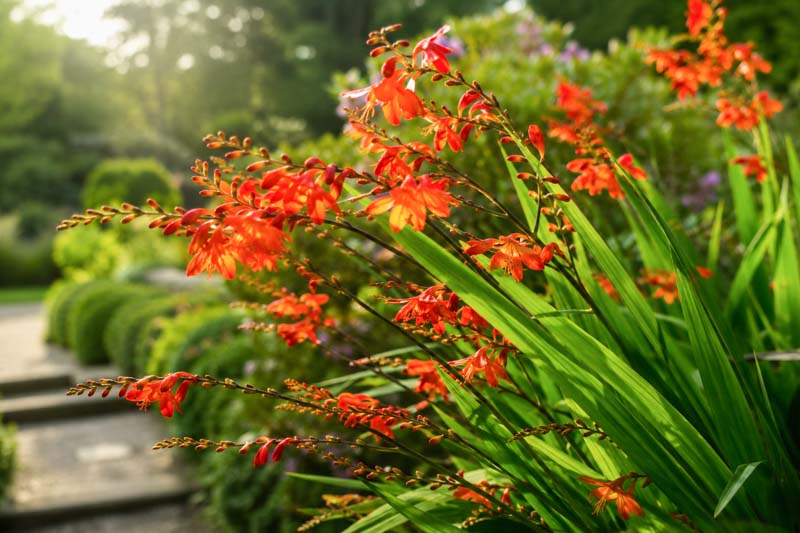


Crocosmia is one of the great late-summer garden performers: fiery flowers, sword-like foliage, easy growth, hummingbird appeal, and weeks of color just when many borders start to tire. But there is a catch. Some crocosmias are delightful clump-forming perennials. Others, especially old common montbretia types, can spread aggressively by underground corms and become a headache in mild, moist climates.
The answer is not to banish Crocosmia from the garden. It is to choose deliberately, plant where you can manage it, and divide clumps before they turn into a glowing orange takeover. This guide focuses on beautiful Crocosmia varieties that are easier to identify, place, monitor, and control than anonymous common montbretia.
Quick answer
For better-behaved Crocosmia, avoid unnamed common montbretia and choose named cultivars such as ‘Lucifer’, ‘George Davison’, ‘Emily McKenzie’, ‘Meteore’, ‘Solfatare’, ‘Severn Sunrise’, ‘Star of the East’, ‘Walberton Yellow’, and compact modern selections. “Better behaved” does not mean non-spreading, so divide clumps regularly and avoid planting Crocosmia near natural areas where it is considered invasive.
Use this table as a quick starting point. These named Crocosmia cultivars are generally easier to identify, place, monitor, and divide than anonymous common montbretia, but none should be considered completely non-spreading in every climate.
| Variety | Flower Color | Height | Best Use | Behavior Note | Management Tip |
|---|---|---|---|---|---|
| ‘Lucifer’ | Scarlet red | 2-4 ft. tall | Bold borders, architectural accents, hummingbird gardens | Strong clump-former; usually easier to manage than common montbretia | Divide every 3-4 years and remove stray corms promptly |
| ‘George Davison’ | Golden yellow | 24-30 in. tall | Small borders, cottage gardens, softer color schemes | Less visually dominant than red or orange forms | Plant where the clump edge is easy to inspect and thin |
| ‘Emily McKenzie’ | Orange with red throat | 24-30 in. tall | Mixed borders, bicolor displays, late-summer focal groups | Showy and vigorous; can bulk up well in favorable soil | Give room and divide when flowering declines or clump expands |
| ‘Meteore’ | Orange with red reverse | 24-36 in. tall | Informal borders, warm color schemes, naturalistic plantings | Named cultivar with classic montbretia charm | Use in contained beds rather than wild edges or shrub thickets |
| ‘Solfatare’ | Apricot-yellow | 24-30 in. tall | Bronze foliage effects, soft borders, blue-purple companions | Valued for foliage as well as flowers; softer garden presence | Keep in a visible border where foliage and spread can be monitored |
| ‘Severn Sunrise’ | Salmon-apricot-orange | 24-30 in. tall | Gentle hot-color schemes, cottage borders, peach plantings | Softer color makes it easier to blend than harsh orange types | Pair with open companions and lift surplus corms as needed |
| ‘Star of the East’ | Orange with pale center | 20-28 in. tall | Specimen clumps, mixed borders, large-flowered displays | Large flowers give high impact without needing a large colony | Grow as a defined clump and thin before it merges with neighbors |
| ‘Walberton Yellow’ | Clear yellow | 24-32 in. tall | Yellow borders, prairie-style plantings, grass combinations | Useful alternative to classic orange montbretia color | Plant in groups, then reduce clump size every few years |
| Compact modern selections | Yellow, orange, apricot, red | 18-30 in. tall | Containers, small gardens, front borders | Often easier to place and supervise in tight spaces | Grow in pots or contained beds and refresh crowded corms regularly |
Editor’s note
Heights vary with climate, soil moisture, and fertility. In mild, moist gardens, Crocosmia may grow taller and spread faster than in colder or drier regions.
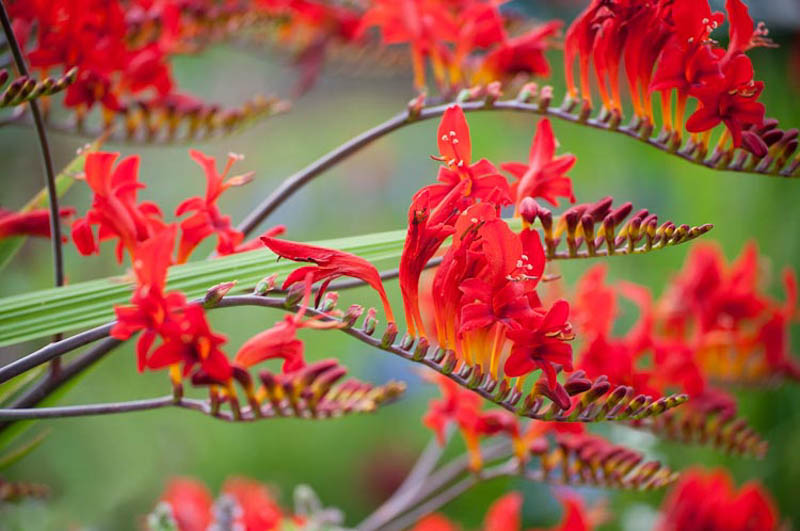
Crocosmia spreads from corms. A healthy plant makes new corms around and above the old ones, gradually forming a larger clump. In a border, that can be a blessing: more stems, more flowers, and a fuller late-summer display. In mild, damp climates with little winter check, it can become too much of a good thing.
The main problem plant is usually common montbretia, often listed as Crocosmia × crocosmiiflora. It has escaped gardens in some regions, especially where winters are mild and soils stay moist. The Royal Horticultural Society warns that some crocosmias can become invasive and specifically highlights common montbretia as a plant that may crowd out native vegetation near open countryside. Regional invasive-plant guidance also notes that montbretia spreads mainly by corms and can form dense colonies.
That does not mean every Crocosmia cultivar behaves the same way. Named selections vary in vigor, height, flower size, corm production, and clump density. The best approach is responsible selection: choose named cultivars, plant them where they can be monitored, and divide clumps before they become congested.
Responsible gardening rule
If Crocosmia is listed as invasive or problematic in your region, do not plant it near natural areas, stream banks, roadsides, woodland edges, or places where garden waste might escape.
A better-behaved Crocosmia is not necessarily small, sterile, or slow. It is a plant that stays more predictably in a clump, is easy to inspect, and does not quietly travel through the border like old montbretia. Look for named cultivars from reputable growers rather than pass-along clumps of unknown orange Crocosmia.
Useful traits include a compact or upright habit, strong stems, larger flowers that justify their space, a clear cultivar identity, and corms that can be lifted and thinned without guesswork. These plants still spread over time, but they are easier to manage with a spade every few years.
The most important distinction is this: “less aggressive” does not mean “maintenance-free.” Crocosmia is a living, multiplying perennial. If you never divide it, never remove stray corms, and plant it in ideal moist soil, even a polite cultivar can become pushy.
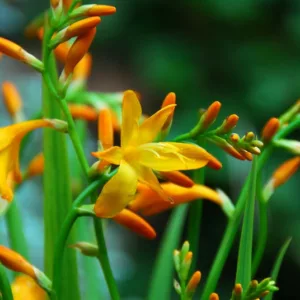
Choose red cultivars such as ‘Lucifer’ when you want height, drama, and a strong vertical accent. Choose yellow cultivars such as ‘George Davison’ or ‘Walberton Yellow’ when you want Crocosmia brightness without the intense orange montbretia look. Choose apricot, salmon, and bronze-toned varieties when you want a softer, designer-friendly palette.
For small gardens, containers, and narrow borders, compact selections are usually the safest starting point. For large mixed borders, taller cultivars can be excellent, but they need space around the clump so you can see when it is spreading. If your garden is mild, moist, or near a natural area, prioritize containment and regular division over flower color alone.
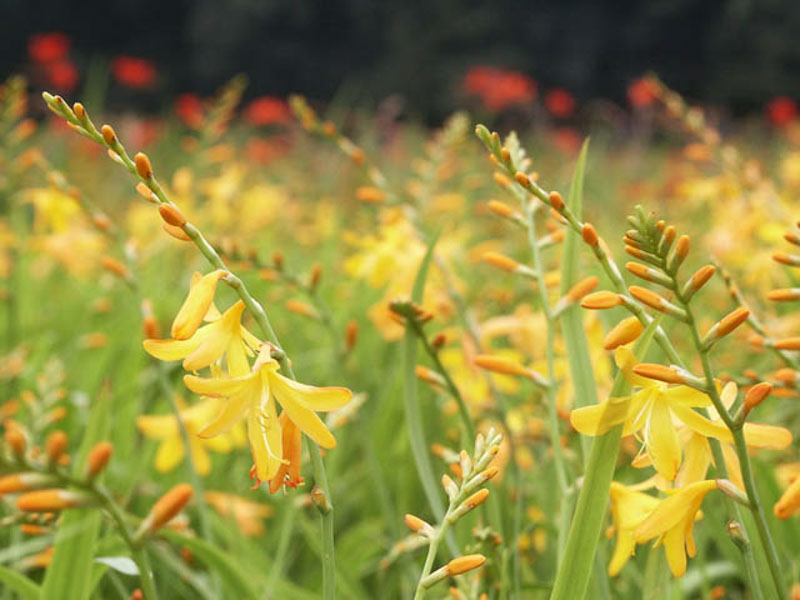
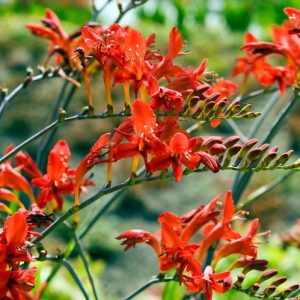
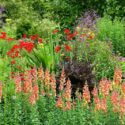
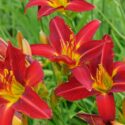
‘Lucifer’ is the choice for drama. Its scarlet flowers, tall stems, and pleated foliage make it one of the most architectural crocosmias. Use it as a bold focal clump rather than scattering it everywhere through the garden.
‘George Davison’ is better for gardeners who want brightness without visual heat. Its golden-yellow flowers are easier to blend with cottage-garden plants, soft grasses, blue salvias, and pale summer perennials.
‘Emily McKenzie’ is the showy bicolor option, with orange blooms marked by a rich red throat. It is excellent when you want Crocosmia to be noticed up close, especially in mixed borders where its outward-facing flowers can shine.
‘Meteore’ keeps the warm, old-fashioned montbretia mood but with the advantage of a named cultivar. It suits informal borders, hot-color schemes, and naturalistic plantings where arching stems can mingle gracefully with neighbors.
‘Solfatare’ is one of the best choices when foliage matters. Its bronzy leaves and apricot-yellow flowers create a softer, more sophisticated effect than bright orange types, especially with blue, purple, bronze, or dark-leaved companions.
‘Severn Sunrise’ brings warm salmon, apricot, and orange tones that are easier to weave through a border than harsh orange-red. It is useful for peach, copper, cream, and soft yellow planting schemes.
‘Star of the East’ is valuable for gardeners who want fewer but larger, more visible flowers. Its orange blooms with pale centers make a defined specimen clump feel intentional rather than weedy.
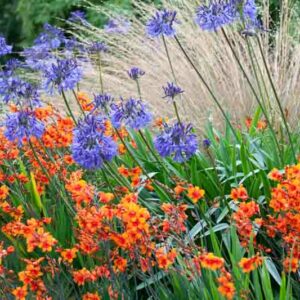
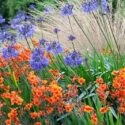
‘Walberton Yellow’ and other strong yellow selections are good alternatives to the familiar orange montbretia look. They work especially well with ornamental grasses, Kniphofia, Achillea, and Agapanthus.
Shopping tip
Buy named Crocosmia cultivars in pots or clearly labeled corm packets. Be cautious with “free orange montbretia” from a neighbor unless you know exactly how it behaves in your region.
Best choice for drama
Choose ‘Lucifer’ when you want height, scarlet flowers, and architectural impact. Choose yellow or apricot cultivars when you want Crocosmia energy without the intense orange montbretia look.
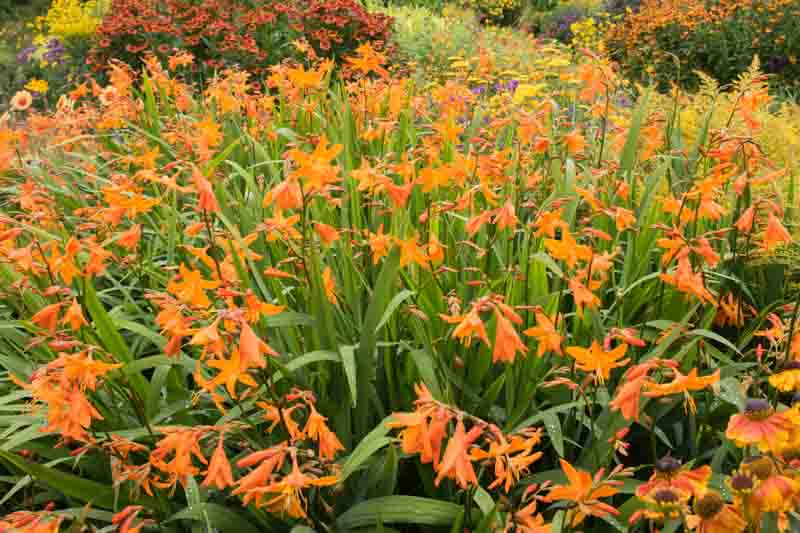
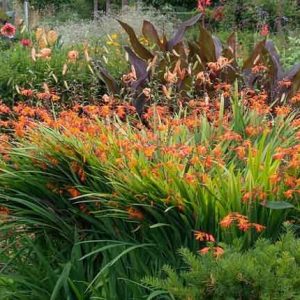
The Crocosmia most likely to cause regret is not usually a carefully chosen named cultivar. It is the old, unnamed, bright orange montbretia that has been passed from garden to garden for decades. It is tough, pretty, and persistent – which is exactly why it can become a problem.
Be especially cautious with common montbretia in coastal climates, mild-winter areas, damp gardens, and properties bordering woodland, meadows, streams, or unmanaged land. If you already grow it and love it, keep it contained. Deadhead if seedlings are a concern, lift and thin clumps regularly, and never dump corms in green waste, wild areas, hedgerows, or vacant land.
If you inherit a garden full of old Crocosmia, do not assume you must remove it all at once. Start by identifying where it is useful. Keep disciplined clumps in contained borders and remove colonies that are spreading into shrubs, lawns, paths, or naturalized areas.
Crocosmia grows best in full sun to partial sun, in fertile, humus-rich, moist but well-drained soil. It enjoys moisture during active growth, but it should not sit in stagnant winter wet. In colder regions, plant corms in spring after the soil warms. In mild climates, potted plants can be installed in spring or early fall if soil conditions are suitable.
Plant Crocosmia corms at about three times their own depth – often around 3-5 inches deep depending on corm size – and space them 6-8 inches apart. Plant with the slightly pointed end upward and the roots downward. For more refined borders, leave 18-24 inches between Crocosmia and neighboring perennials so you can see and manage the clump.
Avoid planting Crocosmia where you cannot easily reach it with a spade. The best locations are sunny borders, contained island beds, large containers, raised beds, and designed perennial plantings. The worst locations are shrub thickets, wild edges, steep banks, and anywhere stray corms would be hard to remove.
Containment trick
For small gardens, grow Crocosmia in large containers or bottomless root-control rings sunk into the soil. This makes lifting, thinning, and replanting much easier.
Division is the difference between Crocosmia as a garden treasure and Crocosmia as a chore. Lift congested clumps every three to four years, or sooner if the plant spreads beyond its allotted space. The best time is usually spring, just as growth begins, although mild regions may allow division in early fall after flowering.
A smaller, vigorous group will flower better and behave better than a congested mass of exhausted corms.
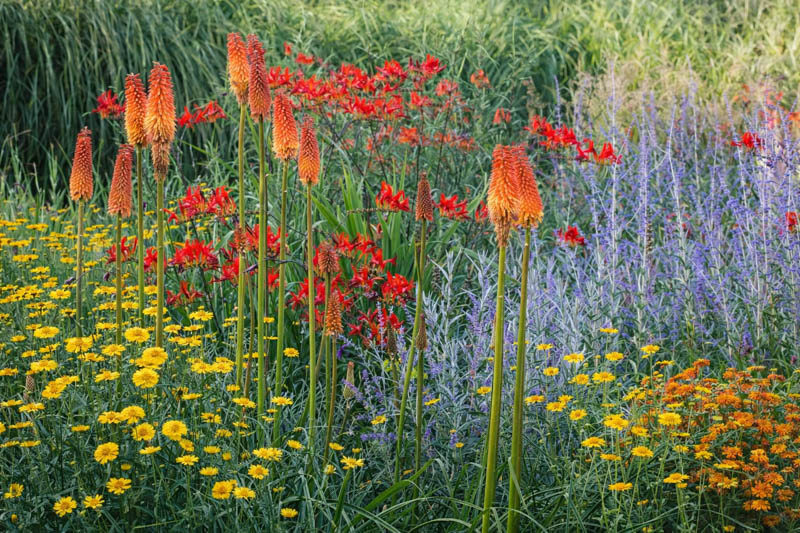
The best Crocosmia companions enjoy similar conditions: full sun to partial sun, reasonably fertile soil, good drainage, and moderate moisture during the growing season. Matching site needs is what keeps the combination attractive and low-maintenance.
Agapanthus – sun, well-drained soil, moderate moisture, best in mild zones or protected sites.
Helenium – full sun, fertile soil, even moisture, late-summer color that echoes Crocosmia beautifully.
Achillea – full sun, well-drained soil, drought tolerance once established, excellent with yellow, orange, and red Crocosmia.
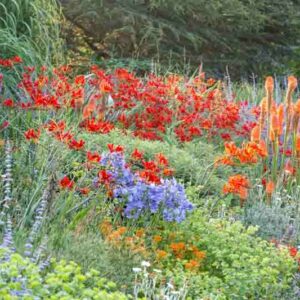
Salvia – full sun, well-drained soil, moderate to low moisture, blue and purple flowers that cool Crocosmia’s heat.
Kniphofia – full sun, well-drained soil, similar hot-color energy, strong vertical form.
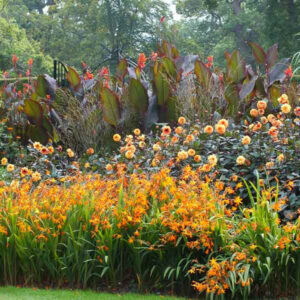
Dahlia – full sun, fertile well-drained soil, regular moisture, dramatic late-season pairing with red or apricot Crocosmia.
Rudbeckia – full sun, average to fertile soil, moderate moisture, golden daisies that extend the late-summer display.
Ornamental grasses – full sun, well-drained soil, drought tolerance depending on species, perfect for softening Crocosmia foliage and flower stems.
Verbena bonariensis – full sun, well-drained soil, airy purple flowers that float above Crocosmia without crowding it.
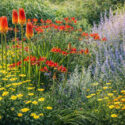
Crocosmia is strongest when repeated, not scattered. Use three to five clumps through a border to create rhythm, or plant one large container as a focal point. Red cultivars such as ‘Lucifer’ work well as exclamation points. Yellow and apricot varieties are easier to weave through softer plantings.
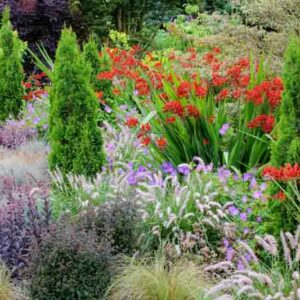
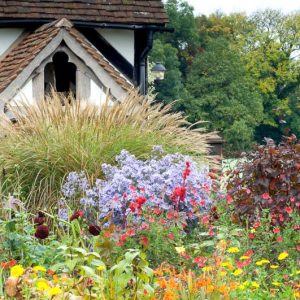
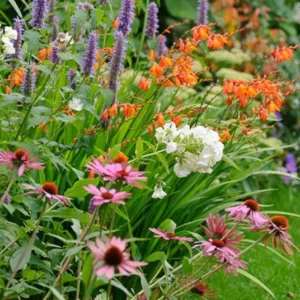
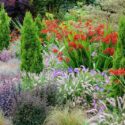
For a polished look, pair Crocosmia with plants that contrast its sword-shaped foliage. Rounded dahlias, daisy-flowered Helenium, airy Verbena bonariensis, and fine-textured grasses all make Crocosmia look intentional rather than unruly. Avoid planting it only with other strappy plants unless you want a bold, tropical effect.
In small gardens, choose one Crocosmia role: focal point, container star, or repeated accent. Do not let it do all three. A single well-managed clump of ‘Lucifer’ with blue salvia and ornamental grass is far more elegant than a border crowded with orange montbretia from end to end.
Browse Garden Design Ideas with Crocosmia
Skip Crocosmia if your garden borders a sensitive natural area and your region lists montbretia as invasive. Also avoid it if you cannot commit to division, have no place to dispose of surplus corms responsibly, or garden in a wet site where corms may spread beyond control.
In those situations, choose alternatives with similar color and less spreading risk: Helenium, Kniphofia, Echinacea, Rudbeckia, Gaillardia, Dahlia, or orange daylilies in contained garden settings. You can still create the hot late-summer look without planting something that may be difficult to manage locally.
Crocosmia deserves its place in the late-summer garden. Few perennials deliver the same combination of glowing color, vertical foliage, hummingbird appeal, and easy seasonal drama. The key is choosing deliberately. Avoid anonymous common montbretia where it is risky. Select named cultivars with better garden manners. Plant them where you can reach them. Divide before the clump becomes congested.
With that approach, Crocosmia becomes what it should be: a thrilling, manageable perennial rather than a regret planted in orange.
Better-behaved Crocosmia varieties include named cultivars such as ‘Lucifer’, ‘George Davison’, ‘Emily McKenzie’, ‘Meteore’, ‘Solfatare’, ‘Severn Sunrise’, ‘Star of the East’, and ‘Walberton Yellow’. They can still spread, but they are generally easier to identify, monitor, and manage than unnamed common montbretia.
Some Crocosmia can be invasive or problematic, especially common montbretia in mild, moist regions such as parts of the United Kingdom, Ireland, New Zealand, coastal Australia, and the Pacific Coast of North America. In colder or drier regions, it may be much easier to manage, but local invasive-plant guidance should always come first.
Crocosmia ‘Lucifer’ is a named, clump-forming cultivar and is often easier to manage than common montbretia. However, it can still increase by corms and should be divided regularly, especially in mild, moist gardens.
Plant Crocosmia in a contained border or large pot, remove stray shoots, deadhead if seed is a concern, and lift and divide clumps every three to four years. Remove the full corm chain when thinning, not just the top growth.
Yes. Containers are one of the best ways to enjoy Crocosmia in small gardens or regions where spreading is a concern. Use a large pot, free-draining compost, regular summer water, and divide the corms when the container becomes crowded.
Crocosmia grows best in full sun to partial sun and fertile, moist but well-drained soil. It appreciates moisture during active growth but dislikes stagnant winter wet. Good air circulation and periodic division help keep clumps healthy.
Good Crocosmia companions include Agapanthus, Helenium, Achillea, Salvia, Kniphofia, Dahlia, Rudbeckia, ornamental grasses, and Verbena bonariensis. Choose companions that enjoy sun, good drainage, and moderate moisture.
Updated: June 2026 • Reviewed by Gardenia Editors
| Hardiness |
5 - 9 |
|---|---|
| Heat Zones |
2 - 10 |
| Climate Zones | 4, 5, 6, 7, 8, 9, 10, 11, 12, 13, 14, 15, 16, 17, 18, 19, 20, 21, 22, 23, 24, H1, H2 |
| Plant Type | Bulbs |
| Genus | Crocosmia |
| Exposure | Full Sun, Partial Sun |
| Season of Interest | Summer (Mid, Late), Fall |
| Maintenance | Low |
| Water Needs | Low, Average |
| Soil Type | Chalk, Clay, Loam, Sand |
| Soil pH | Acid, Alkaline, Neutral |
| Soil Drainage | Moist but Well-Drained |
| Characteristics | Cut Flowers, Plant of Merit, Showy |
| Tolerance | Drought, Deer, Salt, Rabbit |
| Attracts | Birds, Butterflies, Hummingbirds |
| Landscaping Ideas | Banks And Slopes, Beds And Borders, Patio And Containers |
| Garden Styles | City and Courtyard, Coastal Garden, Informal and Cottage, Traditional Garden |
Crocosmia "Lucifer" in the garden at Overbeck's, Salcombe, Devon, ©NTPL/Andrew Butler (Nationaltrust.org)
| Hardiness |
5 - 9 |
|---|---|
| Heat Zones |
2 - 10 |
| Climate Zones | 4, 5, 6, 7, 8, 9, 10, 11, 12, 13, 14, 15, 16, 17, 18, 19, 20, 21, 22, 23, 24, H1, H2 |
| Plant Type | Bulbs |
| Genus | Crocosmia |
| Exposure | Full Sun, Partial Sun |
| Season of Interest | Summer (Mid, Late), Fall |
| Maintenance | Low |
| Water Needs | Low, Average |
| Soil Type | Chalk, Clay, Loam, Sand |
| Soil pH | Acid, Alkaline, Neutral |
| Soil Drainage | Moist but Well-Drained |
| Characteristics | Cut Flowers, Plant of Merit, Showy |
| Tolerance | Drought, Deer, Salt, Rabbit |
| Attracts | Birds, Butterflies, Hummingbirds |
| Landscaping Ideas | Banks And Slopes, Beds And Borders, Patio And Containers |
| Garden Styles | City and Courtyard, Coastal Garden, Informal and Cottage, Traditional Garden |
Create a membership account to save your garden designs and to view them on any device.
Becoming a contributing member of Gardenia is easy and can be done in just a few minutes. If you provide us with your name, email address and the payment of a modest $25 annual membership fee, you will become a full member, enabling you to design and save up to 25 of your garden design ideas.
Join now and start creating your dream garden!
Create a membership account to save your garden designs and to view them on any device.
Becoming a contributing member of Gardenia is easy and can be done in just a few minutes. If you provide us with your name, email address and the payment of a modest $25 annual membership fee, you will become a full member, enabling you to design and save up to 25 of your garden design ideas.
Join now and start creating your dream garden!