Deer usually leave lamb's ear alone - Rutgers gives this soft, silver perennial its strongest deer-resistance rating. Learn why browsing is uncommon, when deer may still sample it, how to distinguish deer damage from moisture problems, and which lamb's ear varieties work best in sunny, well-drained gardens.
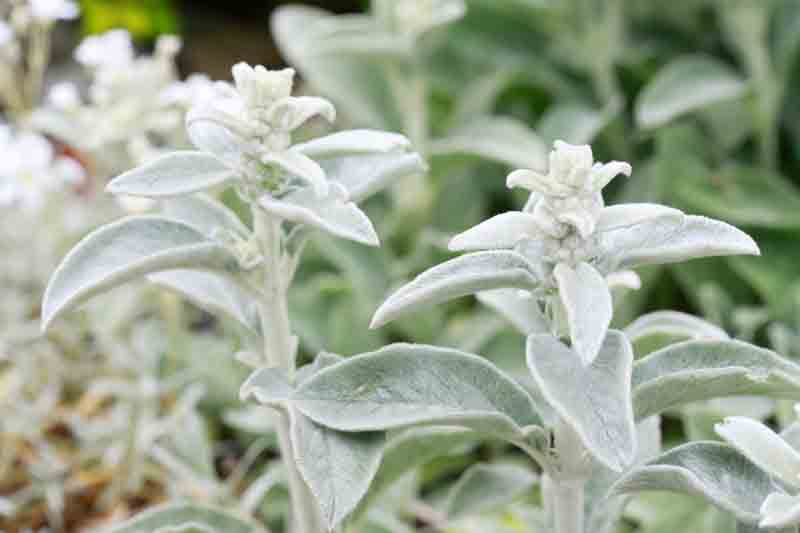


Deer can eat lamb’s ear, but they usually leave it alone. Lamb’s ear (Stachys byzantina) has a strong deer-resistance record and is rated A – Rarely Damaged by Rutgers Cooperative Extension. Occasional sampling can happen, especially where deer pressure is severe, but repeated heavy browsing is unusual.
Lamb’s ear is one of the better-documented deer-resistant perennials.
Rutgers Cooperative Extension gives Stachys byzantina an A – Rarely Damaged rating, its highest deer-resistance category. NC State Extension also lists lamb’s ear as deer resistant, while Missouri Botanical Garden includes deer among the plant’s tolerances.
That consistency is useful. Lamb’s ear is not simply a plant that has acquired a reputation for deer resistance through garden folklore. Multiple horticultural references independently place it among plants deer generally avoid.
Even a strong resistance rating is not a promise that a plant will never be tasted. Deer feeding changes with season, drought, population pressure, and the availability of preferred food.
The more useful question is not whether a deer can take a bite, but whether lamb’s ear is likely to suffer repeated browsing. In most gardens, it is not.
Gardenia’s Lamb’s Ear Rule: deer are rarely this plant’s main weakness. Once browsing risk is low, drainage, sunlight, airflow, and prolonged leaf wetness usually matter more.
The foliage offers an obvious clue.
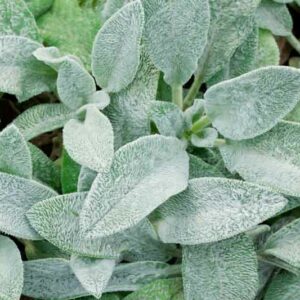
Lamb’s ear produces thick silver-gray leaves covered in dense woolly hairs, giving them the soft, felt-like texture that gives the plant its common name.
That fuzzy surface is often suggested as one reason deer find lamb’s ear less appealing than smooth, tender foliage. NC State also notes that the leaves may have an unpleasant aroma when bruised.
Still, it is better not to reduce deer resistance to a single trait. The strongest evidence is practical: lamb’s ear repeatedly appears on deer-resistant plant lists and receives one of the strongest available ratings from Rutgers.
Its foliage also gives lamb’s ear ornamental value even when it is not flowering. The silver leaves provide long-lasting color and texture without depending on tender flower buds that browsing animals might remove.
Most gardeners grow lamb’s ear for its silver foliage rather than its flowers, but different selections create noticeably different effects.
| Hardiness |
4 - 8 |
|---|---|
| Heat Zones |
1 - 8 |
| Climate Zones | 1, 1A, 1B, 2, 2A, 2B, 3, 3A, 3B, 4, 5, 6, 7, 8, 9, 10, 11, 12, 13, 14, 15, 16, 17, 18, 19, 20, 21, 22, 23, 24 |
| Plant Type | Perennials |
| Plant Family | Lamiaceae |
| Genus | Stachys |
| Exposure | Full Sun, Partial Sun |
| Season of Interest | Spring (Early, Mid, Late), Summer (Early, Mid, Late), Fall, Winter |
| Maintenance | Low |
| Water Needs | Low |
| Soil Type | Chalk, Loam, Sand |
| Soil pH | Acid, Alkaline, Neutral |
| Soil Drainage | Well-Drained |
| Tolerances | Deer |
Choose by garden role: grow the species if you want both silver foliage and flower spikes, ‘Big Ears’ for bolder leaves, or ‘Silver Carpet’ when you want a low, consistent carpet with very little flowering.
Even a highly resistant perennial may receive an exploratory bite.
Young transplants and tender new growth can be more vulnerable, particularly where deer populations are high or preferred food is scarce.
The useful distinction is simple: one bite is sampling; repeated clipping is browsing.
A torn leaf or missing flower stalk does not contradict lamb’s ear’s strong resistance record. If the plant is tasted once and then ignored, there is usually no reason to treat it as a deer favorite.
If fresh growth repeatedly disappears, however, local deer pressure may be high enough that even normally resistant plants need some protection.
Do not overreact to one damaged leaf. Watch the pattern. A single bite is very different from repeated removal of new shoots and stems.
If your lamb’s ear looks damaged or unhealthy, deer should not automatically be your first suspect.
This is where lamb’s ear differs from many highly palatable garden plants. Its most persistent problems are often tied to too much moisture rather than browsing.
A useful diagnostic shortcut: deer remove tissue. Moisture problems usually leave the leaf in place while it spots, yellows, browns, softens, rots, or collapses.
This distinction can save you from solving the wrong problem. Deer repellent will not correct soggy soil, and fencing will not improve airflow.
If deer are leaving your lamb’s ear alone but the plant still looks poor, focus first on the site.
Check the drainage. Lamb’s ear prefers well-drained soil and does poorly where the root zone stays wet for long periods.
Check how long the foliage stays wet. Its woolly leaves can hold moisture, so avoid unnecessary overhead watering and conditions that keep the foliage damp.
Check the light and airflow. Full sun to light shade and good air movement help the leaves dry more quickly and keep growth more compact.
Gardenia’s Lamb’s Ear Success Check: if deer are ignoring the plant but it is still declining, ask three questions: Does the soil drain quickly? Does the foliage dry after rain or watering? Is there enough airflow through the patch?
No. Lamb’s ear is useful because deer generally avoid the lamb’s ear itself, not because it creates a protective barrier around neighboring plants.
A border of fuzzy silver foliage may reduce the amount of highly palatable material in a planting, but deer can still step past it to reach Hostas, tulips, daylilies, or other preferred foods.
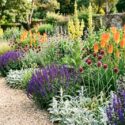
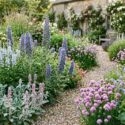
Use lamb’s ear as one component of a deer-resistant planting scheme rather than as a living fence.
Think plant palette, not plant barrier: building a planting from several lower-browse plants is more useful than expecting one deer-resistant species to protect highly palatable neighbors.
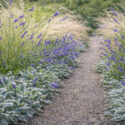
Lamb’s ear is an excellent deer-resistant groundcover when its growing conditions match your site.
That matters because deer resistance is only one part of choosing the right plant. A species can be rarely browsed and still perform poorly if the soil, light, or moisture conditions are wrong.
| Your Garden Conditions | Is Lamb’s Ear a Good Fit? |
|---|---|
| Sunny, dry to moderately moist, well-drained soil | Excellent fit. These are the conditions in which lamb’s ear is most useful as a deer-resistant groundcover. |
| Hot, dry site with good drainage | Usually a strong fit. Established plants tolerate dry conditions well. |
| Light shade with good airflow | Possible. Growth may be less compact than in full sun. |
| Wet or poorly drained soil | Poor fit. Choose a deer-resistant plant adapted to wetter conditions instead. |
| Deep shade with poor airflow | Usually not the best choice. Another deer-resistant groundcover is likely to perform better. |
So the best question is not simply:
“Will deer eat it?”
It is:
“Will deer usually leave it alone – and will it thrive in my garden?”
Lamb’s ear is an excellent deer-resistant choice for sunny, well-drained sites, but it is not the right plant for every garden.
Start with the Gardenia Lamb’s Ear profile to compare its mature size, hardiness, growing conditions, and garden uses, then explore Gardenia’s Stachys collection for related plants and cultivars.
If lamb’s ear does not match your conditions, use the Gardenia Plant Finder to find deer-resistant plants that also fit your sun, soil, drainage, water needs, hardiness, mature size, garden style, and other tolerances.
Browse Deer-Resistant Garden Ideas for inspiration, then use the Garden Design Tool to check whether your selected plants actually want compatible growing conditions before you combine them.
Deer can eat lamb’s ear, but they usually avoid it. Rutgers rates Stachys byzantina A – Rarely Damaged, its highest deer-resistance category. Occasional sampling can still occur, especially where deer pressure is severe.
Yes. Lamb’s ear has a strong deer-resistance record and is listed as deer resistant by several horticultural sources. No plant is completely deer proof, but repeated heavy browsing of lamb’s ear is unusual.
Its densely woolly foliage is often suggested as one reason deer find it less appealing than smooth, tender foliage. More importantly, lamb’s ear has a consistently strong lower-browse record in horticultural references.
Yes. ‘Big Ears’ and ‘Silver Carpet’ are cultivars of deer-resistant Stachys byzantina. ‘Big Ears’ is valued for especially large leaves, while ‘Silver Carpet’ forms a low silver mat and rarely flowers.
Lamb’s ear is also generally considered rabbit resistant. As with deer resistance, that lowers browsing risk but does not guarantee that a hungry animal will never sample the plant.
Poor drainage, prolonged leaf wetness, humidity, crowding, crown or root problems, and disease are often more likely than deer damage. If the leaves remain on the plant but are browning, yellowing, softening, or collapsing, check moisture and drainage first.
Not reliably. Deer may avoid lamb’s ear while still browsing a preferred plant nearby. Use lamb’s ear as part of a deer-resistant planting palette, not as a living barrier around deer favorites.
Yes, especially for sunny sites with well-drained soil. Lamb’s ear is a poorer choice for wet soil, deep shade, or locations where its woolly foliage remains damp for long periods.
Updated: September 2026 – Reviewed by Gardenia Editors
| Hardiness |
4 - 8 |
|---|---|
| Heat Zones |
1 - 8 |
| Climate Zones | 1, 1A, 1B, 2, 2A, 2B, 3, 3A, 3B, 4, 5, 6, 7, 8, 9, 10, 11, 12, 13, 14, 15, 16, 17, 18, 19, 20, 21, 22, 23, 24 |
| Plant Type | Perennials |
| Plant Family | Lamiaceae |
| Genus | Stachys |
| Exposure | Full Sun, Partial Sun |
| Season of Interest | Spring (Early, Mid, Late), Summer (Early, Mid, Late), Fall, Winter |
| Maintenance | Low |
| Water Needs | Low |
| Soil Type | Chalk, Loam, Sand |
| Soil pH | Acid, Alkaline, Neutral |
| Soil Drainage | Well-Drained |
| Tolerances | Deer |
Create a membership account to save your garden designs and to view them on any device.
Becoming a contributing member of Gardenia is easy and can be done in just a few minutes. If you provide us with your name, email address and the payment of a modest $25 annual membership fee, you will become a full member, enabling you to design and save up to 25 of your garden design ideas.
Join now and start creating your dream garden!