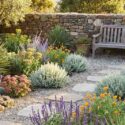
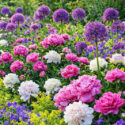
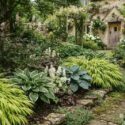
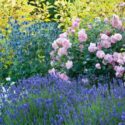
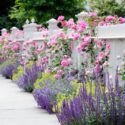
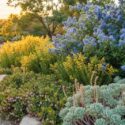
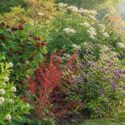
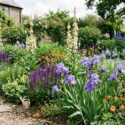
A lush blue and silver garden featuring Echium ‘Blue Bedder’, Veronica, chives and Borago - beautiful, pollinator-friendly and full of texture.
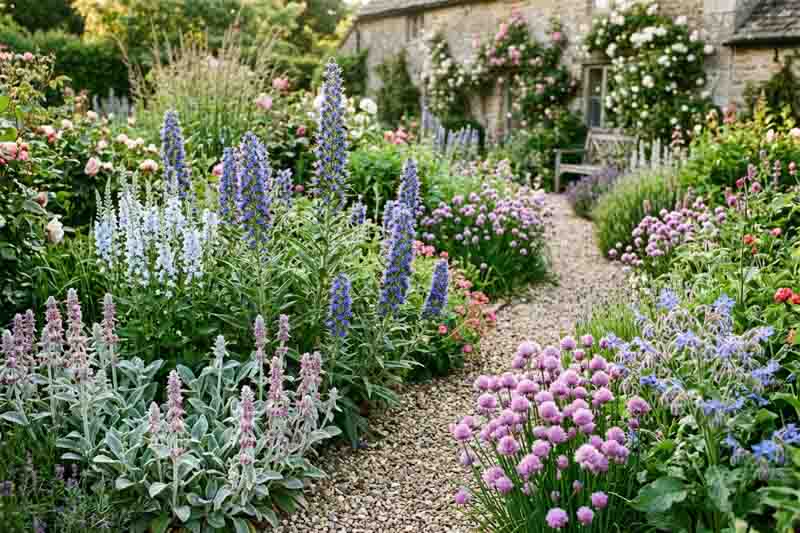


This sunny border brings together five plants in a cool palette of blue, silver, and soft purple. Upright blue flower spikes rise through silver foliage, while chives, pale Veronica, and borage fill the lower and middle layers beside a paved path. The planting is loose enough to feel natural, but the repeated colors keep it from looking untidy.
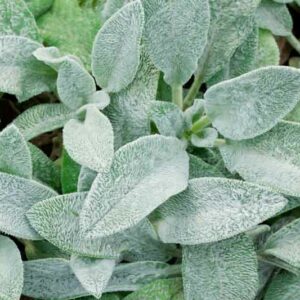
Echium vulgare ‘Blue Bedder’ provides the strongest blue accents, Stachys byzantina (Lamb’s Ear) forms broad silver clumps, Veronica gentianoides adds paler flower spikes, Allium schoenoprasum (Chives) contributes rounded mauve-purple flower heads, and Borago officinalis (Borage) threads through with star-shaped blue flowers.
Main plants used: Echium vulgare ‘Blue Bedder’, Stachys byzantina, Veronica gentianoides, Allium schoenoprasum, and Borago officinalis
The border benefits from several different flower shapes. Echium and Veronica provide upright spikes, Chives add rounded flower heads, and Borage carries looser star-shaped flowers on branching stems. Lamb’s Ear contributes no strong flower color in this combination, but its soft silver foliage gives the eye somewhere to rest between the blues and purples.
The color range is deliberately narrow. The deeper blue of Echium is strongest, while Veronica is paler and Borage adds a softer, more informal blue. The Chive flowers introduce mauve-purple without taking the border in a completely different direction.
The image also shows a garden that is not planted in rigid blocks. The species overlap, but each is still recognizable. That is the right approach for this kind of border: repeated groups, but not a repeated pattern.
Echium vulgare ‘Blue Bedder’ provides vivid blue flower spikes and strong pollinator value. Despite the bold appearance of the flowers, this cultivar is relatively compact, typically around 12-18 in (30-45 cm) tall, so it works best as a repeated mid-border accent rather than a towering focal plant.
Stachys byzantina is most useful near the front, where its felted silver leaves can form generous clumps. It prefers good drainage and can suffer in persistently wet or humid conditions, so avoid overwatering established plants.
Veronica gentianoides contributes lighter blue flowers and a softer vertical shape. It performs best in moist but well-drained soil and is a useful contrast to the drier preferences of Lamb’s Ear.
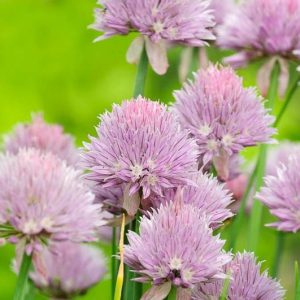
Allium schoenoprasum combines edible foliage with rounded purple flowers. Allow some clumps to bloom for pollinators, then cut them back after flowering if you want fresh foliage and less self-seeding.
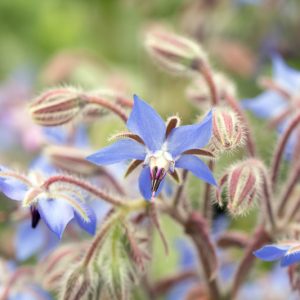
Borago officinalis is short-lived but grows quickly and often self-seeds. Its loose stems and blue flowers fit naturally between more permanent plants. Thin seedlings where they become crowded rather than trying to confine the plant too tightly.
Create a pollinator-friendly border with repeated blue flowers, silver foliage, and a loose cottage-garden structure that still feels intentional beside a path.
The equal ratio applies to the five featured plants only. Other background plants can remain in the wider border, as in the garden shown.
Place Echium and Veronica through the middle of the bed so their upright flowers remain visible.
Use Lamb’s Ear and Chives nearer the path in repeated but irregular clumps.
Allow Borage to appear between the other groups rather than giving it a separate section. Keep the path edge open enough that the planting feels generous without spilling too far onto the walking surface.
This combination should not be watered as though all five plants have identical needs. Lamb’s Ear prefers sharper drainage, while Veronica and Chives generally benefit from more even moisture. A broad border with slight differences in soil moisture from one area to another suits the mix well.
Borage and Echium are also shorter-lived than the more permanent perennials. Expect the planting to shift slightly from year to year, especially where Borage self-seeds. Some editing is useful, but that small amount of change is part of the natural character of the border.
| Hardiness |
4 - 7 |
|---|---|
| Heat Zones |
1 - 7 |
| Climate Zones | 4, 5, 6, 7, 8, 9, 14, 15, 16, 17, 18, 19, 20, 21 |
| Exposure | Full Sun |
| Season of Interest | Spring (Late), Summer (Early) |
| Maintenance | Low |
| Water Needs | Average |
| Soil Type | Chalk, Loam, Sand |
| Soil pH | Acid, Neutral, Alkaline |
| Soil Drainage | Moist but Well-Drained, Well-Drained |
| Characteristics | Cut Flowers, Showy |
| Attracts | Bees, Butterflies |
| Landscaping Ideas | Beds And Borders |
| Garden Styles | Butterfly Garden, Informal and Cottage, Pollinator Garden, Prairie and Meadow |



| Hardiness |
4 - 7 |
|---|---|
| Heat Zones |
1 - 7 |
| Climate Zones | 4, 5, 6, 7, 8, 9, 14, 15, 16, 17, 18, 19, 20, 21 |
| Exposure | Full Sun |
| Season of Interest | Spring (Late), Summer (Early) |
| Maintenance | Low |
| Water Needs | Average |
| Soil Type | Chalk, Loam, Sand |
| Soil pH | Acid, Neutral, Alkaline |
| Soil Drainage | Moist but Well-Drained, Well-Drained |
| Characteristics | Cut Flowers, Showy |
| Attracts | Bees, Butterflies |
| Landscaping Ideas | Beds And Borders |
| Garden Styles | Butterfly Garden, Informal and Cottage, Pollinator Garden, Prairie and Meadow |
Recreate this garden. Specify the percentages you would like to have of each plant and input the dimensions of your garden space.We'll give you a shopping list so you know how many plants you need.
| Plant | Quantity | |
|---|---|---|
| Echium vulgare 'Blue Bedder' (Viper's Bugloss) | N/A | Buy Plants |
| Borago officinalis (Borage) | N/A | Buy Plants |
| Allium schoenoprasum (Chives) | N/A | Buy Plants |
| Veronica gentianoides (Gentian Speedwell) | N/A | Buy Plants |
| Stachys byzantina (Lamb's Ear) | N/A | Buy Plants |
Create a membership account to save your garden designs and to view them on any device.
Becoming a contributing member of Gardenia is easy and can be done in just a few minutes. If you provide us with your name, email address and the payment of a modest $25 annual membership fee, you will become a full member, enabling you to design and save up to 25 of your garden design ideas.
Join now and start creating your dream garden!