Deer-resistant groundcovers can turn difficult spaces into beautiful, low-maintenance planting without inviting constant browsing. Discover dependable choices for sun, shade, dry soil, slopes, native gardens, pollinators, and evergreen cover - plus the plants that need more caution and a smarter way to match groundcovers to your exact garden conditions and goals.
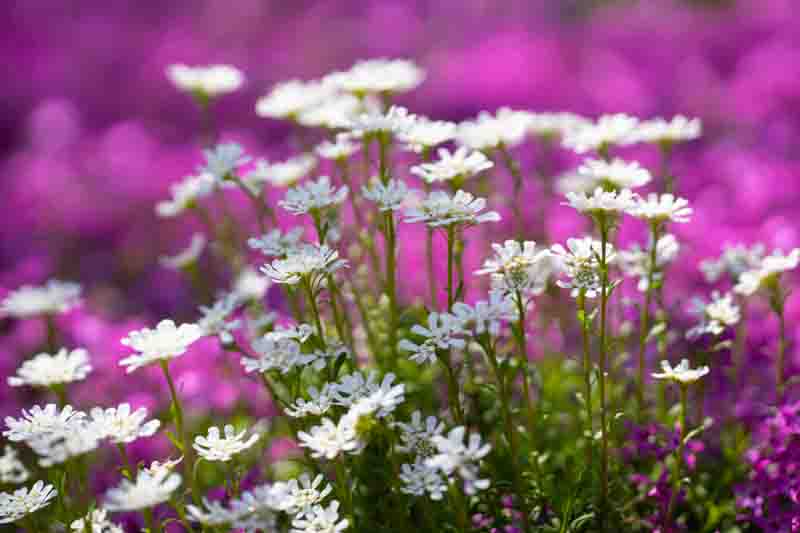


When deer regularly wander through the garden, filling bare ground can become surprisingly difficult. Many of the plants gardeners normally reach for – soft-leaved perennials, lush edging plants, and tender new growth – are exactly the sort of things hungry deer like to sample.
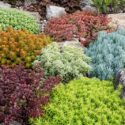
Fortunately, there are plenty of deer-resistant groundcovers that can carpet soil, soften paths, cover slopes, suppress some weeds, and knit a planting together without becoming the first stop at the deer buffet. The challenge is not simply finding a plant deer dislike. It is finding one that also fits the light, soil, moisture, climate, space, and spreading behavior your garden requires.
A creeping thyme that thrives beside a hot stone path will struggle in damp shade. Epimedium can make a beautiful carpet beneath trees but is not the plant for an exposed, baking slope. Creeping juniper can cover dry ground for years, yet may overwhelm a tiny planting pocket. And some plants commonly promoted as “deer resistant” are much more variable than others.
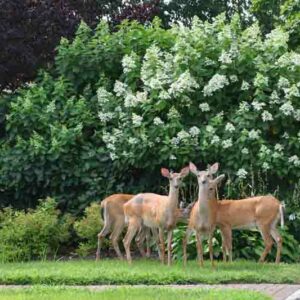
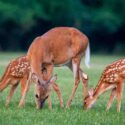
Deer-resistant groundcovers are low-growing or spreading plants that deer tend to browse less readily than more palatable alternatives. None is completely deer-proof. Local deer pressure, season, drought, plant age, and food availability can all change browsing behavior.
| Garden Situation | Strong Starting Points |
|---|---|
| Dry shade | Epimedium, bigroot geranium, Allegheny spurge |
| Sunny, dry sites | Creeping thyme, low-growing sedums, creeping juniper |
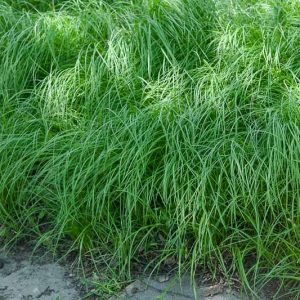
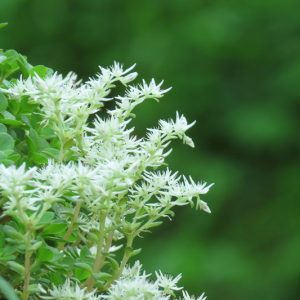
| Woodland gardens | Pennsylvania sedge, woodland stonecrop, Allegheny spurge, wild ginger |
| Slopes | Creeping juniper, bigroot geranium, dwarf plumbago |
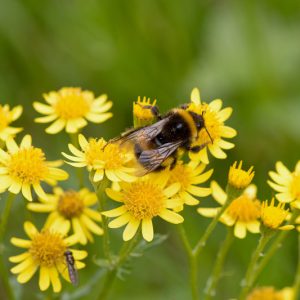
| Native-focused planting | Pennsylvania sedge, woodland stonecrop, golden ragwort, Allegheny spurge – where native |
“Groundcover” describes a job, not a single type of plant. A groundcover may be a creeping perennial, low shrub, sedge, succulent, fern, or evergreen conifer. What these plants share is their ability to cover soil horizontally and create the lower layer of a planting.
The best deer-resistant groundcovers do more than survive occasional browsing. They also fit the conditions where they are planted. Before choosing one, consider:
Shade is where deer damage often feels most frustrating because one of the classic shade plants – hosta – is also famously attractive to deer. Fortunately, several excellent alternatives provide foliage, flowers, and spreading growth without the same level of temptation.
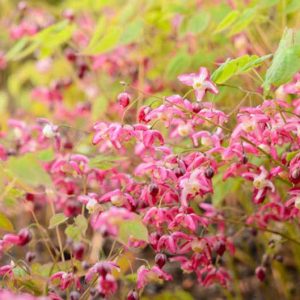
Epimedium × rubrum and other barrenworts are among the most useful groundcovers for difficult shade, particularly beneath established trees where roots compete heavily for moisture. Once established, many epimediums tolerate dry shade remarkably well.
Their spring flowers hover above attractive foliage, and the plants spread by rhizomes to form durable colonies without usually racing through the garden.
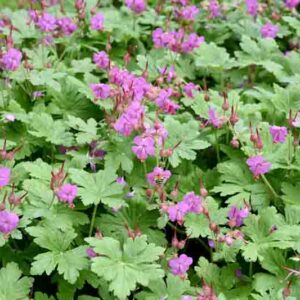
Bigroot geranium is a genuine garden workhorse. Its aromatic foliage is generally unappealing to deer, while spreading rhizomes gradually knit together into a substantial ground layer. It tolerates sun to part shade, handles dry soil once established, and often develops excellent fall color.
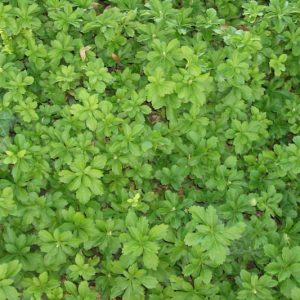
For an American native alternative to Japanese pachysandra, consider Allegheny spurge. It forms slowly expanding colonies in partial to full shade and offers beautifully mottled foliage plus fragrant spring flowers.
It is native to parts of the southeastern United States, so check regional suitability before treating it as a native choice for your own garden.
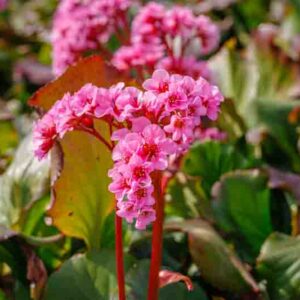
Bergenia cordifolia is less carpet-like than epimedium but creates a substantial ground layer with large, leathery leaves. It is especially useful where you want bold texture rather than a tiny-leaved mat.
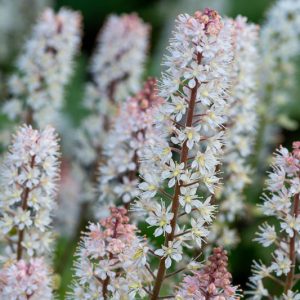
Foamflower brings frothy spring flowers and attractive foliage to woodland gardens, but its deer resistance is more variable than that of the strongest choices above. Where deer pressure is intense, treat it as a secondary choice rather than the backbone of the planting.
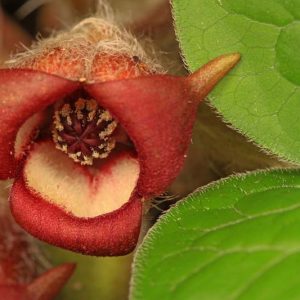
Wild ginger forms broad mats of heart-shaped leaves in cool, moist woodland conditions. It is native across much of eastern North America and is generally avoided by deer. Despite its common name, it is not culinary ginger and should not be eaten.
| Genus | Asarum, Bergenia, Epimedium, Pachysandra, Phlox, Sedum, Stachys, Thymus, Tiarella |
|---|---|
| Tolerance | Deer |
| Landscaping Ideas | Ground Covers |
Sunny, dry ground gives you some of the toughest deer-resistant choices, but drainage matters. Plants adapted to lean, dry soil often perform poorly if their roots remain wet for long periods.
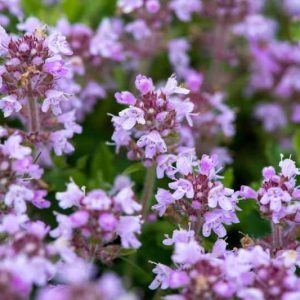
Creeping thyme combines aromatic foliage, pollinator-friendly flowers, low growth, and excellent drought tolerance once established. It is ideal along paths, over low walls, between widely spaced stepping stones, and at the edges of gravel gardens.
Give it plenty of sun and sharply drained soil. It can tolerate light foot traffic but is not a substitute for turf in a heavily used lawn.
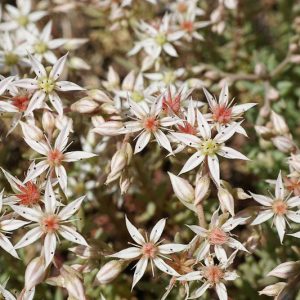
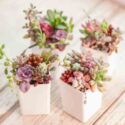
Sedum is an enormous group, so growth habit matters. Some stonecrops form tight mats, others trail, and some spread much more quickly. Sedum album, for example, is a low-growing choice for dry, sunny sites.
Gardenia’s guide to low-growing sedums separates compact mat-formers from faster spreaders – a useful distinction when choosing a groundcover for a defined space.
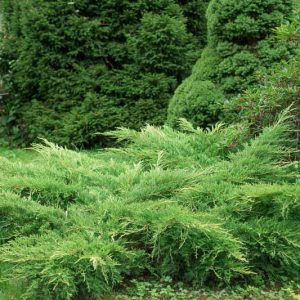
Creeping juniper is one of the strongest evergreen choices for sunny slopes, banks, exposed sites, and dry soils. Its horizontal branches create broad coverage while mature plants tolerate drought well.
Check mature width carefully. Creeping junipers remain low but can eventually occupy several feet of ground.
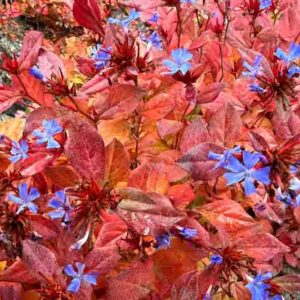
Dwarf plumbago adds vivid blue flowers from summer into fall followed by bronzy-red foliage. It works on banks, beneath open shrubs, and in sunny to partly shaded beds.
Dwarf plumbago spreads vigorously by rhizomes, so give it room and monitor its boundaries in smaller gardens.
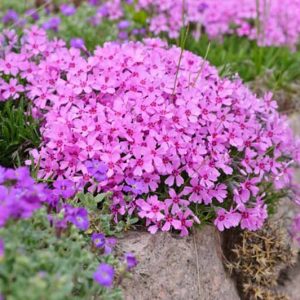
Creeping phlox creates spectacular spring carpets over sunny banks, rock gardens, and wall edges. Deer resistance, however, can be less consistent than with thyme or creeping juniper, so it is better regarded as a moderate rather than foolproof choice in high-pressure gardens.
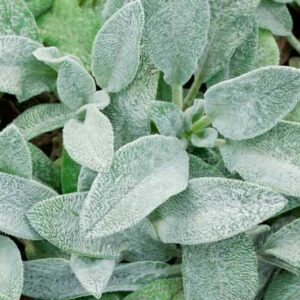
Lamb’s ear spreads into low colonies of thick, woolly silver foliage. Its fuzzy texture makes it less attractive to deer, while its color is useful for breaking up large areas of green. Good drainage is important, especially in humid climates.
A slope asks more from a groundcover than level ground does. Plants need to establish securely, spread enough to reduce exposed soil, and tolerate water either moving through the root zone or draining away quickly.
For sunny, dry slopes, creeping juniper is one of the strongest structural choices. Creeping thyme and low-growing sedums can work beautifully on smaller, sharply drained banks.
For partly shaded slopes, bigroot geranium is especially useful because its rhizomatous growth gradually knits together. Dwarf plumbago can also cover sunny or lightly shaded banks, although its vigorous spread makes it better suited to areas where it has room to roam.
On shaded eastern woodland slopes, Pennsylvania sedge, Allegheny spurge, woodland stonecrop, and wild ginger can create a more naturalistic ground layer where conditions suit them.
Native does not mean deer resistant, and deer resistant does not mean native. These are separate plant traits. When you want both, filter for them independently and make sure the species is genuinely native to your region.
Native ranges differ enormously. A plant native to Virginia is not automatically native to California, Texas, Maine, or Oregon. Use regional native status as part of the selection process rather than relying on a national “native groundcovers” label.
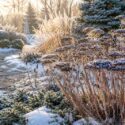
If winter soil coverage matters, look beyond flowers and ask what the foliage does after frost.
Creeping juniper offers dependable evergreen structure in sun. Bergenia often retains bold foliage and may turn burgundy or bronze in winter. Allegheny spurge can remain semi-evergreen to evergreen in milder parts of its range.
Epimedium varies by species and cultivar: some selections are deciduous while others retain foliage for much of winter. Low-growing sedums also vary, with some remaining evergreen or semi-evergreen in suitable climates.
When winter appearance is important, check the specific species or cultivar rather than assuming every member of a genus behaves the same way.
One of the biggest problems with online deer-resistant plant lists is that plants with very different browsing records are often presented as equally dependable.
Phlox subulata, for example, is a beautiful sunny groundcover, but browsing can be more variable than with plants such as creeping thyme or creeping juniper. It may perform perfectly well in one neighborhood and be sampled regularly in another.
Heuchera is similarly variable. Some gardeners see little damage, while others find deer browse the flowers or foliage. Foamflower also belongs in the more nuanced category: valuable in a native woodland planting, but not as consistently avoided as the strongest choices.
Do not assume a palatable plant becomes protected simply because it grows beside something aromatic. Thyme, lavender, catmint, and other fragrant plants may themselves be browsed less, but they do not create an invisible barrier around neighboring plants.
There is another filter that matters just as much as deer resistance: how the plant behaves after you put it in the ground.
Some traditional groundcovers are tough, persistent, and rarely bothered by deer – but those same qualities can allow them to spread aggressively beyond the place where they were planted. In some regions, certain species can invade woodland edges, streambanks, lawns, or neighboring gardens.
Plants that deserve particular caution include English ivy, periwinkle or vinca, Japanese pachysandra, goutweed, yellow archangel, creeping Jenny, wintercreeper, and, in some regions, ajuga or creeping liriope.
That does not mean every one of these plants is considered invasive everywhere. Status varies by state and region. It does mean you should check local invasive-plant guidance before choosing a vigorous groundcover simply because deer tend to leave it alone.
Even a vigorous groundcover will disappoint if it is planted into compacted soil, buried beneath mulch, or spaced without regard to mature spread.
If deer pressure is intense, temporary cages, fencing, netting, or an appropriate repellent can help young plants establish. Tender new shoots may be more attractive than mature foliage even on plants that eventually prove relatively resistant.
A deer-resistant groundcover is only useful if it also fits the site and spreads the way you want it to. Gardenia’s Deer-Smart Groundcover Match looks at deer resistance, growing conditions, mature footprint, and garden goals together.
The key question: “Will deer usually leave it alone, will it thrive here, and will it cover the right amount of ground?”
Use the Gardenia Plant Finder to find deer-resistant groundcovers suited to your light, soil, drainage, moisture, climate, and available space. Browse Deer-Resistant Garden Ideas for inspiration, then use the Garden Design Tool to see how your choices fit into the whole planting.
| Problem | Good Starting Points | Watch For |
|---|---|---|
| Dry shade under trees | Epimedium, bigroot geranium | Root competition and establishment watering |
| Hot, dry sunny edge | Creeping thyme, Sedum album | Poor drainage and overly rich soil |
| Large sunny slope | Creeping juniper, dwarf plumbago | Mature spread and erosion before establishment |
| Native woodland layer | Pennsylvania sedge, woodland stonecrop, wild ginger | Regional native range and moisture requirements |
| Evergreen coverage | Creeping juniper, bergenia, selected sedums | Climate-dependent winter appearance |
Hardiness zone is useful, but it is only one part of plant selection. A Zone 7 groundcover for hot, dry sun may be completely wrong for a Zone 7 woodland garden. Use zone information first, then refine by light, moisture, soil, mature spread, and local deer pressure.
For climate-specific starting points, see Gardenia’s existing guides:
For the broader deer-resistant plant strategy – including shrubs, perennials, bulbs, grasses, and trees – see Deer-Resistant Plants: Best Shrubs, Perennials and Flowers.
There is no single best choice. Epimedium and bigroot geranium are excellent for dry shade, creeping thyme and low sedums suit sunny dry sites, and creeping juniper is a strong evergreen option for large sunny areas and slopes.
Epimedium, bigroot geranium, Allegheny spurge, bergenia, Pennsylvania sedge, woodland stonecrop, and wild ginger are useful choices, depending on soil moisture, climate, and shade. Foamflower can also work, but deer resistance is more variable.
Creeping juniper is a dependable evergreen choice for sunny sites. Bergenia, some sedums, Allegheny spurge, and some epimediums may remain evergreen or semi-evergreen depending on species, cultivar, and climate.
Creeping thyme is generally a good deer-resistant choice because of its aromatic foliage. It performs best in full sun and sharply drained soil.
Low-growing sedums are generally relatively deer resistant, although no sedum is completely deer-proof. Choose a mat-forming type suited to your climate and provide good drainage.
Creeping juniper is excellent for sunny, dry slopes, while bigroot geranium works well on partly shaded banks. Dwarf plumbago is another useful option where it has enough room to spread.
Yes. Depending on your region, possibilities include Pennsylvania sedge, woodland stonecrop, golden ragwort, Allegheny spurge, and wild ginger. Foamflower is another native possibility, but deer resistance can be more variable. Always check native range for your location.
Yes. Some traditional groundcovers are avoided by deer but can spread aggressively or become invasive in certain regions. Check local guidance before planting English ivy, periwinkle, goutweed, wintercreeper, or other vigorous spreaders.
No. Deer-resistant plants are less likely to be browsed, but deer may sample almost any plant when food is scarce or deer pressure is unusually high.
Updated: September 2026
| Genus | Asarum, Bergenia, Epimedium, Pachysandra, Phlox, Sedum, Stachys, Thymus, Tiarella |
|---|---|
| Tolerance | Deer |
| Landscaping Ideas | Ground Covers |
Create a membership account to save your garden designs and to view them on any device.
Becoming a contributing member of Gardenia is easy and can be done in just a few minutes. If you provide us with your name, email address and the payment of a modest $25 annual membership fee, you will become a full member, enabling you to design and save up to 25 of your garden design ideas.
Join now and start creating your dream garden!
Create a membership account to save your garden designs and to view them on any device.
Becoming a contributing member of Gardenia is easy and can be done in just a few minutes. If you provide us with your name, email address and the payment of a modest $25 annual membership fee, you will become a full member, enabling you to design and save up to 25 of your garden design ideas.
Join now and start creating your dream garden!