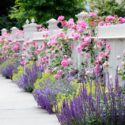
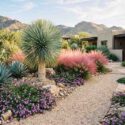
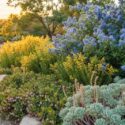
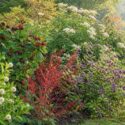
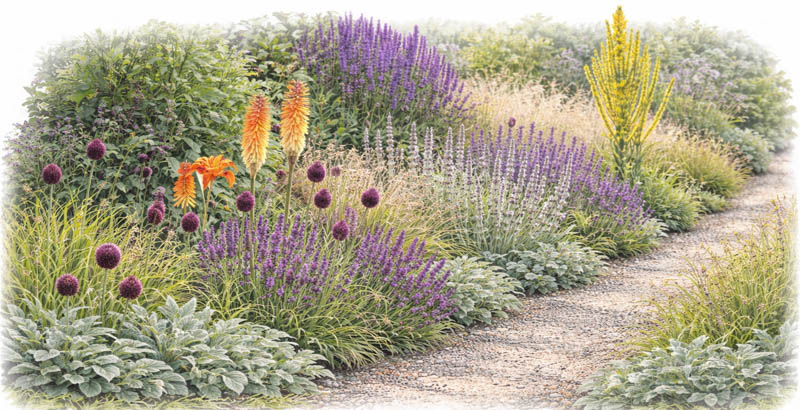
A sun-loving perennial border for a gravel path, layered with silver lamb’s ear, purple salvia, and floating drumstick alliums. Red hot poker and giant mullein add bold summer height. Bloom time: late spring into summer, with strongest color from early to mid-summer and accents continuing later.
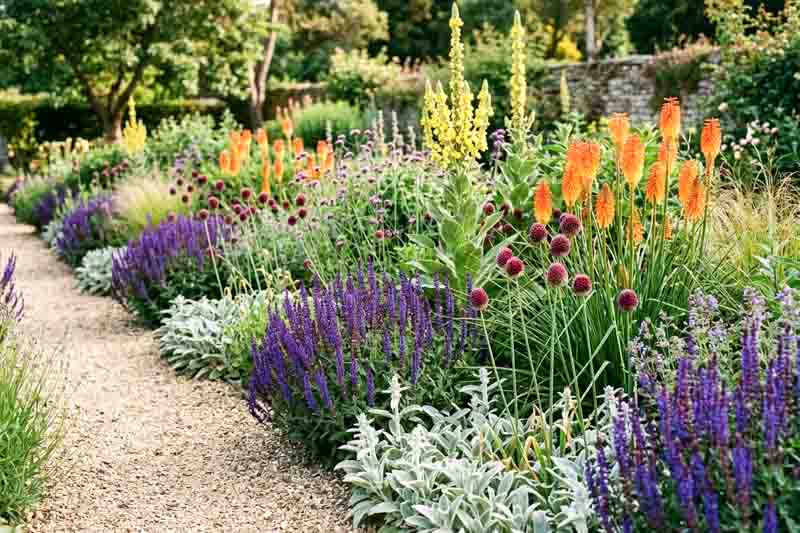


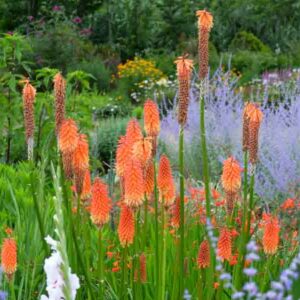
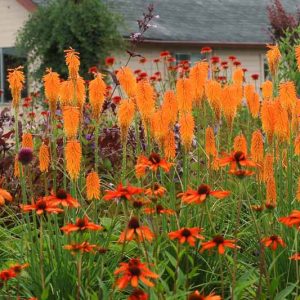
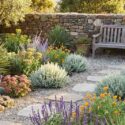
A gravel path curves beside this generous sunny border, with silver foliage and purple flowers repeated along the edge and taller perennials rising farther back. Salvia nemorosa provides much of the violet-purple color, while Stachys byzantina forms pale, woolly patches close to the gravel. Above them, burgundy heads of Allium sphaerocephalon, orange Kniphofia flowers, and tall yellow Verbascum olympicum give the border considerably more height.
The planting is full rather than formal. Groups vary in size, flowers overlap, and ornamental grasses and other perennials appear between the five featured plants. That looser arrangement suits the curving path and mature garden setting better than planting each species in a separate block.
Main plants used: Allium sphaerocephalon (Drumstick Allium), Kniphofia (Red Hot Poker), Verbascum olympicum (Giant Mullein), Salvia nemorosa (Woodland Sage), and Stachys byzantina (Lamb’s Ear)
The border has enough repetition to feel coherent, but not so much that it looks patterned. Salvia appears several times along the path, and Lamb’s Ear repeats at the lower edge. Those two plants establish the main purple-and-silver theme.
The taller flowers are used less evenly. Kniphofia introduces strong orange color in several places, Verbascum rises well above the surrounding plants, and the smaller heads of drumstick allium appear on thin stems through the middle. This variation in height gives the border depth when viewed along the path.
The gravel is equally useful. It provides a quiet surface beside a very full planting and makes the pale foliage of Lamb’s Ear particularly noticeable. Keeping some gravel clearly visible prevents the border from feeling congested.
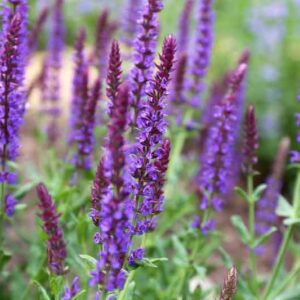
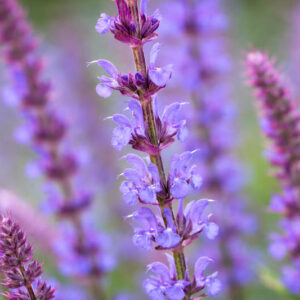
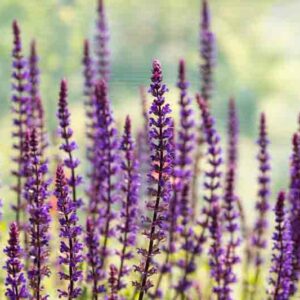
Salvia nemorosa is most effective in repeated clumps through the front and middle. Its dense purple flower spikes contrast particularly well with Lamb’s Ear and the warmer Kniphofia flowers. Cutting plants back after the first major flush can encourage fresh growth and additional bloom.
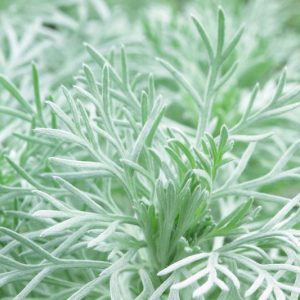
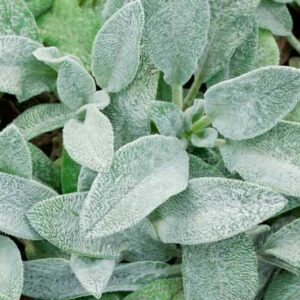
Stachys byzantina belongs near the front, where its silver leaves can spread into irregular patches beside the gravel. Give it well-drained soil and avoid keeping the foliage consistently wet, particularly in humid climates.
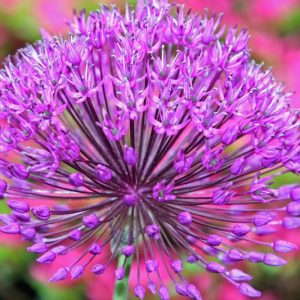
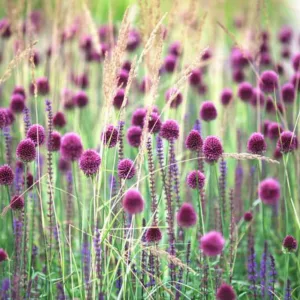
Allium sphaerocephalon is best planted in loose bulb clusters among established perennials. Its narrow stems take up little visual space, allowing the burgundy flower heads to appear above neighboring foliage without forming a solid block.
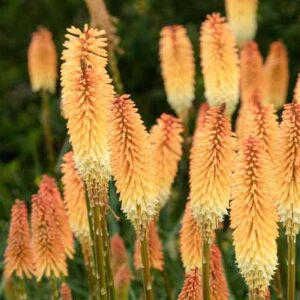
Kniphofia provides the strongest warm color. Small groups repeated at intervals are enough to carry orange through the border. Although established plants can tolerate periods of dryness, they generally flower more generously when they receive some moisture during active growth rather than being kept extremely dry.
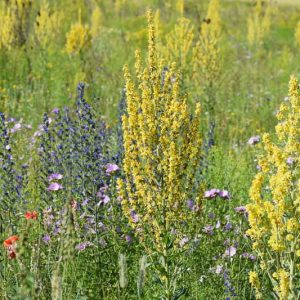
Verbascum olympicum needs room. Its tall yellow flower stems work well farther back or occasionally through the middle of a broad border. Rather than repeating it densely, use a few well-spaced plants and allow their height to stand out.
Create a broad, sunny path border with repeated purple and silver near the edge, then add warmer flowers and taller stems through the middle and rear.
These percentages apply only to the five featured plants. Grasses and other perennials can be worked between them, as in the garden shown.
Repeat Salvia and Lamb’s Ear most strongly near the path, but vary the size of each group.
Thread drumstick alliums through the middle rather than giving them their own strip.
Place Kniphofia in several small groups so the orange flowers recur along the length of the border.
Use Verbascum more sparingly, allowing its taller stems to rise above neighboring plants. Grasses or other compatible perennials can fill some of the spaces between these groups.
This is not a border that needs uniformly dry soil. Good drainage matters, but Kniphofia may appreciate more summer moisture than established Salvia, Stachys, or Verbascum. Slight differences in soil moisture across a broad bed can be useful.
Also allow for mature size. The photograph works because the border is generous enough for large plants, grasses, and overlapping stems without crowding the path. In a narrower bed, reduce the number of tall accents rather than squeezing everything together.
| Hardiness |
6 - 8 |
|---|---|
| Heat Zones |
4 - 8 |
| Climate Zones | 4, 5, 6, 7, 8, 9, 14, 15, 16, 17, 18, 19, 20, 21, 22, 23, 24 |
| Exposure | Full Sun |
| Season of Interest | Spring (Late), Summer (Early, Mid, Late), Fall |
| Maintenance | Low |
| Water Needs | Low |
| Soil Type | Loam |
| Soil pH | Neutral |
| Soil Drainage | Moist but Well-Drained, Well-Drained |
| Characteristics | Showy |
| Tolerances | Drought, Deer, Rabbit |
| Attracts | Bees, Butterflies, Birds |
| Landscaping Ideas | Pathways |
| Garden Styles | Butterfly Garden, Informal and Cottage, Pollinator Garden |

| Hardiness |
6 - 8 |
|---|---|
| Heat Zones |
4 - 8 |
| Climate Zones | 4, 5, 6, 7, 8, 9, 14, 15, 16, 17, 18, 19, 20, 21, 22, 23, 24 |
| Exposure | Full Sun |
| Season of Interest | Spring (Late), Summer (Early, Mid, Late), Fall |
| Maintenance | Low |
| Water Needs | Low |
| Soil Type | Loam |
| Soil pH | Neutral |
| Soil Drainage | Moist but Well-Drained, Well-Drained |
| Characteristics | Showy |
| Tolerances | Drought, Deer, Rabbit |
| Attracts | Bees, Butterflies, Birds |
| Landscaping Ideas | Pathways |
| Garden Styles | Butterfly Garden, Informal and Cottage, Pollinator Garden |
Recreate this garden. Specify the percentages you would like to have of each plant and input the dimensions of your garden space.We'll give you a shopping list so you know how many plants you need.
| Plant | Quantity | |
|---|---|---|
| Kniphofia 'Tawny King' (Red Hot Poker) | N/A | Buy Plants |
| Allium sphaerocephalon (Drumstick Allium) | N/A | Buy Plants |
| Stachys byzantina (Lamb's Ear) | N/A | Buy Plants |
| Salvia nemorosa 'Caradonna' (Woodland Sage) | N/A | Buy Plants |
| Verbascum olympicum (Olympic Mullein) | N/A | Buy Plants |
Create a membership account to save your garden designs and to view them on any device.
Becoming a contributing member of Gardenia is easy and can be done in just a few minutes. If you provide us with your name, email address and the payment of a modest $25 annual membership fee, you will become a full member, enabling you to design and save up to 25 of your garden design ideas.
Join now and start creating your dream garden!
Create a membership account to save your garden designs and to view them on any device.
Becoming a contributing member of Gardenia is easy and can be done in just a few minutes. If you provide us with your name, email address and the payment of a modest $25 annual membership fee, you will become a full member, enabling you to design and save up to 25 of your garden design ideas.
Join now and start creating your dream garden!