Apricot, yellow, pink, and burgundy Daylilies mingle with blue-green Hostas, chartreuse Lady's Mantle, and violet-blue Veronica in this generous summer border. By combining Daylilies from several bloom seasons, the planting changes gradually through summer while contrasting foliage and flower shapes keep it interesting between waves of color.
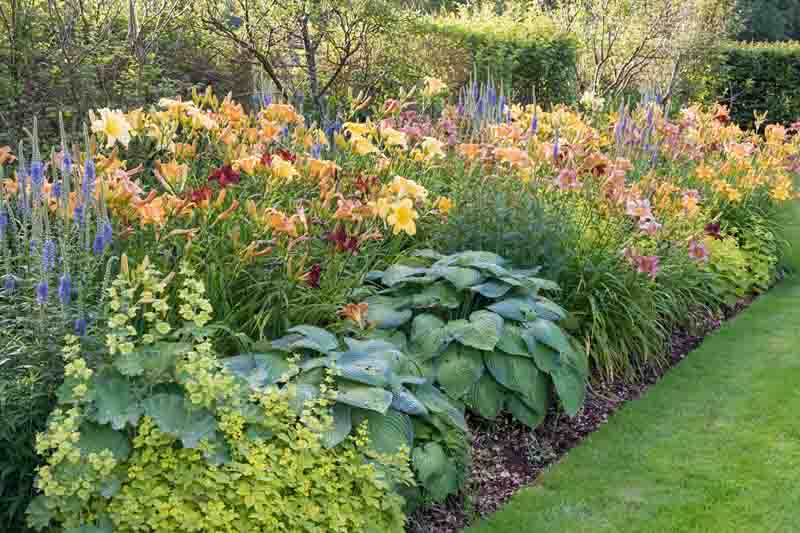


This generous perennial border is built around Daylilies, but the supporting plants are what give it depth. Warm apricot, yellow, pink, and burgundy Hemerocallis flowers rise through a broad planting of blue-green Hostas, chartreuse Alchemilla mollis, and slender violet-blue spikes of Veronica longifolia. The result is colorful without feeling gaudy, with foliage doing almost as much work as the flowers.
The Daylilies are repeated in loose groups rather than planted as a single mass. Different colors appear across the border, while Hostas anchor the lower layer and Lady’s Mantle brightens the front with fresh green foliage and frothy flowers. Veronica adds the vertical accents needed to break up the rounded forms.
Main plants used: Hemerocallis (Daylily), Hosta, Alchemilla mollis (Lady’s Mantle), and Veronica longifolia (Longleaf Speedwell)
Choose Daylilies with overlapping early, midseason, and late bloom times, then weave the companion plants between them rather than separating everything into individual blocks.
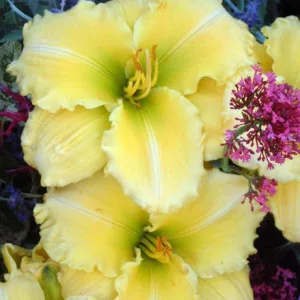
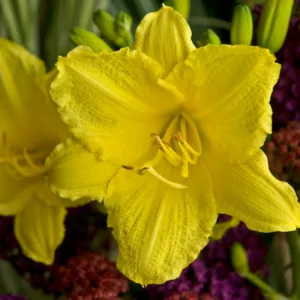
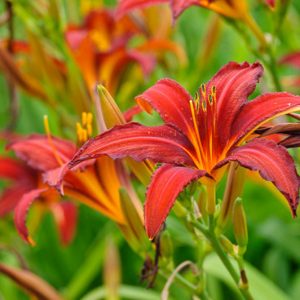
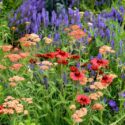
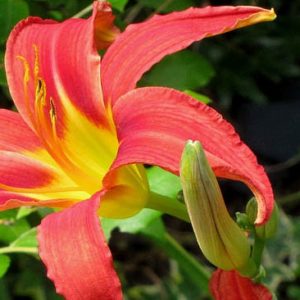
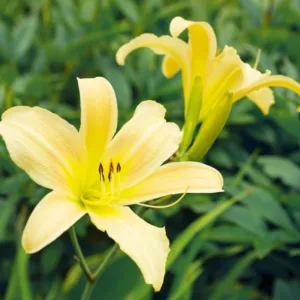
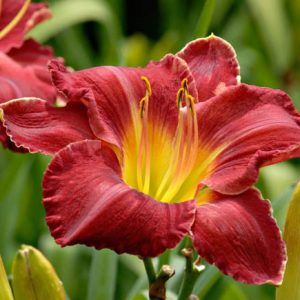
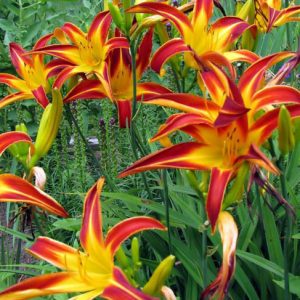
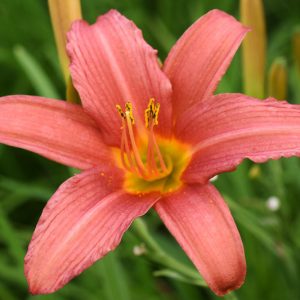
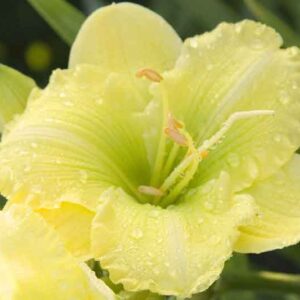
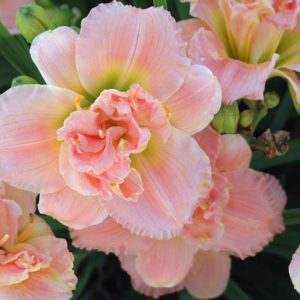
The Daylilies provide most of the color, but they do not all look alike. Soft yellow and apricot flowers mingle with pink, peach, and darker burgundy blooms, giving the border variation without introducing an entirely new plant palette.
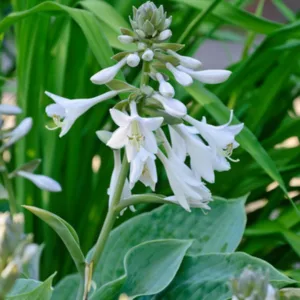
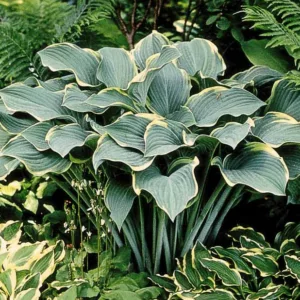
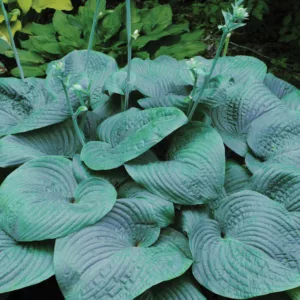
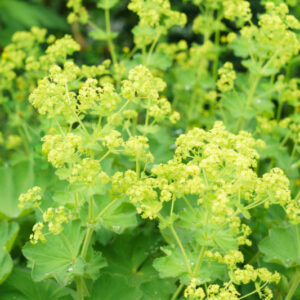
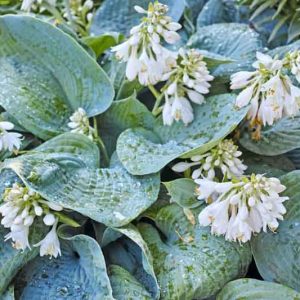
The foliage prevents all that flower color from becoming overwhelming. Large Hosta leaves create broad blue-green resting points, while Lady’s Mantle brings a lighter yellow-green at the front. The narrow violet-blue spikes of Veronica provide a completely different shape and a useful cool counterpoint to the warmer Daylily flowers.
The border also changes naturally through the season. Lady’s Mantle flowers around late spring and early summer, Veronica contributes its upright bloom in summer, and the different Daylily cultivars can carry the main display over a considerably longer period.
The original planting uses seven cultivars selected to flower at different points in the season: ‘Irish Envy’ as an early bloomer; ‘Charles Johnston’ and ‘Siloam Double Classic’ in the early-midseason period; ‘Hyperion’, ‘Marse Connell’, and ‘Pink Damask’ around midseason; and ‘Autumn Accent’ later in the season.
That succession is more useful than planting seven cultivars that all peak together. It also allows the color balance to shift gradually, so the border never looks exactly the same from one week to the next.
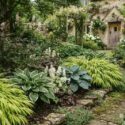
Hosta gives the border its broadest foliage. Use substantial clumps near the front and middle, particularly where there is some protection from hot afternoon sun.
Alchemilla mollis works beautifully along the front edge, where its softly pleated leaves and sprays of chartreuse flowers lighten the planting and blend warm and cool flower colors.
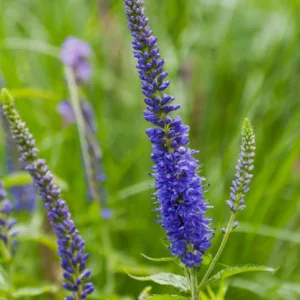
Veronica longifolia adds narrow violet-blue flower spikes. Repeat it through the border in small groups so the vertical accents appear in several places rather than forming one solid band.
Build a long-flowering summer border around Daylilies, then use bold foliage and blue flower spikes to keep the planting balanced.
The Daylilies should dominate, but leave enough companion foliage visible to break up the flower color.
Plant Daylilies in irregular groups through the middle and rear, mixing cultivars rather than placing each color in its own section.
Use Hostas as larger foliage anchors and let Lady’s Mantle soften the front edge.
Thread Veronica through the planting in smaller repeated groups so its blue spikes rise between the Daylily flowers.
Lady’s Mantle helps start the display in late spring to early summer, just as the first Daylilies begin to flower. Veronica follows with its cool blue-violet spikes, while the Hostas are already providing substantial foliage.
The border reaches its fullest effect in summer. By mixing Daylilies from several flowering periods, one group can take over as another begins to fade. Later cultivars then help carry color beyond the main midsummer peak.
The light level is the main compromise in this combination. Daylilies and Veronica appreciate plenty of sun, while Hostas are happier with some shade. A site with morning sun, filtered light, or light afternoon shade can suit the whole group well.
For the longest display, pay as much attention to flowering season as flower color when choosing Daylilies. Repeating early, midseason, and late cultivars across the border gives a much more convincing succession than relying on one large midsummer flush.
| Hardiness |
4 - 8 |
|---|---|
| Heat Zones |
2 - 7 |
| Exposure | Partial Sun |
| Season of Interest | Summer (Early, Mid, Late) |
| Maintenance | Low |
| Water Needs | Average |
| Soil Type | Loam |
| Soil pH | Acid, Neutral |
| Soil Drainage | Moist but Well-Drained |
| Characteristics | Cut Flowers, Fragrant, Plant of Merit, Showy |
| Attracts | Butterflies, Hummingbirds |
| Landscaping Ideas | Beds And Borders |
| Garden Styles | Butterfly Garden, City and Courtyard, Informal and Cottage, Pollinator Garden, Traditional Garden |


| Hardiness |
4 - 8 |
|---|---|
| Heat Zones |
2 - 7 |
| Exposure | Partial Sun |
| Season of Interest | Summer (Early, Mid, Late) |
| Maintenance | Low |
| Water Needs | Average |
| Soil Type | Loam |
| Soil pH | Acid, Neutral |
| Soil Drainage | Moist but Well-Drained |
| Characteristics | Cut Flowers, Fragrant, Plant of Merit, Showy |
| Attracts | Butterflies, Hummingbirds |
| Landscaping Ideas | Beds And Borders |
| Garden Styles | Butterfly Garden, City and Courtyard, Informal and Cottage, Pollinator Garden, Traditional Garden |
Recreate this garden. Specify the percentages you would like to have of each plant and input the dimensions of your garden space.We'll give you a shopping list so you know how many plants you need.
| Plant | Quantity | |
|---|---|---|
| Hemerocallis 'Autumn Accent' (Daylily) | N/A | Buy Plants |
| Hemerocallis 'Hyperion' (Daylily) | N/A | Buy Plants |
| Hemerocallis 'Charles Johnston' (Reblooming Daylily) | N/A | Buy Plants |
| Hemerocallis 'Marse Connell' (Daylily) | N/A | Buy Plants |
| Hemerocallis 'Pink Damask' (Reblooming Daylily) | N/A | Buy Plants |
| Hemerocallis 'Irish Envy' (Reblooming Daylily) | N/A | Buy Plants |
| Hemerocallis 'Siloam Double Classic' (Daylily) | N/A | Buy Plants |
| Veronica longifolia 'Blue Giant' (Speedwell) | N/A | Buy Plants |
| Alchemilla mollis (Lady's Mantle) | N/A | Buy Plants |
| Hosta 'Blue Angel' (sieboldiana) (Plantain Lily) | N/A | Buy Plants |
Create a membership account to save your garden designs and to view them on any device.
Becoming a contributing member of Gardenia is easy and can be done in just a few minutes. If you provide us with your name, email address and the payment of a modest $25 annual membership fee, you will become a full member, enabling you to design and save up to 25 of your garden design ideas.
Join now and start creating your dream garden!
Create a membership account to save your garden designs and to view them on any device.
Becoming a contributing member of Gardenia is easy and can be done in just a few minutes. If you provide us with your name, email address and the payment of a modest $25 annual membership fee, you will become a full member, enabling you to design and save up to 25 of your garden design ideas.
Join now and start creating your dream garden!