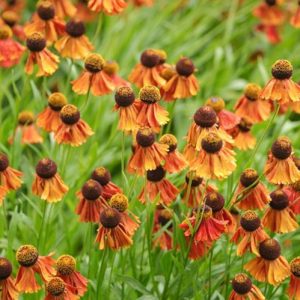
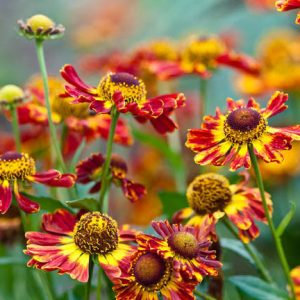
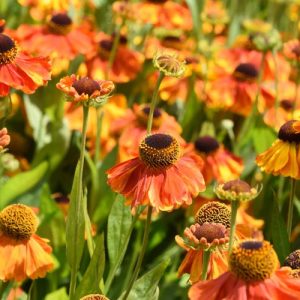
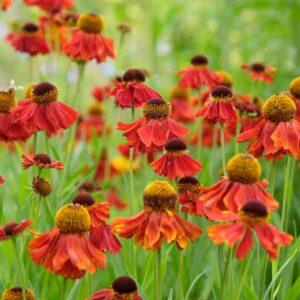
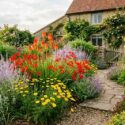
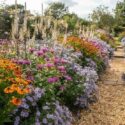
Warm drifts of Helenium in yellow, orange, and amber mingle with airy pink Cosmos and the upright blond plumes of Karl Foerster grass in this cheerful late-summer border. Informal yet structured, it is a beautiful meadow-inspired planting for sunny gardens where movement, color, and pollinator appeal all matter.
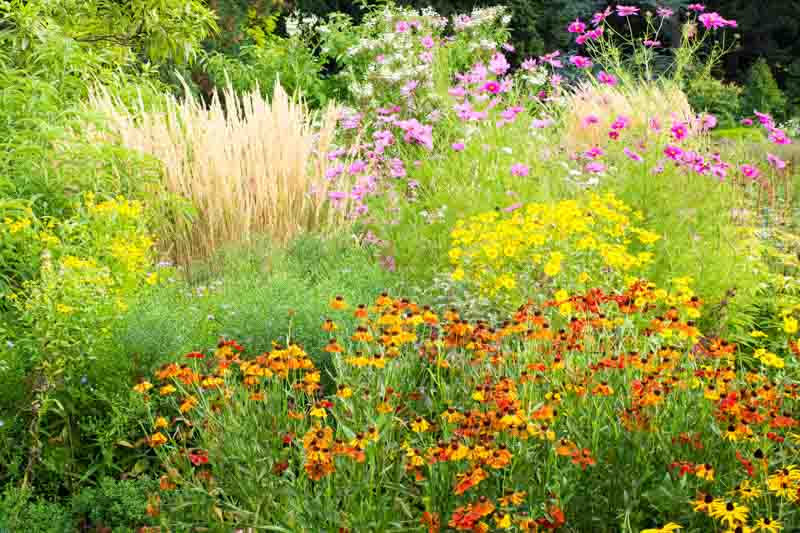


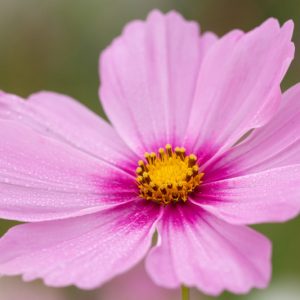
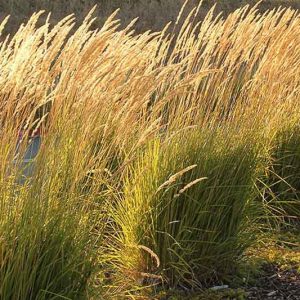
This lively late-summer border combines warm flower color, airy movement, and a relaxed naturalistic style. Orange and amber tones from Helenium autumnale and Helenium ‘Sahin’s Early Flowerer’ are woven through soft pink Cosmos bipinnatus, while the upright blond plumes of Calamagrostis × acutiflora ‘Karl Foerster’ give the planting structure and vertical rhythm.
The effect is abundant without feeling heavy. The Heleniums provide the strongest color and much of the lower and middle body of the border, Cosmos brings lightness and a more transparent layer, and ‘Karl Foerster’ rises above them with its narrow, architectural stems. Together they create a planting that feels bright, informal, and full of seasonal movement.
Main plants used: Helenium autumnale, Helenium ‘Sahin’s Early Flowerer’, Calamagrostis × acutiflora ‘Karl Foerster’, and Cosmos bipinnatus
Repeat the Heleniums in generous drifts, thread the Cosmos through them, and use ‘Karl Foerster’ at intervals so the border stays loose but still reads clearly.
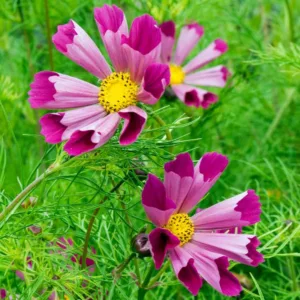
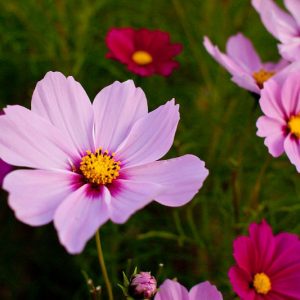
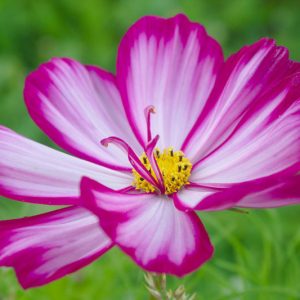
The planting succeeds because it balances density with transparency. The Heleniums form the colorful heart of the border, with daisy-like flowers in warm yellow, orange, and coppery tones. If they were used alone, the effect could feel solid and heavy, but the open habit of Cosmos bipinnatus breaks up the mass and lets light pass through the planting.
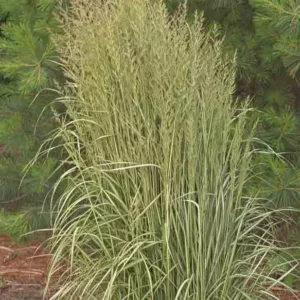
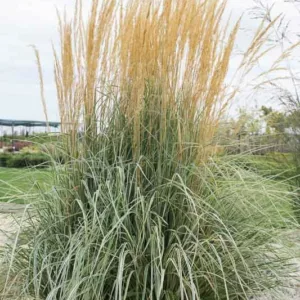
Calamagrostis ‘Karl Foerster’ plays a different role. Its narrow, upright growth and pale plumes add vertical punctuation and keep the border from becoming too loose or floppy. That strong line is especially useful beside the lighter, more informal Cosmos.
The color combination is also effective. Warm Helenium tones dominate, while pink Cosmos cools and softens the composition. The buff-colored grass plumes act almost like a neutral, helping the brighter flowers sit together comfortably.
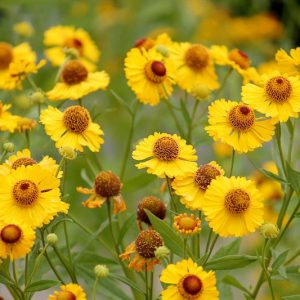
Helenium autumnale brings clear yellow late-season color and helps brighten the planting. Use it in noticeable groups through the middle and rear of the border.
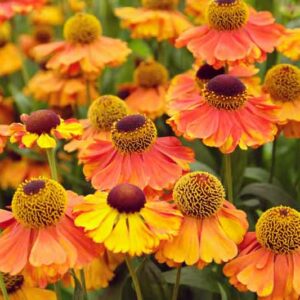
Helenium ‘Sahin’s Early Flowerer’ extends the Helenium display and introduces richer shades of orange, amber, and bronze. Repeat it in broad drifts so its warmer coloring is echoed across the planting.
Cosmos bipinnatus adds softness and a lighter, more transparent layer. Its pink flowers and airy stems help lift the composition and are best allowed to weave among the other plants rather than being confined to one block.
Calamagrostis × acutiflora ‘Karl Foerster’ provides the strongest vertical structure. Use it in repeated clumps toward the middle and back so its upright stems rise above the flowering layer without forming a wall.
Create a cheerful, meadow-like late-season border with warm Helenium drifts, airy pink flowers, and upright grass accents.
Let the Heleniums dominate, while the Cosmos and grasses keep the planting open and light.
Use a few broader Helenium drifts and smaller repeated groups of grass for a more natural look.
Place the Heleniums in generous drifts through the middle and rear, mixing the yellow and coppery-orange tones rather than separating them completely.
Thread Cosmos between and behind them so its airy stems and pink flowers appear at different depths.
Set ‘Karl Foerster’ in repeated groups toward the back and middle so its upright plumes rise through the planting and provide rhythm across the border.
The grasses begin contributing structure relatively early, and Cosmos starts flowering in summer with its airy pink blooms. As the season progresses, the Heleniums become increasingly important, with Helenium ‘Sahin’s Early Flowerer’ often starting sooner and Helenium autumnale carrying the display later.
By late summer, the border reaches its fullest expression, with warm Helenium drifts, pink Cosmos floating above and between them, and the vertical plumes of ‘Karl Foerster’ holding everything together.
This is not really a dry-garden combination. Although Cosmos can cope with leaner conditions, Heleniums perform best in reasonably fertile soil with consistent moisture, especially during summer.
It is also worth allowing the border to evolve a little from year to year. Cosmos can self-sow, and that slight unpredictability often improves the relaxed, meadow-like character of the planting rather than detracting from it.
| Hardiness |
4 - 8 |
|---|---|
| Climate Zones | 2, 2A, 2B, 3, 3A, 3B, 4, 5, 6, 7, 8, 9, 10, 11, 12, 13, 14, 15, 16, 17, 18, 19, 20, 21, 22, 23, 24 |
| Exposure | Full Sun |
| Season of Interest | Summer (Mid, Late), Fall |
| Maintenance | Average |
| Water Needs | Average |
| Soil Type | Chalk, Clay, Loam, Sand |
| Soil pH | Acid, Neutral, Alkaline |
| Soil Drainage | Moist but Well-Drained |
| Characteristics | Cut Flowers, Showy |
| Tolerances | Clay Soil |
| Attracts | Butterflies, Birds |
| Landscaping Ideas | Beds And Borders |
| Garden Styles | Butterfly Garden, Informal and Cottage, Pollinator Garden, Prairie and Meadow |

| Hardiness |
4 - 8 |
|---|---|
| Climate Zones | 2, 2A, 2B, 3, 3A, 3B, 4, 5, 6, 7, 8, 9, 10, 11, 12, 13, 14, 15, 16, 17, 18, 19, 20, 21, 22, 23, 24 |
| Exposure | Full Sun |
| Season of Interest | Summer (Mid, Late), Fall |
| Maintenance | Average |
| Water Needs | Average |
| Soil Type | Chalk, Clay, Loam, Sand |
| Soil pH | Acid, Neutral, Alkaline |
| Soil Drainage | Moist but Well-Drained |
| Characteristics | Cut Flowers, Showy |
| Tolerances | Clay Soil |
| Attracts | Butterflies, Birds |
| Landscaping Ideas | Beds And Borders |
| Garden Styles | Butterfly Garden, Informal and Cottage, Pollinator Garden, Prairie and Meadow |
Recreate this garden. Specify the percentages you would like to have of each plant and input the dimensions of your garden space.We'll give you a shopping list so you know how many plants you need.
| Plant | Quantity | |
|---|---|---|
| Helenium autumnale (Sneezeweed) | N/A | Buy Plants |
| Helenium 'Sahin's Early Flowerer' (Sneezeweed) | N/A | Buy Plants |
| Cosmos bipinnatus 'Gloria' | N/A | Buy Plants |
| Calamagrostis x acutiflora 'Karl Foerster' (Feather Reed Grass) | N/A | Buy Plants |
Create a membership account to save your garden designs and to view them on any device.
Becoming a contributing member of Gardenia is easy and can be done in just a few minutes. If you provide us with your name, email address and the payment of a modest $25 annual membership fee, you will become a full member, enabling you to design and save up to 25 of your garden design ideas.
Join now and start creating your dream garden!
Create a membership account to save your garden designs and to view them on any device.
Becoming a contributing member of Gardenia is easy and can be done in just a few minutes. If you provide us with your name, email address and the payment of a modest $25 annual membership fee, you will become a full member, enabling you to design and save up to 25 of your garden design ideas.
Join now and start creating your dream garden!