Regional Gardening, Hardiness Zones, UK Climate


Before buying a plant, check whether it is hardy enough for your garden. A plant that thrives in one part of the United Kingdom may struggle only a few miles away because winter temperatures, exposure, rainfall, wind, altitude, soil drainage, and local microclimates can vary significantly.
Hardiness ratings help answer one important question: how much winter cold can a plant tolerate? In the UK, the most useful system is the Royal Horticultural Society’s RHS H1a-H7 hardiness scale. Gardeners will also frequently encounter USDA Plant Hardiness Zones, particularly on international plant labels, websites, and seed catalogues.
The two systems can be compared, but they are not identical. Understanding both makes it much easier to judge whether a plant is likely to survive winter in your garden.
Plant hardiness systems classify plants according to the coldest temperatures they are likely to tolerate. They help distinguish a plant that can remain outdoors through a British winter from one that may need a sheltered wall, winter protection, an unheated greenhouse, or a heated indoor environment.
Hardiness is only part of the picture. A rating cannot tell you everything about whether a plant will succeed. Winter wet, wind, summer heat, soil drainage, snow cover, frost duration, altitude, and microclimate can all influence survival.
This is especially important in Britain, where a relatively mild maritime climate can still produce challenging combinations of damp soil, cold wind, and sudden frost.
Selecting plants suited to your local conditions is one of the most important steps toward gardening successfully. If you already know your hardiness rating or approximate zone, find plants suited to your growing conditions.
You can also explore garden ideas for the United Kingdom.
The map below provides a useful overview of winter hardiness across the United Kingdom. It should be treated as a guide rather than a guarantee: gardens near the coast, in large cities, on exposed hillsides, or in sheltered valleys may experience very different minimum temperatures from nearby areas.
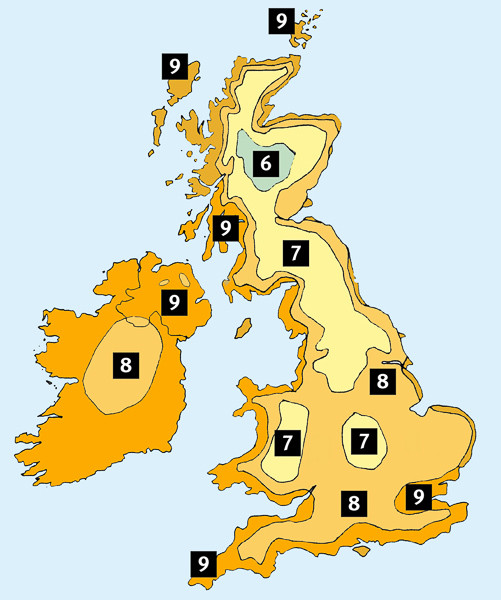
The UK’s temperate maritime climate generally brings milder winters and cooler summers than many continental locations at the same latitude. However, there is considerable regional variation.
Gardeners sometimes describe UK locations using USDA Zones because that system is widely used internationally. Many parts of the UK experience winter minimum temperatures broadly comparable with USDA Zones 7-9, with colder inland and upland areas and milder coastal locations outside that range.
However, USDA zones should not be treated as a perfect translation of British growing conditions.
The RHS hardiness system runs from H1a, for tropical plants that require warmth throughout the year, to H7, for plants capable of surviving extremely cold European winters.
RHS ratings indicate the lowest winter temperature a plant is likely to withstand under suitable growing conditions.
Below -20°C (-4°F)
Plants rated H7 can tolerate the coldest European climates and are suitable even for exposed upland areas of the UK, provided their other growing requirements are met.
-20 to -15°C (-4 to 5°F)
Hardy throughout the UK and much of northern Europe. Container-grown plants may still need extra protection because roots in pots are more exposed to freezing.
-15 to -10°C (5 to 14°F)
Hardy in most UK gardens, including severe winters, although exposed sites and colder northern or upland locations can still cause damage.
-10 to -5°C (14 to 23°F)
Suitable for much of the UK. Plants may suffer damage in particularly cold inland valleys, exposed locations, high altitudes, or harsh northern gardens.
-5 to 1°C (23 to 34°F)
May survive outdoors in mild coastal areas or sheltered microclimates but can be damaged by hard or early frosts. Winter protection may be necessary elsewhere.
1 to 5°C (34 to 41°F)
These plants tolerate cool conditions but should not be frozen. They generally require frost-free winter protection.
5 to 10°C (41 to 50°F)
Usually grown under glass or indoors in winter but can often spend the warmer months outdoors.
10 to 15°C (50 to 59°F)
Needs warm indoor or heated-glasshouse conditions for much of the year, although plants may be placed outdoors during sufficiently warm summer weather.
Above 15°C (59°F)
Tropical plants requiring consistently warm conditions and normally grown as houseplants or in heated glasshouses in the UK.
RHS and USDA ratings are useful to compare, but they are not exact equivalents. RHS ratings indicate the lowest winter temperature a plant is likely to withstand, while USDA zones classify locations according to their average annual extreme minimum winter temperature.
The USDA equivalents below are approximate comparisons published by the RHS and should be used as a guide rather than a direct conversion.
| RHS Rating | Temperature | Hardiness | Approx. USDA Zones |
|---|---|---|---|
| H7 | Below -20°C Below -4°F |
Very hardy | 6a-1 |
| H6 | -20 to -15°C -4 to 5°F |
Hardy – very cold winter | 6b-7a |
| H5 | -15 to -10°C 5 to 14°F |
Hardy – cold winter | 7b-8a |
| H4 | -10 to -5°C 14 to 23°F |
Hardy – average winter | 8b-9a |
| H3 | -5 to 1°C 23 to 34°F |
Half-hardy – mild winter | 9b-10a |
| H2 | 1 to 5°C 34 to 41°F |
Tender – cool or frost-free | 10b |
| H1c | 5 to 10°C 41 to 50°F |
Warm temperate | 11 |
| H1b | 10 to 15°C 50 to 59°F |
Subtropical | 12 |
| H1a | Above 15°C Above 59°F |
Tropical | 13 |
Find plants suited to your conditions, or browse garden ideas for inspiration.
A hardiness map describes a broad area, but plants experience the conditions in your individual garden. Small differences can make a surprisingly large difference to winter survival.
A plant’s ability to survive a cold winter does not tell you how well it will cope with summer heat, drought, humidity, or intense sun.
This is one reason the USDA and RHS systems should not be the only criteria used when selecting plants. A plant may be perfectly winter-hardy in your garden yet perform poorly because the soil is too wet, the summers are too cool, or the exposure is unsuitable.
Tender and half-hardy plants should generally be moved outdoors only after the main risk of frost has passed. The exact timing depends on location and year, so local weather conditions are more useful than a fixed calendar date.
Coastal and southern gardens may become frost-free considerably earlier than northern, inland, upland, or frost-pocket locations.
When moving plants from a greenhouse or indoors, harden them off gradually so they can adjust to stronger sunlight, cooler nights, and wind before being left outside permanently.
When deciding whether a plant is right for your garden, use this sequence rather than relying on a zone number alone:
| Hardiness |
6 - 9 |
|---|
Photo: 123rf
| Hardiness |
6 - 9 |
|---|
Create a membership account to save your garden designs and to view them on any device.
Becoming a contributing member of Gardenia is easy and can be done in just a few minutes. If you provide us with your name, email address and the payment of a modest $25 annual membership fee, you will become a full member, enabling you to design and save up to 25 of your garden design ideas.
Join now and start creating your dream garden!