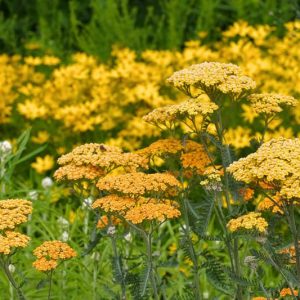
This full-sun border pairs blue fescue (Festuca glauca), a compact ornamental grass, with yarrow (Achillea millefolium), a hardy flowering perennial. Blue mounds provide year-round texture while yarrow blooms in summer, often repeating with deadheading. Together they form a drought-tolerant, pollinator-friendly fence-line planting.
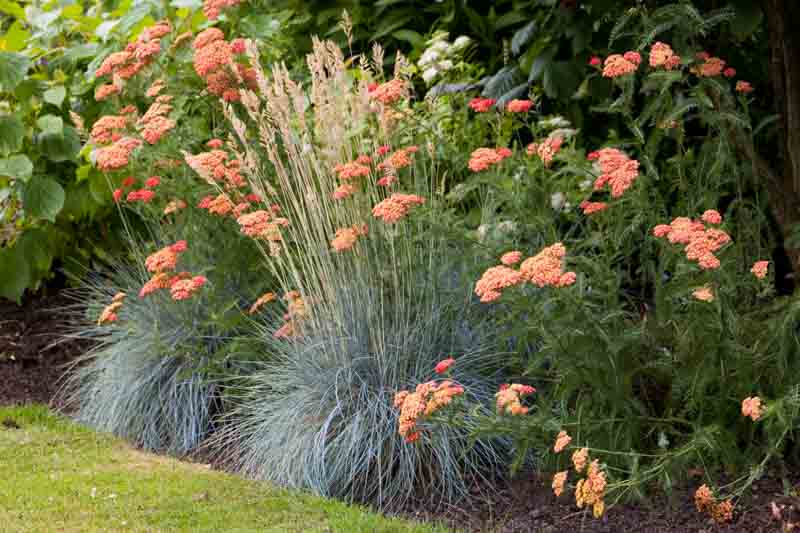
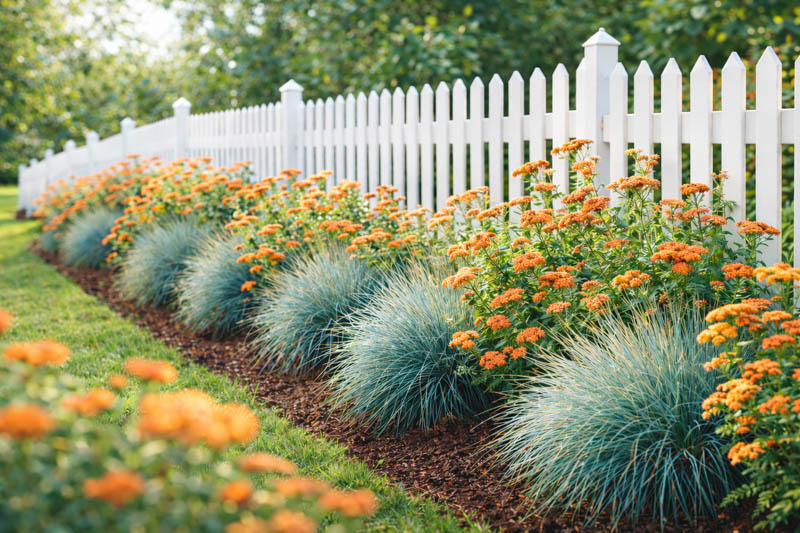


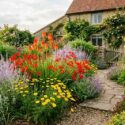
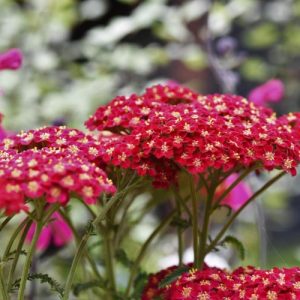
This simple border relies on two very different plants: compact blue-gray mounds of Festuca glauca and taller flat-topped flowers of orange-flowered Achillea. Against a white picket fence, the contrast is particularly clear. The grass creates a low, repeated foreground while the Yarrow rises above it with warm summer color.
Although the plant list is short, the border does not need to look rigid. Blue Fescue can be repeated in irregular groups along the front, with Yarrow planted in broader patches behind and between them. The result suits cottage gardens, gravel gardens, sunny front yards, and other relatively dry sites where good drainage is available.
Main plants used: Festuca glauca (Blue Fescue) and an orange-flowered Achillea selection
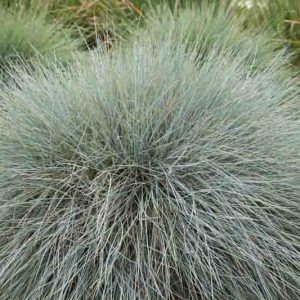
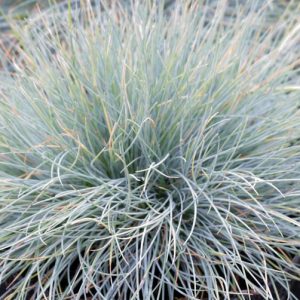
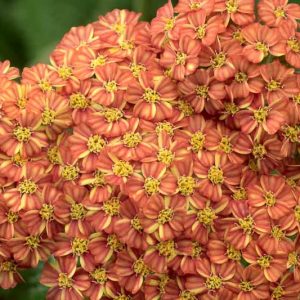
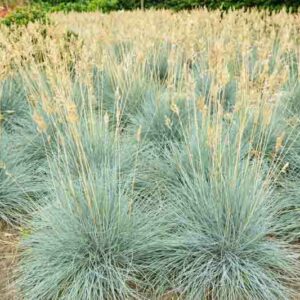
The strongest contrast is between foliage and flowers. Blue Fescue forms dense clumps of very fine, narrow leaves, while Yarrow carries broad clusters of many tiny flowers on taller stems. Even when the plants overlap, their shapes remain easy to distinguish.
The colors reinforce that difference. The cool blue-gray foliage makes orange flowers appear warmer, while the white fence provides a neutral background for both. There is no need to add numerous other flowering plants to make the scheme effective.
Repetition is useful here, but perfect spacing is not. Groups of three or five Fescues can be followed by a slightly larger or smaller group, with Yarrow drifting between and behind them. This produces a more relaxed border than alternating individual plants at fixed intervals.
Festuca glauca, or Blue Fescue, is a small clump-forming grass valued for its fine blue to blue-gray foliage. It develops its best color in full sun and prefers well-drained soil that is not overly fertile. Established plants tolerate drought, but prolonged wet conditions can cause decline.
Its foliage may remain attractive for much of the year in suitable climates, but it should not be described as universally evergreen. Blue Fescue can look tired after harsh winters and may also struggle in regions with hot, humid summers. Remove dead foliage in spring and divide or replace aging clumps when their centers become sparse.
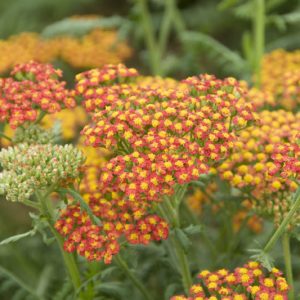
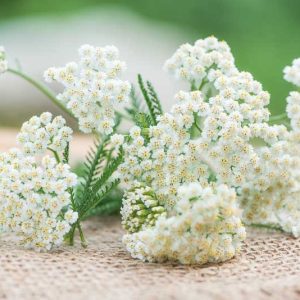
Orange-flowered Achillea provides the taller summer layer. Yarrow performs well in full sun and relatively lean, well-drained soil. Rich soil or excessive fertilizer can produce weak stems that flop. Deadheading faded flower clusters can tidy the planting and may encourage additional flowering.
Yarrow can also spread through rhizomes and, depending on the selection, by seed. Where space is limited, remove unwanted shoots before they move into neighboring plants.
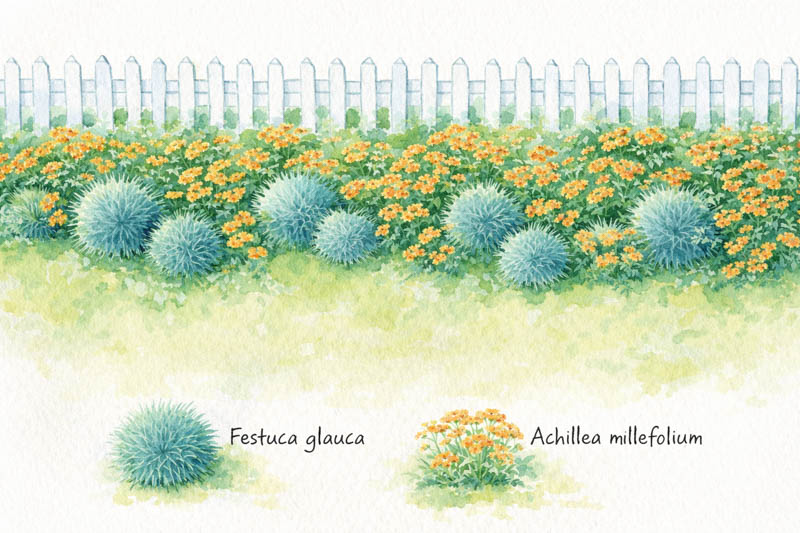
Create a sunny, relatively low-water border with repeated blue foliage at the front and broader groups of warm-colored Yarrow behind.
Treat these percentages as a visual balance rather than equal plant numbers or exact ground coverage.
Plant Blue Fescue primarily toward the front in repeated groups rather than as a perfectly continuous line. Leave enough space between mature clumps for their rounded forms to remain visible.
Place Yarrow behind and between the grasses in broader, irregular drifts. Allow some groups to come forward while others remain farther back so the border has depth.
Neither plant enjoys heavy, persistently wet soil. If the site remains waterlogged during winter, improve drainage or choose plants better adapted to those conditions rather than simply adding gravel to the planting hole.
Yarrow can spread beyond its original position, while individual Blue Fescue clumps may become less attractive with age. Occasional thinning of the Yarrow and renewal of older grasses will preserve the distinction between the two plants.
Climate also matters. Blue Fescue generally performs best where summers are not excessively hot and humid. In climates where it becomes short-lived, the same design can be recreated with a locally suitable compact, blue-leaved grass.
| Hardiness |
4 - 9 |
|---|---|
| Heat Zones |
1 - 8 |
| Climate Zones | 1, 2, 3, 4, 5, 6, 7, 8, 9, 10, 11, 12, 13, 14, 15, 16, 17, 18, 19, 20, 21, 22, 23, 24 |
| Exposure | Full Sun |
| Season of Interest | Summer (Early, Mid, Late) |
| Maintenance | Low |
| Water Needs | Low |
| Soil Type | Chalk, Loam, Sand |
| Soil pH | Acid, Alkaline, Neutral |
| Soil Drainage | Moist but Well-Drained, Well-Drained |
| Characteristics | Dried Arrangements, Cut Flowers, Fragrant, Showy |
| Tolerances | Drought, Deer, Dry Soil |
| Attracts | Butterflies |
| Landscaping Ideas | Beds And Borders |
| Garden Styles | Butterfly Garden, Informal and Cottage, Mediterranean Garden, Pollinator Garden, Traditional Garden |
Credit: GAP Photos/Jonathan Buckley - Design: John Massey, Ashwood Nurseries
| Hardiness |
4 - 9 |
|---|---|
| Heat Zones |
1 - 8 |
| Climate Zones | 1, 2, 3, 4, 5, 6, 7, 8, 9, 10, 11, 12, 13, 14, 15, 16, 17, 18, 19, 20, 21, 22, 23, 24 |
| Exposure | Full Sun |
| Season of Interest | Summer (Early, Mid, Late) |
| Maintenance | Low |
| Water Needs | Low |
| Soil Type | Chalk, Loam, Sand |
| Soil pH | Acid, Alkaline, Neutral |
| Soil Drainage | Moist but Well-Drained, Well-Drained |
| Characteristics | Dried Arrangements, Cut Flowers, Fragrant, Showy |
| Tolerances | Drought, Deer, Dry Soil |
| Attracts | Butterflies |
| Landscaping Ideas | Beds And Borders |
| Garden Styles | Butterfly Garden, Informal and Cottage, Mediterranean Garden, Pollinator Garden, Traditional Garden |
Recreate this garden. Specify the percentages you would like to have of each plant and input the dimensions of your garden space.We'll give you a shopping list so you know how many plants you need.
| Plant | Quantity | |
|---|---|---|
| Achillea 'Fanal' or 'The Beacon' (Yarrow) | N/A | Buy Plants |
| Festuca glauca 'Elijah Blue' (Blue Fescue) | N/A | Buy Plants |
Create a membership account to save your garden designs and to view them on any device.
Becoming a contributing member of Gardenia is easy and can be done in just a few minutes. If you provide us with your name, email address and the payment of a modest $25 annual membership fee, you will become a full member, enabling you to design and save up to 25 of your garden design ideas.
Join now and start creating your dream garden!
Create a membership account to save your garden designs and to view them on any device.
Becoming a contributing member of Gardenia is easy and can be done in just a few minutes. If you provide us with your name, email address and the payment of a modest $25 annual membership fee, you will become a full member, enabling you to design and save up to 25 of your garden design ideas.
Join now and start creating your dream garden!