Red Abyssinian Banana, Maurelii Red Banana, Red Banana, Purple Abyssinian Banana, Ethiopian Black Banana, Wild Banana, Ensete 'Maurelii', Ensete ventricosum 'Rubrum', Musa maurelii, Ensete Maurelli, Bananier Rouge.

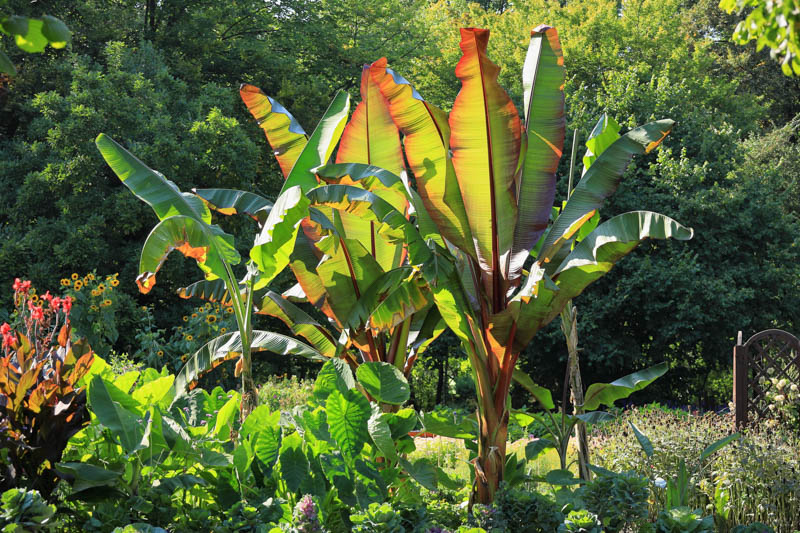


Summary: A dramatic, fast-growing “banana” with huge paddle leaves flushed burgundy, bronze, and ruby. Grown for foliage, not fruit, ‘Maurelii’ turns patios and borders into instant resorts—especially in cooler regions where true bananas struggle.
Best For: Statement containers, poolside drama, tropical borders, seasonal show in temperate climates.
Growing Note: Solitary (doesn’t clump like Musa). Monocarpic pseudostem; flowering is rare outside frost-free zones. Treat as a tender perennial you can lift and store over winter.
| Botanical Name | Ensete ventricosum ‘Maurelii’ |
|---|---|
| Family | Musaceae |
| Common Names | Red Abyssinian Banana, Red Ensete, False Banana ‘Maurelii’ |
| Plant Type & Habit | Tender, herbaceous perennial with a thick pseudostem; solitary (non-suckering) habit |
| Hardiness (USDA) | Outdoors year-round in 9b–11 (9a in warm microclimates). Leaves scorch near 32°F (0°C); pseudostem injury below ~28–30°F (−2 to −1°C); in-ground plants often die around ~25–27°F (−4 to −3°C). Not rhizome-hardy like Musa basjoo. |
| Size | 8–10 ft (2.4–3 m) tall in seasonal temperate culture; to 15 ft (4.5 m+) in frost-free gardens; 6–8 ft (1.8–2.4 m) wide |
| Sun & Exposure | Full sun to bright part sun; in hot-dry regions provide light PM shade. More sun deepens red if moisture is steady. |
| Soil | Rich, moisture-retentive but well-drained loam; pH ~6.0–7.5; hates waterlogging |
| Bloom | Large, rarely seen inflorescence in cool climates; after flowering, that stem dies (monocarpic) |
| Pruning | Remove tattered leaves; trim frost damage; no pup thinning (it’s solitary) |
| Primary Uses | Foliage spectacle, containers, tropical borders, poolside/backdrop planting |
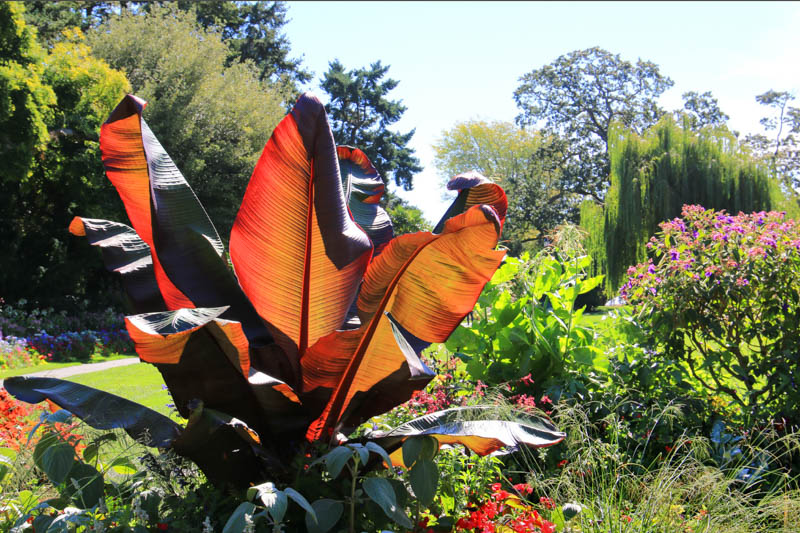
Want that “is this a resort?” feeling from May to October? Plant a Red Banana. Ensete ventricosum ‘Maurelii’ unfurls massive, glossy paddles lined with burgundy veins and bronze blush—like stained glass against the sun. It doesn’t fruit for the kitchen, but it delivers instant tropical architecture in containers and beds.
This red banana is the recipient of the prestigious Award of Garden Merit of the Royal Horticultural Society.
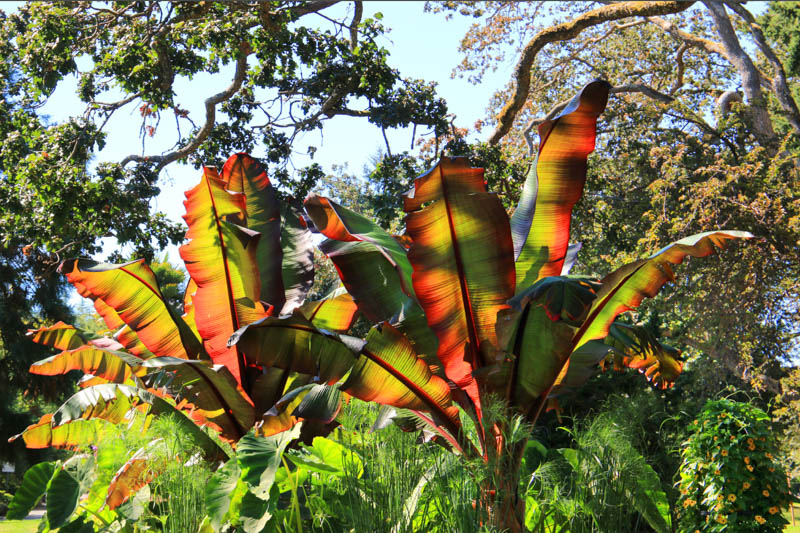
‘Maurelii’ is a selected, red-leaf form of the Abyssinian banana, Ensete ventricosum. Unlike many true bananas (Musa), Ensete is solitary: it doesn’t produce a clump of pups. The “trunk” is a pseudostem built from tightly layered leaf bases. Leaves are broad, architectural, and richly colored—green suffused with burgundy to dark ruby, especially on new growth and in strong light with steady moisture and nutrition.
The species Ensete ventricosum is native to the highlands of East Africa (especially Ethiopia). There, related green forms are cultivated as a staple crop (“enset” or “false banana”). The ornamental red-leaf ‘Maurelii’ is grown worldwide for foliage drama.
Give it warmth and a full belly and it rockets upward: 8–10 ft in a single warm season isn’t unusual; bigger in frost-free gardens (to 15 ft+). Expect a statuesque, vase-like silhouette about 6–8 ft wide with a thick, tapering pseudostem and leaves that can exceed 6 ft (1.8 m) long.
Lightning fast in summer. With heat, consistent moisture, and a steady feeding program, you’ll see leaf after enormous leaf unfurl every 7–10 days. In cool spells it idles, then surges again when nights warm up.
Each pseudostem is monocarpic—it flowers once near maturity, then dies. In temperate gardens, flowering is uncommon because frost ends the season. In frost-free climates a mature plant may produce a huge, dramatic inflorescence followed by large, inedible, seedy fruits. Most gardeners grow it for foliage and replace or restart plants after several seasons.
Color intensity varies with light, feeding, and temperature. Full sun (with ample water) brings out deeper burgundy and bronze tones; part sun yields a greener cast with red midribs. Cool nights can intensify pigment. Old leaves naturally shred in wind—an aesthetic many tropical gardeners embrace.
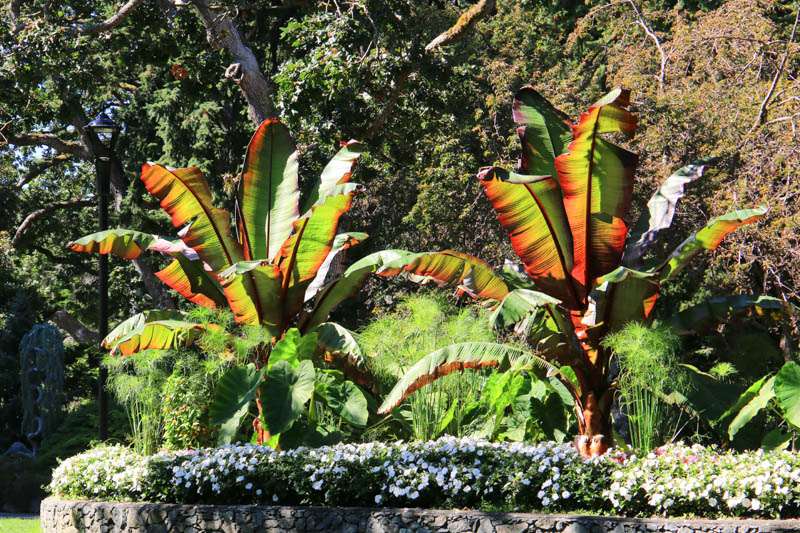
‘Maurelii’ is a container icon. Use modern planters or rustic half-barrels—either way, it steals the scene.
| Task | Notes |
|---|---|
| Pick a sunny, wind-sheltered spot with rich, draining soil. | Wind shreds leaves; fences/hedges help. Full sun = deeper burgundy if moisture is steady. |
| Amend generously with compost before planting. | Aim for moisture retention without waterlogging. |
| Plant at the same depth; firm and water deeply. | No crown burying. Remove air pockets with a thorough soak. |
| Mulch wide; start steady, light feeding. | 3–4 in (7–10 cm) organic mulch; fertilize little-and-often in warmth. |
| Stake if windy; rotate containers monthly. | Keeps leaves intact and color even. |
| Plan your winter move early. | Have space ready for indoor growth or dormant storage. |
Because ‘Maurelii’ is a selected form, seeds don’t come true. Most plants are produced via tissue culture. Home growers can:
In cool-temperate climates, plant out after danger of frost in spring. Peak growth roars through summer. In early fall, decide: keep it leafy in a bright room, or cut and store dormant. Reawaken in spring with warmth, repot as needed, and get ready for another summer of spectacle.
No. ‘Maurelii’ is an ornamental Ensete, grown for foliage. Edible red bananas are cultivars of Musa.
Shelter from wind with fences or hedges. Stake young plants and keep them well-watered so leaves stay supple.
Generally no—Ensete is solitary. Any offsets are uncommon and can be separated only when well-rooted.
Yes. After cutting leaves back, store the bare-root pseudostem and corm in a cool (40–50°F / 4–10°C), dark place. Keep dry and replant in spring.
Start with at least 20–30 gallons and size up as it grows. Large containers stabilize moisture and prevent tipping.
Usually light, nutrition, or temperature. Give more sun (without drought), steady feeding, and warm nights for stronger burgundy tones.
Rarely in cool-temperate zones (season too short). In frost-free gardens, mature plants may flower; that stem then dies.
No standard division. It lacks a multi-stem “mat.” Propagation is typically via tissue culture or advanced corm techniques.
In warm months, apply a slow-release fertilizer plus light liquid feeds every few weeks. Pause in winter.
Large leaves naturally age and may shred. A quick tidy every few weeks keeps it show-ready.
Updated: September 2025 • Reviewed by Gardenia Editors
| Hardiness |
9 - 11 |
|---|---|
| Plant Type | Perennials |
| Plant Family | Musaceae |
| Common names | Banana |
| Exposure | Full Sun |
| Season of Interest | Spring (Early, Mid, Late), Summer (Early, Mid, Late), Fall, Winter |
| Height | 8' - 10' (240cm - 3m) |
| Spread | 6' - 8' (180cm - 240cm) |
| Spacing | 72" - 96" (180cm - 240cm) |
| Maintenance | Average |
| Water Needs | Average |
| Soil Type | Loam, Sand |
| Soil pH | Acid, Alkaline, Neutral |
| Soil Drainage | Well-Drained |
| Characteristics | Plant of Merit, Showy, Evergreen |
| Garden Uses | Beds And Borders, Patio And Containers, Wall-Side Borders |
| Garden Styles | City and Courtyard, Mediterranean Garden |
| Toxic to Humans | No known toxicity |
| Toxic to Cats | No known toxicity |
| Toxic to Dogs | No known toxicity |
| Toxic to Horses | No known toxicity |


| Hardiness |
9 - 11 |
|---|---|
| Plant Type | Perennials |
| Plant Family | Musaceae |
| Common names | Banana |
| Exposure | Full Sun |
| Season of Interest | Spring (Early, Mid, Late), Summer (Early, Mid, Late), Fall, Winter |
| Height | 8' - 10' (240cm - 3m) |
| Spread | 6' - 8' (180cm - 240cm) |
| Spacing | 72" - 96" (180cm - 240cm) |
| Maintenance | Average |
| Water Needs | Average |
| Soil Type | Loam, Sand |
| Soil pH | Acid, Alkaline, Neutral |
| Soil Drainage | Well-Drained |
| Characteristics | Plant of Merit, Showy, Evergreen |
| Garden Uses | Beds And Borders, Patio And Containers, Wall-Side Borders |
| Garden Styles | City and Courtyard, Mediterranean Garden |
| Toxic to Humans | No known toxicity |
| Toxic to Cats | No known toxicity |
| Toxic to Dogs | No known toxicity |
| Toxic to Horses | No known toxicity |
How many Ensete ventricosum ‘Maurelii’ (Red Banana) do I need for my garden?
| Plant | Quantity | |
|---|---|---|
| Ensete ventricosum ‘Maurelii’ (Red Banana) | N/A | Buy Plants |
Create a membership account to save your garden designs and to view them on any device.
Becoming a contributing member of Gardenia is easy and can be done in just a few minutes. If you provide us with your name, email address and the payment of a modest $25 annual membership fee, you will become a full member, enabling you to design and save up to 25 of your garden design ideas.
Join now and start creating your dream garden!
Create a membership account to save your garden designs and to view them on any device.
Becoming a contributing member of Gardenia is easy and can be done in just a few minutes. If you provide us with your name, email address and the payment of a modest $25 annual membership fee, you will become a full member, enabling you to design and save up to 25 of your garden design ideas.
Join now and start creating your dream garden!