Umbrella Tree, Dwarf Schefflera, Dwarf Umbrella Tree, Hawaiian Umbrella Tree, Octopus Tree, Parasol Plant, Umbrella Plant, Heptapleurum arboricola

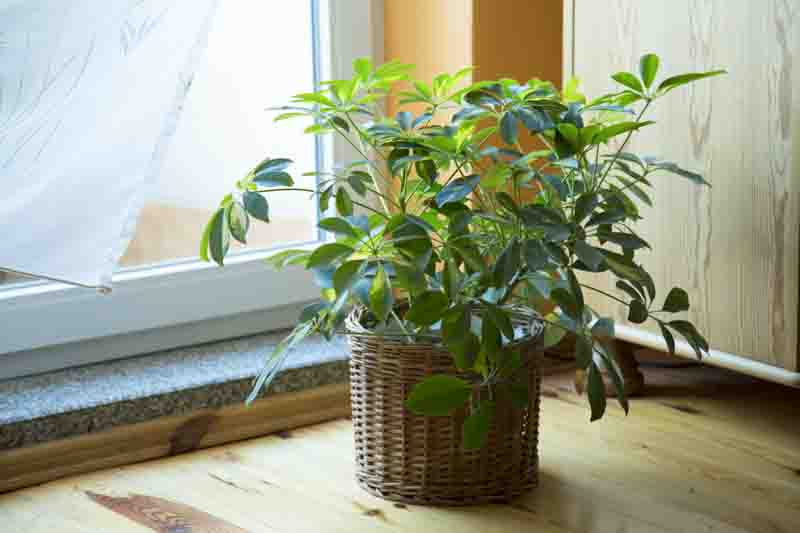
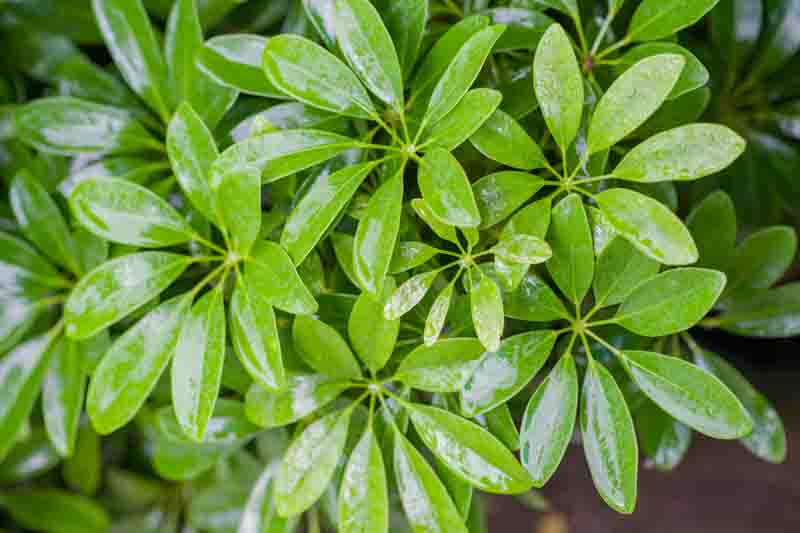
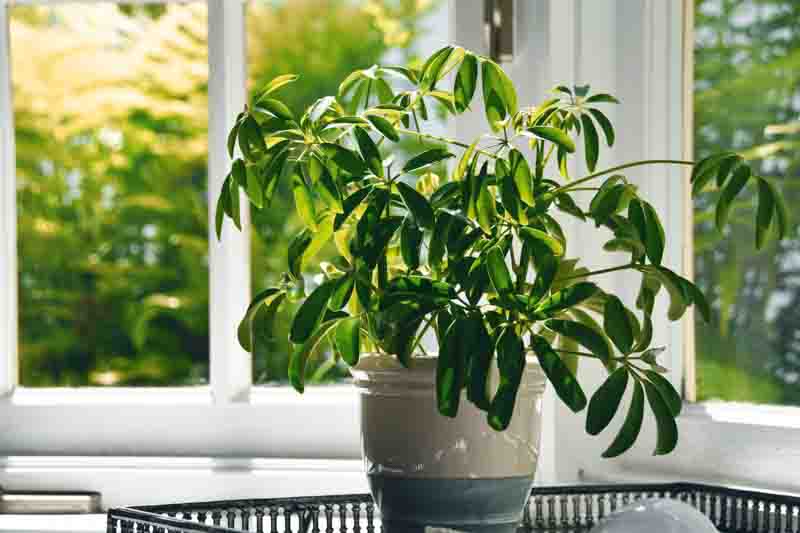


A healthy Schefflera arboricola (Dwarf Umbrella Tree) has glossy leaves, a full, rounded shape, and an easygoing presence that suits almost any room. But give it too little light, or keep its roots constantly wet, and those handsome leaves begin to yellow and fall. Fortunately, most Schefflera problems are easy to correct once you know what to look for.
Popular for its umbrella-shaped foliage and green or golden-variegated leaves, this tropical evergreen makes a handsome indoor shrub. With good light, sensible watering, and occasional pruning, it can remain attractive for many years.
Summary: Tropical evergreen shrub valued for glossy, palmately compound leaves and a naturally bushy habit.
Use: Ideal for indoor containers, bright offices, tropical patios, and frost-free hedges.
Highlight: Easy to shape through pruning; available in green and variegated selections.
Safety: Toxic to cats and dogs if chewed or swallowed.
| Botanical Name | Schefflera arboricola (Hayata) Merr. |
|---|---|
| Accepted Name | Heptapleurum arboricola Hayata |
| Family | Araliaceae |
| Common Names | Dwarf Umbrella Tree, Dwarf Schefflera, Hawaiian Umbrella Tree |
| Plant Type and Habit | Evergreen tropical shrub; bushy, upright, sometimes tree-like |
| Hardiness | USDA Zones 9-12 outdoors; Zone 9b plants require sheltered, frost-protected conditions. |
| Size | Indoors usually 3-6 ft. tall (90-180 cm); outdoors 10-25 ft. (3-7.5 m), when grown in tropical areas |
| Exposure | Bright indirect light indoors; partial shade outdoors |
| Soil | Well-drained, airy potting mix; well-drained outdoor soil |
| Foliage | Glossy green or cream-and-gold variegated leaflets |
| Flowers | Small reddish flowers on mature outdoor plants; rarely blooms indoors |
Native to Taiwan and Hainan, China, Dwarf Umbrella Tree belongs to the Araliaceae family. Botanically, its accepted name is now Heptapleurum arboricola, although Schefflera arboricola remains the name most gardeners recognize.
Young plants form dense clusters of leafy stems that become woody with age. Indoors, they commonly reach 3-6 ft. tall, while outdoor specimens in warm climates can become substantial shrubs. Regular pruning keeps container plants compact.
Each leaf consists of several oval leaflets radiating from a central point, giving the plant its familiar umbrella appearance. Most varieties have deep green foliage, although popular selections feature cream, yellow, or gold markings.
Mature outdoor plants may produce clusters of tiny reddish flowers, followed by small orange fruits that eventually turn black. Flowering indoors is uncommon, and this plant is grown primarily for its foliage.
Dwarf Umbrella Tree can grow outdoors in USDA Zones 9-12, with Zone 9b suitable only in protected locations. Frost can damage the foliage and stems, while prolonged freezing temperatures may kill the plant. Indoors, it remains evergreen throughout the year.
Dwarf Umbrella Tree has received the prestigious Award of Garden Merit from the Royal Horticultural Society.
Outdoor flowers may attract insects, and fruits can occasionally be visited by birds. Indoor plants rarely flower. For wildlife gardens, locally native plants generally offer more appropriate habitat value.
Reliable browsing-resistance data are limited. Do not assume outdoor plants are protected from deer or rabbits.
Established landscape plants tolerate some dry conditions, but houseplants need more consistent attention. Allow the potting mix to partially dry, without repeatedly letting the entire root ball become parched.
Schefflera contains irritating calcium oxalate crystals. Chewing the foliage may cause mouth irritation, excessive drooling, vomiting, or difficulty swallowing in cats and dogs. Keep plants out of reach of pets and children. Seek veterinary advice if an animal eats the plant.
Dwarf Schefflera has naturalized in some warm regions outside its native range. UF/IFAS does not currently classify it as a problem species in Florida, although this does not rule out local concerns elsewhere. Check regional guidance before planting near natural habitats.
Variegated Schefflera generally needs brighter indirect light to maintain strong leaf coloration. Green varieties tolerate moderate light better. If stems become elongated and new leaves lose their distinctive patterns, improve the light before increasing fertilizer.
These two umbrella trees are frequently confused. Schefflera arboricola has smaller leaflets and a bushier growth habit, making it more suitable for most homes. Schefflera actinophylla (Queensland Umbrella Tree) has larger leaves, can become a substantial tree, and is invasive in parts of Florida.
A position near an east-facing window is often ideal. Bright south- or west-facing windows also work, provided plants are protected from sudden exposure to intense sun. Too little light causes leggy stems and leaf loss; strong direct sunlight can scorch foliage.
Use a quality houseplant mix containing ingredients such as perlite or fine bark for aeration. Water thoroughly when the upper soil feels dry, allowing excess water to drain away. In large containers, check moisture several inches below the surface before watering.
Temperatures around 60-80°F (16-27°C) suit most plants. Normal household humidity is usually sufficient, but extremely dry air can favor spider mites. Avoid cold drafts, heating vents, and sudden temperature changes.
A plant in a bright, warm room dries faster than one in a cool, dim room. Check the soil before watering, and never leave the pot sitting in collected water. Yellow leaves alone do not mean the plant needs another drink.
Choose a container with drainage holes, only slightly larger than the root ball. Repot in spring when roots become crowded or the potting mix deteriorates. Oversized pots can remain wet long enough to encourage root problems.
If your Schefflera is growing tall and bare, shorten a healthy stem just above a leaf node in spring or early summer. New shoots may develop below the cut, encouraging a bushier shape. Prune several stems at different heights for a natural outline, rather than cutting everything to the same level.
Not every stem will branch equally, and pruning cannot compensate for poor light. Give the plant adequate brightness to maintain its fuller growth. Feed lightly during spring and summer.
Take stem cuttings with several nodes during active growth. Remove lower leaves and insert the cuttings into moist, well-drained propagation mix. Provide warmth, humidity, and bright indirect light until roots develop.
Leaf drop is one of the most common Schefflera complaints, but the color and condition of the leaves often help identify the cause.
| What You See | Likely Cause | Check First |
|---|---|---|
| Yellow leaves, wet soil | Overwatering or root stress | Drainage holes and root condition |
| Dry, curled leaves | Underwatering or heat | Moisture deeper in the pot |
| Sudden green leaf drop | Environmental shock | Recent moves, drafts, temperature |
| Long stems, sparse leaves | Insufficient light | Distance from the window |
| Pale, scorched patches | Excessive direct sun | Afternoon sunlight |
| Sticky leaves | Scale or mealybugs | Stems and leaf undersides |
Spider mites may also cause pale stippling and fine webbing. Isolate infested plants, clean the foliage, and use appropriately labeled treatments if necessary.
A Schefflera can drop leaves because its roots are too wet, too dry, or suddenly exposed to cold. Before changing your routine, examine the soil, check the roots if necessary, and consider what changed during the previous two weeks. Treat the cause, not just the fallen leaves.
Schefflera makes an excellent upright focal point in a bright indoor foliage display. Choose companions that enjoy similar temperatures and indirect light, but grow them in separate containers so watering can be adjusted individually.
Use Schefflera for height, Golden Pothos for trailing foliage, and Baby Rubber Plant at the front. Their contrasting leaf shapes create interest without flowers. Keep each plant in its own pot and allow space for its mature growth.
Water when the upper 1-2 inches of potting mix feel dry, checking deeper in larger containers. Water thoroughly, allow excess to drain, and adjust frequency to light, temperature, and season.
Leaf drop may result from overwatering, underwatering, cold drafts, sudden environmental changes, or inadequate light. Check soil moisture and recent changes before adjusting care.
Prune leggy stems just above healthy leaf nodes during active growth. New shoots may develop below the cut. Provide bright indirect light to support fuller growth.
Yes. Schefflera contains irritating calcium oxalate crystals that can cause oral irritation, drooling, vomiting, and difficulty swallowing if chewed. Keep it away from pets.
Yes. Heptapleurum arboricola is the accepted botanical name according to Kew. Schefflera arboricola remains widely used by gardeners and nurseries.
Royal Botanic Gardens, Kew – Heptapleurum arboricola, Taxonomy and Native Distribution.
ASPCA Animal Poison Control – Schefflera Toxicity.
University of Florida IFAS Extension – The Right Schefflera.
University of Florida IFAS – Dwarf Schefflera Assessment.
Updated: October 2026
| Hardiness |
9 - 12 |
|---|---|
| Plant Type | Houseplants, Shrubs |
| Plant Family | Araliaceae |
| Exposure | Partial Sun |
| Season of Interest | Spring (Early, Mid, Late), Summer (Early, Mid, Late), Fall, Winter |
| Height | 10' - 25' (3m - 7.6m) |
| Spread | 4' - 8' (120cm - 240cm) |
| Spacing | 48" - 96" (120cm - 240cm) |
| Maintenance | Low |
| Water Needs | Average |
| Soil Type | Clay, Loam, Sand |
| Soil pH | Acid, Neutral, Alkaline |
| Soil Drainage | Moist but Well-Drained |
| Characteristics | Showy, Plant of Merit |
| Tolerances | Drought, Salt, Clay Soil |
| Garden Uses | Beds And Borders, Hedges And Screens, Patio And Containers |
| Garden Styles | Informal and Cottage, Woodland Garden |
| Toxic to Humans | Low severity |
| Toxic to Cats | Toxic |
| Toxic to Dogs | Toxic |
| Toxic to Horses | No known toxicity |


| Hardiness |
9 - 12 |
|---|---|
| Plant Type | Houseplants, Shrubs |
| Plant Family | Araliaceae |
| Exposure | Partial Sun |
| Season of Interest | Spring (Early, Mid, Late), Summer (Early, Mid, Late), Fall, Winter |
| Height | 10' - 25' (3m - 7.6m) |
| Spread | 4' - 8' (120cm - 240cm) |
| Spacing | 48" - 96" (120cm - 240cm) |
| Maintenance | Low |
| Water Needs | Average |
| Soil Type | Clay, Loam, Sand |
| Soil pH | Acid, Neutral, Alkaline |
| Soil Drainage | Moist but Well-Drained |
| Characteristics | Showy, Plant of Merit |
| Tolerances | Drought, Salt, Clay Soil |
| Garden Uses | Beds And Borders, Hedges And Screens, Patio And Containers |
| Garden Styles | Informal and Cottage, Woodland Garden |
| Toxic to Humans | Low severity |
| Toxic to Cats | Toxic |
| Toxic to Dogs | Toxic |
| Toxic to Horses | No known toxicity |
How many Schefflera arboricola (Dwarf Umbrella Tree) do I need for my garden?
| Plant | Quantity | |
|---|---|---|
| Schefflera arboricola (Dwarf Umbrella Tree) | N/A | Buy Plants |
Create a membership account to save your garden designs and to view them on any device.
Becoming a contributing member of Gardenia is easy and can be done in just a few minutes. If you provide us with your name, email address and the payment of a modest $25 annual membership fee, you will become a full member, enabling you to design and save up to 25 of your garden design ideas.
Join now and start creating your dream garden!