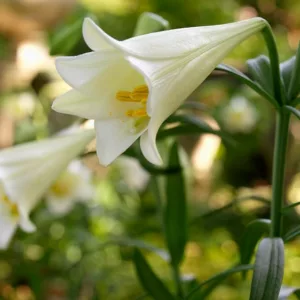
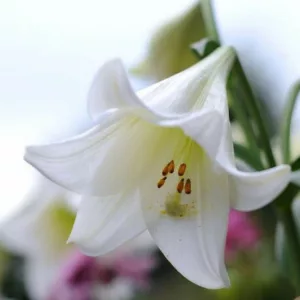
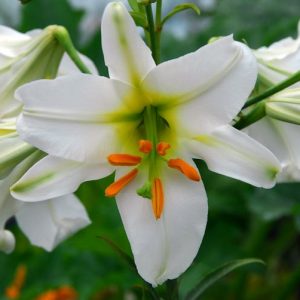
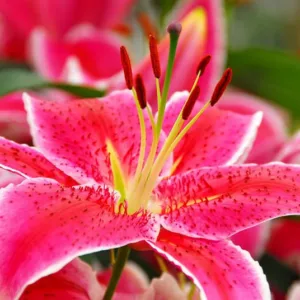
Tall, fragrant, and spectacular in midsummer, Trumpet lilies bring architectural height and enormous waxy flowers to borders and cutting gardens. Discover the best varieties, flower forms, planting conditions, soil, bloom time, care, containers, companions, and fragrance - plus how to choose the right height and flower direction for your garden.
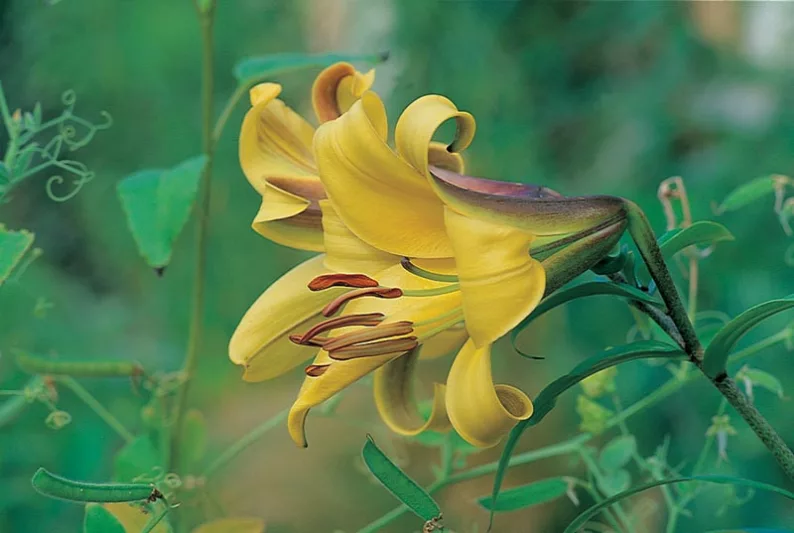


Few lilies command a summer border like Trumpet lilies. Tall stems rise above surrounding perennials and carry large, waxy flowers whose powerful fragrance can drift across the garden, especially on warm summer evenings.
They occupy an important place in the lily season. Asiatic lilies and Martagon lilies generally begin the display earlier, while Trumpet and Aurelian lilies create a strong midsummer wave. Later Aurelian forms can extend the show toward late summer, overlapping with Oriental lilies and Orienpet lilies.
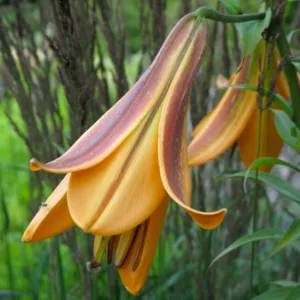
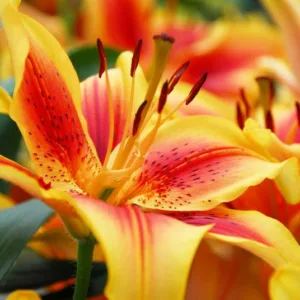
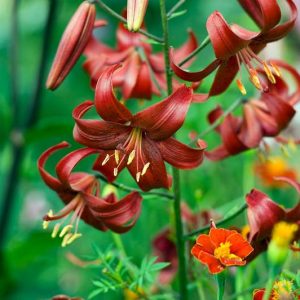
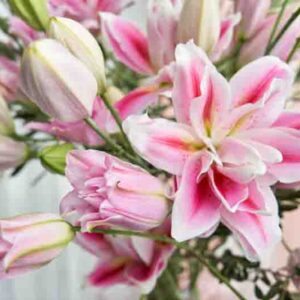
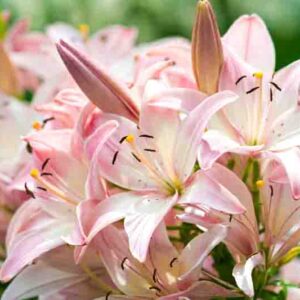
Despite the name, not every flower in this group is a narrow trumpet. The horticultural Trumpet and Aurelian Hybrid Division includes flowers that may be trumpet-shaped, widely flaring, bowl-shaped, star-like, outward-facing, upward-facing, or pendant. Aurelian breeding involving Lilium henryi helped broaden the range of flower forms beyond the classic trumpet.
What usually unites the group is presence. Trumpet and Aurelian lilies tend to be tall, architectural plants with substantial flowers, noticeable fragrance, and enough vertical scale to become focal points. They are especially effective toward the middle or back of perennial borders, in cutting gardens, beside patios, and wherever a summer planting needs height.
Gardenia’s shortcut: choose Trumpet and Aurelian lilies when you want fragrance, height, and architectural summer flowers – then choose the cultivar for flower direction, color, mature scale, hardiness, and garden role.
| Feature | Trumpet and Aurelian Lily Profile |
|---|---|
| Botanical group | Lilium Trumpet and Aurelian Hybrids – Horticultural Division VI |
| Plant type | Bulbous perennial |
| Bloom season | Primarily midsummer, with later Aurelian forms extending the display into late summer |
| Height | Often about 4-6 ft. (120-180 cm), although cultivar height varies |
| Flowers | Large; trumpet-shaped, flaring, bowl-shaped, star-like, or recurved depending on breeding and cultivar |
| Flower direction | Outward-facing, downward-facing, or upward-facing depending on cultivar |
| Fragrance | Usually fragrant, often strongly or intensely scented |
| Colors | White, cream, yellow, gold, apricot, orange, pink, plum, and combinations with contrasting throats or outer tepals |
| Light | Full sun to partial shade; abundant light generally supports strong flowering |
| Soil | Fertile, moist but well-drained; generally more flexible about pH than Oriental lilies |
| Hardiness | Many popular cultivars fall around USDA Zones 4-8; check the individual cultivar |
| Best uses | Mixed borders, cutting gardens, fragrance gardens, patio plantings, large containers, and planting among shrubs |
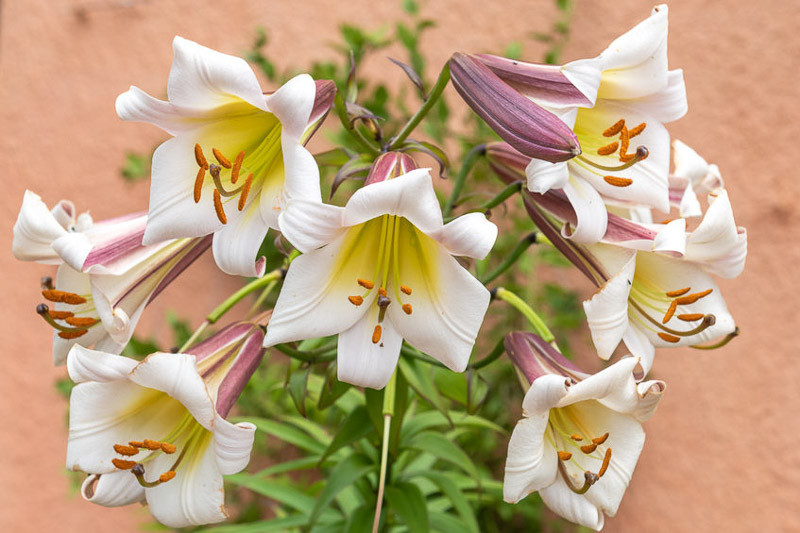
Trumpet and Aurelian hybrids belong to Horticultural Division VI of the genus Lilium. Their ancestry includes trumpet-flowered Asian species such as Lilium regale, Lilium leucanthum, Lilium sargentiae, and Lilium sulphureum, together with Lilium henryi in Aurelian breeding.
The classic Trumpet lily has a long, waxy flower that opens outward like a horn. Division VI, however, is much more diverse than its name suggests.
Flowers may be:
This variation matters in the garden. A tall lily whose flowers face outward is easy to appreciate from across a border, while a similarly tall cultivar with pendant flowers may be more effective beside a path, on a slope, or somewhere the blooms can be viewed from below.
Not every trumpet-shaped lily belongs to Division VI. The species Lilium regale, for example, is one of the classic parents behind Trumpet breeding, but the species itself belongs to Division IX. Longiflorum or Easter lilies may likewise have elegant trumpet-shaped flowers without being Trumpet and Aurelian hybrids.
Classification matters: flower shape and horticultural division are not the same thing. A lily can have a trumpet-shaped flower without belonging to the Trumpet and Aurelian Hybrid Division.
Trumpet and Aurelian lilies are primarily midsummer bloomers, with later Aurelian forms extending the display into late summer.
Their flowering season often follows earlier Asiatic lilies and Martagons. Later Trumpet and Aurelian cultivars can overlap with the beginning of Oriental and Orienpet flowering.
Exact timing varies with cultivar, climate, spring temperatures, and seasonal weather. Some Aurelian hybrids also develop secondary or tertiary buds, which can prolong the display after the earliest flowers fade.
For a longer lily season: start with Asiatics and Martagons, continue with Trumpet and Aurelian lilies in midsummer, then move into Orientals and Orienpets. Gardenia’s Lilies for Long Summer Blooms explains how to build this succession.
Fragrance is one of the defining attractions of Trumpet lilies. Many cultivars release a rich, sweet perfume that becomes particularly noticeable on still, warm evenings.
This makes placement important. A fragrant Trumpet lily beside a path, terrace, or seating area can be spectacular because the scent becomes part of the garden experience rather than something noticed only while standing beside the flowers.
Popular fragrant Division VI selections include:
For scent-focused choices, explore Gardenia’s Most Fragrant Trumpet Lilies and the broader Most Fragrant Lilies guide.
Think about fragrance placement: powerful perfume can be wonderful outdoors, but several heavily scented Trumpet lilies beside an open bedroom window or on a small enclosed patio may be more fragrance than some gardeners want.
Trumpet lilies are often chosen by flower color, but flower direction can matter just as much in the landscape.
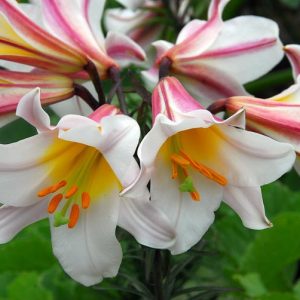
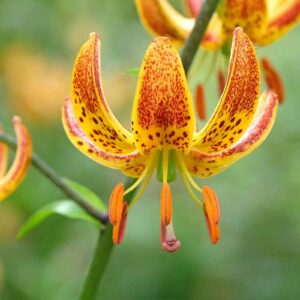
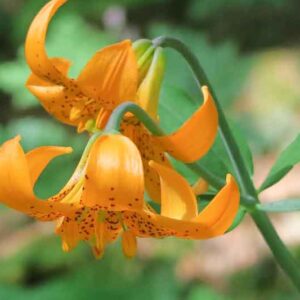
An outward-facing Trumpet is easy to appreciate from across a border. Pendant flowers often work particularly well where they can be viewed slightly from below. Upward-facing forms create strong blocks of color when seen from above or at close range.
Aurelian breeding broadens those possibilities further, producing flowers that may flare widely or open into bowls, stars, and sunburst-like forms.
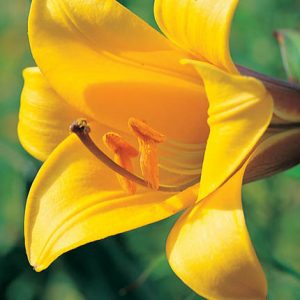
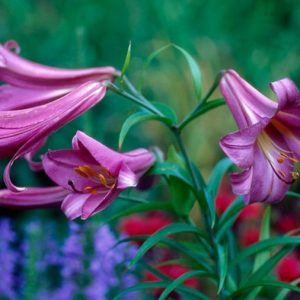
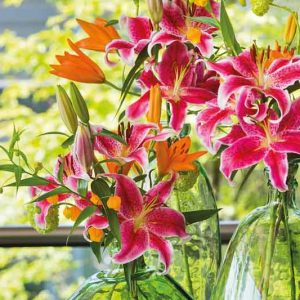
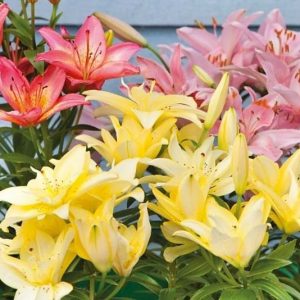
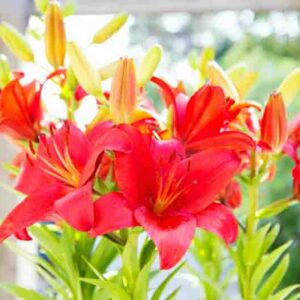
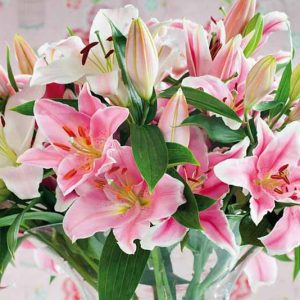
Color ranges from white and cream through yellow, gold, apricot, orange, pink, and plum. Contrasting throats and darker outer tepals may make the same flower look dramatically different from the front and back.
Trumpet and Aurelian lilies are generally among the taller garden lilies. Many familiar cultivars grow approximately 4-6 ft. (120-180 cm) tall, although mature height varies with cultivar, climate, soil, and growing conditions.
Gardenia’s records for ‘African Queen’ and ‘Pink Perfection’, for example, place them within this 4-6 ft. range.
That height is part of their appeal. Trumpet lilies can rise through lower perennials and carry their flowers above much of the surrounding border, adding a vertical layer that shorter bulbs cannot provide.
Height also has practical consequences. Large flowers on tall stems can catch wind and become especially vulnerable after heavy rain. In exposed gardens, discreet staking may prevent leaning or broken stems.
Gardenia cultivar insight: with Trumpet lilies, mature height tells only half the story. Flower direction determines where that height works. An outward-facing bloom can be enjoyed across a border, while pendant flowers are often best where they can be viewed from below. Choose height and flower direction together.
Trumpet lilies perform well in full sun to partial shade. Abundant light generally encourages good flowering and sturdy growth, although some afternoon protection can be useful in hotter climates.
A useful approach is to keep the flowering stems in good light while allowing lower-growing plants or mulch to shade the soil. This can moderate soil temperatures and conserve moisture around the root zone.
Good positions include:
Avoid very exposed locations where tall stems and substantial flower heads receive the full force of summer storms. If staking is likely to be necessary, install support before the plants become top-heavy with flowers.
Trumpet and Aurelian lilies generally perform best in fertile, moist but well-drained soil. Good drainage is particularly important because lily bulbs can deteriorate when they remain in persistently saturated conditions.
Gardenia’s cultivar records frequently list Trumpet and Aurelian selections as accepting acidic, neutral, and alkaline conditions. That broad pattern makes the group more adaptable to soil chemistry than many Oriental lilies, but individual cultivar requirements should still be checked where soil conditions are unusual or extreme.
Site-fit priority: drainage comes before flower color. Even a spectacular cultivar is a poor choice if its bulb will spend winter sitting in waterlogged soil.
Plant Trumpet lily bulbs in fall or spring. Lily bulbs lack the dry protective tunic found on bulbs such as tulips, so plant healthy bulbs reasonably promptly rather than allowing them to dry excessively in storage.
Planting depth and spacing vary with bulb size and cultivar. As a useful Gardenia guideline, large Trumpet lily bulbs are generally planted about 6-8 in. (15-20 cm) deep and given at least 15 in. (37 cm) of space. Check the individual cultivar and Gardenia’s Lily Planting Depth and Spacing Guide where more specific recommendations are available.
For general planting, watering, feeding, staking, and seasonal care, use Gardenia’s How to Grow and Care for Lilies.
Trumpet lilies can grow successfully in containers, but their mature height makes container choice particularly important.
Use a deep, substantial, stable pot that will not tip when several tall flowering stems become top-heavy.
If space is limited, compare compact Asiatic or Oriental lilies before choosing a tall Trumpet cultivar.
Gardenia’s Best Lilies for Pots and Containers provides additional container advice and cultivar ideas.
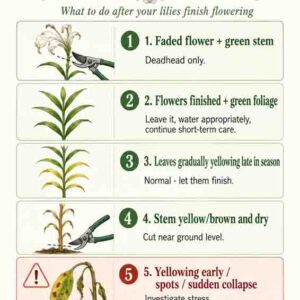
Once flowering finishes, remove faded flowers if you do not want seed, but leave healthy stems and foliage intact.
The leaves continue photosynthesizing after flowering, helping replenish the bulb and build reserves for the following year’s growth.
After-bloom rule: Flowers Off, Foliage On. Removing spent flowers is fine, but healthy green leaves should remain until they have finished replenishing the bulb.
For more detail, see Gardenia’s What to Do With Lilies After They Bloom.
Trumpet and Aurelian lilies can be propagated by offsets and bulb scales. Seed is also used in breeding and for species lilies, although seedlings take time to reach flowering size.
Named hybrid cultivars should not be expected to come true from seed. If the goal is to reproduce a particular cultivar, vegetative propagation is the more reliable approach.
Offsets can be separated when plants are dormant and replanted promptly. As with other lilies, avoid leaving exposed bulbs to dry excessively.
Trumpet and Aurelian lilies are generally dependable garden plants, but they remain true lilies and can be affected by many of the same pests and diseases as other members of Lilium.
Potential problems include Botrytis or gray mold, lily disease, viruses, and bulb or basal rot.
Good prevention begins with healthy bulbs, adequate spacing, air movement, and well-drained soil. Remove badly diseased material and avoid persistently wet conditions around the bulbs.
Not every leaning stem indicates disease. A tall Trumpet lily may lean because it is reaching toward stronger light, because heavy blooms have made it top-heavy, or because the planting is exposed to wind. Likewise, foliage naturally yellowing late in the season is not itself a disease symptom.
Trumpet lilies are architectural plants. Their height, large flowers, and fragrance give them enough presence to act as vertical accents rather than simply filling space in a border.
They often look strongest planted in groups, where several flowering stems create a deliberate column or drift rather than isolated exclamation points.
Good companions include:
Flower direction should influence placement. Outward-facing flowers need enough open space in front of them to be appreciated, while pendant forms can be especially effective on slopes, raised beds, or beside paths where viewers naturally see the flowers from below.
Gardenia’s Great Companion Plants for Trumpet Hybrid Lilies provides specific combinations, while Great Companion Plants for Lilies explains the broader principles of lily companion planting.
Trumpet and Aurelian lilies are particularly valuable when the goal is height, fragrance, and architectural midsummer bloom. Other lily groups solve different garden problems.
For a broader comparison of the major groups, use Gardenia’s How to Choose Lilies.
If you like the height and fragrance of Trumpet lilies but prefer broader, more Oriental-looking flowers, compare Orienpet lilies. These Oriental-Trumpet hybrids often combine substantial height and large fragrant flowers with a more open or recurved flower form.
The best choice depends on the effect you want. A classic outward-facing trumpet produces a very different silhouette from a broad, recurved Orienpet even when the two plants occupy similar vertical space. Choose the group for its overall character, then compare the actual cultivars.
For apricot-orange flowers: choose ‘African Queen’.
For pink: ‘Pink Perfection’ combines color, fragrance, and substantial height.
For golden yellow: Golden Splendor brings warm yellow tones and classic Trumpet character.
For classic white trumpet-flowered species character: consider Lilium regale, remembering that it is a species lily rather than a Division VI hybrid.
For strong fragrance: compare individual selections in Gardenia’s Most Fragrant Trumpet Lilies.
For broader Oriental-style flowers: compare Orienpet lilies.
Knowing that you want a Trumpet lily is only the first decision. Cultivars differ in height, fragrance, flower direction, color, hardiness, bloom timing, and final garden effect.
Know you want a Trumpet lily but not which one? Use Gardenia’s Lilium Comparison Tool to compare lilies by height, hardiness, bloom season, flower color, soil, drainage, pH, light, and other garden characteristics – then narrow the choices to lilies that actually fit your site.
You can also browse Gardenia’s complete Lilium plant collection or explore the Lilium guide library.
The Trumpet label tells you to expect fragrance, height, and architectural summer flowers. Gardenia’s cultivar records help answer the more useful question: which lily has the height, flower direction, color, and garden role you actually need?
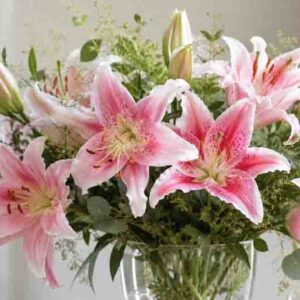
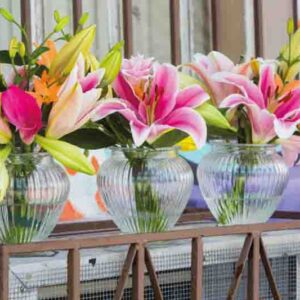
Trumpet lilies make spectacular cut flowers. Their tall stems, substantial blooms, and fragrance can create dramatic arrangements with relatively few stems.
Fragrance matters indoors as much as outdoors. A cultivar whose scent seems perfectly balanced in an open garden may feel much stronger in a small room.
When cutting stems from lilies you want to retain in the garden, leave plenty of healthy foliage on the plant so the bulb can continue photosynthesizing and rebuilding its reserves.
For more ideas, explore Gardenia’s Lily Flowers: From Garden Favorites to Stunning Arrangements.
Yes. Trumpet lilies are true lilies in the genus Lilium and are extremely dangerous to cats. Flowers, leaves, stems, pollen, and even water from a vase containing true lilies can present a serious risk.
If a cat may have been exposed to a true lily, seek urgent veterinary attention rather than waiting for symptoms. For more information, see Gardenia’s Lilies and Cats Safety Guide.
| Hardiness |
3 - 9 |
|---|---|
| Heat Zones |
1 - 7 |
| Climate Zones | 1, 2, 3, 4, 5, 6, 7, 8, 9, 14, 15, 16, 17, 18, 19, 20, 21, 22, 23, 24 |
| Plant Type | Bulbs, Perennials |
| Genus | Lilium |
| Exposure | Full Sun, Partial Sun |
| Season of Interest | Summer (Mid, Late) |
| Maintenance | Low |
| Water Needs | Average |
| Soil Type | Chalk, Clay, Loam, Sand |
| Soil pH | Acid, Alkaline, Neutral |
| Soil Drainage | Moist but Well-Drained, Well-Drained |
| Characteristics | Cut Flowers, Fragrant, Showy |
| Landscaping Ideas | Beds And Borders, Patio And Containers |
| Garden Styles | City and Courtyard, Cutting Garden, Informal and Cottage, Traditional Garden |
Trumpet and Aurelian lilies are true lilies in Horticultural Division VI. They are generally tall, fragrant plants with large flowers that may be trumpet-shaped, flaring, bowl-shaped, upward-facing, outward-facing, or pendant.
Trumpet and Aurelian lilies primarily bloom in midsummer, with later Aurelian forms extending the display into late summer. Exact timing varies with cultivar, climate, and seasonal conditions.
Yes. Fragrance is one of the major attractions of Trumpet lilies, and many cultivars produce a strong, sweet perfume that can be particularly noticeable on warm summer evenings.
Many familiar Trumpet and Aurelian lilies grow about 4 to 6 feet tall, although mature height varies with cultivar and growing conditions. Tall plants may benefit from support in exposed or windy gardens.
Trumpet lilies grow well in full sun to partial shade. Abundant light generally supports strong flowering, while lower plants or mulch can help moderate soil temperature and conserve moisture around the root zone.
Trumpet lilies perform best in fertile, moist but well-drained soil. They are generally more flexible about soil pH than Oriental lilies, but cultivar requirements should still be checked where soil conditions are unusual.
Trumpet lily bulbs can be planted in fall or spring. For large Trumpet bulbs, Gardenia’s planting guidance uses about 6 to 8 inches deep and at least 15 inches apart, while individual cultivar recommendations should be checked where available.
Yes. Trumpet lilies can grow in large containers, but their height requires a deep, stable pot with excellent drainage. Tall cultivars may need support, especially in exposed locations.
Remove faded flowers if you are not saving seed, but leave healthy green stems and foliage intact. Cut the plant back only after the leaves and stems have yellowed or browned naturally.
Yes. Trumpet lilies are true lilies in the genus Lilium and are extremely dangerous to cats. Flowers, leaves, stems, pollen, and water from a vase containing true lilies can present a serious risk. Seek urgent veterinary attention if exposure is suspected.
Trumpet and Aurelian lilies bring a distinctive combination of qualities to the summer garden: architectural height, substantial flowers, powerful fragrance, and a flowering season that creates a strong midsummer peak and can extend later with selected Aurelian forms.
The most useful way to choose one is not by color alone. Consider mature height, flower direction, fragrance, bloom timing, wind exposure, and where the flowers will actually be viewed. A well-placed Trumpet lily can become one of the most memorable plants in a summer border.
Updated: August 2026 • Reviewed by Gardenia Editors
| Hardiness |
3 - 9 |
|---|---|
| Heat Zones |
1 - 7 |
| Climate Zones | 1, 2, 3, 4, 5, 6, 7, 8, 9, 14, 15, 16, 17, 18, 19, 20, 21, 22, 23, 24 |
| Plant Type | Bulbs, Perennials |
| Genus | Lilium |
| Exposure | Full Sun, Partial Sun |
| Season of Interest | Summer (Mid, Late) |
| Maintenance | Low |
| Water Needs | Average |
| Soil Type | Chalk, Clay, Loam, Sand |
| Soil pH | Acid, Alkaline, Neutral |
| Soil Drainage | Moist but Well-Drained, Well-Drained |
| Characteristics | Cut Flowers, Fragrant, Showy |
| Landscaping Ideas | Beds And Borders, Patio And Containers |
| Garden Styles | City and Courtyard, Cutting Garden, Informal and Cottage, Traditional Garden |
Create a membership account to save your garden designs and to view them on any device.
Becoming a contributing member of Gardenia is easy and can be done in just a few minutes. If you provide us with your name, email address and the payment of a modest $25 annual membership fee, you will become a full member, enabling you to design and save up to 25 of your garden design ideas.
Join now and start creating your dream garden!
Create a membership account to save your garden designs and to view them on any device.
Becoming a contributing member of Gardenia is easy and can be done in just a few minutes. If you provide us with your name, email address and the payment of a modest $25 annual membership fee, you will become a full member, enabling you to design and save up to 25 of your garden design ideas.
Join now and start creating your dream garden!