What should you plant with lilies? Discover companion plants that do more than look beautiful. Compare hardy geraniums, catmint, salvia, alliums, roses, peonies, grasses and shade-loving partners by sun, soil, moisture, root competition, height and bloom season to build healthier, longer-lasting lily combinations.
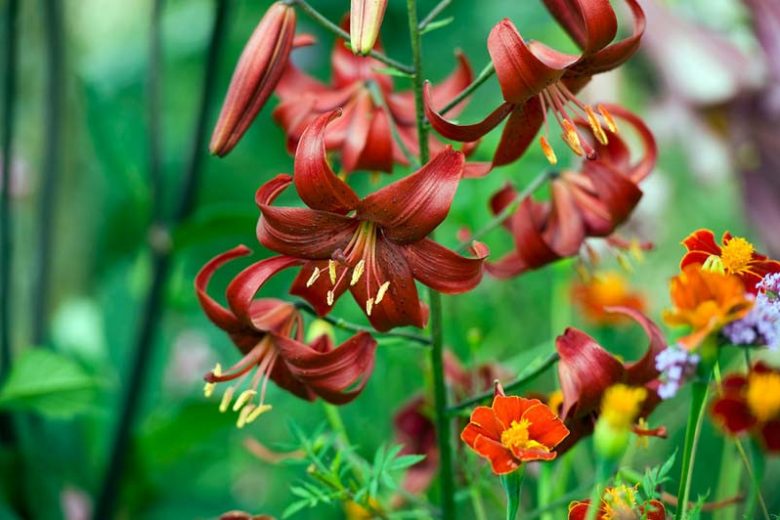


Lilies are spectacular when they flower, but the most successful lily borders rarely rely on lilies alone. Their upright stems, relatively narrow footprint, dramatic blooms, and long-lived post-flowering foliage make them unusually easy to weave through perennial borders – provided their neighbors are chosen for more than color.
The best companion plants for lilies share compatible light, soil, moisture, and drainage requirements. They also earn their place in the border by doing something useful: covering the lower stems, introducing a contrasting flower shape, adding foliage texture, attracting pollinators, extending the season before or after lily bloom, or carrying the garden visually while lily foliage ripens.
A plant can therefore look wonderful beside a lily in a photograph and still be a poor garden partner. A vigorous grass may overwhelm the bulb zone. A dry-loving perennial may resent the watering needed by lilies. A dense tall plant may hide too much lily foliage. Conversely, two plants with slightly different preferences can work beautifully when their positions within the border are adjusted.
This guide goes beyond a list of attractive pairings. It explains why each companion works, which lilies it suits best, where it belongs in the planting, and what tradeoffs to consider.
Gardenia’s rule: Match → Layer → Extend. Match the conditions first, layer the plants so they occupy different visual and physical space, then extend the season beyond the lilies themselves.
How Gardenia selects lily companions: We do not recommend a plant simply because it looks attractive beside a lily. Gardenia considers overlap in light, soil, moisture, and drainage, then looks at mature height, spread, root competition, bloom timing, foliage, and the plant’s role before and after lily flowering. The result is a compatibility recommendation, not just a color pairing.

Most garden lilies perform best in well-drained soil with reasonably consistent moisture during active growth; soil fertility and pH preferences vary somewhat by lily group.
Their upright growth habit creates natural opportunities for layering. Low plants can occupy the foreground, medium-height perennials can weave around the stems, and airy plants can rise through the border without forming a dense screen around the lilies.
A useful companion normally performs one or more of these jobs:
Cover the stems, not the leaves. Lily foliage should remain exposed to light after flowering so it can continue photosynthesizing and replenishing the bulb for the following year. A companion should soften the planting without swallowing the lily.

Hardy geraniums are among the most versatile plants to grow around lilies. Their mounded or spreading foliage creates a soft lower layer while lily flowers rise clearly above it, and many bloom for considerably longer than an individual lily cultivar.
Good candidates include:
The practical advantage is height. These geraniums soften the lower stems without creating another tall floral mass beside the lilies.
Leave a clear opening around emerging lily shoots in spring. Geranium foliage should flow around the lilies rather than directly over the point where each stem emerges.
Gardenia best all-around pick: Geranium ‘Rozanne’ combines a useful low layer, exceptionally long flowering, cool color contrast, and manageable competition when properly spaced.
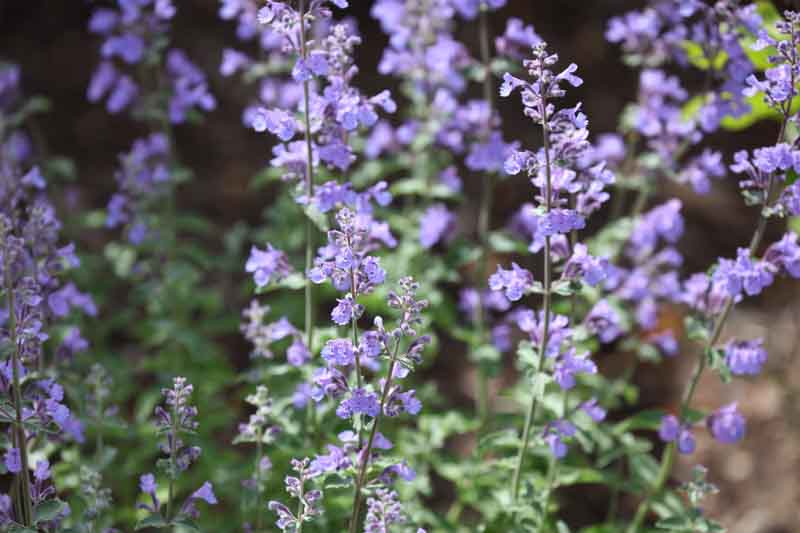
Nepeta and perennial salvias bring a color that true lilies cannot provide themselves: blue to violet. Their small flowers and narrow spikes also provide welcome contrast with the much larger flowers of Lilium.
The principal tradeoff is moisture. Nepeta and many border salvias tolerate drier conditions once established than actively growing lilies prefer. Use them toward the freer-draining front or outer edge of the border, while placing lilies slightly farther inside where summer moisture remains more reliable.
Companions need overlap, not identical requirements. A small change in position can accommodate a drier-loving Nepeta at the edge and lilies with steadier summer moisture farther into the bed.
One of the most effective ways to use companion plants with lilies is through succession. The border should already be interesting before the lilies become dominant.
Start with low-growing spring bulbs such as:
These bulbs occupy the border when lilies are little more than emerging shoots. By the time their display fades, lily stems are rising and preparing to take over.
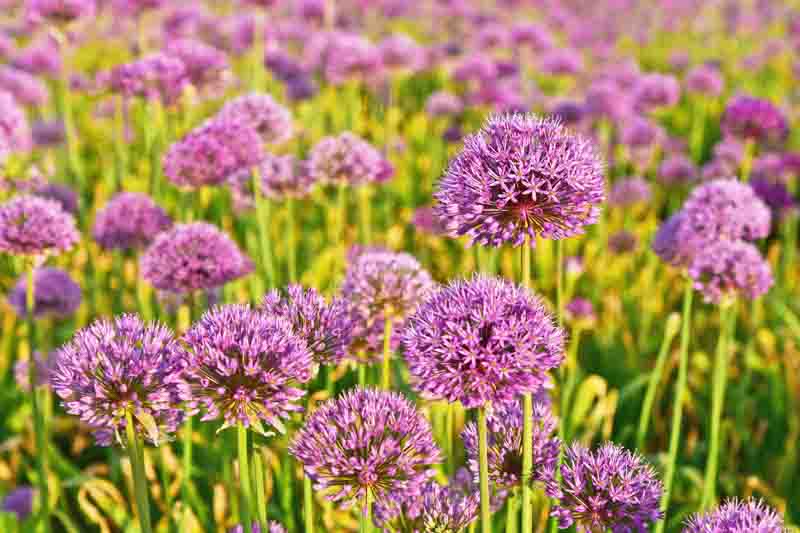
Ornamental alliums then create a particularly useful late-spring to early-summer bridge. Good choices include:
Do not pack different bulb systems tightly together. Interweave them in loose groups and leave enough soil around established lilies for root growth, maintenance, and eventual division.
Why spring bulbs work so well: they add color precisely when lilies are not at their best. The plants share the stage rather than competing for the same moment.
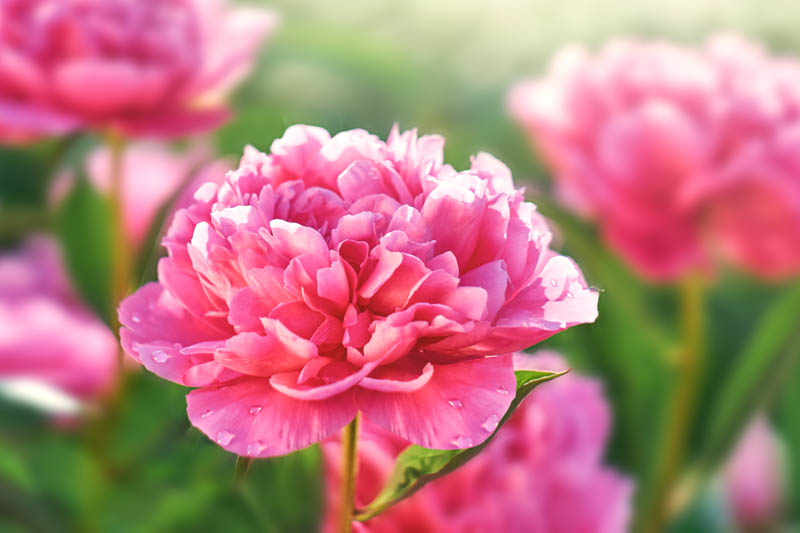
Peonies and roses work differently from low underplanting. They contribute substantial permanent masses of foliage around which groups of lilies can be positioned.
Peonies often make their main floral contribution before many garden lilies reach peak bloom, then remain as broad leafy mounds through summer. Useful cultivars include:
Plant lily bulbs beside or between peony clumps, not through the crown itself.
Roses offer a longer flowering season and an enormous choice of colors. Rosa ‘Gertrude Jekyll’, for example, combines rich pink flowers and strong fragrance with a long season of bloom.
Give lilies their own rooting space away from the rose crown and major woody roots. Roses are strong competitors for both moisture and nutrients.
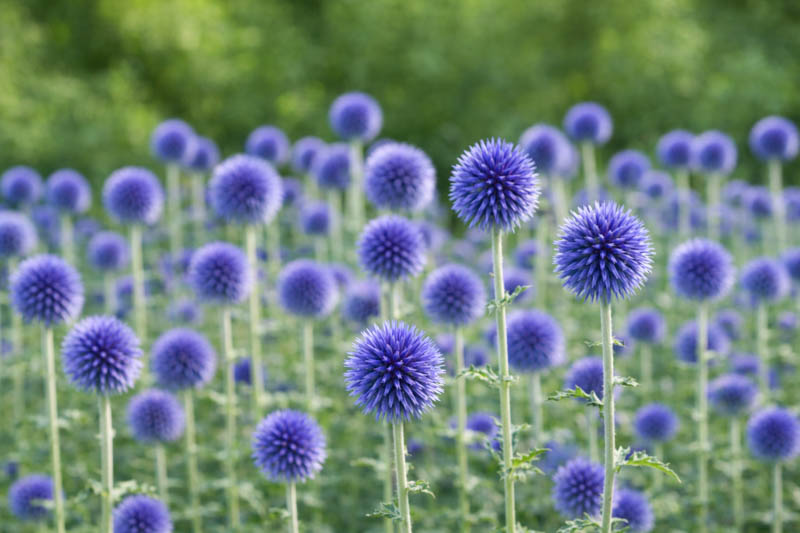
These plants are particularly useful with tall lilies because they add height without necessarily creating a dense wall of foliage.
Echinops and Agastache prefer particularly good drainage and tolerate drier conditions once established, so they make their best lily partners in sunny, freely drained borders.
Verbena bonariensis can self-seed generously and has naturalized beyond gardens in some regions. Check local invasive-plant guidance before using the species.
Why airy companions work: they occupy vertical space without hiding the lily flowers. This is particularly valuable beside tall Trumpet and Orienpet lilies, whose silhouettes are worth preserving.
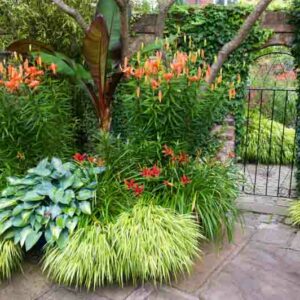
Agapanthus and Hemerocallis form broad clumps of arching leaves below their flowers, making them useful where you want summer color and a substantial lower layer around taller lilies.
Do not plant lily bulbs inside established Agapanthus or daylily crowns. Place the clumps beside the lilies so their arching foliage screens the lower stems while each plant retains its own root space.
Lily and daylily are not the same plant. Hemerocallis is not a true Lilium, but its broad clump of arching leaves can make a useful lower layer beneath taller true lily flowers.
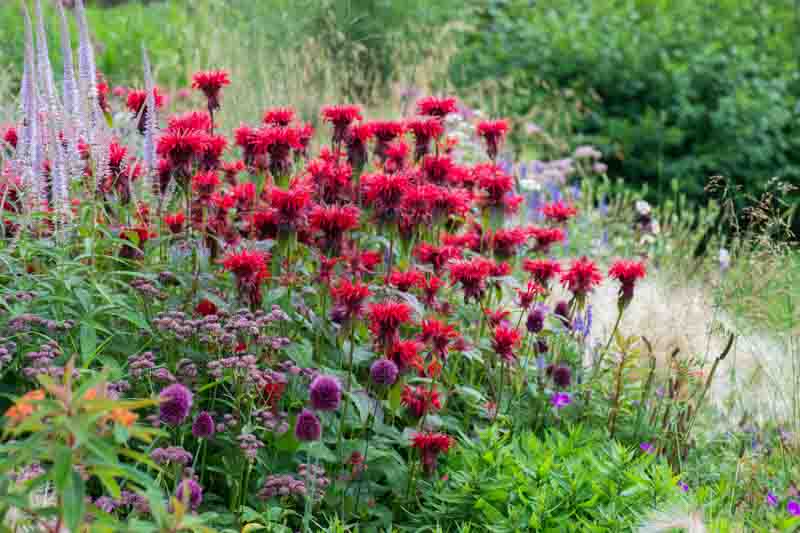
Not every sunny lily border is dry. Where soil remains reasonably moist but drains freely, Monarda and Helenium can provide strong midsummer and late-season color.
Both become substantial plants, so use them as middle or background companions rather than tight underplanting.
Monarda also benefits from good air circulation. Do not surround lily stems and Monarda with a dense mass of additional foliage simply to make the border look full.
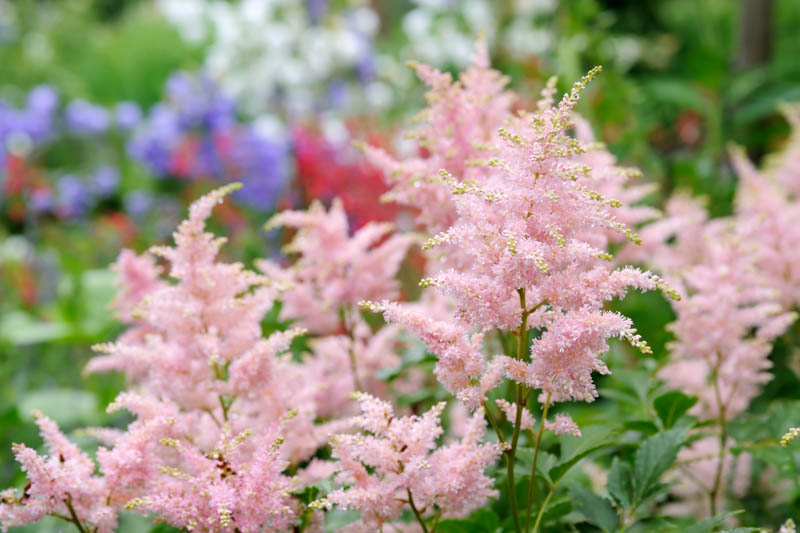
Martagon lilies are particularly useful in light woodland and dappled shade, so their companion palette should be very different from that of lilies growing in a hot, exposed border.
Astilbe and Hakonechloa are particularly useful where summer moisture remains reliable. They should not be transferred automatically to a dry Asiatic or Trumpet border simply because the visual combination looks attractive.
Companion plants should follow the lily and the site. The best partner for a Martagon in moist dappled shade may be completely wrong for a Trumpet lily growing in an exposed sunny border.
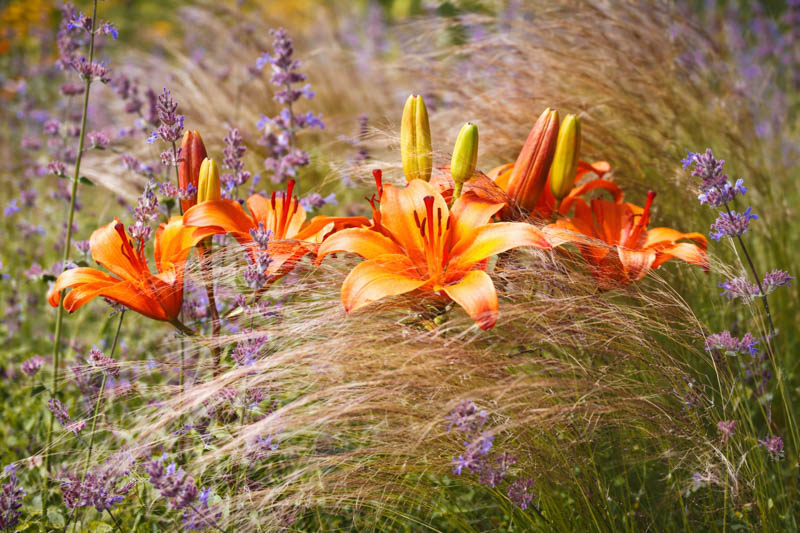
“Ornamental grasses” is too broad to be a meaningful recommendation. Some grasses are drought-tolerant sun lovers; others thrive in moist shade. Some remain compact while others develop enormous root systems.
For sunny, freely drained lily borders:
For moist, partly shaded Martagon borders:
Stipa tenuissima can self-seed prolifically and is considered invasive in some regions. Check local guidance before planting it.
Large grasses should also be given their own footprint. Do not plant lily bulbs directly against a mature grass crown where root competition will become intense.
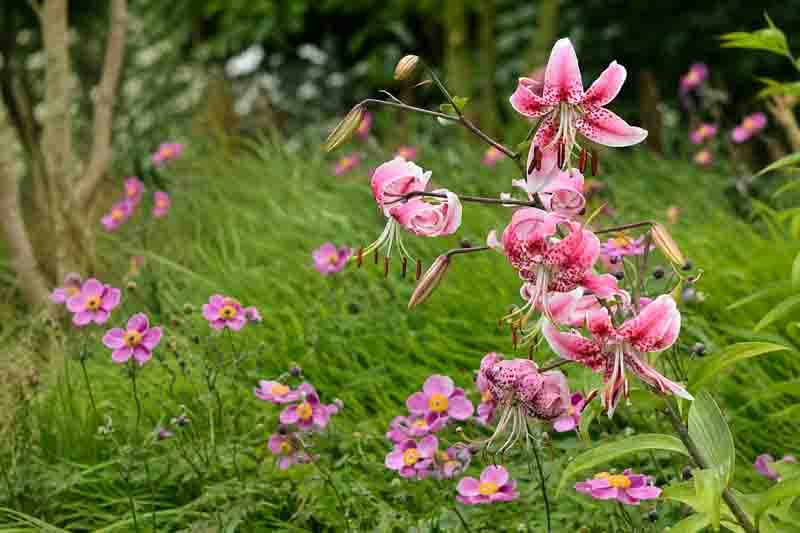
Late-season plants are just as important as the companions flowering alongside the lilies. Once the lily flowers fade, their foliage should remain until it yellows naturally, so another layer of the border needs to take over visually.
The best late companions flower from late summer into fall, provide enough foliage to distract from ripening lily stems, and continue the border without forming such a dense mass that air circulation disappears.
Good choices include:
Gardenia late-season strategy: let the visual weight of the border shift away from the lilies as summer ends. Asters and Japanese anemones add lighter flowers, Rudbeckia and Solidago provide stronger color, chrysanthemums create fuller masses, and upright Sedum adds durable structure into fall.
Different lily groups have different strengths, flowering seasons, heights, and site preferences. Companion planting becomes much more useful when the recommendations are tied to the lily you are actually growing.
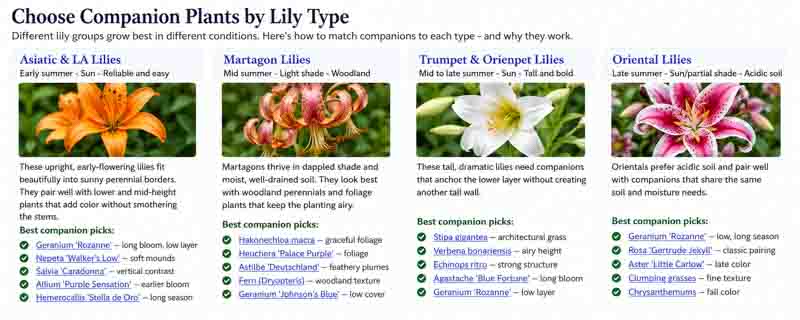
Asiatic and LA lilies are generally useful in sunny borders and occupy the earlier portion of the main lily season. Their upright growth benefits from lower companions, while later perennials prevent the border from becoming empty after flowering.
3 Gardenia combinations to try:
Lilium ‘Black Out’ + Salvia ‘Caradonna’ + Geranium ‘Rozanne’ – dark red lilies against cool violet-blue flowers.
Lilium ‘Brindisi’ + Nepeta ‘Walker’s Low’ + pale pink roses – a soft romantic palette with strong height layering.
Lilium ‘Dot Com’ + Allium ‘Purple Sensation’ + Geranium ‘Johnson’s Blue’ – a sequence of violet and pink from late spring into summer.
Martagons are particularly valuable in light woodland and dappled shade. Their nodding flowers and whorled leaves suit a softer, foliage-rich planting style rather than the dry, exposed palette that works around many sunny hybrids.
3 Gardenia combinations to try:
Lilium ‘Fairy Morning’ + Hakonechloa macra + Heuchera – an airy woodland composition with three very different foliage forms.
Lilium ‘Manitoba Morning’ + Astilbe + ferns – particularly suitable where the soil remains moist but well drained.
Lilium ‘Chameleon’ + Heuchera + hardy geranium – lower foliage lets the color-changing Martagon flowers remain the focus.
Oriental lilies produce some of the largest and most fragrant lily flowers and generally favor acidic soil more strongly than many other hybrid groups. Companion plants therefore need to fit both the visual scale and the soil conditions.
3 Gardenia combinations to try:
Lilium ‘Casa Blanca’ + Geranium ‘Rozanne’ + pink roses – white lilies rise above a romantic blue-and-pink lower layer.
Lilium ‘Star Gazer’ + blue hardy geranium + later asters – strong summer color followed by a late-season handoff.
Lilium ‘Muscadet’ + pale grasses + soft pink perennials – fine texture allows the large spotted flowers to remain dominant.
Tall Trumpet and Orienpet lilies create strong vertical architecture. Their best companions provide a lower anchor or an airy second layer without hiding the lilies behind equally dense tall foliage.
3 Gardenia combinations to try:
Lilium ‘Anastasia’ + Verbena bonariensis + Geranium ‘Rozanne’ – tall pink lilies above a transparent purple haze and blue lower layer.
Lilium ‘Scheherazade’ + Echinops ‘Veitch’s Blue’ + Stipa gigantea – bold crimson flowers against blue spheres and fine golden movement.
Lilium ‘Conca d’Or’ + Agastache ‘Blue Fortune’ + Salvia ‘Caradonna’ – creamy yellow lilies with two layers of cool blue-violet flowers.

A successful lily border should behave like a relay. Spring bulbs begin the display. Peonies and alliums carry it toward early summer. Asiatic and LA lilies overlap with geraniums, Nepeta, and Salvia. Trumpets and Orienpets take over around midsummer, while later perennials, asters, Japanese anemones, Solidago, Sedum, chrysanthemums, and ornamental grasses keep the border alive as the lily season winds down.
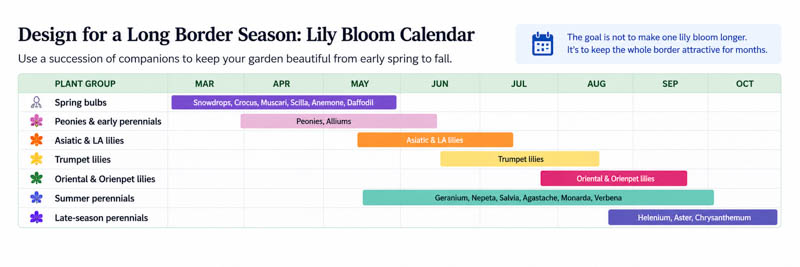
A useful sequence is:
For the lily side of the sequence, see Gardenia’s When Do Lilies Bloom? Lily Bloom Calendar. For succession using lilies themselves, see Lilies for Long Summer Blooms.
The goal is not one perfect week. A well-designed border changes. Spring bulbs disappear as lilies rise; summer perennials take over around them; later flowers become prominent while lily foliage quietly ripens in the background.
Find and Plan Your Perfect Combination on Gardenia
Use our tools to check the exact plants for your garden conditions, compare their characteristics, and build a collection.
Plant Finder
Find companion plants that match your light, soil, moisture, and garden conditions.
Try Plant Finder →Compare Lilium
Compare lily cultivars side by side by hardiness, size, bloom season, soil, light, and more.
Compare Lilies →Garden Design Tool
Save your plants, review bloom timing and mature size, and design your border as a complete planting.
Start Your Design →“Better companions make better lilies – and a more beautiful garden, all season long.”
– The Gardenia Editors
Lilies are perennial bulbs with living roots. A nearby plant can compete with them even if the two look perfectly compatible above ground.
This does not mean lilies need a ring of bare soil around them. The goal is to place neighboring plants so their crowns and most competitive roots are separated while their foliage overlaps visually.
A mixed cottage border can look wonderfully full, but fullness and congestion are not the same thing.
Lily leaves buried inside a dense mass of wet foliage dry more slowly after rain or irrigation. That is especially undesirable in humid gardens and where foliar disease is already a concern.
Use companions to frame and layer the lilies rather than fill every available inch. Allow the stems to emerge cleanly and leave enough space for light and air to reach the foliage, especially in humid or disease-prone gardens.
For lily-specific spacing guidance, see Gardenia’s Lily Planting Depth and Spacing Guide.
Once the plants can genuinely share the site, color becomes the fun part.
Blue and violet are especially useful with lilies because clear blue is absent from commercially available true Lilium cultivars. Geraniums, Nepeta, Salvia, Echinops, Agastache, and Verbena can therefore introduce a color the lilies themselves cannot provide.
Warm orange, yellow, apricot, and red lilies become more vivid beside blue-purple flowers. Pink and white lilies create softer combinations. Burgundy lilies can be echoed with dark foliage or contrasted with silver grasses and pale blooms.
Texture is just as important. Huge Oriental flowers become more elegant beside fine grasses. Recurved Martagon flowers look natural above ferns and Hakonechloa. Tall Trumpets become even more architectural when airy Verbena or Echinops is allowed to float nearby rather than blocking them with another dense perennial.
Gardenia design order: compatibility first, structure second, season third, color fourth. Starting with color and trying to solve the growing conditions afterward is one of the easiest ways to create a beautiful combination that performs poorly.
There is no universal blacklist because lilies and garden conditions vary, but several types of neighbors deserve caution.
An attractive pairing is not necessarily a compatible one. Gardenia’s tools can help you move from a general recommendation to the exact plants you intend to grow.
Use the Lilium Comparison Tool to compare individual lilies by light, bloom season, soil, drainage, pH, height, spread, and other characteristics.
Use the Gardenia Plant Finder to find potential companion plants that match the conditions in your own garden.
Then save your shortlisted lilies and companion plants to the Garden Design Tool, where you can organize them in a garden collection, compare mature size, review seasonal timing, and consider the planting as a whole before you buy.
A general companion list can give you ideas. Gardenia helps you take the next step: compare the exact lily and companion plants, check whether their growing requirements overlap, and build a combination suited to your own garden.
Good lily companions include hardy geraniums, Nepeta, Salvia, alliums, peonies, roses, Echinops, Verbena, Agastache, Agapanthus, Hemerocallis, Monarda, Helenium, Heuchera, Astilbe, suitable ornamental grasses, asters, and chrysanthemums. The best choice depends on the lily type and the site’s light, soil, moisture, drainage, and space.
Low or medium-height plants such as hardy geraniums, Nepeta, compact Salvia, Heuchera, Hakonechloa, and some daylilies can soften the base of lily stems. Leave room around emerging shoots and keep enough lily foliage exposed to light and air after flowering.
Use succession rather than relying only on plants that flower with the lilies. Start with snowdrops, crocus, Muscari, Scilla, Anemone, daffodils, peonies, and alliums. Follow with summer lilies and perennials, then use asters, chrysanthemums, Rudbeckia, Japanese anemones, Solidago, Sedum, and ornamental grasses to carry the border into fall.
Martagon lilies are especially suited to light or dappled shade. Good companions include Hakonechloa, Heuchera, Astilbe where moisture is reliable, ferns, and shade-tolerant hardy geraniums. These plants create a lower woodland layer while allowing the tall Martagon flowers to remain visible.
Oriental lilies can pair well with hardy geraniums, compatible roses, suitable grasses, and later-flowering asters or other perennials. Because Oriental lilies generally favor acidic soil, check the soil requirements of the companion before choosing plants only for their color.
Tall Trumpet and Orienpet lilies work well with airy or lower companions such as Verbena bonariensis, Echinops, Agastache, Stipa gigantea, hardy geraniums, and roses. These plants add structure and season without necessarily creating a dense wall that hides the lily flowers.
Yes. Hemerocallis and true Lilium are different plants, but they can grow together where their site requirements overlap. Daylily foliage creates a broad lower mound beneath taller lily stems. Keep the lily bulbs outside the established daylily crown so the two plants retain adequate root space.
Avoid aggressive spreaders, running grasses, plants that create severe root competition, plants requiring permanently saturated soil, and companions that completely shade the lily foliage. Also avoid pairings with strongly conflicting soil pH or moisture requirements.
No. Companion plants do not extend the flowering period of an individual lily. They extend the ornamental season of the border by flowering before, during, or after the lilies and by keeping attention away from lily stems while the post-bloom foliage remains green and replenishes the bulbs.
The best lily companions are not simply the flowers that look prettiest beside lilies. They are plants that can share the same garden successfully and make the border better beyond the lily’s own flowering period.
Start with light, soil, moisture, and drainage. Then consider mature size and root competition. Layer plants so lily foliage still receives light and air. Finally, use spring bulbs, summer perennials, grasses, and later flowers to create a border that changes naturally from spring through fall.
Hardy geraniums, Nepeta, and Salvia make excellent low and medium layers in sunny borders. Peonies, roses, Agapanthus, and Hemerocallis add body. Echinops, Verbena, and Agastache bring airiness and vertical contrast. Hakonechloa, Heuchera, Astilbe, and ferns suit woodland-style Martagon plantings. Asters, Helenium, chrysanthemums, and grasses carry the garden after the lilies have finished.
Gardenia’s simplest lily companion rule is worth remembering: Match → Layer → Extend. Match the site, layer the plants intelligently, and extend the garden season beyond the lilies themselves.
Updated: August 2026 • Reviewed by Gardenia Editors
| Hardiness |
3 - 9 |
|---|---|
| Heat Zones |
1 - 3 |
| Climate Zones | 1, 2, 3, 4, 5, 6, 7, 8, 9, 14, 15, 16, 17, 18, 19, 20, 21, 22, 23 |
| Plant Type | Bulbs, Perennials |
| Genus | Lilium |
| Exposure | Full Sun, Partial Sun |
| Season of Interest | Summer (Early, Mid, Late) |
| Maintenance | Low |
| Water Needs | Average |
| Soil Type | Chalk, Clay, Loam, Sand |
| Soil pH | Acid, Alkaline, Neutral |
| Soil Drainage | Moist but Well-Drained, Well-Drained |
| Characteristics | Cut Flowers, Fragrant, Showy |
| Landscaping Ideas | Beds And Borders, Patio And Containers |
| Garden Styles | City and Courtyard, Cutting Garden, Informal and Cottage, Traditional Garden |
| Hardiness |
3 - 9 |
|---|---|
| Heat Zones |
1 - 3 |
| Climate Zones | 1, 2, 3, 4, 5, 6, 7, 8, 9, 14, 15, 16, 17, 18, 19, 20, 21, 22, 23 |
| Plant Type | Bulbs, Perennials |
| Genus | Lilium |
| Exposure | Full Sun, Partial Sun |
| Season of Interest | Summer (Early, Mid, Late) |
| Maintenance | Low |
| Water Needs | Average |
| Soil Type | Chalk, Clay, Loam, Sand |
| Soil pH | Acid, Alkaline, Neutral |
| Soil Drainage | Moist but Well-Drained, Well-Drained |
| Characteristics | Cut Flowers, Fragrant, Showy |
| Landscaping Ideas | Beds And Borders, Patio And Containers |
| Garden Styles | City and Courtyard, Cutting Garden, Informal and Cottage, Traditional Garden |
Create a membership account to save your garden designs and to view them on any device.
Becoming a contributing member of Gardenia is easy and can be done in just a few minutes. If you provide us with your name, email address and the payment of a modest $25 annual membership fee, you will become a full member, enabling you to design and save up to 25 of your garden design ideas.
Join now and start creating your dream garden!
Create a membership account to save your garden designs and to view them on any device.
Becoming a contributing member of Gardenia is easy and can be done in just a few minutes. If you provide us with your name, email address and the payment of a modest $25 annual membership fee, you will become a full member, enabling you to design and save up to 25 of your garden design ideas.
Join now and start creating your dream garden!