Night-Blooming Jessamine, Night-Blooming Jasmine, Night-Blooming Cestrum, Raatrani, Queen of the Night, Night Jessamine, Lady of the Night

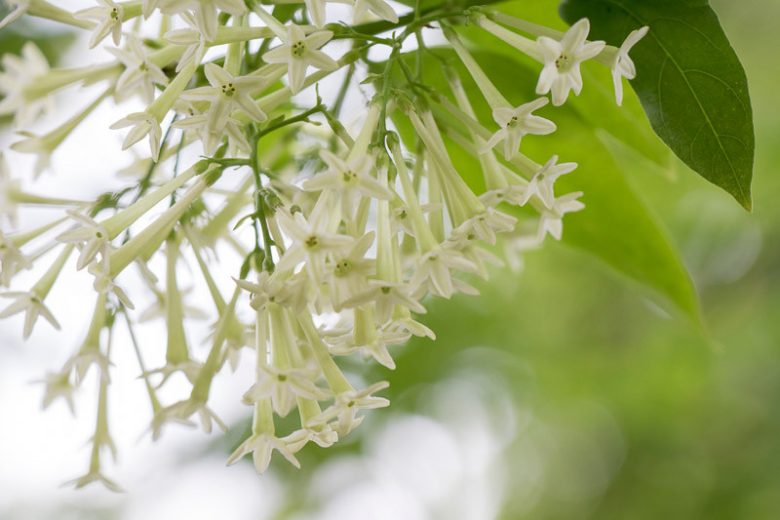
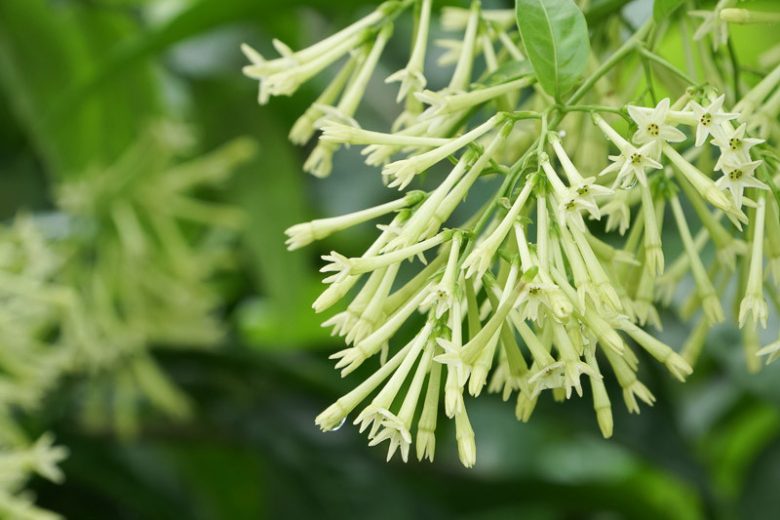
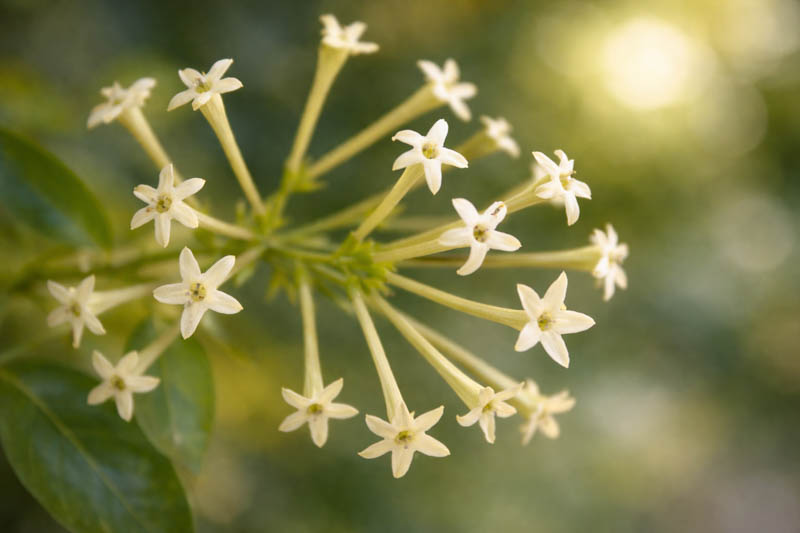
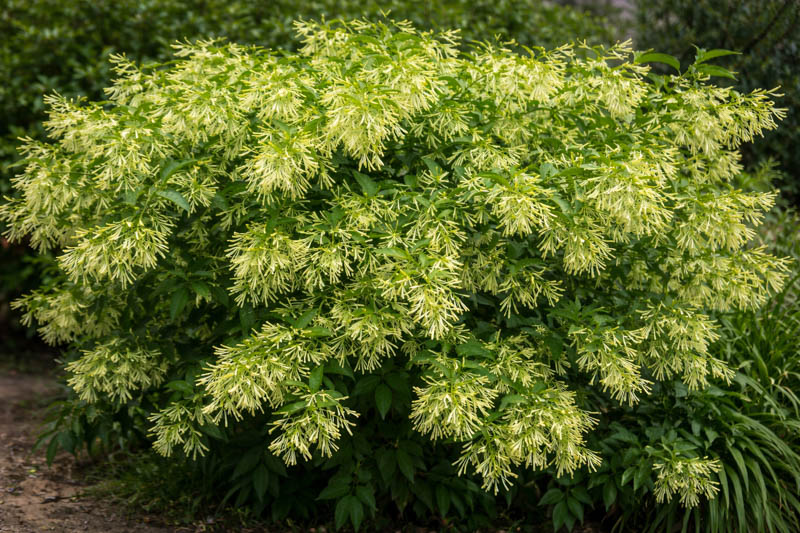


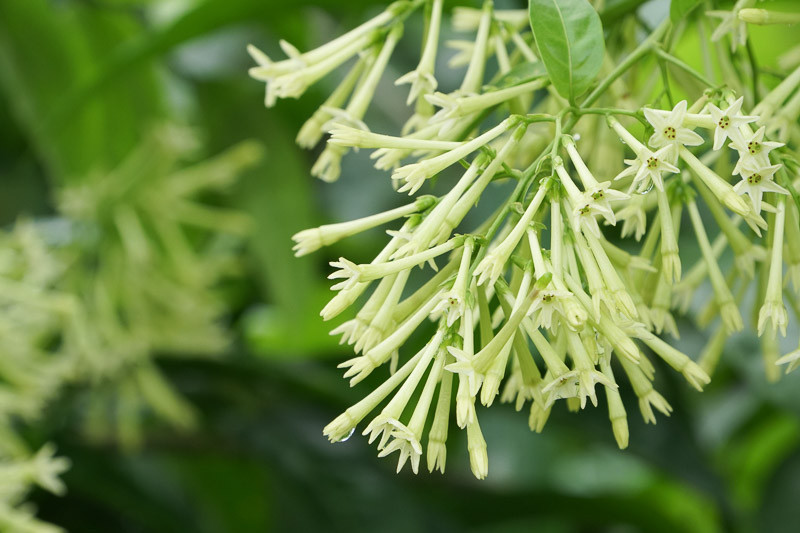
Cestrum nocturnum, commonly called Night-Blooming Jasmine, Night Jessamine, or Lady of the Night, is a fast-growing evergreen shrub grown above all for its extraordinary nighttime fragrance. Its slender, tubular, creamy white to pale green flowers open after dusk and release a sweet, musky perfume that can travel remarkably far in warm, still air. The flowers are modest in appearance, but the scent is unforgettable. In the right place, this shrub becomes one of the most memorable fragrance plants in a warm-climate garden.
Cestrum nocturnum is a tender evergreen flowering shrub grown for intensely fragrant tubular blooms that open at night. Plant it in full sun to part shade in fertile, moist but well-drained soil, give it warmth and shelter, water regularly while establishing, and prune as needed to control size after flowering or during active growth. Best in USDA Zones 9-11, it is widely grown near patios, entrances, windows, and seating areas where its evening scent can be fully appreciated. Because the plant is toxic if eaten and invasive in some warm regions, site selection should be thoughtful.
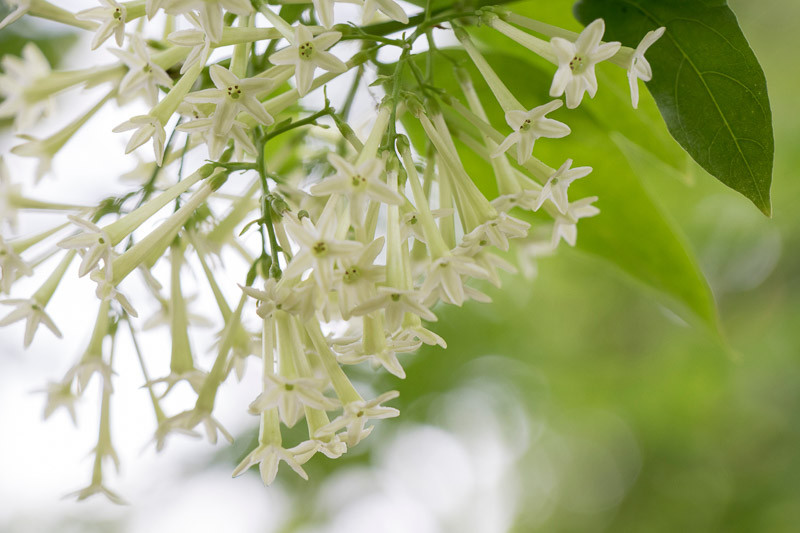
Use: Excellent for hedges, screens, shrub borders, warm walls, large containers, and fragrance gardens.
Highlight: Clusters of powerfully fragrant creamy white to pale green tubular flowers that open at night over a long warm-season bloom period.
Design note: Place it where evening scent matters – near patios, doors, courtyards, windows, and garden paths – but not so close that the fragrance becomes overwhelming indoors.
| Botanical Name | Cestrum nocturnum |
|---|---|
| Family | Nightshade family (Solanaceae) |
| Common Names | Night-Blooming Jasmine, Night Jessamine, Lady of the Night, Night-Flowering Jessamine |
| Native Range | Southern Mexico, Central America, Panama, and the West Indies |
| Plant Type | Evergreen shrub, scrambling shrub, tropical ornamental |
| Hardiness (approx. USDA) | Best in USDA Zones 9-11 |
| Height | 3-13 ft. (0.9-4 m) |
| Spread | 3-13 ft. (0.9-4 m) |
| Sun Exposure | Full sun to part shade |
| Soil | Rich to moderately fertile, moist but well-drained soil |
| Bloom Time | Warm season; often flowers freely from summer into fall in favorable climates |
| Flower Color | Creamy white to pale green |
| Foliage | Glossy green, elliptic to oblong leaves on arching stems |
| Wildlife | Pollinated by moths and other night-flying insects |
| Toxicity | Poisonous if ingested; all major plant parts should be treated with caution |
Night-Blooming Jasmine is an evergreen ornamental shrub grown primarily for fragrance rather than floral display. By day, it is an attractive but relatively understated shrub with arching stems and glossy green foliage. By night, it changes character completely as its narrow flowers open and perfume the surrounding air. That contrast – modest by daylight, unforgettable after dusk – is the main reason Cestrum nocturnum remains one of the best-known warm-climate scent plants.
Cestrum nocturnum is a bushy to sprawling evergreen shrub with long, slender, often arching stems that may be pruned into a dense mound or allowed to grow in a looser, somewhat scrambling habit. Leaves are generally glossy green, simple, smooth-edged, and elliptic to oblong, contributing to the plant’s refined tropical appearance even when it is not in bloom.
The flowers are produced in clusters, usually near the ends of the stems. Each flower is narrow, tubular, and typically about 1 inch long (2.5 cm), creamy white to pale green, and adapted more for scent than visual display. Rather than creating showy color from across the garden, the flowers create impact through perfume. In bloom, the plant can scent a broad area, especially in warm, sheltered conditions.
After flowering, the plant may produce small, white, ovoid to oblong berries. These fruits help explain both the plant’s ornamental persistence and its invasive potential in some warm regions, since birds may disperse them beyond the original planting site.
Cestrum nocturnum is native to southern Mexico, Central America, Panama, and the West Indies. It is now cultivated widely in tropical and subtropical regions as an ornamental fragrance shrub.
Night-Blooming Jasmine is valued for a long flowering season rather than a single brief flush. In favorable climates, it often flowers repeatedly through the warm season, especially from summer into fall. The flowers open at night and close by morning, which makes the species especially suitable for moon gardens, evening patios, outdoor dining spaces, and gardens designed around nighttime atmosphere.
The plant’s habit varies with climate, age, pruning, and site conditions. It may be upright and bushy when young, more arching and spreading with maturity, or somewhat scrambling if left largely unpruned. In frost-free climates, the foliage remains evergreen and provides year-round structure. This flexible growth habit allows the plant to function as a hedge, informal screen, wall-side shrub, large container specimen, or focal fragrance shrub near seating areas.
This is a vigorous shrub, not a small accent plant. Mature specimens commonly grow 3 to 13 feet tall with a similar spread. In rich soil and consistently warm conditions, growth can be fast. That vigor is useful when screening or quick landscape effect is desired, but it also means that pruning is often necessary to keep the plant dense, balanced, and within bounds.
Cestrum nocturnum performs best in USDA Zones 9-11. It is a tender evergreen that dislikes frost and may be damaged or killed by freezing temperatures. In colder regions, it is best grown in a conservatory, greenhouse, or patio container that can be moved indoors before cold weather arrives.
Cestrum nocturnum has received the Royal Horticultural Society’s Award of Garden Merit, confirming its reliability, beauty, and garden performance.
Takeaway:
Night-Blooming Jasmine is grown for fragrance first, flowers second. If you want a plant that transforms a warm evening garden with scent, few shrubs rival Cestrum nocturnum.
The flowers are pollinated by moths and other night-flying insects, giving the plant value in nocturnal pollinator gardens. At the same time, ecological value must be balanced with regional risk. In some subtropical and tropical regions, Cestrum nocturnum has escaped cultivation, spread by birds, and formed dense thickets.
This is a plant that deserves serious caution. NC State Extension flags Cestrum nocturnum as poisonous to humans and problematic for cats, dogs, horses, children, and livestock. The plant is described as highly toxic, with poisonous compounds reported in the bark, flowers, fruits, leaves, roots, seeds, and stems.
Reported symptoms after ingestion in large quantities include headache, dizziness, hallucinations, nausea, vomiting, bloody diarrhea, muscular spasms, nervousness, high temperature, salivation, sweating, paralysis, and coma. NC State also notes elevated calcium levels, hepatic necrosis, and liver failure among reported toxic effects. In practical gardening terms, this is not merely a “handle with care” ornamental. It should be planted thoughtfully and kept away from areas where accidental ingestion is more likely.
Its fragrance can also be too intense for some people in enclosed spaces or for those sensitive to strong scents. That is not the same as toxicity, but it is another reason placement matters.
Night-Blooming Jasmine is a beautiful but caution-worthy ornamental. All major plant parts should be treated as potentially hazardous if eaten, and site selection matters around children, pets, and livestock.
Cestrum nocturnum is not simply “vigorous.” In several warm regions, it has escaped cultivation and naturalized beyond gardens, and in some places it is regarded as a serious invasive risk. In Florida, for example, UF/IFAS assesses it as High Invasion Risk and does not recommend it. In parts of Oceania, including Australia, New Zealand, Fiji, French Polynesia, New Caledonia, and Samoa, it has also been reported as an aggressive weed or invasive plant. Its bird-dispersed fruits help it spread, and established shrubs can form dense thickets that crowd out native vegetation.
Gardeners should check local and regional guidance before planting, especially near natural areas, woodland edges, or habitats where birds may carry the fruit into surrounding vegetation. Where spread is a concern, remove spent flower clusters before berries mature, watch for volunteer seedlings, and avoid casual planting in ecologically sensitive areas. Check where it is invasive in the U.S.
Night-Blooming Jasmine can be invasive in frost-free climates. In warm regions, responsible gardeners should verify local recommendations before planting and remove berries if spread is a concern.
Water regularly during establishment. Once rooted, Night-Blooming Jasmine tolerates short dry periods better than many tropical shrubs, but flowering and foliage quality are best when the soil does not remain dry for long. In containers, watering must be more consistent because warm weather and fast growth can dry pots quickly.
Feed in spring with compost or a balanced fertilizer, and repeat lightly in summer if the plant looks weak or pale. Avoid overfeeding with high nitrogen, which can push excessive leafy growth at the expense of flowering.
Placement tip:
The best place for Night-Blooming Jasmine is close enough to enjoy the perfume, but not so close that the scent becomes overpowering indoors or in tightly enclosed outdoor spaces.
Pruning is simple but important. This shrub responds well to trimming and can be kept dense, rounded, hedge-like, or more informal depending on how it is used. Remove weak, tangled, or wayward stems to improve shape and airflow. Heavier pruning can be used to reduce size after flowering flushes or during active growth in warm climates. If berry production is unwanted because of toxicity or spread risk, remove spent flower clusters before fruit matures.
A light mulch helps conserve soil moisture, moderate root temperatures, and reduce summer stress. Keep mulch clear of the stem base to avoid excess moisture around the crown.
In truly warm climates, winter care is minimal. In marginal areas, protect plants from frost and cold wind. Container-grown plants should be brought indoors or into a greenhouse before temperatures drop into the danger zone. Indoors, provide bright light and reduce watering slightly while growth slows.
Cestrum nocturnum is most successful where heat, long growing seasons, and frost-free conditions support active growth. Its main limitations are cold sensitivity, overwhelming fragrance in confined spaces, fast growth that demands pruning, and the practical challenges of overwintering large container plants in colder climates.
Container culture is often the smartest option outside mild regions, but even then the plant can become large quickly. Flowering indoors may be reduced if light is insufficient, and many gardeners find that the scent is less desirable inside the house than outdoors in evening air. For that reason, overwintering is often best done in bright protected conditions rather than in prime living space.
Night-Blooming Jasmine adapts well to container culture, which is often the best way to grow it outside truly tropical climates. Use a large container with excellent drainage, a rich but airy potting mix, and a position in sun or bright filtered light. Prune regularly to keep the plant balanced and manageable.
Because potted plants dry out faster and exhaust nutrients sooner than in-ground shrubs, they need more attentive watering and feeding. Container-grown plants are also easier to move under protection before cold weather, which is one of the main advantages of pot culture in cooler climates.
When this plant struggles, the causes are usually practical rather than mysterious. Weak bloom most often points to inadequate light, excessive nitrogen, or repeated hard pruning at the wrong time. Yellowing foliage often suggests drainage issues, inconsistent watering, or root stress. Overgrown, sparse, or sprawling plants usually need more decisive shaping and better light.
Pest pressure is generally light, but whiteflies, aphids, and spider mites may appear, especially on stressed plants or under protected growing conditions with limited airflow. In most cases, stronger light, steadier watering, less excess fertilizer, and improved air movement solve more problems than aggressive spraying.
Fruit production can also become a “problem” in two ways: it increases the risk of accidental ingestion and it increases the risk of unwanted spread where birds disperse berries. In these cases, deadheading after flowering is more useful than treating the issue as purely ornamental mess.
This shrub performs best where fragrance is the main goal: near patios, terraces, warm walls, seating areas, and enclosed-but-ventilated courtyards where scent can gather pleasantly after sunset.
It is a poor choice for some settings. Avoid using it casually near children’s play spaces, pet-heavy gardens, livestock areas, enclosed bedrooms, or landscapes close to sensitive natural areas in regions where it may spread. In other words, it is a highly effective plant, but not a universally appropriate one.
Because this shrub is fragrance-led, the best companions are plants that support the atmosphere without competing too aggressively. Choose warm-climate shrubs, perennials, and grasses that enjoy similar light and drainage and that reinforce the evening-garden mood. Silver foliage, bold tropical leaves, and pale moon-garden flowers all work well with the glossy green foliage and pale blooms of Cestrum nocturnum.
Cestrum nocturnum, commonly called Night-Blooming Jasmine or Night Jessamine, is a fragrant evergreen shrub grown mainly for tubular flowers that open at night and release a powerful sweet scent.
No. It is not a true jasmine. It belongs to the nightshade family, Solanaceae, not the genus Jasminum.
It typically grows 3 to 13 feet tall and about as wide, depending on climate, pruning, and growing conditions.
It flowers during the warm season, often repeatedly from summer into fall in favorable climates.
Yes. NC State Extension describes it as poisonous, with toxic compounds reported in the bark, flowers, fruits, leaves, roots, seeds, and stems.
Yes. It grows well in a large container with excellent drainage, regular feeding, and winter protection in cold climates.
In some warm regions, yes. Florida, for example, treats it as high invasion risk, but the degree of concern varies by region, so local guidance should be checked before planting.
Its flowers are pollinated by moths and other night-flying insects.
Updated: March 2026 – Reviewed by Gardenia Editors
| Hardiness |
9 - 11 |
|---|---|
| Climate Zones | 13, 16, 17, 18, 19, 20, 21, 22, 23, 24, H1, H2 |
| Plant Type | Shrubs |
| Plant Family | Solanaceae |
| Common names | Lady of the Night, Night-Blooming Jasmine, Queen of the Night |
| Exposure | Full Sun, Partial Sun |
| Season of Interest | Summer (Early, Mid, Late) |
| Height | 3' - 13' (90cm - 4m) |
| Spread | 3' - 13' (90cm - 4m) |
| Spacing | 72" - 120" (180cm - 3m) |
| Maintenance | Low |
| Water Needs | Average |
| Soil Type | Chalk, Loam, Sand |
| Soil pH | Acid, Alkaline, Neutral |
| Soil Drainage | Moist but Well-Drained, Well-Drained |
| Characteristics | Fragrant, Showy, Evergreen, Plant of Merit |
| Tolerance | Deer, Rabbit |
| Attracts | Birds |
| Garden Uses | Beds And Borders, Hedges And Screens, Patio And Containers, Wall-Side Borders |
| Garden Styles | City and Courtyard, Mediterranean Garden |


| Hardiness |
9 - 11 |
|---|---|
| Climate Zones | 13, 16, 17, 18, 19, 20, 21, 22, 23, 24, H1, H2 |
| Plant Type | Shrubs |
| Plant Family | Solanaceae |
| Common names | Lady of the Night, Night-Blooming Jasmine, Queen of the Night |
| Exposure | Full Sun, Partial Sun |
| Season of Interest | Summer (Early, Mid, Late) |
| Height | 3' - 13' (90cm - 4m) |
| Spread | 3' - 13' (90cm - 4m) |
| Spacing | 72" - 120" (180cm - 3m) |
| Maintenance | Low |
| Water Needs | Average |
| Soil Type | Chalk, Loam, Sand |
| Soil pH | Acid, Alkaline, Neutral |
| Soil Drainage | Moist but Well-Drained, Well-Drained |
| Characteristics | Fragrant, Showy, Evergreen, Plant of Merit |
| Tolerance | Deer, Rabbit |
| Attracts | Birds |
| Garden Uses | Beds And Borders, Hedges And Screens, Patio And Containers, Wall-Side Borders |
| Garden Styles | City and Courtyard, Mediterranean Garden |
How many Cestrum nocturnum (Night-Blooming Jasmine) do I need for my garden?
| Plant | Quantity | |
|---|---|---|
| Cestrum nocturnum (Night-Blooming Jasmine) | N/A | Buy Plants |
Create a membership account to save your garden designs and to view them on any device.
Becoming a contributing member of Gardenia is easy and can be done in just a few minutes. If you provide us with your name, email address and the payment of a modest $25 annual membership fee, you will become a full member, enabling you to design and save up to 25 of your garden design ideas.
Join now and start creating your dream garden!
Create a membership account to save your garden designs and to view them on any device.
Becoming a contributing member of Gardenia is easy and can be done in just a few minutes. If you provide us with your name, email address and the payment of a modest $25 annual membership fee, you will become a full member, enabling you to design and save up to 25 of your garden design ideas.
Join now and start creating your dream garden!