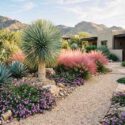
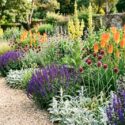
A stunning desert courtyard border featuring Texas sage, Apache plume, blue sotol, and red yucca - heat-loving, drought-tolerant plants for low-water landscapes.
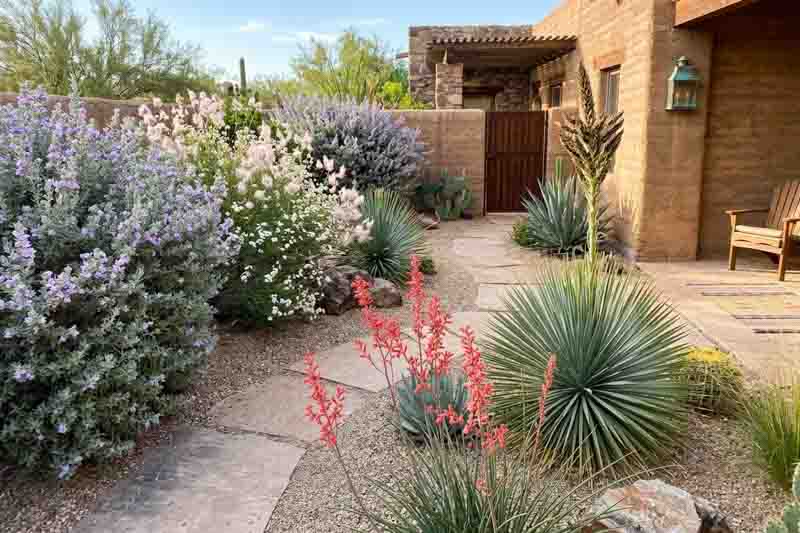


This sunny courtyard uses a restrained group of desert plants to soften gravel, stone paving, and warm adobe walls. Mature Leucophyllum frutescens fills much of the left side with silver-gray foliage and lavender-purple flowers, while the looser growth of Fallugia paradoxa rises behind it with white flowers and pale feathery seedheads.
Closer to the path, rounded Dasylirion wheeleri plants provide strong evergreen forms, and Hesperaloe parviflora sends coral-red flower stalks above its narrow foliage. Agaves, prickly pears, rocks, and a few smaller desert plants appear elsewhere in the courtyard, adding variety without competing with the four featured plants.
Main plants used: Leucophyllum frutescens, Fallugia paradoxa, Dasylirion wheeleri, and Hesperaloe parviflora
The photograph shows how well these plants suit a courtyard where the hardscape is always visible. Gravel and broad flagstones leave clear spaces around the plants, so their natural forms are easy to appreciate rather than disappearing into a densely filled border.
Texas Sage provides the largest mass, but its small silver leaves keep it from looking heavy against the wall. Apache Plume is much looser, with slender branches, white flowers, and feathery seedheads that give the upper part of the planting a lighter appearance.
At ground level, Desert Spoon changes the scale completely. Its narrow leaves radiate from a central crown to form a bold, almost spherical plant. Red Yucca is less bulky but becomes conspicuous when its coral flower stems rise above the gravel.
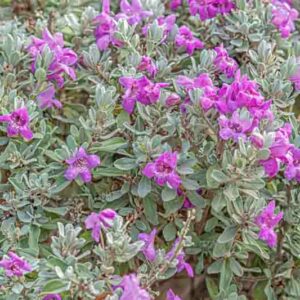
Leucophyllum frutescens forms the main shrub layer. Its silver-gray foliage suits the pale gravel and warm walls even when the plant is not flowering. During warm weather, it can produce dramatic flushes of lavender-purple bloom, often associated with periods of increased humidity or rainfall. Allow shrubs to retain their naturally rounded shape rather than repeatedly shearing them into tight forms.
Fallugia paradoxa provides a noticeably lighter texture. White, rose-like flowers are followed by pinkish to silvery feathery seed plumes, so the shrub remains interesting after flowering. Its open branching habit works particularly well beside denser Texas Sage.
Dasylirion wheeleri, or Desert Spoon, is one of the strongest year-round forms in the courtyard. Its long blue-green leaves radiate outward from the center, eventually forming a substantial rounded specimen. Keep mature plants away from narrow walkways and seating areas because the leaf margins are toothed.
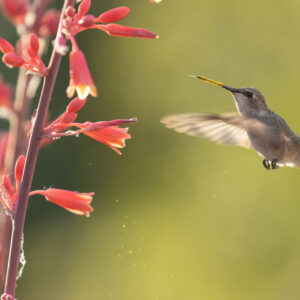
Hesperaloe parviflora produces narrow evergreen foliage and tall coral-red to pink flower stalks. In the photograph, these flower stems provide some of the brightest color near the path without taking up much ground space. The tubular flowers are particularly attractive to hummingbirds.
Create an open Southwestern courtyard where silver shrubs soften walls and boundaries while distinctive desert rosettes and flowering stalks punctuate gravel and paving.
These percentages describe the balance of the four featured plants rather than equal numbers. Mature shrubs and Desert Spoons will occupy substantially more physical space than individual Red Yuccas.
Use Texas Sage toward the perimeter or against broad walls where its mature width can be accommodated. Mix in Apache Plume rather than creating a continuous row of identical shrubs; its looser branches help break up the heavier masses.
Place Desert Spoon as individual or repeated specimens beside wider areas of gravel, keeping enough distance from the path for its mature leaves. Position Red Yucca where its tall flowering stems will be visible against walls, shrubs, or open sky.
Leave irregular areas of exposed gravel between the four main plants. Agaves, prickly pears, boulders, or other desert plants can be added selectively, as shown in the courtyard, without turning the planting into a crowded collection.
These are low-water plants, but newly installed specimens still need regular irrigation until their roots are established. Once mature, watering can be reduced considerably, with occasional deep irrigation during exceptionally hot or dry periods.
Drainage is equally important. In heavy or poorly drained soil, use raised planting areas or properly constructed, freely draining beds rather than placing these plants where water collects.
Finally, plan carefully around paths and doors. The photograph works because the broadest plants are given room away from the main walkway, while the more open Red Yucca occupies narrower spaces. Desert Spoon in particular should not be planted where its mature leaves will project into regular foot traffic.
| Hardiness |
8 - 10 |
|---|---|
| Exposure | Full Sun |
| Season of Interest | Spring (Late), Summer (Early, Mid, Late), Fall |
| Maintenance | Low |
| Water Needs | Low |
| Soil Type | Loam, Sand |
| Soil pH | Alkaline, Neutral |
| Soil Drainage | Well-Drained |
| Characteristics | Showy, Evergreen |
| Native Plants | United States, Southwest, Texas |
| Tolerances | Drought |
| Attracts | Bees, Butterflies, Hummingbirds, Birds |
| Landscaping Ideas | Beds And Borders |
| Garden Styles | Butterfly Garden, City and Courtyard, Informal and Cottage, Pollinator Garden |



| Hardiness |
8 - 10 |
|---|---|
| Exposure | Full Sun |
| Season of Interest | Spring (Late), Summer (Early, Mid, Late), Fall |
| Maintenance | Low |
| Water Needs | Low |
| Soil Type | Loam, Sand |
| Soil pH | Alkaline, Neutral |
| Soil Drainage | Well-Drained |
| Characteristics | Showy, Evergreen |
| Native Plants | United States, Southwest, Texas |
| Tolerances | Drought |
| Attracts | Bees, Butterflies, Hummingbirds, Birds |
| Landscaping Ideas | Beds And Borders |
| Garden Styles | Butterfly Garden, City and Courtyard, Informal and Cottage, Pollinator Garden |
Recreate this garden. Specify the percentages you would like to have of each plant and input the dimensions of your garden space.We'll give you a shopping list so you know how many plants you need.
| Plant | Quantity | |
|---|---|---|
| Leucophyllum frutescens (Texas Sage) | N/A | Buy Plants |
| Fallugia paradoxa (Apache Plume) | N/A | Buy Plants |
| Hesperaloe parviflora (Red Yucca) | N/A | Buy Plants |
| Dasylirion wheeleri (Desert Spoon) | N/A | Buy Plants |
Create a membership account to save your garden designs and to view them on any device.
Becoming a contributing member of Gardenia is easy and can be done in just a few minutes. If you provide us with your name, email address and the payment of a modest $25 annual membership fee, you will become a full member, enabling you to design and save up to 25 of your garden design ideas.
Join now and start creating your dream garden!