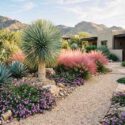
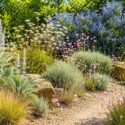
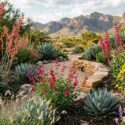
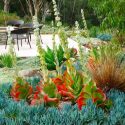
A sculptural desert garden featuring Agave parryi, Red Yucca, Desert Spoon, Texas Sage, and Autumn Sage: perfect for hot, dry, low-water landscapes.
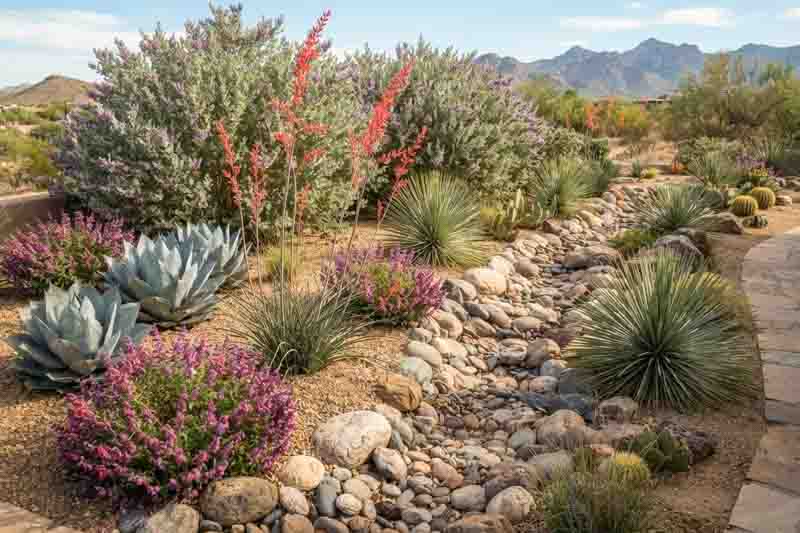


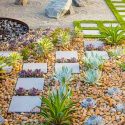
This Southwestern garden is organized around a broad dry creek bed that winds through gravel, rounded stones, and drought-adapted planting. Large silver-gray shrubs of Leucophyllum frutescens form the background, while blue-gray rosettes of Agave parryi sit prominently in the foreground. Tall coral-red flower stalks of Hesperaloe parviflora rise above the lower plants, and repeated Dasylirion wheeleri create strong rounded forms along both sides of the creek.
Lower mounds of Salvia greggii bring purple-pink flowers into the gravel planting and soften the transition between the larger architectural plants. Scattered cacti and other desert species appear farther through the landscape, making the garden feel established rather than restricted to five evenly repeated plants.
Main plants used: Agave parryi, Hesperaloe parviflora, Dasylirion wheeleri, Salvia greggii, and Leucophyllum frutescens
The dry creek is central to the design. Its mix of rounded stones and larger boulders creates a strong line through the garden while providing open space between the plants. The creek also makes the planting easier to read: large rosettes, rounded shrubs, fine leaves, and flower stalks all stand out clearly against the stone.
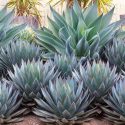
The plants themselves offer very different shapes. Agave parryi forms broad, low rosettes, while Desert Spoon produces large spheres of narrow radiating leaves. Red Yucca stays comparatively low in foliage but sends flower stalks high above the garden. Texas Sage forms the largest soft mass, providing a useful contrast to the harder outlines of the agaves and spoons.
Autumn Sage fills selected gaps with a looser, more flowering habit. Its smaller scale keeps the garden from becoming a collection of isolated specimen plants.
Agave parryi provides some of the strongest year-round structure in the garden. Its blue-gray rosettes contrast particularly well with tan gravel and rounded creek stones. Full sun and excellent drainage are essential, especially during winter.
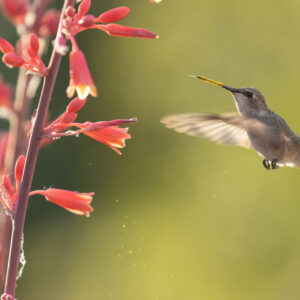
Hesperaloe parviflora adds height without creating a bulky plant. Its narrow evergreen leaves remain relatively low, while tall coral-red flower stalks appear above them during the warmer months. The tubular flowers are especially attractive to hummingbirds.
Dasylirion wheeleri develops into a substantial rounded plant made up of hundreds of narrow leaves. Repeating it at intervals along the creek helps connect different parts of the garden, but allow plenty of room for mature specimens.
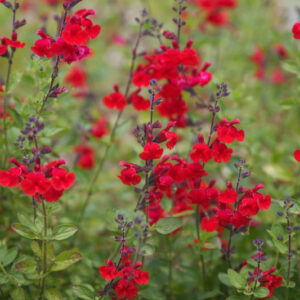
Salvia greggii introduces softer growth and repeated flowering. Flower color varies widely by cultivar; purple and magenta selections work particularly well with silver foliage and blue-gray agaves. Light pruning can encourage a denser habit and fresh flowering growth.
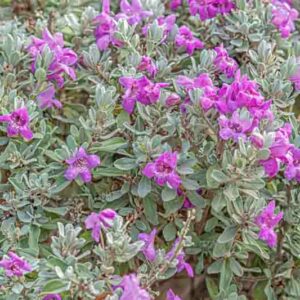
Leucophyllum frutescens forms the largest shrub layer. Its silver foliage is attractive even when the plant is not blooming, while bursts of lavender-purple flowers often follow periods of summer humidity or rainfall. Allow its naturally rounded habit to develop instead of repeatedly shearing it into a formal ball.
Create a dry Southwestern landscape where a stone-lined creek provides the main route through repeated groups of silver shrubs, blue rosettes, flowering perennials, and spiky desert plants.
These percentages describe the balance of the five featured plants rather than a literal plant count. Larger Texas Sage and Desert Spoon specimens will occupy considerably more physical space than Autumn Sage.
Shape the dry creek first, using a mixture of larger boulders and smaller rounded stones rather than rocks of one uniform size.
Position Texas Sage toward the back and sides, where its mature width can be accommodated. Repeat Desert Spoon along the creek, but vary the distances between individual plants.
Use Agave as lower focal points and place Red Yucca where its flower stalks can rise clearly above neighboring plants. Fill selected gaps with irregular groups of Autumn Sage, while preserving areas of exposed gravel.
These plants are drought adapted, but low-water gardening does not mean no watering. Newly planted specimens need regular irrigation while their roots establish, and mature plants may still benefit from occasional deep watering during prolonged drought.
Drainage is just as important as irrigation. Agave and Desert Spoon are particularly vulnerable where water remains around their crowns and roots. In heavy or poorly drained soil, plant them on raised mounds or in properly constructed, freely draining beds rather than in low areas where water collects.
Allow for mature size as well. Texas Sage and Desert Spoon can become substantial plants, and the exposed gravel between young specimens will gradually narrow. Leaving some deliberate open space at planting time generally produces a better long-term landscape than filling every gap immediately.
| Hardiness |
8 - 9 |
|---|---|
| Exposure | Full Sun |
| Season of Interest | Spring (Early, Mid, Late), Summer (Early, Mid, Late), Fall, Winter |
| Maintenance | Low |
| Water Needs | Low |
| Soil Type | Loam, Sand |
| Soil pH | Alkaline, Neutral |
| Soil Drainage | Well-Drained |
| Characteristics | Showy, Evergreen |
| Native Plants | United States, Southwest, Texas |
| Tolerances | Drought, Deer |
| Attracts | Bees, Butterflies, Hummingbirds, Birds |
| Landscaping Ideas | Beds And Borders |
| Garden Styles | Butterfly Garden, Gravel and Rock Garden, Informal and Cottage, Pollinator Garden |



| Hardiness |
8 - 9 |
|---|---|
| Exposure | Full Sun |
| Season of Interest | Spring (Early, Mid, Late), Summer (Early, Mid, Late), Fall, Winter |
| Maintenance | Low |
| Water Needs | Low |
| Soil Type | Loam, Sand |
| Soil pH | Alkaline, Neutral |
| Soil Drainage | Well-Drained |
| Characteristics | Showy, Evergreen |
| Native Plants | United States, Southwest, Texas |
| Tolerances | Drought, Deer |
| Attracts | Bees, Butterflies, Hummingbirds, Birds |
| Landscaping Ideas | Beds And Borders |
| Garden Styles | Butterfly Garden, Gravel and Rock Garden, Informal and Cottage, Pollinator Garden |
Recreate this garden. Specify the percentages you would like to have of each plant and input the dimensions of your garden space.We'll give you a shopping list so you know how many plants you need.
| Plant | Quantity | |
|---|---|---|
| Leucophyllum frutescens (Texas Sage) | N/A | Buy Plants |
| Salvia greggii (Autumn Sage) | N/A | Buy Plants |
| Hesperaloe parviflora (Red Yucca) | N/A | Buy Plants |
| Dasylirion wheeleri (Desert Spoon) | N/A | Buy Plants |
| Agave parryi (Artichoke Agave) | N/A | Buy Plants |
Create a membership account to save your garden designs and to view them on any device.
Becoming a contributing member of Gardenia is easy and can be done in just a few minutes. If you provide us with your name, email address and the payment of a modest $25 annual membership fee, you will become a full member, enabling you to design and save up to 25 of your garden design ideas.
Join now and start creating your dream garden!