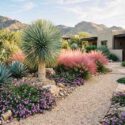
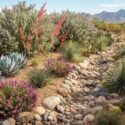
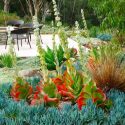
Bring the beauty of California’s wild landscapes home. This native dry garden shimmers with silver foliage, pink blooms, and soft grasses—thriving effortlessly in sun and drought. Low maintenance and full of pollinator life, it’s sustainable gardening that feels timeless, natural, and beautifully local.
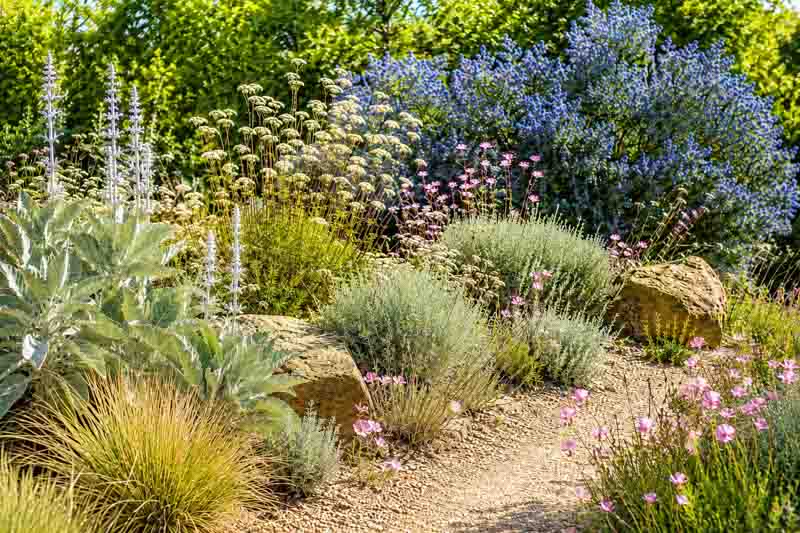


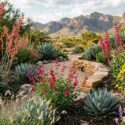
This sunny dry garden combines some of California’s most distinctive foliage plants with flowers in blue, cream, white, and pink. A mature Ceanothus ‘Concha’ forms the deep blue backdrop, while the broad silver leaves and tall pale flower stalks of Salvia apiana stand out strongly in the foreground.
Between them, Eriogonum fasciculatum carries airy cream-colored flower clusters, and low mounds of Artemisia californica repeat the gray-green foliage through the planting. Festuca californica adds a finer grassy texture near the path, while pink Oenothera speciosa appears informally through the open gravel rather than forming a continuous edging.
Main plants used: Salvia apiana, Eriogonum fasciculatum, Artemisia californica, Festuca californica, Ceanothus ‘Concha’, and Oenothera speciosa
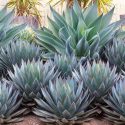
The strongest contrast comes from foliage. White Sage has broad, pale leaves, California Sagebrush is finer and more feathery, and California Fescue contributes narrow arching blades. Those differences keep a predominantly gray-green planting from becoming visually flat.
The flowers also arrive in very different forms. Ceanothus creates the largest block of color with dense blue clusters. White Sage sends tall flower stalks above its foliage, while California Buckwheat carries smaller cream-colored clusters on branching stems. Pink evening primrose provides a lighter, lower accent through the gravel.
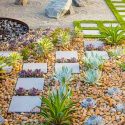
The photograph also shows the importance of leaving some ground exposed. Gravel, rocks, and open spaces remain visible between the plants, allowing the shrubs and rounded foliage masses to keep their individual shapes. A dry garden can still look full without covering every inch of soil.
Salvia apiana, or White Sage, is one of the strongest foliage plants in the combination. Its aromatic silver-white leaves reflect intense sunlight, while tall flower stalks rise above the foliage in spring and early summer. It performs best in full sun, excellent drainage, and relatively lean soil.
Eriogonum fasciculatum, or California Buckwheat, has a looser, branching habit. Creamy flower clusters gradually age toward pink, rust, and brown, extending seasonal interest and providing an important food source for native insects.
Artemisia californica, or California Sagebrush, contributes fine aromatic gray-green foliage. It works particularly well in irregular mounds between larger shrubs rather than as a clipped edging. During severe summer drought, plants may become less leafy as part of their natural adaptation to dry conditions.
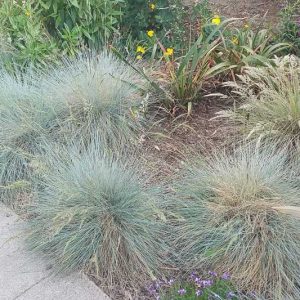
Festuca californica, or California Fescue, forms soft clumps of narrow blue-green to gray-green foliage. It is especially useful near rocks and paths, where its arching leaves contrast with the broader foliage of the shrubs. Compared with the more drought-adapted shrubs in this combination, it generally appreciates somewhat more moisture and can tolerate partial shade, particularly in hotter inland gardens.
Ceanothus ‘Concha’ forms the largest evergreen mass in the garden. Its intense blue spring flowers make it a major focal point, while its dark green foliage remains useful throughout the year. Give it excellent drainage and avoid frequent summer irrigation once established.
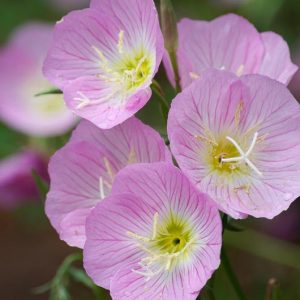
Oenothera speciosa, or Showy Evening Primrose, provides the scattered pink flowers visible near the path. It is not native to California, but it tolerates dry conditions and works visually with the native plants. It can spread quickly by rhizomes and seed, so use it where its expansion can be managed.
Create an open California dry garden where large native shrubs provide structure and smaller silver-foliaged plants, grasses, and seasonal flowers fill the spaces without hiding the gravel.
Give the greatest physical space to Ceanothus, White Sage, California Buckwheat, and California Sagebrush. Use California Fescue in smaller repeated clumps and allow Showy Evening Primrose to appear as scattered pink accents rather than a continuous groundcover.
Position Ceanothus first where its mature width can be accommodated, using it as the main evergreen background plant.
Repeat White Sage, California Buckwheat, and California Sagebrush in irregular groups through the middle of the planting. Avoid arranging the silver shrubs in a straight line or at equal intervals.
Place California Fescue near rocks and path edges, particularly where the soil retains slightly more moisture. Allow small pockets of Showy Evening Primrose to appear through the gravel, while keeping enough open mineral surface visible to preserve the dry-garden character.
A California dry garden should not automatically be treated as a zero-water garden. Newly planted shrubs need regular irrigation while establishing, and even mature plants may need occasional deep watering during exceptional drought. Frequent shallow summer watering, however, can be harmful to several California chaparral and coastal-sage species.
The plants also differ in their tolerance of summer moisture. California Fescue generally appreciates more moisture than Ceanothus, White Sage, and California Sagebrush and can tolerate some partial shade, especially in hotter inland gardens. Positioning it accordingly makes the combination easier to manage.
Finally, Oenothera speciosa is not California-native and can spread aggressively. Where a strictly native planting is the goal—or where its spreading habit is undesirable—replace it with a locally appropriate California wildflower suited to the same exposure and soil.
| Hardiness |
8 - 9 |
|---|---|
| Climate Zones | 7, 8, 9, 14, 15, 16, 17, 18, 19, 20, 21, 22, 23, 24 |
| Exposure | Full Sun |
| Season of Interest | Spring (Early, Mid, Late), Summer (Early, Mid, Late), Fall, Winter |
| Maintenance | Low |
| Water Needs | Low |
| Soil Type | Loam, Sand |
| Soil pH | Alkaline, Neutral |
| Soil Drainage | Well-Drained |
| Characteristics | Showy, Fragrant |
| Native Plants | United States |
| Tolerances | Drought, Deer |
| Attracts | Bees, Butterflies, Birds |
| Landscaping Ideas | Beds And Borders |
| Garden Styles | Butterfly Garden, Gravel and Rock Garden, Informal and Cottage, Pollinator Garden |





| Hardiness |
8 - 9 |
|---|---|
| Climate Zones | 7, 8, 9, 14, 15, 16, 17, 18, 19, 20, 21, 22, 23, 24 |
| Exposure | Full Sun |
| Season of Interest | Spring (Early, Mid, Late), Summer (Early, Mid, Late), Fall, Winter |
| Maintenance | Low |
| Water Needs | Low |
| Soil Type | Loam, Sand |
| Soil pH | Alkaline, Neutral |
| Soil Drainage | Well-Drained |
| Characteristics | Showy, Fragrant |
| Native Plants | United States |
| Tolerances | Drought, Deer |
| Attracts | Bees, Butterflies, Birds |
| Landscaping Ideas | Beds And Borders |
| Garden Styles | Butterfly Garden, Gravel and Rock Garden, Informal and Cottage, Pollinator Garden |
Recreate this garden. Specify the percentages you would like to have of each plant and input the dimensions of your garden space.We'll give you a shopping list so you know how many plants you need.
| Plant | Quantity | |
|---|---|---|
| Ceanothus 'Concha' (California Lilac) | N/A | Buy Plants |
| Salvia apiana (White Sage) | N/A | Buy Plants |
| Eriogonum fasciculatum (California Buckwheat) | N/A | Buy Plants |
| Oenothera speciosa (Evening Primrose) | N/A | Buy Plants |
| Festuca californica (California Fescue) | N/A | Buy Plants |
| Artemisia californica (California Sagebrush) | N/A | Buy Plants |
Create a membership account to save your garden designs and to view them on any device.
Becoming a contributing member of Gardenia is easy and can be done in just a few minutes. If you provide us with your name, email address and the payment of a modest $25 annual membership fee, you will become a full member, enabling you to design and save up to 25 of your garden design ideas.
Join now and start creating your dream garden!