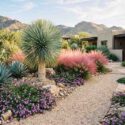
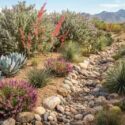
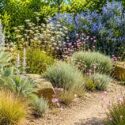
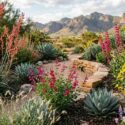
A native shrub border packed with seasonal interest. Buttonbush (summer bloom) and elderberry (late spring to summer bloom) feed pollinators, while Carolina allspice adds spring fragrance. Beautyberry’s purple clusters and winterberry’s red berries carry the display into fall and winter for birds and color.
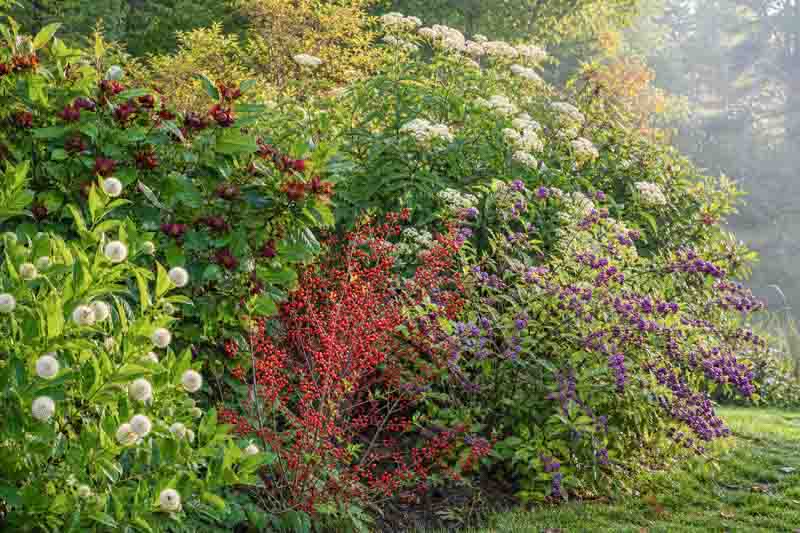


This mixed shrub border brings together five eastern North American natives with different flowering and fruiting seasons. White buttonbush flowers stand out at the front, dark burgundy Carolina allspice blooms appear among the foliage behind them, and American elderberry rises above the planting with broad clusters of creamy white flowers. Red winterberries and purple beautyberries add another layer of color as the season progresses.
The planting is dense, but the shrubs remain easy to distinguish because their flowers, fruit, foliage, and growth habits are so different. Taller shrubs form the background, while lower and more open plants occupy the front and edges. Mature trees and woodland beyond the border make the whole planting feel comfortably at home in its setting.
It is also a useful wildlife garden. Flowers provide nectar and pollen for visiting insects, dense branching offers shelter, and the berries of several shrubs provide food for birds later in the year.
Main plants used: Cephalanthus occidentalis, Calycanthus floridus, Ilex verticillata, Callicarpa americana, and Sambucus canadensis
This border has several periods of interest rather than one short flowering peak. Carolina allspice begins the season with unusual dark flowers and fragrance. Buttonbush and elderberry provide white flowers later, while winterberry and beautyberry become increasingly important as their fruit develops.
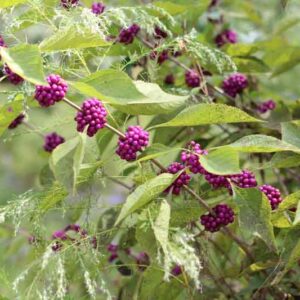
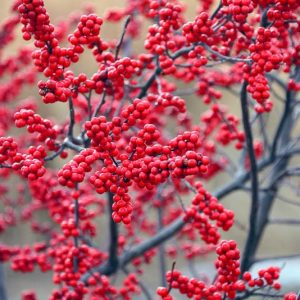
The different fruit colors are especially useful. Winterberry contributes bright red berries, while American beautyberry produces violet-purple clusters along its stems. Because they do not look alike, the two shrubs remain distinct even when planted fairly close together.
There is also plenty of foliage between the showier moments. Elderberry and the other shrubs create a substantial green background, allowing the flowers and berries to stand out without the border needing constant bloom.
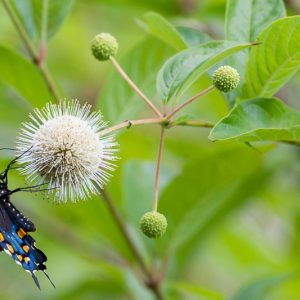
Cephalanthus occidentalis (Buttonbush) is easy to recognize by its round white flower heads. It is particularly useful in moist areas and works well toward the front or middle where the flowers can be seen clearly. Butterflies, bees, and other insects visit the blooms readily.
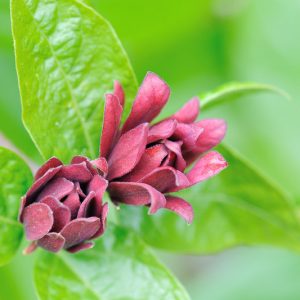
Calycanthus floridus (Carolina Allspice) contributes dark reddish-brown to burgundy flowers and, on many plants, a noticeable fragrance. Place it where its flowers can be appreciated at close range rather than burying it behind larger shrubs.
Ilex verticillata (Winterberry) is grown largely for its bright red fruit. Since winterberry is dioecious, female plants need a compatible male flowering nearby for reliable berry production. The berries become particularly striking after the leaves fall.
Callicarpa americana (American Beautyberry) produces distinctive purple fruit clustered closely around the stems. Give it enough space that the branches remain visible in fall rather than disappearing into neighboring shrubs.
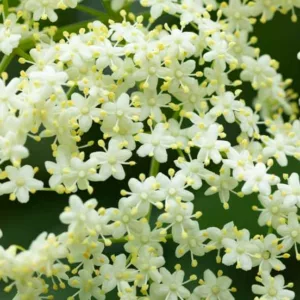
Sambucus canadensis (American Elderberry) is one of the largest plants in the combination. Its broad white flower clusters appear above the foliage, followed by dark fruit. It is best used toward the rear or side of the planting where there is room for its naturally spreading habit.
Create a native shrub border with flowers, fruit, and shelter through several seasons, using shrubs of different heights rather than a single uniform hedge.
Use these proportions only as a guide. Mature size and available space are more important than keeping the percentages exact.
Place elderberry toward the back or side, where its size will not overwhelm smaller shrubs.
Use buttonbush in the moister part of the site and where its summer flowers can be easily seen.
Repeat winterberry and beautyberry through the middle of the planting so the red and purple fruit appears in more than one place.
Keep Carolina allspice reasonably accessible if you want to enjoy its flowers and fragrance at close range.
This is a planting that needs room. Elderberry, buttonbush, Carolina allspice, and beautyberry can all become substantial shrubs, so spacing them for mature size will reduce the need for repeated pruning later.
It is also worth accepting a little irregularity. These shrubs naturally differ in height and spread, and that variation suits a wildlife border. Allowing them to develop as individual plants will usually look more convincing than trying to maintain a perfectly level or symmetrical outline.
| Hardiness |
6 - 9 |
|---|---|
| Exposure | Full Sun, Partial Sun |
| Season of Interest | Spring (Late), Summer (Early, Mid, Late), Fall, Winter |
| Maintenance | Low |
| Water Needs | Average |
| Soil Type | Clay, Loam |
| Soil pH | Acid, Neutral |
| Soil Drainage | Moist but Well-Drained |
| Characteristics | Showy, Fruit & Berries |
| Native Plants | United States, Southeast, North Carolina, Tennessee, Virginia, Alabama, Georgia |
| Tolerances | Clay Soil |
| Attracts | Bees, Butterflies, Birds |
| Landscaping Ideas | Beds And Borders, Rain Gardens |
| Garden Styles | Butterfly Garden, Informal and Cottage, Pollinator Garden |
| Hardiness |
6 - 9 |
|---|---|
| Exposure | Full Sun, Partial Sun |
| Season of Interest | Spring (Late), Summer (Early, Mid, Late), Fall, Winter |
| Maintenance | Low |
| Water Needs | Average |
| Soil Type | Clay, Loam |
| Soil pH | Acid, Neutral |
| Soil Drainage | Moist but Well-Drained |
| Characteristics | Showy, Fruit & Berries |
| Native Plants | United States, Southeast, North Carolina, Tennessee, Virginia, Alabama, Georgia |
| Tolerances | Clay Soil |
| Attracts | Bees, Butterflies, Birds |
| Landscaping Ideas | Beds And Borders, Rain Gardens |
| Garden Styles | Butterfly Garden, Informal and Cottage, Pollinator Garden |
Recreate this garden. Specify the percentages you would like to have of each plant and input the dimensions of your garden space.We'll give you a shopping list so you know how many plants you need.
| Plant | Quantity | |
|---|---|---|
| Sambucus canadensis (American Elderberry) | N/A | Buy Plants |
| Calycanthus floridus (Carolina Allspice) | N/A | Buy Plants |
| Callicarpa americana (American Beautyberry) | N/A | Buy Plants |
| Ilex verticillata (Winterberry) | N/A | Buy Plants |
| Cephalanthus occidentalis (Buttonbush) | N/A | Buy Plants |
Create a membership account to save your garden designs and to view them on any device.
Becoming a contributing member of Gardenia is easy and can be done in just a few minutes. If you provide us with your name, email address and the payment of a modest $25 annual membership fee, you will become a full member, enabling you to design and save up to 25 of your garden design ideas.
Join now and start creating your dream garden!
Create a membership account to save your garden designs and to view them on any device.
Becoming a contributing member of Gardenia is easy and can be done in just a few minutes. If you provide us with your name, email address and the payment of a modest $25 annual membership fee, you will become a full member, enabling you to design and save up to 25 of your garden design ideas.
Join now and start creating your dream garden!