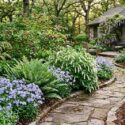
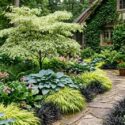
A layered shade border featuring Cornus kousa ‘Satomi’ (small flowering tree, late spring-early summer bloom), Hosta ‘Patriot’ and ‘Hadspen Blue’ (foliage perennials), Pulmonaria (spring-blooming groundcover), and Saxifraga urbium (late spring bloom). Calm, lush, and beautifully repeatable.
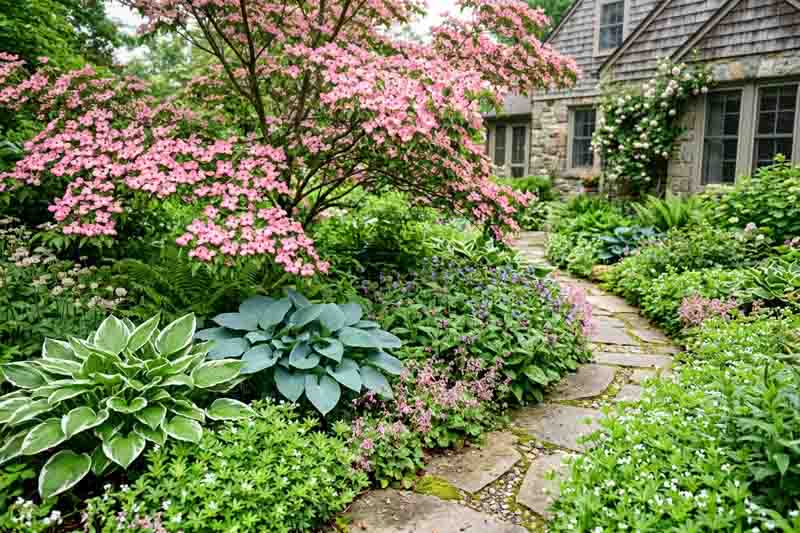


This shaded border sits beneath a flowering Cornus kousa ‘Satomi’, whose soft pink bracts form a light canopy over the planting. Below it, large hosta clumps provide most of the foliage, with white-edged ‘Patriot’ on one side and blue-green ‘Hadspen Blue’ on the other. Between them, Pulmonaria adds silver-marked leaves and small blue-purple flowers.
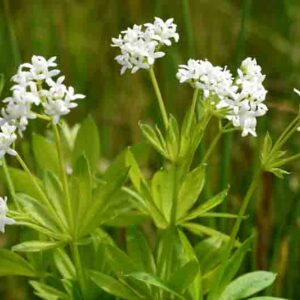
The lower edge is much finer in texture. Sweet woodruff and Saxifraga spread around the larger perennials and soften the rocks at the front of the bed. Their smaller leaves and delicate flowers contrast well with the broad hosta foliage without competing for attention.
The result is a compact woodland planting that relies more on foliage than continuous bloom. The pink dogwood flowers provide the main seasonal display above, while the hostas, Pulmonaria, and groundcovers keep the border attractive after flowering has finished.
Main plants used: Cornus kousa ‘Satomi’, Hosta ‘Patriot’, Hosta ‘Hadspen Blue’, Pulmonaria, Galium odoratum (Sweet Woodruff), and Saxifraga × urbium (London Pride)
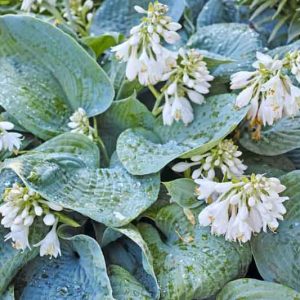
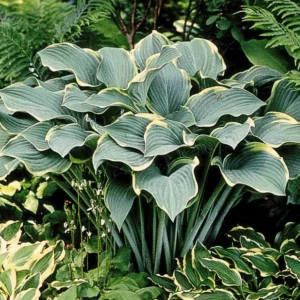
The strongest contrast is between the hostas. ‘Patriot’ has green leaves edged in cream, while ‘Hadspen Blue’ is broader and distinctly blue-green. Placing the two near each other gives the border variation without introducing another flower color.
Pulmonaria sits comfortably between them because its leaves are smaller and mottled with silver. Its blue-purple flowers add spring color at a time when the hostas are still developing.
The smaller groundcovers are important too. Sweet woodruff and Saxifraga fill some of the open soil and soften the transition to the stones without hiding the larger plants. That difference in scale keeps the foreground detailed while allowing the hostas to remain dominant.
Cornus kousa ‘Satomi’ provides the canopy and seasonal focal point. Its pink bracts are most effective when the tree is allowed to develop naturally rather than being crowded by larger shrubs beneath it.
Hosta ‘Patriot’ is useful in the brighter parts of the planting, where its pale margins catch the available light. One mature clump can make a strong statement, so there is no need to repeat it too densely.
Hosta ‘Hadspen Blue’ contributes cooler foliage and a heavier texture. Protection from strong afternoon sun helps preserve its blue coloring and reduces leaf scorch.
Pulmonaria fills the middle layer with spotted foliage and spring flowers. It is especially effective where it can spread into small groups beneath the hostas without being completely shaded by them.
Galium odoratum works as a low woodland groundcover, producing small white flowers in spring. It can spread steadily in favorable conditions, so thin it occasionally where it begins to crowd slower-growing plants.
Saxifraga × urbium is useful along the front edge and among stones. Its small rosettes and light flower stems add detail without adding much height.

Create a compact woodland border beneath a small flowering tree, using broad hosta foliage as the main feature and lower perennials to fill the spaces between larger clumps.
Use these proportions as a guide only. A single mature dogwood may represent the entire tree layer, while the smaller plants can be repeated more freely beneath it.
Establish the dogwood first and leave enough space around its trunk and root zone.
Place the hostas where their mature leaves can spread without overlapping heavily.
Use Pulmonaria between the hosta clumps, then allow sweet woodruff and Saxifraga to occupy some of the lower spaces and soften the rock edge.
Avoid covering every inch of soil immediately. The groundcovers will gradually spread into open areas.
This combination depends on reasonably consistent moisture, especially where tree roots compete with the perennials below. Check the soil during dry spells rather than assuming a shaded bed remains moist.
It is also worth allowing the planting to mature gradually. The large hostas and spreading groundcovers will fill much more space after a few seasons, so a border that looks slightly open at first is usually easier to manage in the long run.
| Hardiness |
6 - 7 |
|---|---|
| Heat Zones |
6 - 7 |
| Exposure | Partial Sun |
| Season of Interest | Spring (Mid, Late), Summer (Early, Mid, Late), Fall |
| Maintenance | Low |
| Water Needs | Average |
| Soil Type | Clay, Loam |
| Soil pH | Acid, Alkaline, Neutral |
| Soil Drainage | Moist but Well-Drained |
| Characteristics | Showy, Fragrant |
| Landscaping Ideas | Beds And Borders |
| Garden Styles | Informal and Cottage, Woodland Garden |





| Hardiness |
6 - 7 |
|---|---|
| Heat Zones |
6 - 7 |
| Exposure | Partial Sun |
| Season of Interest | Spring (Mid, Late), Summer (Early, Mid, Late), Fall |
| Maintenance | Low |
| Water Needs | Average |
| Soil Type | Clay, Loam |
| Soil pH | Acid, Alkaline, Neutral |
| Soil Drainage | Moist but Well-Drained |
| Characteristics | Showy, Fragrant |
| Landscaping Ideas | Beds And Borders |
| Garden Styles | Informal and Cottage, Woodland Garden |
Recreate this garden. Specify the percentages you would like to have of each plant and input the dimensions of your garden space.We'll give you a shopping list so you know how many plants you need.
| Plant | Quantity | |
|---|---|---|
| Cornus kousa 'Miss Satomi' (Kousa Dogwood) | N/A | Buy Plants |
| Hosta 'Patriot' (Plantain Lily) | N/A | Buy Plants |
| Hosta (Tardiana Group) 'Hadspen Blue' (Plantain Lily) | N/A | Buy Plants |
| Pulmonaria 'Silver Bouquet' (Lungwort) | N/A | Buy Plants |
| Saxifraga x urbium (London Pride) | N/A | Buy Plants |
| Galium odoratum (Sweet Woodruff) | N/A | Buy Plants |
Create a membership account to save your garden designs and to view them on any device.
Becoming a contributing member of Gardenia is easy and can be done in just a few minutes. If you provide us with your name, email address and the payment of a modest $25 annual membership fee, you will become a full member, enabling you to design and save up to 25 of your garden design ideas.
Join now and start creating your dream garden!