A layered creekside border with possumhaw, roughleaf dogwood, beautyberry, switchgrass, and blue mistflower—ideal for moist soils and bird habitat.
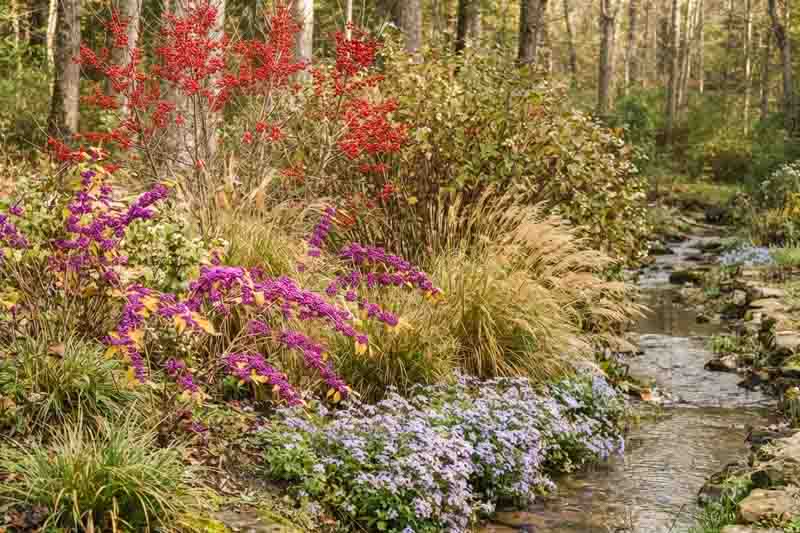


This creekside planting follows the edge of a shallow woodland stream, where moisture is more consistent and the soil stays cooler than in the open garden. Red-fruited Ilex decidua rises above the planting, while Callicarpa americana brings vivid purple berries through the lower shrub layer. Between them, broad clumps of Panicum virgatum add tawny fall texture, and Conoclinium coelestinum spreads in soft lavender-blue mats along the water’s edge.
Cornus drummondii forms part of the woody background, contributing cover and a more natural thicket-like structure. Together, these five plants create a border that feels connected to the surrounding woodland rather than planted as a separate ornamental bed.
Main plants used: Ilex decidua, Cornus drummondii, Callicarpa americana, Panicum virgatum, and Conoclinium coelestinum
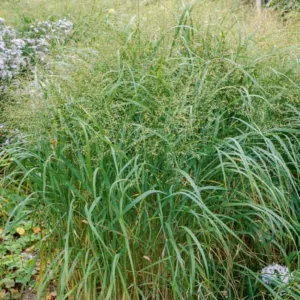
The strongest feature is the contrast between fruit, foliage, and grass. Possumhaw carries clusters of bright red berries on increasingly bare branches, while American Beautyberry produces dense purple fruit along arching stems. Switchgrass fills the spaces between the shrubs with fine, upright foliage that turns tan and gold in fall.
Blue Mistflower is much lower and softer. In the photograph, it spreads right along the creek edge, where its small lavender-blue flowers make a cool contrast with the red and purple fruit above.
The planting also feels convincing because it is not arranged in strict layers. Shrubs overlap, grasses push forward toward the water, and the mistflower spills along the bank. Roughleaf Dogwood helps knit the garden into the woodland behind it.
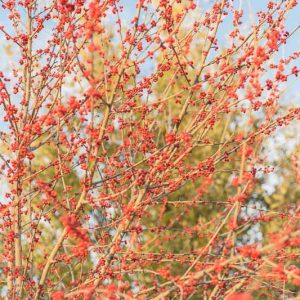
Ilex decidua, or Possumhaw, provides the strongest winter color. Female plants produce bright red fruits when a compatible male pollinator is nearby, and the berries can persist well after the leaves fall. It tolerates moist soils well and is suited to low ground, stream margins, and woodland edges.
Cornus drummondii, or Roughleaf Dogwood, forms a multi-stemmed shrub or small tree and can spread into thickets over time. Its white flower clusters appear in late spring to early summer, followed by pale fruit used by birds. It is useful where a looser, more natural woody screen is wanted.
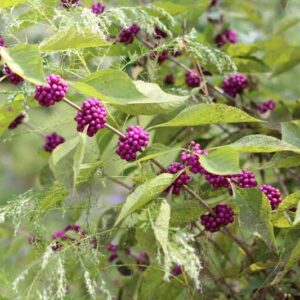
Callicarpa americana produces its best-known display in late summer and fall, when bright purple berries cluster tightly around the stems. It performs well in sun or partial shade and appreciates reasonably moist soil, especially in warmer climates.
Panicum virgatum provides upright grassy structure through summer and fall. Its deep root system makes it useful on slopes and banks, while the standing stems continue to provide cover and winter interest after flowering has finished.
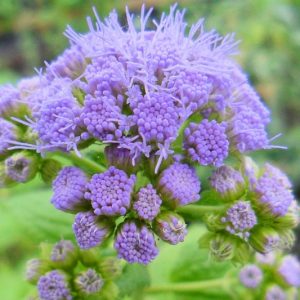
Conoclinium coelestinum, or Blue Mistflower, flowers from late summer into fall with clusters of soft blue to lavender flowers. It spreads by rhizomes and can form broad colonies in moist soil, which makes it useful along stream edges but also means its spread may need occasional control.
Create a layered creekside planting that combines woody cover, fall berries, grasses, and late flowers while keeping the watercourse visually open.
These percentages describe the balance of the five featured plants rather than equal numbers. The woody plants will occupy much more physical space than the mistflower.
Place Possumhaw and Roughleaf Dogwood toward the back and outer edge, where they can mature into broad woody groups without hiding the creek.
Use American Beautyberry through the middle layer, where its arching branches and purple fruit remain easy to see. Repeat Switchgrass in irregular clumps along the bank rather than planting it as a continuous strip.
Allow Blue Mistflower to occupy lower pockets close to the water, where consistent moisture supports flowering and spreading growth.
This is a moist-site planting, but it does not require permanently standing water. The best conditions are soils that stay reasonably moist, with occasional flooding or temporary saturation tolerated by several of these plants. Permanently stagnant water is not necessary for this combination.
Several of these plants can spread. Roughleaf Dogwood may sucker into thickets, and Blue Mistflower can expand quickly by rhizomes. That tendency is useful for naturalizing a bank, but occasional thinning may be needed in a smaller garden.
For the strongest berry display, pay attention to pollination. Possumhaw is dioecious, so female plants need a male plant nearby to set fruit. Beautyberry does not require the same male-female pairing, but good growing conditions and adequate light generally produce the best berry display.
Finally, avoid cutting everything down in fall. Switchgrass, berrying shrubs, and standing stems provide winter structure and useful cover at a time when the surrounding garden may be relatively bare.
| Hardiness |
6 - 8 |
|---|---|
| Exposure | Full Sun, Partial Sun |
| Season of Interest | Spring (Mid, Late), Summer (Early, Mid, Late), Fall |
| Maintenance | Low |
| Water Needs | Average |
| Soil Type | Clay, Loam |
| Soil pH | Acid, Neutral |
| Soil Drainage | Moist but Well-Drained |
| Characteristics | Showy, Fruit & Berries |
| Native Plants | United States, Southeast, Louisiana, Arkansas, Southwest, Texas, Oklahoma |
| Attracts | Bees, Butterflies, Birds |
| Landscaping Ideas | Beds And Borders, Ponds And Streams, Rain Gardens |
| Garden Styles | Butterfly Garden, Informal and Cottage, Pollinator Garden |

| Hardiness |
6 - 8 |
|---|---|
| Exposure | Full Sun, Partial Sun |
| Season of Interest | Spring (Mid, Late), Summer (Early, Mid, Late), Fall |
| Maintenance | Low |
| Water Needs | Average |
| Soil Type | Clay, Loam |
| Soil pH | Acid, Neutral |
| Soil Drainage | Moist but Well-Drained |
| Characteristics | Showy, Fruit & Berries |
| Native Plants | United States, Southeast, Louisiana, Arkansas, Southwest, Texas, Oklahoma |
| Attracts | Bees, Butterflies, Birds |
| Landscaping Ideas | Beds And Borders, Ponds And Streams, Rain Gardens |
| Garden Styles | Butterfly Garden, Informal and Cottage, Pollinator Garden |
Recreate this garden. Specify the percentages you would like to have of each plant and input the dimensions of your garden space.We'll give you a shopping list so you know how many plants you need.
| Plant | Quantity | |
|---|---|---|
| Callicarpa americana (American Beautyberry) | N/A | Buy Plants |
| Ilex decidua (Possumhaw) | N/A | Buy Plants |
| Cornus drummondii (Roughleaf Dogwood) | N/A | Buy Plants |
| Conoclinium coelestinum (Blue Mistflower) | N/A | Buy Plants |
| Panicum virgatum (Switchgrass) | N/A | Buy Plants |
Create a membership account to save your garden designs and to view them on any device.
Becoming a contributing member of Gardenia is easy and can be done in just a few minutes. If you provide us with your name, email address and the payment of a modest $25 annual membership fee, you will become a full member, enabling you to design and save up to 25 of your garden design ideas.
Join now and start creating your dream garden!