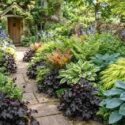
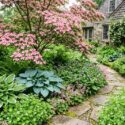
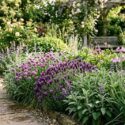
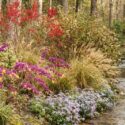
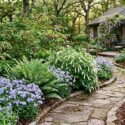
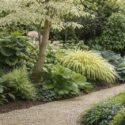
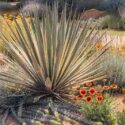
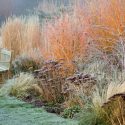
A native garden featuring evergreen shrub Ceanothus thyrsiflorus with spring blue blooms, plus Solidago canadensis for late summer-fall gold. The front edge is stitched with Arctostaphylos uva-ursi groundcover and Sedum spathulifolium rosettes with yellow spring-summer flowers.
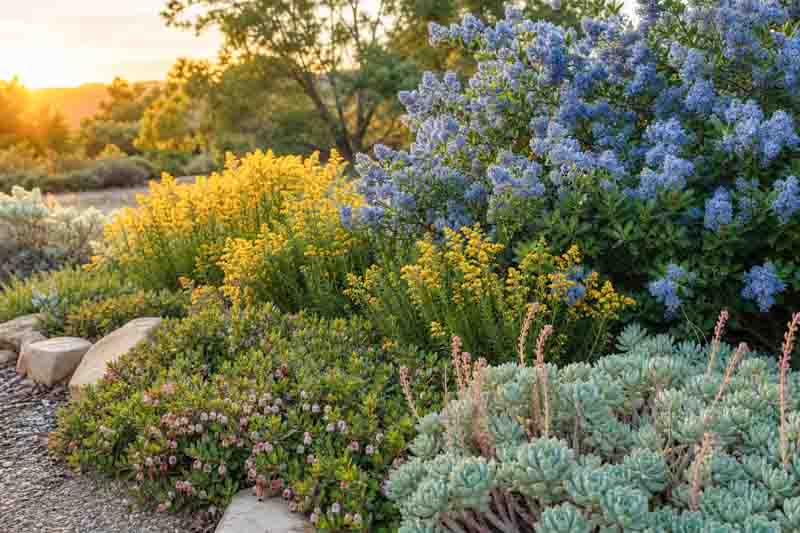


This planting brings together four plants with very different habits: a large flowering Ceanothus, upright goldenrod, low evergreen bearberry, and compact blue-gray Sedum. In the garden, they form distinct layers rather than blending into one continuous mass.
The Ceanothus is the largest presence, filling much of the right side with blue flowers and glossy green foliage. Goldenrod occupies the middle of the planting in generous yellow groups, while bearberry spreads close to the ground in the foreground. At the front right, Sedum spathulifolium forms a dense patch of pale succulent rosettes. Rocks and areas of open ground separate the plants and give the lower-growing species room to spread.
The result is colorful without relying on a large plant palette. Blue, yellow, green, and silver foliage do most of the work, while differences in height and texture keep the planting interesting.
Main plants used: Ceanothus thyrsiflorus, Solidago canadensis, Arctostaphylos uva-ursi, and Sedum spathulifolium
The strongest feature is the difference in height. Ceanothus forms the upper layer, goldenrod rises through the middle, and bearberry and Sedum stay close to the ground. That clear change in scale allows a relatively small number of plants to create a layered garden.
There is also a useful contrast between the foliage. Ceanothus and bearberry are green and woody, goldenrod is finer and more upright, and Sedum provides a distinctly succulent texture and blue-gray coloring. Even when the main flowering periods do not overlap, the leaves remain different enough to keep the planting varied.
The rocks and exposed ground are worth preserving. They prevent the lower plants from becoming one uninterrupted carpet and make the Sedum and bearberry easier to distinguish.
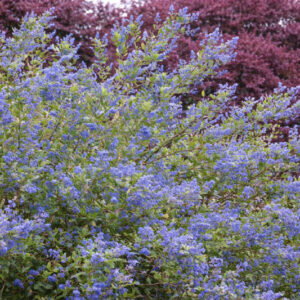
Ceanothus thyrsiflorus is the largest plant in the combination and needs enough room to mature naturally. Its blue flowers provide the strongest spring color, while the evergreen foliage gives the border structure after flowering. Avoid placing it where it will receive frequent summer irrigation once established.
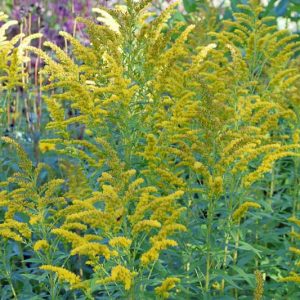
Solidago canadensis brings height and strong yellow color later in the season. Use it in a substantial group rather than scattering individual stems. It can spread vigorously where conditions suit it, so allow room for expansion and manage unwanted growth if necessary.
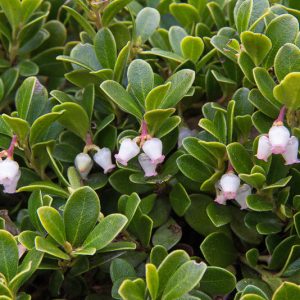
Arctostaphylos uva-ursi forms a much lower evergreen layer. In the foreground, its small leaves and pinkish urn-shaped flowers provide a softer transition between the larger plants and the rocks. Allow it to spread naturally rather than trimming it into a rigid edge.
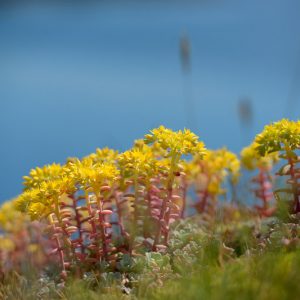
Sedum spathulifolium works particularly well beside stone and gravel. Its low rosettes bring a cooler blue-gray tone to the foreground, followed by yellow flowers when in bloom. Give it excellent drainage and avoid burying the crowns under mulch.
Create a layered planting with one substantial flowering shrub, broad groups of goldenrod, and evergreen groundcovers around rocks and open ground.
Use these figures as a guide rather than a fixed formula. Mature size and available space matter more than keeping the percentages exact.
Give the Ceanothus the largest space and allow it to develop naturally rather than squeezing it between other shrubs.
Place goldenrod in broad groups through the middle of the planting, where the yellow flowers can rise above the lower groundcovers.
Let bearberry spread through some of the open foreground, particularly around rocks.
Use Sedum in the driest, best-drained positions near stones and along exposed edges. Leave some soil, gravel, or rock visible between the lower plants.
The plants in this combination do not all have identical moisture requirements. Rather than watering the entire border uniformly, place goldenrod where the soil retains a little more moisture and keep Ceanothus and Sedum in the better-drained sections.
Allow the planting to become fuller with age, but preserve some separation between the main groups. The contrast between the large blue-flowered shrub, upright goldenrod, evergreen bearberry, and pale Sedum rosettes is what gives this garden much of its character.
| Hardiness |
5 - 7 |
|---|---|
| Exposure | Full Sun, Partial Sun |
| Season of Interest | Spring (Mid, Late), Summer (Early, Mid, Late), Fall |
| Maintenance | Low |
| Water Needs | Low |
| Soil Type | Loam, Sand |
| Soil pH | Acid, Neutral |
| Soil Drainage | Well-Drained |
| Characteristics | Showy |
| Native Plants | United States, Southeast, North Carolina, Tennessee, Virginia, Alabama, Georgia |
| Attracts | Bees, Butterflies, Birds |
| Landscaping Ideas | Beds And Borders, Hedges And Screens |
| Garden Styles | Butterfly Garden, Informal and Cottage, Pollinator Garden |
| Hardiness |
5 - 7 |
|---|---|
| Exposure | Full Sun, Partial Sun |
| Season of Interest | Spring (Mid, Late), Summer (Early, Mid, Late), Fall |
| Maintenance | Low |
| Water Needs | Low |
| Soil Type | Loam, Sand |
| Soil pH | Acid, Neutral |
| Soil Drainage | Well-Drained |
| Characteristics | Showy |
| Native Plants | United States, Southeast, North Carolina, Tennessee, Virginia, Alabama, Georgia |
| Attracts | Bees, Butterflies, Birds |
| Landscaping Ideas | Beds And Borders, Hedges And Screens |
| Garden Styles | Butterfly Garden, Informal and Cottage, Pollinator Garden |
Recreate this garden. Specify the percentages you would like to have of each plant and input the dimensions of your garden space.We'll give you a shopping list so you know how many plants you need.
| Plant | Quantity | |
|---|---|---|
| Ceanothus thyrsiflorus (Blue Blossom) | N/A | Buy Plants |
| Solidago canadensis (Canada Goldenrod) | N/A | Buy Plants |
| Arctostaphylos uva-ursi (Bearberry) | N/A | Buy Plants |
| Sedum spathulifolium (Broadleaf Stonecrop) | N/A | Buy Plants |
Create a membership account to save your garden designs and to view them on any device.
Becoming a contributing member of Gardenia is easy and can be done in just a few minutes. If you provide us with your name, email address and the payment of a modest $25 annual membership fee, you will become a full member, enabling you to design and save up to 25 of your garden design ideas.
Join now and start creating your dream garden!
Create a membership account to save your garden designs and to view them on any device.
Becoming a contributing member of Gardenia is easy and can be done in just a few minutes. If you provide us with your name, email address and the payment of a modest $25 annual membership fee, you will become a full member, enabling you to design and save up to 25 of your garden design ideas.
Join now and start creating your dream garden!