A sunny raised herb garden that looks designed and cooks beautifully. Plant chives (spring to early summer blooms), common sage (evergreen culinary shrub), Spanish lavender (late spring to summer flowers), and society garlic (summer to fall bloom). Gravel mulch and terracotta pots add Mediterranean style and low-maintenance polish.
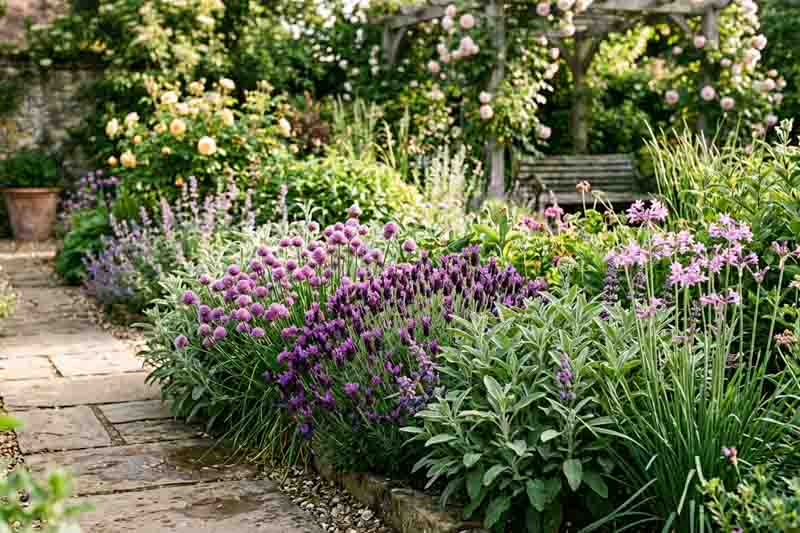


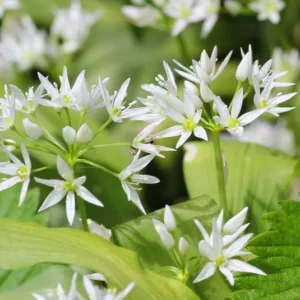
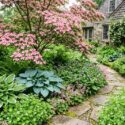
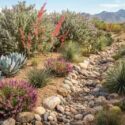
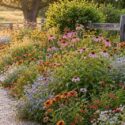
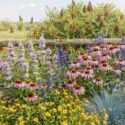
This sunny herb garden combines edible and ornamental plants in a loose planting beside stone paving. Purple chive flowers fill the foreground, Spanish lavender rises behind them, and a substantial clump of common sage provides silver-green foliage on the right. Society garlic adds another layer of pink-lilac flowers at the front, while terracotta pots and rough stones reinforce the informal Mediterranean character of the garden.
What makes the planting work is its simplicity. The four main plants share similar preferences for sun and good drainage, but they differ enough in foliage and flower shape to keep the garden interesting. Chives and society garlic have narrow, upright leaves; sage forms a broader mound; and lavender brings a woody, shrubby presence to the middle of the planting.
Main plants used: Allium schoenoprasum (Chives), Salvia officinalis (Common Sage), Lavandula stoechas (Spanish Lavender), and Tulbaghia violacea (Society Garlic)
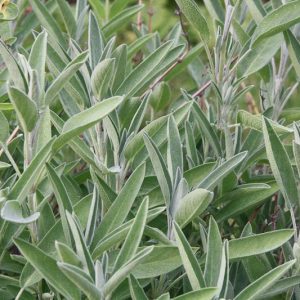
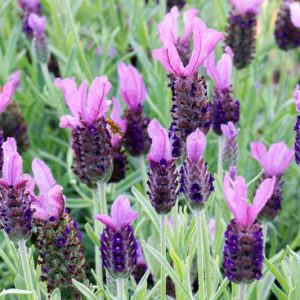
The foliage provides as much contrast as the flowers. Sage has broad, softly textured gray-green leaves, while chives and society garlic produce narrow grassy foliage. Spanish lavender sits between the two, forming a rounded woody plant with slender silver-green leaves.
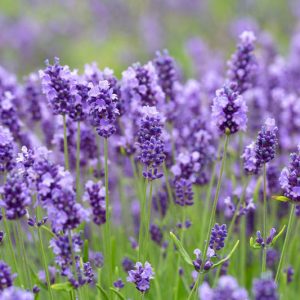
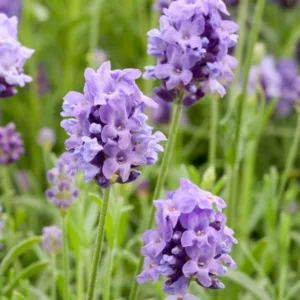
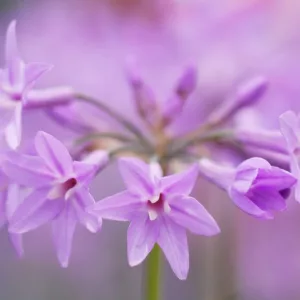
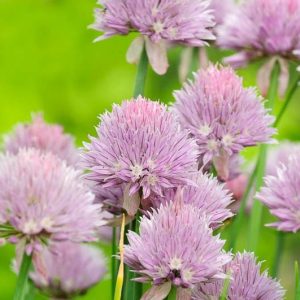
The flower colors are closely related without being identical. Chives produce rounded lilac-purple heads, Spanish lavender carries darker purple flower spikes, and society garlic adds paler pink-lilac clusters. Repeating these colors at different heights gives the garden continuity without making it look overly coordinated.
The stones and terracotta pots are useful visually, but they also suit plants that dislike heavy, waterlogged soil. Leaving some open ground around mature clumps helps air circulation and makes individual plants easier to harvest and maintain.
Allium schoenoprasum is both useful and decorative. Harvest the leaves regularly for cooking, but allow some clumps to flower if you want their lavender-pink heads and pollinator value. Divide older clumps when they become congested.
Salvia officinalis provides the largest mass of foliage. Give it a sunny, freely draining position and enough room to develop into a broad mound. Regular harvesting of younger shoots helps keep plants productive, but avoid severe pruning into old bare wood.
Lavandula stoechas needs excellent drainage and plenty of sun. It is less cold-hardy than English lavender, so its long-term performance depends on climate. Light pruning after flowering helps maintain a compact shape, but again, avoid cutting hard into old leafless stems.
Tulbaghia violacea forms clumps of narrow leaves topped by slender flower stems. It flowers for a long period in warm climates and works particularly well near the front of a border where its lighter flowers can be seen clearly.
Create a sunny herb planting that is useful in the kitchen but attractive enough to sit beside a terrace or garden path, using silver foliage and purple-pink flowers as the main thread.
Use these proportions as a starting point only. A mature sage or lavender plant occupies considerably more space than a clump of chives.
Place the larger sage and lavender plants first, leaving enough room for their mature spread.
Use chives toward the front and in accessible positions where leaves can be harvested easily.
Add society garlic in several clumps along the edge or between the larger herbs. Rocks, gravel, or terracotta containers can be included, but keep the arrangement irregular rather than symmetrical.
Although all four plants suit sunny gardens, their climate tolerances differ. Spanish lavender and society garlic are better suited to mild winters than chives or common sage, so gardeners in colder regions may need to provide protection, grow them in containers, or choose hardier substitutes.
Drainage is also more important than creating uniformly dry soil. Chives generally appreciate more consistent moisture than lavender, so placing them where the soil retains slightly more moisture can help all four plants perform well in the same garden.
| Hardiness |
7 - 9 |
|---|---|
| Heat Zones |
8 - 9 |
| Climate Zones | 13, 14, 15, 16, 17, 18, 19, 20, 21, 22, 23, 24 |
| Exposure | Full Sun |
| Season of Interest | Spring (Mid, Late), Summer (Early, Mid, Late), Fall |
| Maintenance | Low |
| Water Needs | Average |
| Soil Type | Loam, Sand |
| Soil pH | Acid, Neutral, Alkaline |
| Soil Drainage | Moist but Well-Drained, Well-Drained |
| Characteristics | Showy, Fragrant |
| Tolerances | Deer, Drought, Rabbit |
| Attracts | Bees, Butterflies |
| Garden Styles | Butterfly Garden, Gravel and Rock Garden, Informal and Cottage, Mediterranean Garden, Pollinator Garden |

| Hardiness |
7 - 9 |
|---|---|
| Heat Zones |
8 - 9 |
| Climate Zones | 13, 14, 15, 16, 17, 18, 19, 20, 21, 22, 23, 24 |
| Exposure | Full Sun |
| Season of Interest | Spring (Mid, Late), Summer (Early, Mid, Late), Fall |
| Maintenance | Low |
| Water Needs | Average |
| Soil Type | Loam, Sand |
| Soil pH | Acid, Neutral, Alkaline |
| Soil Drainage | Moist but Well-Drained, Well-Drained |
| Characteristics | Showy, Fragrant |
| Tolerances | Deer, Drought, Rabbit |
| Attracts | Bees, Butterflies |
| Garden Styles | Butterfly Garden, Gravel and Rock Garden, Informal and Cottage, Mediterranean Garden, Pollinator Garden |
Recreate this garden. Specify the percentages you would like to have of each plant and input the dimensions of your garden space.We'll give you a shopping list so you know how many plants you need.
| Plant | Quantity | |
|---|---|---|
| Salvia officinalis (Sage) | N/A | Buy Plants |
| Lavandula stoechas 'Anouk' (Spanish Lavender) | N/A | Buy Plants |
| Tulbaghia violacea (Society Garlic) | N/A | Buy Plants |
| Allium schoenoprasum (Chives) | N/A | Buy Plants |
Create a membership account to save your garden designs and to view them on any device.
Becoming a contributing member of Gardenia is easy and can be done in just a few minutes. If you provide us with your name, email address and the payment of a modest $25 annual membership fee, you will become a full member, enabling you to design and save up to 25 of your garden design ideas.
Join now and start creating your dream garden!
Create a membership account to save your garden designs and to view them on any device.
Becoming a contributing member of Gardenia is easy and can be done in just a few minutes. If you provide us with your name, email address and the payment of a modest $25 annual membership fee, you will become a full member, enabling you to design and save up to 25 of your garden design ideas.
Join now and start creating your dream garden!