While hydrangeas may attract deer, especially in areas with limited food sources, proactive measures can be taken to protect these beautiful plants


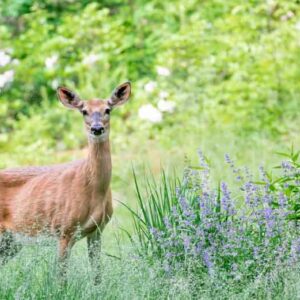
Yes, deer eat hydrangeas. They may browse the leaves, tender shoots, flower buds, flowers, and small stems, and hydrangeas should not be considered reliably deer resistant. Rutgers Cooperative Extension rates several major hydrangea species C – Occasionally Severely Damaged. The amount of damage varies with local deer pressure, season, and available food, but an unprotected hydrangea can lose both foliage and flowers.
Hydrangeas are not among the shrubs you can confidently plant and expect deer to ignore.
Rutgers Cooperative Extension places Hydrangea arborescens (smooth hydrangea), Hydrangea macrophylla (bigleaf hydrangea), Hydrangea paniculata (panicle hydrangea), and Hydrangea quercifolia (oakleaf hydrangea) in its C – Occasionally Severely Damaged category.
That rating is important because it describes risk more accurately than simply calling a plant “deer resistant” or “not deer resistant.”
A hydrangea may grow for months – or even years – with little noticeable browsing in one garden, while the same species can be repeatedly damaged in another. Deer feeding depends on local population pressure, season, weather, food availability, and established feeding habits.
Under heavy pressure, deer may also eat plants they normally find less appealing.
Gardenia’s Hydrangea Rule: treat hydrangeas as deer-vulnerable rather than deer-proof. If deer regularly visit your garden, plan for browsing before flower buds and new shoots disappear – not after.
Garden advice sometimes suggests that certain hydrangeas are reliably more deer resistant than others. The evidence is not strong enough to make that assumption.
Rutgers gives the same C – Occasionally Severely Damaged rating to four of the hydrangeas most commonly grown in landscapes:
| Hydrangea | Rutgers Deer Rating | Flowering Wood |
|---|---|---|
| Bigleaf Hydrangea Hydrangea macrophylla |
C – Occasionally Severely Damaged | Primarily old wood; some reblooming cultivars also flower on new wood |
| Smooth Hydrangea Hydrangea arborescens |
C – Occasionally Severely Damaged | New wood |
| Panicle Hydrangea Hydrangea paniculata |
C – Occasionally Severely Damaged | New wood |
| Oakleaf Hydrangea Hydrangea quercifolia |
C – Occasionally Severely Damaged | Old wood |
There is some horticultural observation that panicle hydrangeas may be browsed less often in certain landscapes. That can be useful local experience, but it should not be treated as a guarantee. Rutgers still places panicle hydrangea in the same C category as the other major types.
Do not choose a hydrangea species solely because it is advertised as “deer resistant.” If deer pressure is high, assume browsing is possible and choose the hydrangea for its climate, light, soil, mature size, and flowering characteristics instead.
Deer do not necessarily limit themselves to the leaves.
On hydrangeas they may browse:
University of Minnesota Extension specifically identifies leaves, flowers, buds, and small branches as susceptible to deer browsing on hydrangeas.
That means a shrub can remain alive and reasonably healthy while still losing much of its ornamental value for the season.
The important question is not just “Did deer hurt my hydrangea?” It is also “What did they remove?” Losing a few leaves and losing the flower buds can have very different consequences.
Deer damage has a different appearance from neat pruning.
Because deer tear vegetation rather than clipping it cleanly, browsed stems often have ragged, shredded, or jagged ends.
Look for:
Rabbit damage can look different. Rabbits tend to clip smaller stems more cleanly and usually feed much closer to ground level.
Gardenia’s Deer Damage Check: missing leaves + missing buds + ragged stem ends + damage well above ground level strongly point toward deer browsing rather than disease or ordinary dieback.
Sometimes yes – but the answer depends on what the deer ate, when they ate it, and what type of hydrangea you grow.
This is one of the most important practical differences among hydrangeas.
Traditional bigleaf hydrangeas generally form their flower buds on stems produced during the previous growing season – commonly called old wood.
If deer remove those overwintering buds or browse the stem tips carrying them, the plant may survive perfectly well but produce far fewer flowers that year.
Some newer reblooming bigleaf cultivars can flower on both old and new wood. Those plants may have another opportunity to produce blooms later in the season, although browsing can still reduce the display.
Oakleaf hydrangeas also flower on old wood. Deer that remove established flower buds or the ends of flowering stems can therefore reduce the coming bloom.
Smooth hydrangeas bloom on new wood produced during the current growing season.
That gives them more ability to recover from dormant-season stem loss and still flower from new shoots. Browsing during active spring growth, however, can still remove developing flowering stems and delay or reduce bloom.
Panicle hydrangeas also flower on new wood.
Winter or very early stem loss therefore does not automatically eliminate the year’s flowers. But if deer repeatedly browse new spring shoots, they may remove the very growth that would have produced flower clusters later in the season.
Gardenia’s Bloom Rule: on old-wood hydrangeas, protecting existing buds is especially important. On new-wood hydrangeas, protecting the fresh shoots that will carry this year’s flowers becomes the priority.
In many cases, yes.
A healthy established hydrangea can usually replace some lost foliage and shoots after moderate browsing. The plant may look uneven for a while, and flowering may be reduced, but leaf loss does not automatically mean the shrub is dying.
The bigger concern is repeated browsing.
If deer continually remove fresh growth as soon as it appears, the hydrangea has less foliage available for photosynthesis and fewer shoots on which to produce flowers. Young or newly planted shrubs are particularly worth protecting because they have less established growth to fall back on.
After browsing, avoid automatically cutting the shrub back even farther. First determine which hydrangea you have and whether it flowers on old wood or new wood. Additional pruning at the wrong time can remove surviving flower buds that the deer missed.
If deer are already visiting your landscape, protection is more reliable than hoping they will choose something else.
A properly constructed deer fence is the most dependable long-term solution for gardens with heavy deer pressure. Extension guidance commonly recommends fencing around 8 feet high for a conventional vertical deer-exclusion fence.
For individual shrubs, temporary cages or netting can also keep deer from reaching tender shoots and flower buds, provided the material is installed securely and does not rest directly against foliage where deer can browse through it.
Physical protection is particularly valuable:
Commercial deer repellents can reduce browsing, especially when deer pressure is light to moderate. They work by making plants smell or taste less attractive.
Follow the product label carefully. Reapplication may be needed as plants produce new growth or after weathering, depending on the product.
It is generally better to begin deterrence before deer establish a feeding habit than to wait until the shrub has been repeatedly browsed.
If your main goal is flowers, pay particular attention to the shoots and buds that will produce them.
For an old-wood hydrangea, overwintering buds may represent much of the following year’s floral display. For a new-wood hydrangea, vigorous spring shoots need enough time to develop without repeatedly being eaten back.
High deer pressure changes the strategy: repellents may help, but repeated damage to a valued hydrangea calls for a physical barrier rather than an endless cycle of browsing and regrowth.
Not reliably.
Lavender, catmint, sage, alliums, and other aromatic or lower-browse plants can be excellent components of a deer-conscious garden. What they cannot do is make a hydrangea beside them deer resistant.
A deer that wants the hydrangea can simply reach or walk past neighboring plants.
The same caution applies to thorny plants. Including less palatable shrubs in a landscape may reduce the amount of attractive browse overall, but it should not be treated as a protective fence around hydrangeas.
Think deer-resistant garden, not deer-repelling companion plant. Choose neighboring plants because they suit the same conditions and are less likely to be browsed – not because you expect them to protect the hydrangea.
You certainly can – but whether hydrangeas make sense depends on the level of deer pressure and how much protection you are willing to provide.
| Your Situation | What It Means for Hydrangeas |
|---|---|
| Deer rarely enter the garden | Hydrangeas may grow with little intervention, but occasional browsing is still possible. |
| Occasional deer visits | Hydrangeas can still be practical, particularly if you are willing to use repellents or temporary protection when growth and buds are vulnerable. |
| Regular deer traffic | Plan on physical protection if flowers are important to you. |
| Heavy browsing and no desire to fence or spray | A shrub with a stronger deer-resistance record may be a more practical choice. |
This is a better way to make the decision than searching for a supposedly “deer-proof hydrangea.”
No hydrangea choice removes the need to consider local deer pressure.
If deer repeatedly destroy your hydrangeas and you do not want to fence or apply repellents, replacing them with a lower-browse shrub may be the easier long-term solution.
But deer resistance should not be the only filter.
A replacement shrub also needs to suit your:
A deer-resistant shrub that hates your site’s conditions is not a better choice simply because deer leave it alone.
Deer keep eating your hydrangeas? Instead of choosing another shrub from a generic deer-resistant list, find one that actually fits your garden.
Use the Gardenia Plant Finder to search for plants that combine deer resistance with your sun, soil, drainage, water needs, hardiness, mature size, garden style, wildlife goals, and other tolerances.
You can also explore Gardenia’s Deer-Resistant Plants and browse Deer-Resistant Garden Ideas for planting inspiration.
Once you have several plants in mind, use the Garden Design Tool to check whether they are compatible with your garden conditions and with one another before you plant.
Yes. Deer may eat hydrangea leaves, tender shoots, flower buds, flowers, and small stems. Rutgers rates several major hydrangea species C – Occasionally Severely Damaged, so hydrangeas should not be considered reliably deer resistant.
Not reliably. Deer pressure varies from garden to garden, but bigleaf, smooth, panicle, and oakleaf hydrangeas are all rated C – Occasionally Severely Damaged by Rutgers Cooperative Extension.
There is no major hydrangea species that should be assumed to be reliably deer resistant. Rutgers gives bigleaf, smooth, panicle, and oakleaf hydrangeas the same C – Occasionally Severely Damaged rating. Local browsing may vary.
Yes. Deer may browse hydrangea flowers as well as flower buds, leaves, shoots, and small stems. Flowers and buds within browsing height can be removed.
It depends on the hydrangea and when browsing occurs. Bigleaf and oakleaf hydrangeas generally flower on old wood, so losing established buds can greatly reduce bloom. Smooth and panicle hydrangeas flower on new wood, but repeated browsing of new shoots can still reduce flowering.
An established, healthy hydrangea can usually replace some foliage and shoots after moderate browsing. Repeated browsing is more damaging because deer continually remove the plant’s new growth and potential flowering shoots.
Look for missing leaves, buds or shoots and ragged or torn ends on browsed stems. Deer tear vegetation rather than clipping it neatly, and damage may occur several feet above ground.
Physical barriers are the most dependable protection where deer pressure is high. Deer repellents can also reduce browsing, particularly when used before deer establish a regular feeding habit and reapplied according to the product label.
Not reliably. Deer may avoid lavender, catmint, or other lower-browse plants and still eat a hydrangea growing beside them. Use deer-resistant companions as part of a lower-browse planting palette, not as a substitute for physical protection.
Updated: September 2026 – Reviewed by Gardenia Editors
| Hardiness |
3 - 9 |
|---|---|
| Heat Zones |
1 - 9 |
| Plant Type | Shrubs |
| Plant Family | Hydrangeaceae |
| Genus | Hydrangea |
| Exposure | Full Sun, Partial Sun |
| Season of Interest | Spring (Late), Summer (Early, Mid, Late), Fall |
| Maintenance | Low |
| Water Needs | Average |
| Soil Type | Clay, Loam, Sand |
| Soil pH | Acid, Alkaline, Neutral |
| Soil Drainage | Moist but Well-Drained |
| Characteristics | Dried Arrangements, Cut Flowers, Showy |
| Attracts | Butterflies, Hummingbirds |
| Landscaping Ideas | Beds And Borders, Hedges And Screens, Patio And Containers |
| Hardiness |
3 - 9 |
|---|---|
| Heat Zones |
1 - 9 |
| Plant Type | Shrubs |
| Plant Family | Hydrangeaceae |
| Genus | Hydrangea |
| Exposure | Full Sun, Partial Sun |
| Season of Interest | Spring (Late), Summer (Early, Mid, Late), Fall |
| Maintenance | Low |
| Water Needs | Average |
| Soil Type | Clay, Loam, Sand |
| Soil pH | Acid, Alkaline, Neutral |
| Soil Drainage | Moist but Well-Drained |
| Characteristics | Dried Arrangements, Cut Flowers, Showy |
| Attracts | Butterflies, Hummingbirds |
| Landscaping Ideas | Beds And Borders, Hedges And Screens, Patio And Containers |
Create a membership account to save your garden designs and to view them on any device.
Becoming a contributing member of Gardenia is easy and can be done in just a few minutes. If you provide us with your name, email address and the payment of a modest $25 annual membership fee, you will become a full member, enabling you to design and save up to 25 of your garden design ideas.
Join now and start creating your dream garden!