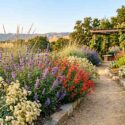
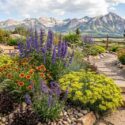
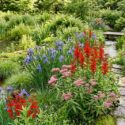
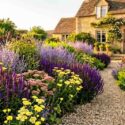
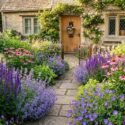
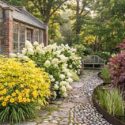
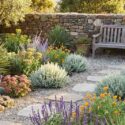
This striking dry garden pairing blends silvery foliage, airy grasses, and vivid summer flowers into a border full of movement and contrast. Blue Agapanthus, violet Salvia and Perovskia, orange-red Kniphofia, and flowing Stipa create a water-wise planting that feels both natural and dramatic in sunny, well-drained conditions.
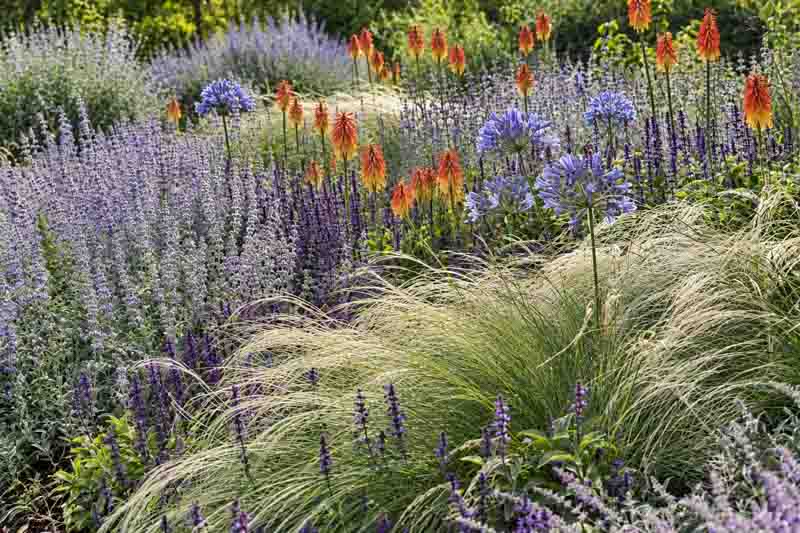


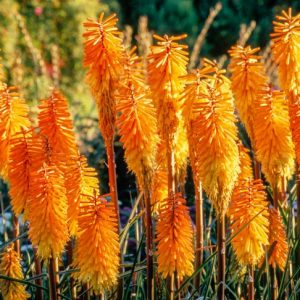
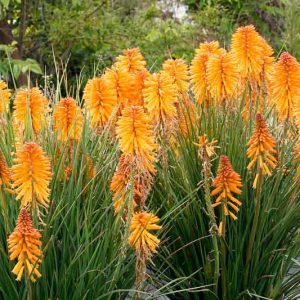
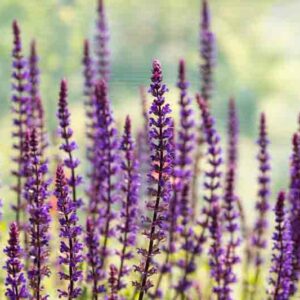
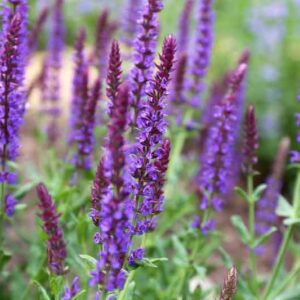
This dry garden border combines cool blue and violet flowers with soft grasses and flashes of orange. Blue Agapanthus rises above Salvia ‘Blue Spires’ and airy Perovskia, while Kniphofia caulescens adds glowing orange-red flower spikes. Stipa tenuissima flows through the foreground, giving the planting movement and a light, informal character.
The plants are repeated in loose groups rather than arranged in obvious blocks. Blue and violet recur across the border, grasses weave between the flowering perennials, and the Kniphofia appears at irregular intervals. The effect is colorful and generous without feeling overly planned.
Main plants used: Agapanthus, Salvia ‘Blue Spires’, Kniphofia caulescens, Perovskia, and Stipa tenuissima
Use the blue and violet plants generously, let Stipa move through the planting, and keep the orange Kniphofia as an accent.
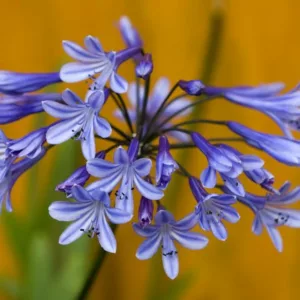
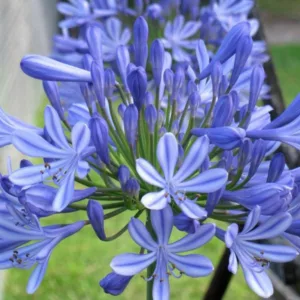
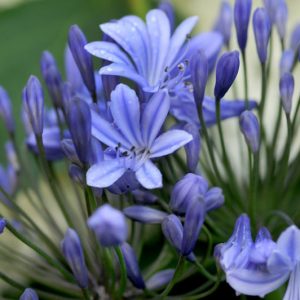
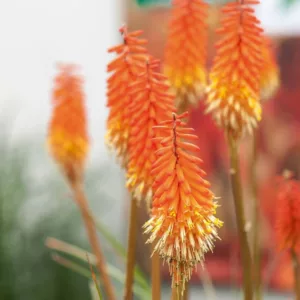
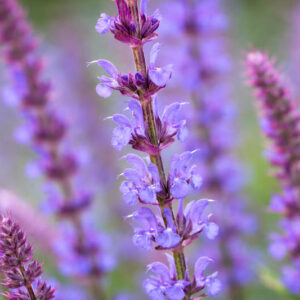
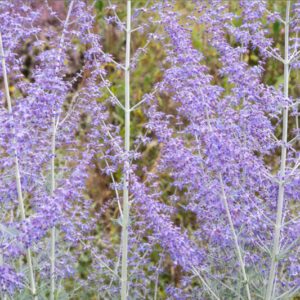
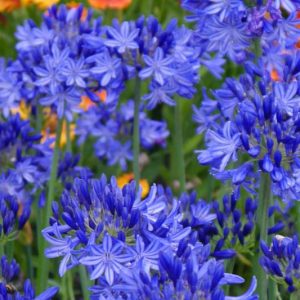
Most of the planting sits in cool lavender, violet, and blue. Perovskia creates a pale haze, Salvia adds darker spikes, and Agapanthus introduces clearer blue flowerheads. Against those cooler shades, the orange-red Kniphofia stands out beautifully.
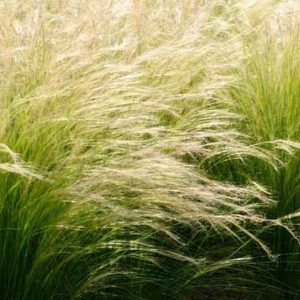
The grasses keep the border from becoming too dense. Stipa tenuissima breaks up the flowering masses and adds a soft, windblown quality, while its pale foliage catches the light.
The flower shapes are varied too. Agapanthus is rounded, Salvia and Kniphofia are upright, Perovskia is airy and branching, and Stipa forms flowing mounds. That contrast gives the border interest even when several plants are flowering at once.
Agapanthus provides bold blue flowerheads on tall stems. Place it in small groups through the middle of the border.
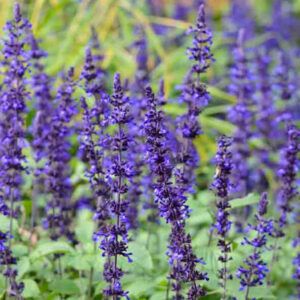
Salvia ‘Blue Spires’ supplies deeper violet color and works best in repeated patches rather than one large block.
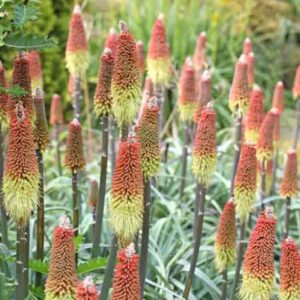
Kniphofia caulescens is the warm accent. Scatter small groups through the middle and rear so its orange-red flowers appear unexpectedly.
Perovskia softens the planting with pale stems and lavender-blue flowers, helping blend the stronger colors together.
Stipa tenuissima ties the composition together. Use it through the foreground and allow some clumps to drift farther back.
Create a loose, drought-tolerant border with cool flowers, soft grasses, and a few strong orange accents.
Use Stipa in loose sweeps through the front, with Perovskia and Salvia repeated behind and between it.
Add Agapanthus in small groups through the middle, then place Kniphofia at irregular intervals so its orange flowers rise above the cooler planting.
Avoid neat rows or identical clumps. The border should feel repeated, but not regimented.
As summer develops, Salvia and Perovskia build the cool-colored background, followed by the taller flowers of Agapanthus and Kniphofia. At peak bloom, blue, violet, silver, and orange overlap without any one color taking over.
Later, Stipa and the fading flower stems continue to provide texture and movement, helping the border remain attractive after the main flush of bloom.
Drought tolerant does not mean drought proof from the day of planting. Give young plants regular water while their roots establish, then reduce irrigation.
Good drainage is essential, particularly in winter. And when copying this look, resist planting each species in a separate block. Let the grasses run through the border, repeat the cool colors unevenly, and use the Kniphofia as bright punctuation.
| Hardiness |
7 - 9 |
|---|---|
| Heat Zones |
7 - 9 |
| Exposure | Full Sun |
| Season of Interest | Summer (Mid, Late), Fall |
| Maintenance | Low |
| Water Needs | Average |
| Soil Type | Loam, Sand |
| Soil pH | Acid, Neutral |
| Soil Drainage | Well-Drained |
| Characteristics | Cut Flowers, Showy |
| Tolerances | Deer, Drought |
| Attracts | Bees, Butterflies, Hummingbirds, Birds |
| Landscaping Ideas | Beds And Borders |
| Garden Styles | Butterfly Garden, Coastal Garden, Informal and Cottage, Pollinator Garden |


| Hardiness |
7 - 9 |
|---|---|
| Heat Zones |
7 - 9 |
| Exposure | Full Sun |
| Season of Interest | Summer (Mid, Late), Fall |
| Maintenance | Low |
| Water Needs | Average |
| Soil Type | Loam, Sand |
| Soil pH | Acid, Neutral |
| Soil Drainage | Well-Drained |
| Characteristics | Cut Flowers, Showy |
| Tolerances | Deer, Drought |
| Attracts | Bees, Butterflies, Hummingbirds, Birds |
| Landscaping Ideas | Beds And Borders |
| Garden Styles | Butterfly Garden, Coastal Garden, Informal and Cottage, Pollinator Garden |
Recreate this garden. Specify the percentages you would like to have of each plant and input the dimensions of your garden space.We'll give you a shopping list so you know how many plants you need.
| Plant | Quantity | |
|---|---|---|
| Kniphofia caulescens (Red Hot Poker) | N/A | Buy Plants |
| Salvia Mystic Spires Blue (Sage) | N/A | Buy Plants |
| Stipa tenuissima (Mexican Feather Grass) | N/A | Buy Plants |
| Salvia yangii (Russian Sage) | N/A | Buy Plants |
| Agapanthus 'Northern Star' (African Lily) | N/A | Buy Plants |
Create a membership account to save your garden designs and to view them on any device.
Becoming a contributing member of Gardenia is easy and can be done in just a few minutes. If you provide us with your name, email address and the payment of a modest $25 annual membership fee, you will become a full member, enabling you to design and save up to 25 of your garden design ideas.
Join now and start creating your dream garden!
Create a membership account to save your garden designs and to view them on any device.
Becoming a contributing member of Gardenia is easy and can be done in just a few minutes. If you provide us with your name, email address and the payment of a modest $25 annual membership fee, you will become a full member, enabling you to design and save up to 25 of your garden design ideas.
Join now and start creating your dream garden!