Spring Gardens, Shady Gardens, Plant Combinations


Plese update the garden description accordingly:
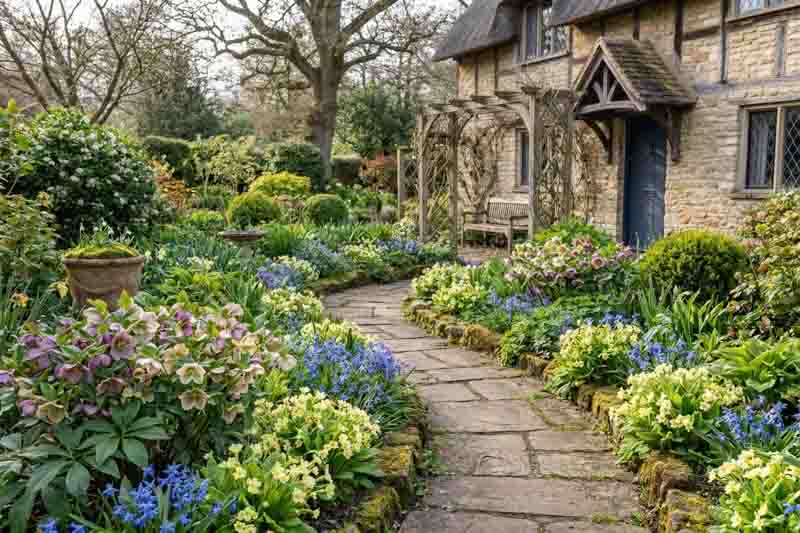
This early-spring border follows the edge of a woodland path, where pale yellow primroses and vivid blue Siberian Squill spread beneath clumps of flowering hellebores. Helleborus × hybridus ‘Penny’s Pink’ provides the taller layer, with dusky pink flowers held above dark leathery foliage, while Primula vulgaris stays low and forms loose colonies across the front and middle of the bed.
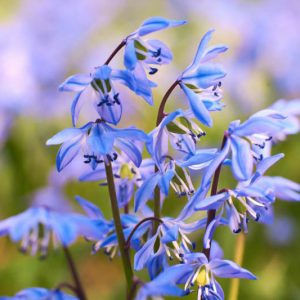
Between them, Scilla sibirica sends up small intense-blue flowers that appear repeatedly through the planting rather than in one solid patch. Ferns, daffodils, and other woodland plants continue into the background, giving the border the layered character of an established spring garden.
Main plants used: Helleborus × hybridus ‘Penny’s Pink’, Primula vulgaris, and Scilla sibirica
The three plants flower at similar heights without looking alike. Hellebores have substantial nodding flowers above bold foliage, Primroses produce smaller open-faced blooms close to the ground, and Siberian Squill carries tiny blue bells on slender stems.
The colors are equally useful together. Pale yellow Primroses lighten the darker Hellebore flowers, while the saturated blue of Squill provides a sharper contrast. Because the blue bulbs appear in small repeated groups, they connect the larger plant masses without overwhelming them.
The photograph also shows why this planting works best when it is allowed to spread naturally. Primroses and Squill move through the spaces between mature Hellebores, while bare soil and leaf litter remain visible in places. The effect is full but not artificially packed.
Helleborus × hybridus ‘Penny’s Pink’ provides the most substantial foliage and flowers. Its pink blooms appear from late winter into spring, depending on climate, above leathery evergreen to semi-evergreen leaves. Hellebores prefer humus-rich soil with good drainage and generally perform best in partial shade.
Primula vulgaris, or Common Primrose, forms low rosettes of wrinkled green leaves topped by pale yellow flowers in spring. It prefers cool, humus-rich soil that remains reasonably moist during active growth and is particularly well suited to woodland edges and deciduous shade.
Scilla sibirica, or Siberian Squill, is a small spring bulb that produces vivid blue nodding flowers before disappearing into dormancy later in the season. It can naturalize readily by offsets and seed where conditions suit it, gradually forming larger colonies beneath deciduous trees and shrubs.
Create an early-spring woodland border where larger Hellebore clumps are surrounded by low Primroses and scattered blue bulbs.
Treat these as approximately equal design proportions rather than literal plant counts. Hellebores occupy far more physical space than individual Squill bulbs.
Position Hellebores first in irregular groups through the middle and back of the border, allowing enough room for mature clumps.
Repeat Primroses around and between them in broader low colonies, especially near the path where their flowers are easy to see.
Plant Siberian Squill in small clusters through both layers rather than in a single drift. Over time, allow some naturalization if you want the planting to become less formal.
Siberian Squill can naturalize very freely and is considered invasive or potentially invasive in parts of North America, particularly in some northern woodland habitats. Check local recommendations before planting it and use a non-invasive spring bulb where necessary.
The plants also need moisture at slightly different times. Primroses appreciate consistent moisture during active growth, while Squill becomes dormant after spring and does not need permanently wet summer soil. Good woodland soil that holds moisture but drains well suits the combination best.
Finally, remember that the strongest display is seasonal. The Squill disappears after spring, Primrose flowering subsides, and the Hellebores become primarily foliage plants. Ferns, later perennials, and other shade plants can continue the border after this early display has finished, as they do in the garden shown.
| Hardiness |
4 - 8 |
|---|---|
| Heat Zones |
5 - 8 |
| Climate Zones | 3, 4, 5, 6 |
| Exposure | Partial Sun |
| Season of Interest | Spring (Early, Mid) |
| Maintenance | Low |
| Water Needs | Average |
| Soil Type | Chalk, Loam |
| Soil pH | Alkaline, Neutral |
| Soil Drainage | Moist but Well-Drained |
| Characteristics | Showy |
| Landscaping Ideas | Beds And Borders |
| Garden Styles | City and Courtyard, Informal and Cottage, Traditional Garden, Woodland Garden |



| Hardiness |
4 - 8 |
|---|---|
| Heat Zones |
5 - 8 |
| Climate Zones | 3, 4, 5, 6 |
| Exposure | Partial Sun |
| Season of Interest | Spring (Early, Mid) |
| Maintenance | Low |
| Water Needs | Average |
| Soil Type | Chalk, Loam |
| Soil pH | Alkaline, Neutral |
| Soil Drainage | Moist but Well-Drained |
| Characteristics | Showy |
| Landscaping Ideas | Beds And Borders |
| Garden Styles | City and Courtyard, Informal and Cottage, Traditional Garden, Woodland Garden |
Recreate this garden. Specify the percentages you would like to have of each plant and input the dimensions of your garden space.We'll give you a shopping list so you know how many plants you need.
| Plant | Quantity | |
|---|---|---|
| Helleborus Penny's Pink (Hellebore) | N/A | Buy Plants |
| Primula vulgaris (Primrose) | N/A | Buy Plants |
| Scilla siberica (Siberian Squill) | N/A | Buy Plants |
Create a membership account to save your garden designs and to view them on any device.
Becoming a contributing member of Gardenia is easy and can be done in just a few minutes. If you provide us with your name, email address and the payment of a modest $25 annual membership fee, you will become a full member, enabling you to design and save up to 25 of your garden design ideas.
Join now and start creating your dream garden!