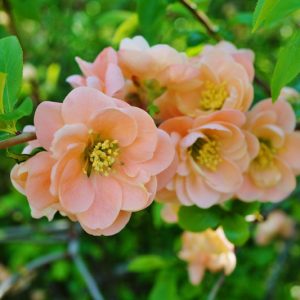
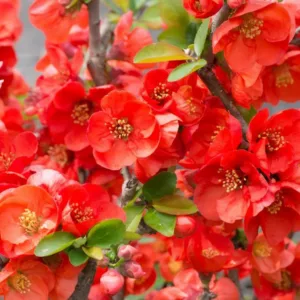
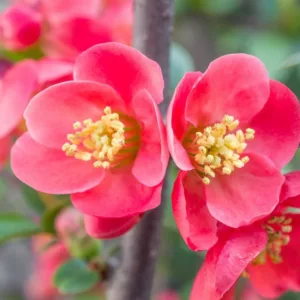
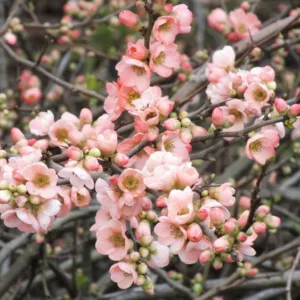
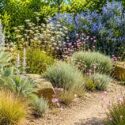
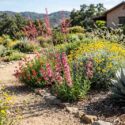
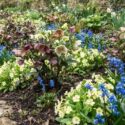
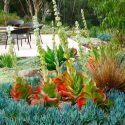
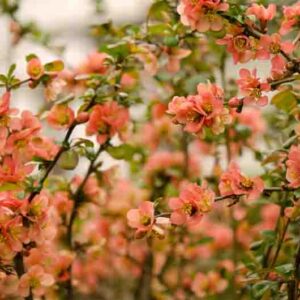
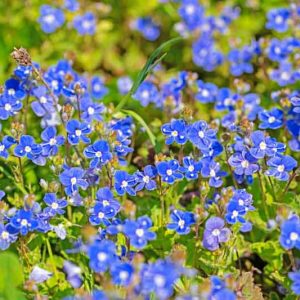
Coral-red Japanese Quince and cobalt-blue Veronica 'Georgia Blue' create a surprisingly dramatic spring pairing. The quince forms a dense, flowering hedge while the low Speedwell spreads beneath it in a carpet of blue. Simple, colorful, and easy to repeat, it is a smart way to brighten a sunny border edge.
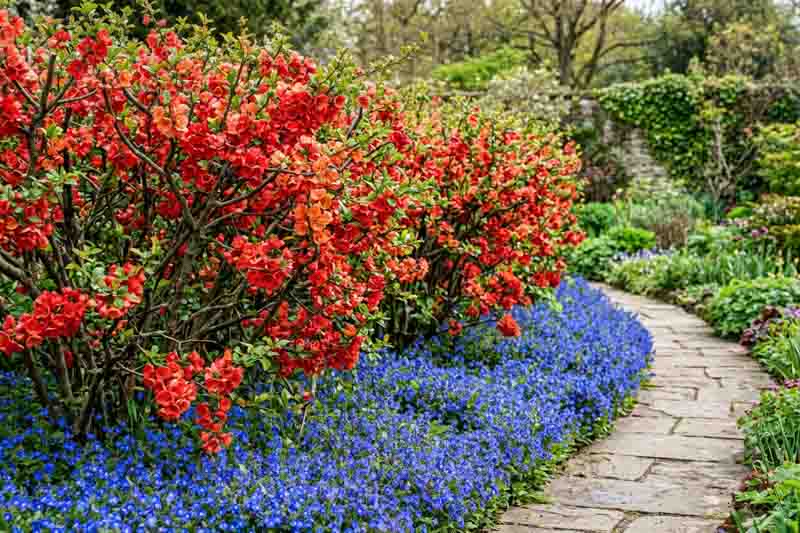


This simple two-plant combination makes a striking spring display from very little effort. The dense, twiggy framework of Chaenomeles japonica is smothered in coral-red to orange-red flowers, while Veronica umbrosa ‘Georgia Blue’ spreads beneath it in low mats of vivid cobalt-blue blooms.
The contrast is immediate: warm flowers above, cool flowers below. The quince gives the planting height and structure, while the Veronica softens the base and prevents the hedge from looking bare at ground level. Because both plants flower early in the season, the effect is especially welcome after winter.
Main plants used: Chaenomeles japonica (Japanese Quince) and Veronica umbrosa ‘Georgia Blue’ (Speedwell)
Keep the quince loose rather than tightly clipped, and let the Veronica spread naturally along the base to create a softer edge.
The color pairing is hard to miss. The warm coral-red flowers of Japanese Quince sit directly above the intense blue of ‘Georgia Blue’, creating a crisp complementary contrast that looks especially bright in spring light.
The difference in plant shape is just as useful. Chaenomeles japonica forms a dense, branching shrub, while the Veronica stays low and spreads outward. That contrast gives the planting a clear upper and lower layer without making it look formal.
It is also a practical way to finish the base of a hedge. Rather than leaving bare soil beneath the shrubs, the Veronica fills gaps, suppresses some weeds, and adds a second seasonally strong flower display.
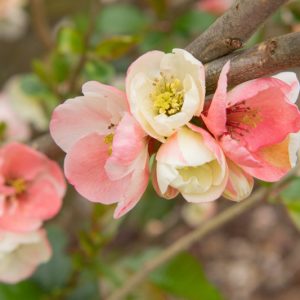
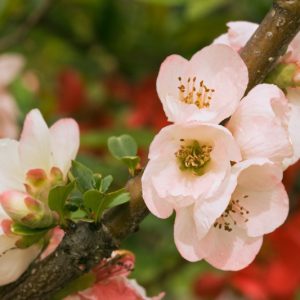
Chaenomeles japonica provides the backbone of the planting. Its thorny, spreading branches carry masses of flowers before or as the leaves emerge. It can be used as a low informal hedge, but avoid shearing it into a rigid shape if flowers are the priority.
Veronica umbrosa ‘Georgia Blue’ forms the flowering carpet at the base. Its small, intense blue flowers appear above low foliage and are most effective when allowed to spread into broad patches rather than planted as isolated individuals.
Create a compact spring hedge with strong warm color above and a cool blue flowering carpet below.
Think in layers rather than plant numbers: quince creates the upper hedge, while Veronica fills the entire lower edge.
Plant Japanese Quince in a loose row, allowing enough room for each shrub to develop naturally.
Set ‘Georgia Blue’ along the front and between the outer edges of the shrubs so it can gradually knit together.
Avoid clipping the hedge too tightly. The slightly irregular outline suits the flowering character of the planting much better.
The main display arrives in spring, when the quince bursts into coral-red flower and ‘Georgia Blue’ creates a low haze of cobalt blue around its base. The combination is especially effective because both colors appear at roughly the same time.
After flowering, the Veronica continues as a low foliage layer, while the quince becomes a leafy green shrub and may later develop small yellow-green fruits.
Japanese Quince is thorny, so place it where its branches will not obstruct a narrow path or frequently used seating area. That same thorniness can, however, make it useful as a low barrier hedge.
It is also safer not to describe the whole combination as completely deer- or rabbit-proof. Both plants are often less attractive to browsing animals than many ornamentals, but feeding pressure varies. The real strength of this pairing is its simplicity: two plants, two very different colors, and a strong spring display.
| Hardiness |
5 - 9 |
|---|---|
| Heat Zones |
6 - 8 |
| Climate Zones | 2, 2B, 3, 3A, 3B, 4, 5, 6, 7, 8, 9, 14, 15, 16, 17, 18, 19, 20, 21, 22, 23 |
| Exposure | Full Sun |
| Season of Interest | Spring (Early, Mid) |
| Maintenance | Low |
| Water Needs | Average |
| Soil Type | Chalk, Loam, Sand |
| Soil pH | Acid, Alkaline, Neutral |
| Soil Drainage | Moist but Well-Drained, Well-Drained |
| Characteristics | Fragrant, Showy |
| Tolerances | Drought, Deer, Rabbit |
| Attracts | Bees, Butterflies, Hummingbirds |
| Landscaping Ideas | Banks And Slopes, Beds And Borders, Hedges And Screens |
| Garden Styles | Butterfly Garden, City and Courtyard, Informal and Cottage, Pollinator Garden |

| Hardiness |
5 - 9 |
|---|---|
| Heat Zones |
6 - 8 |
| Climate Zones | 2, 2B, 3, 3A, 3B, 4, 5, 6, 7, 8, 9, 14, 15, 16, 17, 18, 19, 20, 21, 22, 23 |
| Exposure | Full Sun |
| Season of Interest | Spring (Early, Mid) |
| Maintenance | Low |
| Water Needs | Average |
| Soil Type | Chalk, Loam, Sand |
| Soil pH | Acid, Alkaline, Neutral |
| Soil Drainage | Moist but Well-Drained, Well-Drained |
| Characteristics | Fragrant, Showy |
| Tolerances | Drought, Deer, Rabbit |
| Attracts | Bees, Butterflies, Hummingbirds |
| Landscaping Ideas | Banks And Slopes, Beds And Borders, Hedges And Screens |
| Garden Styles | Butterfly Garden, City and Courtyard, Informal and Cottage, Pollinator Garden |
Recreate this garden. Specify the percentages you would like to have of each plant and input the dimensions of your garden space.We'll give you a shopping list so you know how many plants you need.
| Plant | Quantity | |
|---|---|---|
| Chaenomeles japonica (Japanese Quince) | N/A | Buy Plants |
| Veronica umbrosa 'Georgia Blue' (Speedwell) | N/A | Buy Plants |
Create a membership account to save your garden designs and to view them on any device.
Becoming a contributing member of Gardenia is easy and can be done in just a few minutes. If you provide us with your name, email address and the payment of a modest $25 annual membership fee, you will become a full member, enabling you to design and save up to 25 of your garden design ideas.
Join now and start creating your dream garden!
Create a membership account to save your garden designs and to view them on any device.
Becoming a contributing member of Gardenia is easy and can be done in just a few minutes. If you provide us with your name, email address and the payment of a modest $25 annual membership fee, you will become a full member, enabling you to design and save up to 25 of your garden design ideas.
Join now and start creating your dream garden!