Transform a sunny trellis with fragrant apricot Climbing Rose 'Compassion', lavender-blue Clematis 'Perle d'Azur', and rosy-pink Clematis 'Comtesse de Bouchaud'. These vigorous flowering climbers create a romantic tapestry of large summer blooms, with the repeat-flowering rose extending the display into autumn. Perfect for cottage gardens, arches, and pergolas.
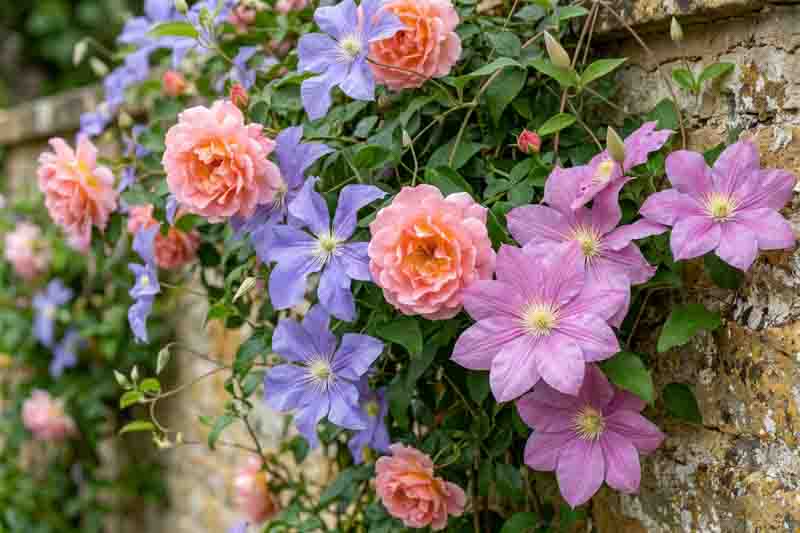


Imagine a rustic garden trellis overflowing with fragrant apricot roses, luminous lavender-blue clematis, and soft rosy-pink flowers. The three climbers weave naturally through one another, creating a beautiful tapestry of color against weathered wood. Romantic, abundant, and wonderfully inviting, this is the kind of flowering display that transforms an ordinary garden fence into a summer focal point.
Three spectacular climbers create the combination: Rosa ‘Compassion’ (Climbing Rose), Clematis ‘Perle d’Azur’, and Clematis ‘Comtesse de Bouchaud’. Their contrasting flower forms, complementary colors, and overlapping bloom periods create a long-lasting summer display, with the rose often continuing to flower into autumn.
Main plants used: Rosa ‘Compassion’, Clematis ‘Perle d’Azur’, and Clematis ‘Comtesse de Bouchaud’.
The beauty of this combination begins with Rosa ‘Compassion’, a vigorous climbing rose producing beautifully formed, double flowers in warm apricot and salmon-pink tones, often with golden highlights. Its rich fragrance adds another dimension to the display, while repeat flowering provides color from early summer into autumn.
Clematis ‘Perle d’Azur’ brings a completely different character. Its generous, open flowers are a luminous pale blue, often with a hint of violet and lighter central markings. Blooming from midsummer into early autumn, it provides a cool-colored contrast that makes the peachy roses appear even warmer.
Clematis ‘Comtesse de Bouchaud’ softens the composition with abundant rosy-pink flowers and pale yellow stamens. Its broad, slightly overlapping petals create a beautiful bridge between the warm roses and cooler blue clematis, helping the three colors blend naturally.
The combination succeeds because each climber contributes something distinctive: the rose provides fragrance and richly layered petals, while the two clematis introduce large, open flowers that bring lightness and movement. Repeating all three colors across the trellis creates a generous display without the stiffness of a formal planting.
Create a romantic, fragrant climbing display with peach-apricot roses, lavender-blue clematis, and rosy-pink clematis mingling across a sturdy garden trellis.
Approximate visual proportions of the flowering display, not exact plant quantities.
Install a strong trellis or pergola and position Rose ‘Compassion’ where its main branches can be trained horizontally or diagonally. Plant Clematis ‘Perle d’Azur’ on one side and ‘Comtesse de Bouchaud’ on the other, allowing their flowering stems to weave through the rose without becoming excessively tangled. Provide additional thin wires or mesh for the clematis to grip. Keep the plants’ crowns accessible for pruning and maintain good air circulation.
Early summer brings the first fragrant apricot flowers of Rose ‘Compassion’, joined by the rosy-pink blooms of Clematis ‘Comtesse de Bouchaud’. By midsummer, Clematis ‘Perle d’Azur’ adds luminous lavender-blue flowers, creating the combination’s most colorful display. The two clematis may continue into late summer or early autumn depending on conditions, while the repeat-flowering rose often produces additional blooms until autumn.
| Hardiness |
5 - 9 |
|---|---|
| Heat Zones |
5 - 9 |
| Climate Zones | 2, 3, 4, 5, 6, 7, 8, 9, 10, 11, 14, 15, 16, 17, 18, 19, 20, 21, 22, 23, 24 |
| Exposure | Full Sun |
| Season of Interest | Summer (Early, Mid, Late) |
| Maintenance | Average |
| Water Needs | Average |
| Soil Type | Chalk, Clay, Loam, Sand |
| Soil pH | Alkaline, Neutral |
| Soil Drainage | Moist but Well-Drained |
| Characteristics | Cut Flowers, Fragrant, Plant of Merit, Showy |
| Tolerances | Clay Soil |
| Attracts | Bees, Butterflies, Hummingbirds |
| Landscaping Ideas | Arbors, Pergolas, Trellises, Walls And Fences |
| Garden Styles | Butterfly Garden, City and Courtyard, Informal and Cottage, Pollinator Garden, Traditional Garden |




| Hardiness |
5 - 9 |
|---|---|
| Heat Zones |
5 - 9 |
| Climate Zones | 2, 3, 4, 5, 6, 7, 8, 9, 10, 11, 14, 15, 16, 17, 18, 19, 20, 21, 22, 23, 24 |
| Exposure | Full Sun |
| Season of Interest | Summer (Early, Mid, Late) |
| Maintenance | Average |
| Water Needs | Average |
| Soil Type | Chalk, Clay, Loam, Sand |
| Soil pH | Alkaline, Neutral |
| Soil Drainage | Moist but Well-Drained |
| Characteristics | Cut Flowers, Fragrant, Plant of Merit, Showy |
| Tolerances | Clay Soil |
| Attracts | Bees, Butterflies, Hummingbirds |
| Landscaping Ideas | Arbors, Pergolas, Trellises, Walls And Fences |
| Garden Styles | Butterfly Garden, City and Courtyard, Informal and Cottage, Pollinator Garden, Traditional Garden |
Recreate this garden. Specify the percentages you would like to have of each plant and input the dimensions of your garden space.We'll give you a shopping list so you know how many plants you need.
| Plant | Quantity | |
|---|---|---|
| Rosa 'Compassion' (Climbing Rose) | N/A | Buy Plants |
| Clematis 'Perle d'Azur' (Late Large-Flowered Clematis) | N/A | Buy Plants |
| Clematis 'Comtesse de Bouchaud' (Late Large-Flowered Clematis) | N/A | Buy Plants |
Create a membership account to save your garden designs and to view them on any device.
Becoming a contributing member of Gardenia is easy and can be done in just a few minutes. If you provide us with your name, email address and the payment of a modest $25 annual membership fee, you will become a full member, enabling you to design and save up to 25 of your garden design ideas.
Join now and start creating your dream garden!