Want better grapes without the backyard chaos? The right trellis changes everything. This guide breaks down the best grape trellis systems for easier pruning, healthier vines, cleaner fruit, and smarter backyard design, so you can choose a setup that fits your space, grape type, and harvest goals perfectly.
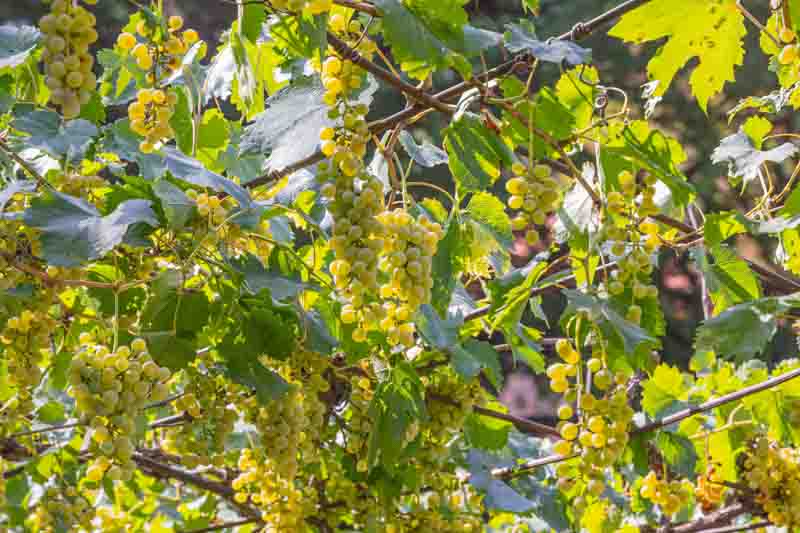


If you want productive backyard grapes, the trellis is not an accessory. It is the operating system for the entire vine. A grapevine without a proper support structure quickly turns into a tangled mass of shoots, shaded leaves, hard-to-reach fruit, and pruning headaches. A grapevine on the right trellis is easier to train, easier to prune, easier to harvest, and far more likely to produce clean, well-exposed clusters year after year.
The key idea is simple: the best grape trellis system is the one that matches your grape variety, pruning method, space, and harvest goals. Backyard growers often make the mistake of choosing the prettiest structure first and only later discovering that it is awkward to prune, too weak for crop load, too tall to pick comfortably, or poorly suited to the way grapes actually grow.
Jump to: Grape Trellis Systems at a Glance | Why Grapes Need a Trellis | What Makes a Good Grape Trellis | Best Trellis Systems for Backyard Grapes | Single-Wire High Cordon | Two-Wire Vertical Trellis | Four-Arm Kniffin | T-Trellis and Divided Canopy | Pergola and Arbor Trellis | Fence Trellis | How to Choose the Best System | Recommended Dimensions and Materials | Common Trellis Mistakes | FAQ
Grapevines are natural climbers, but that does not mean they are naturally productive in a backyard setting. Left unsupported, they sprawl, shade themselves, hide their fruit, and make routine care much harder. A trellis gives the vine a deliberate structure so you can position trunks, cordons, canes, shoots, and fruit where they belong. That matters for sunlight, airflow, disease management, crop exposure, pruning access, and harvest comfort.
In practical terms, a grape trellis does four jobs at once:
If your trellis fails at any of those jobs, vine management gets harder fast.
A good grape trellis system has to be more than sturdy. It also has to be compatible with the way you plan to train and prune the vine. Backyard grapes are usually managed with either cane pruning or spur pruning, and those pruning systems influence what type of support makes sense. Some trellises are ideal for permanent cordons and short spur pruning. Others are better for annually renewed fruiting canes.
Here is what separates a good backyard grape trellis from a frustrating one:
That last point matters more than many beginners realize. Grapes are long-lived plants. Rebuilding a flimsy trellis after the vine is established is far more annoying than building it properly from the start.
There is no one universal best grape trellis for every backyard, but there are clear winners depending on your purpose. Some systems are better for beginners. Some are better for muscadines. Some are better when you want a decorative patio feature. Some are better when you care most about disciplined vine management and reliable fruit quality.
The best backyard trellis systems are usually these six: single-wire high cordon, two-wire vertical trellis, four-arm Kniffin, T-trellis or divided canopy, pergola or arbor, and fence trellis. Each has real advantages, and each comes with tradeoffs.
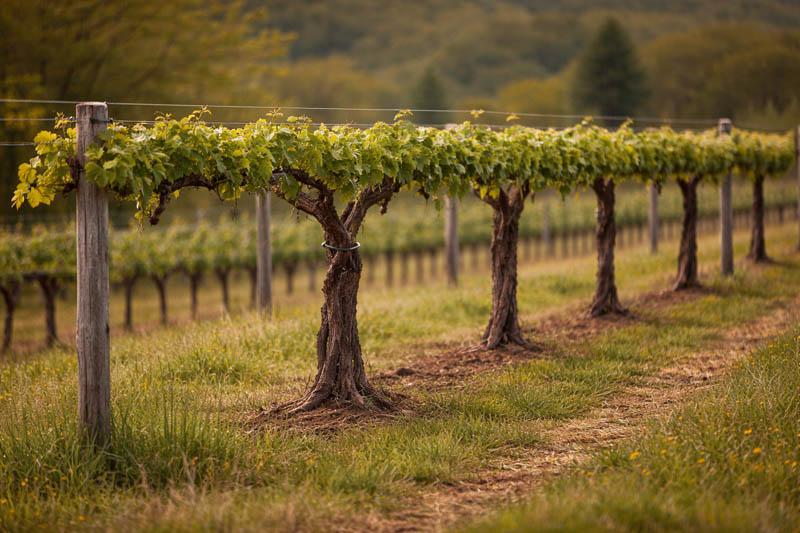
The single-wire high cordon trellis is one of the most practical backyard grape trellis systems. It typically uses sturdy end posts and a single heavy wire set about 5 to 6 feet above the ground. The vine is trained up to the wire, then along it in one or two permanent cordons. Fruiting shoots hang down from those cordons during the growing season.
This system is especially popular for muscadine grapes and can also work well for some vigorous American grapes. Its appeal is obvious. It is simple to build, easy to understand, easy to mow under, and easy to maintain once the vine framework is established. For homeowners who want dependable function without overcomplicating training, this is a top-tier choice.
The main limitation is that it is not ideal for every grape type or every pruning style. If you are growing varieties that perform better under cane pruning, a different system may give you better results. But for muscadines and for growers who value simplicity, it is one of the best backyard grape trellis designs available.
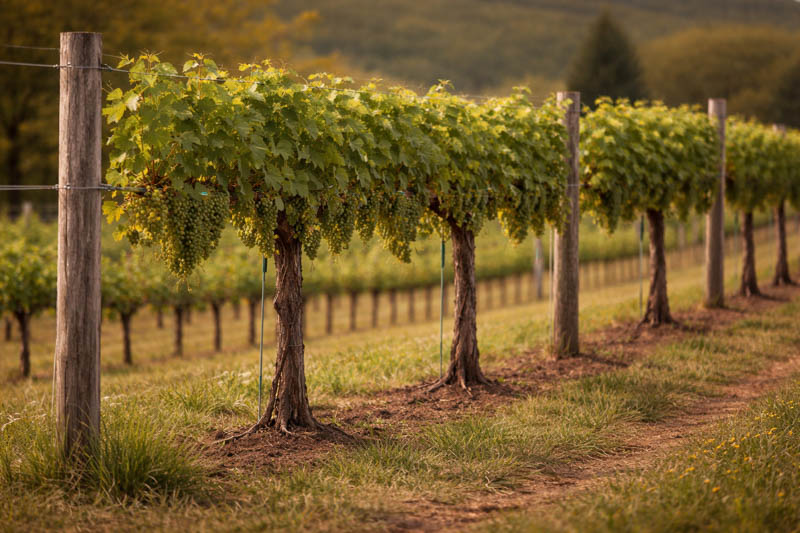
The two-wire vertical trellis is a smart choice for backyard bunch grapes when you want cleaner canopy organization. In its simplest form, one lower wire helps establish the structure while an upper fruiting wire supports cordons or canes. Some versions also use catch wires or additional support as the canopy develops. Compared with a very basic single-wire setup, it gives you more control over shoot positioning and vine shape.
This system is excellent for growers who want backyard grapes to behave more like a managed fruit crop and less like a decorative vine. It helps keep the canopy flatter, easier to inspect, and easier to thin. That can improve light penetration and make the fruiting zone more visible and more manageable.
For homeowners with limited row space, a vertical trellis also keeps the vine compact. Instead of letting growth spill everywhere, it channels the plant into a more disciplined footprint. That matters in suburban gardens where grapes may share space with paths, raised beds, lawns, patios, or neighboring plants.
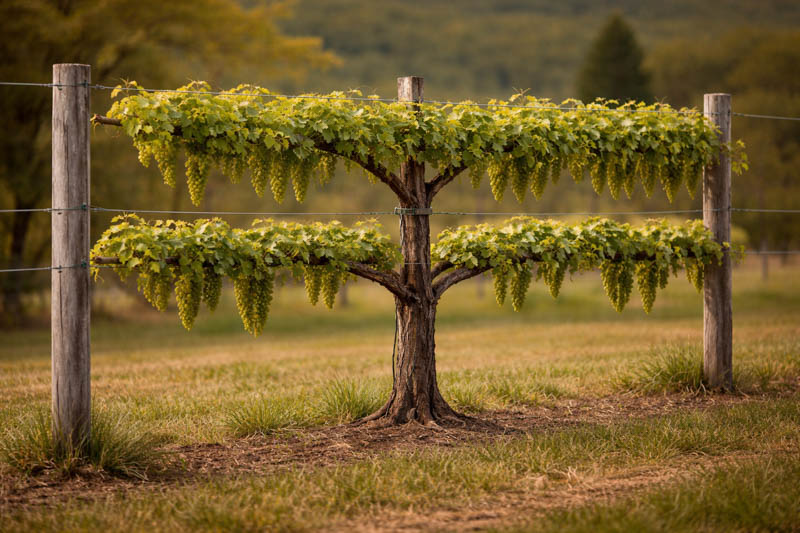
The four-arm Kniffin trellis is an old favorite for a reason. It usually uses two horizontal wires, often around 3 feet and 5 to 6 feet high, with the vine trained to a trunk and then four fruiting arms or canes distributed on the wires. For many backyard gardeners, this is the classic image of a grapevine trained for home production.
The major strength of the Kniffin system is that it gives vigorous vines room to spread fruiting wood over multiple levels without becoming a total tangle. It can be very effective for table grapes and for gardeners who are comfortable learning a bit more about grape structure and annual renewal. It also creates a visually pleasing form that many people prefer over more strictly utilitarian trellises.
The downside is that it is not always the simplest option for beginners. If poorly maintained, the upper and lower tiers can become crowded, and pruning decisions can feel less intuitive than on a straightforward high-cordon system. Still, when managed well, the four-arm Kniffin remains one of the best grape trellis systems for backyard growers who want productive vines and traditional garden character.
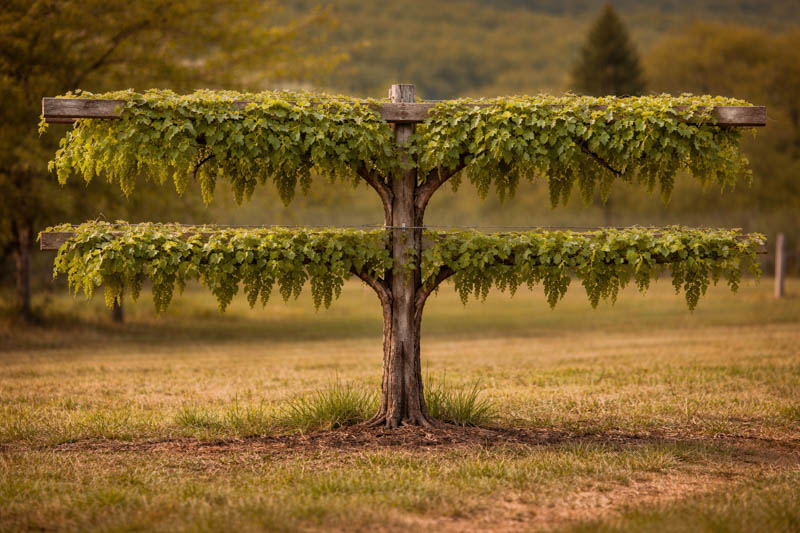
If your grapevines are extremely vigorous, a T-trellis or divided canopy system can be a smarter long-term solution. These systems spread the canopy outward rather than stacking all the shoots into one narrow curtain. That extra room can reduce crowding, improve airflow, and make a powerful vine easier to manage.
In backyard settings, this approach is most useful when a standard single-plane trellis keeps turning into a dense wall of vegetation. If shoots become overly crowded every year, fruit disappears inside the canopy, and summer growth gets wild, a divided system may fit the vine better than repeated attempts to force it into a narrower structure.
The tradeoff is complexity. T-trellises take more materials, more planning, and usually more understanding of training and pruning. They are not the default recommendation for every homeowner. But when vigor is consistently high, they can outperform simpler systems because they give the vine more usable canopy real estate instead of more chaos.
Pergolas and arbors are the most attractive grape trellis systems, and they are often the first thing homeowners imagine when they think about backyard vines. They create overhead shade, define outdoor rooms, soften hardscape, and make a garden feel established and romantic. For the right property, they can be fantastic.
But here is the professional truth: a pergola is not automatically the best trellis for fruit production. Overhead grape training can make pruning more complicated, put fruit out of comfortable reach, and increase the mess below the structure when ripe grapes drop. If the pergola is very tall, harvest becomes less pleasant and routine canopy work gets harder.
That does not mean pergolas are a bad choice. It means they are a lifestyle choice as much as a production choice. If you care deeply about shade, outdoor living, and aesthetics, an arbor or pergola can be excellent. Just build it strong, expect to prune carefully, and understand that appearance and convenience are sharing the priority list with fruiting performance.
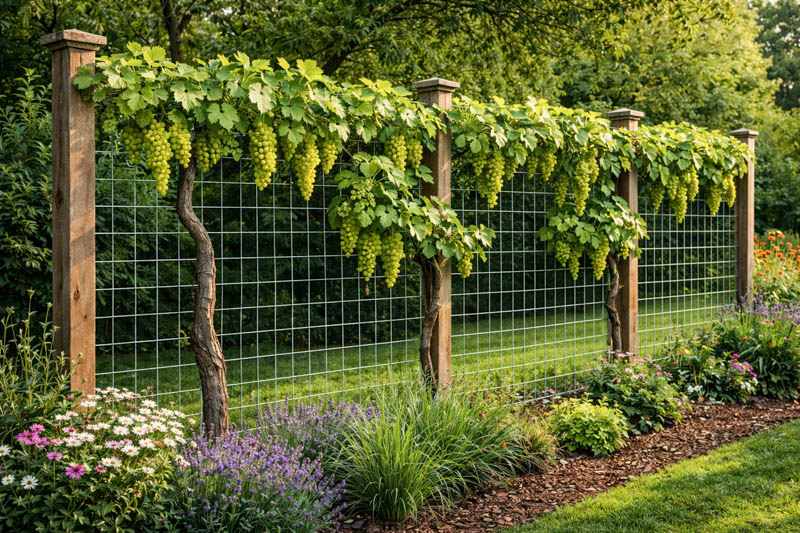
A fence can work as a backyard grape trellis, and for many homeowners it is the most practical low-cost option. If you already have a sturdy fence in the right location, adding training wires can turn it into a functional support for grapes. This can save space and make use of an existing boundary rather than introducing a separate row structure.
However, not every fence is a grape trellis just because a vine can climb it. Lightweight decorative panels, weak lattice, and aging wooden sections often fail under vine weight. Grapes become surprisingly heavy once the permanent wood, summer canopy, and crop load build over several years. If the fence is not engineered for that weight, it may twist, lean, or break.
The other consideration is access. If the fence is against a property line or too close to a wall, pruning and harvest may become awkward. A fence trellis works best when you can access the vine well and when you still have room to train the structure intentionally rather than letting it glue itself flat to the boards.
The best grape trellis for your yard depends on four practical questions.
First, what kind of grapes are you growing? Muscadines often perform very well on high single-wire cordon systems. Many bunch grapes can do well on two-wire, Kniffin, or other multi-wire systems depending on training style and vigor.
Second, how do you want to prune? Spur-pruned cordons pair naturally with high-cordon trellises. Cane-pruned vines often benefit from systems that make annual cane selection and tying easier.
Third, what matters most to you – yield, simplicity, appearance, or shade? If you want the easiest routine, choose a simple row trellis. If you want a landscape focal point, choose a pergola with full awareness of the extra maintenance.
Fourth, how vigorous is your site? Rich soil, irrigation, and strong growing conditions can make vines too crowded on narrow trellises. In those cases, a more generous structure may produce a healthier, more manageable canopy.
| Goal | Best Trellis Choice | Why It Works |
|---|---|---|
| Easiest maintenance | Single-wire high cordon | Simple framework, easy pruning, clear structure |
| Neatest backyard row | Two-wire vertical trellis | Compact canopy, good access, good light distribution |
| Traditional table grape look | Four-arm Kniffin | Classic training style with productive multi-level support |
| Very vigorous vines | T-trellis or divided canopy | More canopy space, less crowding, better airflow |
| Shade and visual impact | Pergola or arbor | Creates an outdoor feature and overhead vine cover |
Most backyard grape trellis failures come from weak posts, poor anchoring, or undersized wire. Grapes are not light-duty plants. Use sturdy end posts, set them deeply, and tension the wire properly. Fruit load, wet foliage, and wind all add stress. A beautiful trellis that sways, bows, or loosens after two summers is not a bargain.
For many home systems, fruiting wires end up around 5 to 6 feet high, which is a sweet spot for pruning and harvest. Lower wires may be added on systems like Kniffin or two-wire trellises. Pergolas vary, but going too high often creates more maintenance trouble than visual benefit. Comfortable management height beats dramatic height in most backyards.
Pressure-treated wood or metal posts can both work well. Galvanized high-tensile wire is a common choice because it stands up to weather and crop load. Whatever materials you choose, build for the mature vine, not the baby vine you just planted. The structure should look slightly overbuilt on planting day. A few years later, it will look appropriately sized.
A trellis and a pruning system are a matched pair. This is where many backyard grape problems begin. Gardeners install a structure first, then later discover it does not suit the way the vine should be pruned. For example, a single-wire cordon system pairs naturally with spur pruning and permanent cordons. A cane-pruned vine often benefits from a system that allows easy annual renewal and tying of fruiting canes.
That is why the best backyard grape trellis is not simply the strongest or prettiest option. It is the one that makes correct annual pruning easier, not harder. A good trellis helps you keep the fruiting zone close to the structure, the canopy open, and the crop accessible. A poor trellis forces workarounds every winter.
Choosing style over function. A decorative arbor may look perfect in a photo but become exhausting to prune and harvest if it is too tall or too dense overhead.
Underbuilding the structure. Weak posts, thin wire, and poor bracing are among the most common causes of trellis failure.
Ignoring grape type. Muscadines, American grapes, and bunch grapes do not always perform best on the exact same setup.
Using a fence with no access. If you cannot comfortably reach both training wood and fruit, routine management suffers.
Forcing a vigorous vine into a cramped trellis. Repeated summer congestion is often a design problem, not just a pruning problem.
Building the trellis too high. Backyard grapes are usually best when fruit stays within comfortable working reach.
For many home growers, the best all-around grape trellis is a single-wire high cordon or a simple two-wire trellis, depending on grape type and pruning style. These systems balance strength, accessibility, and manageable annual maintenance.
Yes, grapes can grow on a fence if the fence is strong enough and you can still access the vine for pruning, training, and harvest. A weak or cramped fence setup often becomes difficult to manage as the vine matures.
A pergola can be excellent for grapevines when you want shade and visual appeal, but it is not always the easiest option for fruit production. Very tall pergolas can make pruning and harvest less convenient.
A single-wire high cordon trellis is one of the most common and practical choices for muscadine grapes because it supports strong permanent cordons and works well with a straightforward pruning routine.
Many backyard grape trellises place the main fruiting wire around 5 to 6 feet high. That height usually provides a good balance between vine management, sunlight exposure, and comfortable picking.
The easiest grape trellis for many beginners is a simple high-cordon system with strong posts and one main wire. It is straightforward to build, easy to understand, and usually easier to maintain than more decorative or more complex systems.
The best trellis systems for backyard grapes are the systems that make grape growing simpler, not harder. That usually means building something strong, choosing a structure that matches the grape’s growth habit, and keeping fruit within comfortable reach. For many homeowners, a single-wire high cordon or a neat two-wire trellis will outperform more elaborate designs simply because it keeps the vine organized and manageable.
If your priority is pure practicality, stay simple. If your priority is a classic home vineyard feel, a Kniffin-style setup can be excellent. If your priority is shade and beauty, a pergola can be wonderful as long as you accept the extra maintenance. In every case, the principle stays the same: build for the mature vine, not the newly planted one.
That is what separates a grapevine that merely grows from a grapevine that produces well for years. The right trellis does not just support the plant. It supports the entire system behind healthy vines, clean fruit, easier pruning, and better harvests.
Updated: March 2026 • Reviewed against university extension guidance on backyard grape trellising, training, and support design
| Hardiness |
3 - 10 |
|---|---|
| Plant Type | Climbers, Fruits |
| Plant Family | Vitaceae |
| Genus | Vitis |
| Exposure | Full Sun |
| Maintenance | High |
| Water Needs | Average |
| Soil Type | Chalk, Loam, Sand |
| Soil pH | Alkaline, Neutral |
| Soil Drainage | Well-Drained, Moist but Well-Drained |
| Attracts | Bees, Birds |
| Hardiness |
3 - 10 |
|---|---|
| Plant Type | Climbers, Fruits |
| Plant Family | Vitaceae |
| Genus | Vitis |
| Exposure | Full Sun |
| Maintenance | High |
| Water Needs | Average |
| Soil Type | Chalk, Loam, Sand |
| Soil pH | Alkaline, Neutral |
| Soil Drainage | Well-Drained, Moist but Well-Drained |
| Attracts | Bees, Birds |

Create a membership account to save your garden designs and to view them on any device.
Becoming a contributing member of Gardenia is easy and can be done in just a few minutes. If you provide us with your name, email address and the payment of a modest $25 annual membership fee, you will become a full member, enabling you to design and save up to 25 of your garden design ideas.
Join now and start creating your dream garden!
Create a membership account to save your garden designs and to view them on any device.
Becoming a contributing member of Gardenia is easy and can be done in just a few minutes. If you provide us with your name, email address and the payment of a modest $25 annual membership fee, you will become a full member, enabling you to design and save up to 25 of your garden design ideas.
Join now and start creating your dream garden!