Annual Salvia horminum ‘Blue’ and calendula create a vivid blue-and-orange cottage border for full sun. Salvia adds upright bracted spikes; calendula supplies orange daisy blooms. Expect peak flowering from late spring through summer, often longer with deadheading. Pollinator-friendly, photogenic, and easy to repeat in drifts.


This sunny annual border is built around one of the clearest color contrasts in the garden: deep violet-blue against warm orange. Salvia viridis ‘Blue’ rises above the planting with strongly colored bracts, while Calendula officinalis fills the lower layer with orange and golden daisy-like flowers.
The combination is simple, which is part of its appeal. Repeating the two plants in generous groups gives the border enough structure to look intentional, while variations in height, flowering stems, and foliage keep it relaxed. It works particularly well in cottage gardens, cutting gardens, and seasonal beds where strong summer color is more important than permanent structure.
Main plants used: Salvia viridis ‘Blue’ (syn. Salvia horminum ‘Blue’) and Calendula officinalis
Blue and orange sit opposite each other on the color wheel, so even a relatively simple planting has strong visual contrast. The effect is especially noticeable when the colors are repeated several times rather than scattered as isolated individual plants.
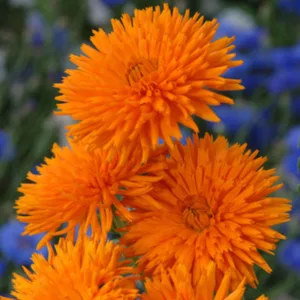
The flower forms are different as well. Calendula has broad, open daisy-like blooms held relatively low in the border. Salvia viridis is more vertical, with small flowers accompanied by showy colored bracts toward the upper parts of the stems. Those blue bracts retain their effect longer than individual flowers and give the planting height without creating a heavy mass.
The border works best when the two species overlap slightly. Calendula can move between Salvia groups rather than forming a separate orange strip, while the taller blue stems can appear at different depths through the planting.
Salvia viridis ‘Blue’, often sold under the older name Salvia horminum, is an annual sage grown primarily for its vivid blue to violet bracts. The small true flowers are less conspicuous, but the colorful bracts remain attractive for an extended period. Plants perform best in full sun and reasonably well-drained soil.
Calendula officinalis, or Pot Marigold, produces bright orange or yellow flowers over a long period in favorable weather. Regular cutting or deadheading encourages plants to continue producing buds rather than putting all their energy into seed. Calendula generally performs best in the cooler parts of the growing season and may slow down during extreme summer heat.

Create a bright seasonal border where orange Calendula forms the main flowering layer and repeated blue Salvia stems rise through it.
This is a design allocation rather than a plant-only percentage. The open space is intentional and helps the individual groups remain visible.
Plant Calendula in generous irregular patches through the front and middle, allowing some spaces between groups rather than creating a continuous carpet.
Repeat Salvia in groups through the middle and toward the back. Vary the number of plants in each group so the blue accents recur without looking like a row.
Allow some mixing at the boundaries. A few Calendula plants pushing between the Salvia groups will make the planting look more established and less diagrammed.
This is primarily a seasonal planting rather than a permanent perennial border. Its exact flowering period will vary considerably with climate. Calendula often performs particularly well in cool spring or autumn weather and may become tired during very hot summers.
The planting also does not need rich soil or heavy feeding. Excess fertilizer can encourage soft leafy growth at the expense of flowers. Moderate fertility, good light, and regular deadheading are usually more useful.
Finally, neither plant should be relied upon as consistently deer resistant. Browsing varies greatly by location and food pressure, so where deer are a serious problem, protect young plants until you know how they behave in your garden.
| Hardiness |
3 - 11 |
|---|---|
| Heat Zones |
1 - 6 |
| Exposure | Full Sun, Partial Sun |
| Season of Interest | Spring (Late), Summer (Early, Mid, Late), Fall |
| Maintenance | Low |
| Water Needs | Average |
| Soil Type | Chalk, Loam, Sand |
| Soil pH | Acid, Alkaline, Neutral |
| Soil Drainage | Well-Drained |
| Characteristics | Showy, Cut Flowers, Dried Arrangements |
| Tolerances | Deer |
| Attracts | Bees, Butterflies |
| Landscaping Ideas | Beds And Borders |
| Garden Styles | Butterfly Garden, Cutting Garden, Informal and Cottage, Pollinator Garden |
Recreate this garden. Specify the percentages you would like to have of each plant and input the dimensions of your garden space.We'll give you a shopping list so you know how many plants you need.
| Plant | Quantity | |
|---|---|---|
| Salvia horminum 'Blue' (Annual Sage) | N/A | Buy Plants |
| Calendula officinalis 'Crown Orange' (Pot Marigold) | N/A | Buy Plants |
Create a membership account to save your garden designs and to view them on any device.
Becoming a contributing member of Gardenia is easy and can be done in just a few minutes. If you provide us with your name, email address and the payment of a modest $25 annual membership fee, you will become a full member, enabling you to design and save up to 25 of your garden design ideas.
Join now and start creating your dream garden!