Agave snout weevil is one of the most serious pests of agaves, tunneling into crowns and roots until plants collapse. Learn how to identify adults and larvae, spot early damage, protect valuable agaves, remove infested plants safely, and prevent future losses in water-wise gardens and desert landscapes.


If a beautiful agave suddenly leans, loosens, smells sour, or collapses from the center, the problem may be more than ordinary rot. The agave snout weevil is a small, dark, long-nosed beetle that can destroy large agaves from the inside out. By the time the damage is obvious, the larvae may already be tunneling through the crown, roots, and lower stem.
The agave snout weevil, Scyphophorus acupunctatus, is also called the agave weevil, sisal weevil, or agave snout beetle. It is one of the most serious pests of agaves in warm, dry, and Mediterranean-style landscapes, especially where large architectural succulents are used as focal points. Century plants, blue agaves, sisal agaves, and other mature rosette-forming species can be badly damaged or killed.
This pest is especially frustrating because it does not usually announce itself with chewed leaves or visible colonies. Adult weevils bore into protected tissue near the base of the plant, and females lay eggs inside the agave. The larvae hatch within the plant and feed in the hidden core. The result is often a dramatic collapse that seems sudden, even though the infestation has been developing out of sight.
Scientific name: Scyphophorus acupunctatus
Common names: Agave snout weevil, agave weevil, sisal weevil, agave snout beetle.
Main damage: Larvae tunnel inside agave crowns, roots, and lower stems, often leading to crown rot, structural collapse, and plant death.
Key symptoms: Leaning rosette, loose or wilting leaves, soft crown, sour or foul odor, small holes near the base, internal tunnels, pale grubs, and sudden plant collapse.
Common host plants: Agave spp., especially large agaves such as Agave americana, Agave tequilana, Agave attenuata, and related species. Associated hosts may include Yucca, Dasylirion, Beaucarnea recurvata, Dracaena draco, and tuberose in some regions.
Favored conditions: Warm climates, stressed agaves, mature plants with large succulent crowns, wounds near the base, poor drainage, and landscapes where infested material is left in place.
First action: Check the crown, base, and root zone for soft tissue, holes, tunnels, larvae, adult weevils, and a fermented or rotten smell.
Best control strategy: Prevention, regular inspection, rapid removal of infested plants, sanitation, less susceptible plant choices, and locally approved preventive treatments where needed.
Snippet-ready answer: Agave snout weevil is a dark, long-snouted beetle whose larvae tunnel inside agave crowns and roots. Infested plants may lean, rot, smell sour, or collapse suddenly. Advanced infestations are rarely curable, so the best control is prevention, early inspection, and prompt removal of infested agaves.
The agave snout weevil is a weevil, a type of beetle with an elongated snout. Adults use this snout to feed and bore into plant tissue, often near the base of an agave where the leaves meet the crown. Females lay eggs in these protected wounds, giving the larvae immediate access to the moist, nutrient-rich interior of the plant.
Once inside, the larvae do the most serious damage. They are pale, legless grubs that feed within the crown, roots, and lower stem. Their tunneling weakens the plant’s structure and creates entry points for secondary decay organisms, including bacterial and fungal rot organisms. This combination of insect feeding and internal decay is why affected agaves often fail so dramatically.
The pest is important in both ornamental landscapes and commercial agave production. It has been associated with agaves grown for tequila, mezcal, pulque, sisal fiber, and landscape design. In a home garden, the loss can be especially painful because large agaves may take many years to reach their full size and character.
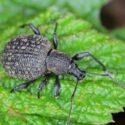
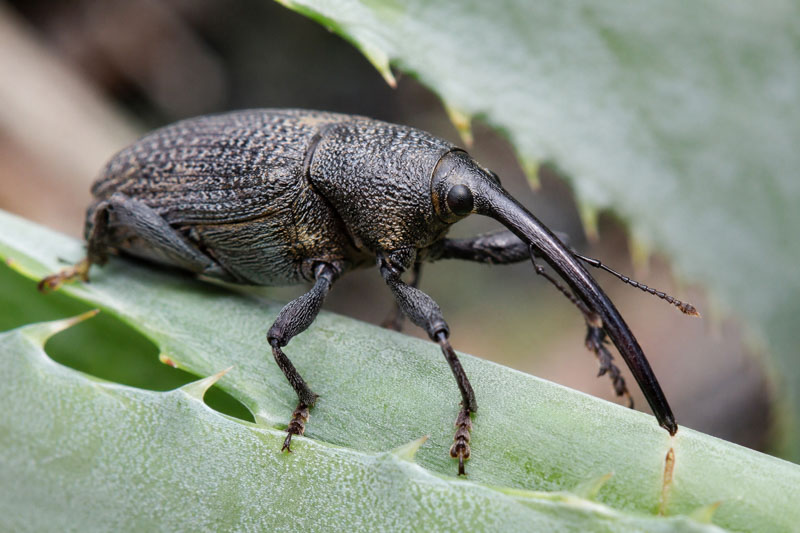
Adult agave snout weevils are usually dark brown to black, hard-bodied, and roughly half an inch long, though size can vary. Their most recognizable feature is the curved, beak-like snout that projects from the head. They are not showy insects, and they often hide near the crown, under lower leaves, inside crevices, or around the base of the plant.
The larvae look very different. They are creamy white to pale, soft-bodied, legless grubs with darker heads. You are unlikely to see them on the outside of healthy leaves. Instead, they are usually discovered when a damaged agave is opened and the crown reveals tunnels, mushy tissue, wet decay, or a sour smell.
Adult agave snout weevils look like small black beetles with a long nose. The larvae look like pale, legless grubs hidden inside the agave core. If the plant is soft, smelly, or unstable, inspect the crown and root zone.
Agave snout weevil damage often looks sudden because the most important feeding happens inside the plant. A healthy-looking agave may already contain larvae tunneling through the crown. As feeding continues, the plant’s central structure weakens, water movement is disrupted, and decay spreads through injured tissue.
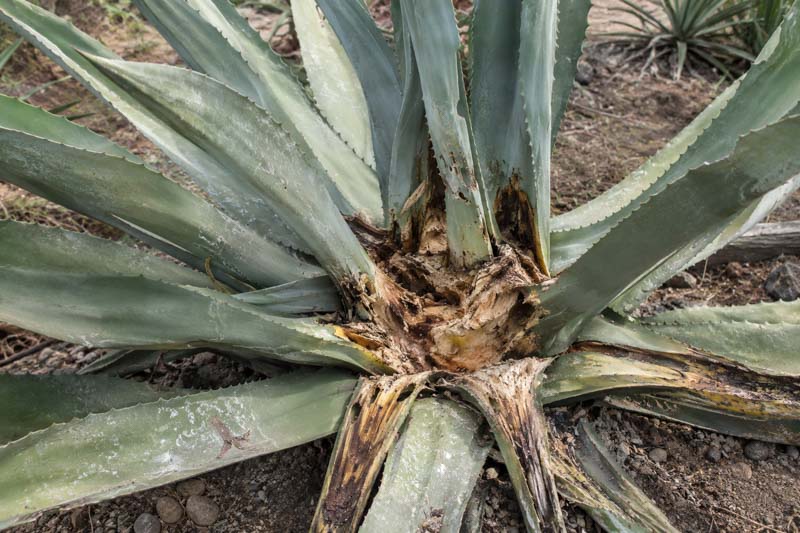
Common symptoms include a leaning rosette, drooping or yellowing leaves, loose lower leaves, a central spear that pulls away easily, small holes at the base, soft or darkened tissue, oozing, and a fermented odor. In advanced cases, the entire plant may detach from the roots or collapse into a rotten mass.
Large agaves are often hit hardest because they provide a thick, moist, protected core where larvae can develop. Mature Agave americana, blue agaves, sisal agaves, and other big rosette-forming species are high-value targets in many warm-climate gardens. Smaller, narrower-leaved species may be less attractive or less vulnerable in some landscapes, but susceptibility varies and no agave should be treated as guaranteed immune.
If an agave wiggles, smells rotten, or pulls away from the soil, act quickly. Open the base, look for larvae and tunnels, and remove badly infested material before adults or developing weevils move to nearby hosts.
Sometimes, but only if the problem is caught very early. If the plant is still firm, the crown is intact, and there is only minor localized damage, careful cleanup and close monitoring may help. However, once the central crown is soft, foul-smelling, filled with larvae, or separated from the roots, the growing point is usually destroyed and recovery is unlikely.
This is the hardest truth about agave snout weevil control: treatment after collapse is usually too late. The goal is not to spray a dying agave and hope for the best. The goal is to protect nearby plants, remove breeding material, and prevent the next infestation.
If your agave is leaning, soft, or smelly, do not wait. Check the crown and root zone, remove badly infested tissue, dispose of it securely, and inspect nearby agaves for early symptoms.
Agave collapse is often blamed on root rot, and sometimes root rot is the main issue. However, agave snout weevil and rot frequently overlap because weevil feeding creates wounds that allow decay to spread. The difference is important because a rotting agave with larvae inside is also a pest reservoir.
| Clue | More Likely Root Rot | More Likely Snout Weevil |
|---|---|---|
| Main trigger | Overwatering, poor drainage, buried crown, cold wet soil. | Adult boring and larval feeding inside the crown or base. |
| Visible insects | Usually none. | Adult weevils, pale grubs, tunnels, or pupal chambers may be present. |
| Plant base | Soft roots or crown decay, often linked to wet conditions. | Small holes, internal galleries, chewed tissue, larvae, and sour-smelling rot. |
| Best response | Improve drainage, reduce irrigation, remove rotted tissue if minor. | Remove infested plant material and inspect nearby agaves immediately. |
The life cycle takes place largely inside the host plant. Adults find suitable agaves, feed near the base or lower leaves, and lay eggs in protected tissue. Larvae hatch and tunnel through the succulent interior, feeding on the crown, roots, and lower stem. After development, they pupate in or near damaged plant material and later emerge as adults.
Warm weather supports activity, and in mild regions adults may be present for much of the year. Gardeners often notice damage during warm seasons or after periods that stress the plant, such as excessive irrigation, heat, transplant shock, or poor drainage. However, the infestation may begin well before the agave shows obvious distress.
Because the larvae are protected inside the plant, ordinary sprays applied to the leaves are often ineffective once the pest is established. That is why inspection, sanitation, and prevention are more reliable than trying to rescue a plant with a destroyed crown.
The primary host group is Agave. The pest is strongly associated with agaves grown for ornamental landscapes, tequila, mezcal, pulque, and sisal fiber. Important or frequently reported hosts include Agave americana, Agave tequilana, Agave sisalana, Agave salmiana, and other large agaves.
Associated host plants may include Yucca, Dasylirion, Beaucarnea recurvata, Dracaena draco, Furcraea, and Polianthes tuberosa, also known as tuberose or Agave amica. Host risk varies by region, plant species, plant stress, and local pest pressure.
In home landscapes, the practical priority is clear: watch large, mature, high-value agaves first. A garden filled with aging century plants can be especially vulnerable if one plant becomes infested and is left to decay in place.
Inspect susceptible agaves regularly, especially in warm regions or in gardens with a history of weevil damage. Start at the base of the plant and look for small holes, darkened tissue, oozing, sawdust-like debris, loosened lower leaves, or soft tissue. Gently test the plant’s stability. A healthy agave should feel firmly anchored.
Check newly purchased plants before planting. Avoid agaves with soft bases, old wounds, suspicious holes, sour odor, or loose central growth. If you are adding valuable specimens in an area where agave snout weevil is known, consider isolating new plants briefly and inspecting them closely before placing them near established agaves.
If one agave collapses, inspect its neighbors. Adults can move to nearby hosts, and larvae or pupae may remain in decaying plant material or adjacent soil. Fast action can prevent one dead specimen from becoming the start of a larger landscape problem.
Make agave inspection part of seasonal maintenance. A quick check at the base of each high-value plant can catch problems before a prized agave becomes a rotting breeding site.
Once larvae are deep inside an agave, control is difficult. If the crown is collapsing, the growing point is rotten, or larvae are present throughout the core, removal is usually the most responsible option. Dig out the plant, including the crown, roots, and immediately adjacent soil where developing stages may be present.
Dispose of infested material securely. Do not leave the rotting core in the garden, and do not place infested tissue in a casual home compost pile. Bag it, remove it from the property, or follow local disposal guidance so larvae, pupae, or adults cannot continue developing and escape.
After removal, inspect nearby agaves and related host plants. Clean tools used on infested tissue. Replant carefully, and consider whether the same location should receive another large agave or a less vulnerable desert plant. In sites with repeated losses, switching to smaller agaves or non-agave desert plants may be the smarter long-term choice.
Insecticides are not a magic rescue treatment for a collapsing agave. Since larvae feed inside the plant, products applied too late may not reach them effectively. Where agave snout weevil is a recurring problem, some professional landscape managers use locally approved systemic or contact treatments as prevention before infestation becomes established.
Systemic products such as imidacloprid may be recommended in some regions before plants are infested, but they must be used carefully and only according to the label. Consider timing, local regulations, pollinator risks, nearby flowering plants, water movement, and whether the product is appropriate for the site. If the agave is already rotten, filled with larvae, or detached from its roots, removal is usually more useful than treatment.
For organic or low-impact management, focus on inspection, sanitation, drainage, plant health, and plant selection. Pheromone trapping, entomopathogenic nematodes, and other tools may be used or studied in some production systems, but results and availability vary. For most home gardens, the strongest approach is still early detection and rapid removal of infested material.
Preventive treatment may help protect healthy agaves in high-risk areas, but it will not reliably save a plant whose crown has already collapsed. When larvae have destroyed the core, sanitation becomes the priority.
Prevention is the heart of agave snout weevil management. Plant agaves in well-drained soil, avoid burying the crown, and reduce unnecessary wounds near the base. Do not overwater or overfertilize, because stressed plants and overly lush tissue can be more vulnerable to pests and rot.
A dead agave left in place can become a breeding site. Garden sanitation may not feel glamorous, but with agave snout weevil, it is one of the most powerful tools available.
Agave snout weevil is not a cosmetic pest. It is a crown-boring, plant-killing insect. Protect valuable agaves with regular inspection, fast sanitation, good drainage, careful plant selection, and locally appropriate preventive measures.
The agave snout weevil is a dark, long-snouted beetle, Scyphophorus acupunctatus, whose larvae tunnel inside agave crowns, roots, and lower stems, often causing rot, collapse, and plant death.
Look for a leaning rosette, loose leaves, soft crown, small holes near the base, sour odor, internal tunnels, and pale legless grubs inside the crown or roots.
An agave may survive only if damage is caught very early and the crown remains firm. If the growing point is rotten, soft, foul-smelling, or filled with larvae, recovery is unlikely.
They primarily attack Agave species, including large ornamental and crop agaves. Associated hosts may include yucca, dasylirion, beaucarnea, dracaena, furcraea, and tuberose in some regions.
Remove and securely dispose of badly infested agaves, including the crown, roots, and nearby soil. Inspect neighboring agaves and use preventive measures before new infestations develop.
In some regions, systemic products such as imidacloprid may help prevent infestation when applied before plants are attacked. They are not reliable rescue treatments for agaves with collapsed or rotten crowns. Always follow local guidance and the product label.
No. Root rot is usually linked to wet soil or poor drainage, while agave snout weevil is an insect pest. However, weevil feeding can cause wounds that lead to secondary rot, so the two problems may occur together.
No. Do not compost infested agave tissue in a home compost pile. Dispose of it securely so larvae, pupae, or adult weevils cannot continue developing and escape.
Prevent agave snout weevil by inspecting plants regularly, avoiding crown wounds, improving drainage, removing infested plants quickly, diversifying plantings, and using locally approved preventive treatments where appropriate.
Updated: June 2026 • Reviewed by Gardenia Editors
Create a membership account to save your garden designs and to view them on any device.
Becoming a contributing member of Gardenia is easy and can be done in just a few minutes. If you provide us with your name, email address and the payment of a modest $25 annual membership fee, you will become a full member, enabling you to design and save up to 25 of your garden design ideas.
Join now and start creating your dream garden!
Create a membership account to save your garden designs and to view them on any device.
Becoming a contributing member of Gardenia is easy and can be done in just a few minutes. If you provide us with your name, email address and the payment of a modest $25 annual membership fee, you will become a full member, enabling you to design and save up to 25 of your garden design ideas.
Join now and start creating your dream garden!