White felted bumps, sticky leaves, and blackened bark may signal crape myrtle bark scale. Learn how to identify this invasive insect, distinguish it from powdery mildew and aphids, monitor vulnerable crawlers, inspect alternative host plants, and combine washing, beneficial insects, horticultural oil, and carefully selected treatments for lasting control.
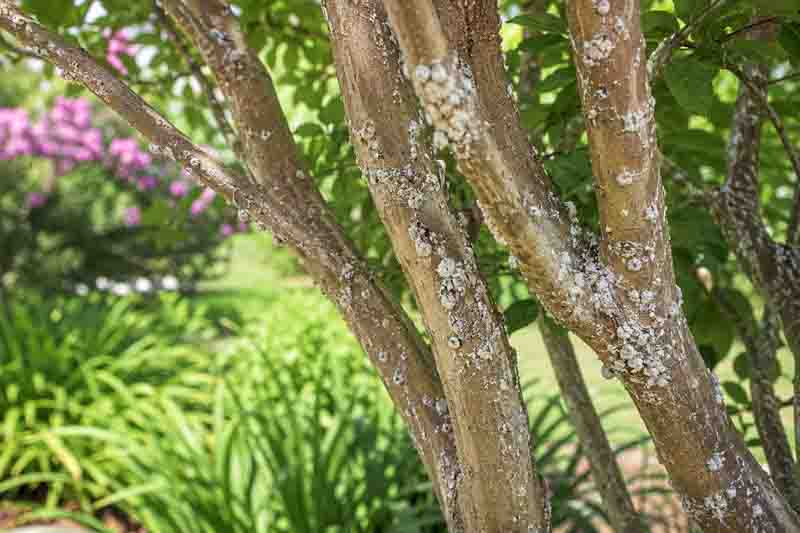


The trunks of a healthy crape myrtle should display smooth, colorful, exfoliating bark. If those trunks are instead dotted with tiny white bumps, the leaves feel sticky, and black mold is spreading across the bark, your tree may have crape myrtle bark scale.
Crape myrtle bark scale is an invasive sap-feeding insect that can transform an elegant flowering tree into a sticky, blackened mess. Heavy infestations may delay spring leaf-out, reduce new growth, and produce fewer or smaller flower clusters. The pest rarely kills a healthy, established crape myrtle outright, but persistent infestations can greatly reduce its vigor and ornamental value.
Scientifically known as Acanthococcus lagerstroemiae and formerly as Eriococcus lagerstroemiae, crape myrtle bark scale is a felt scale native to Asia. It is now established across parts of the southern and south-central United States and continues to appear in new areas through the movement of infested plants.
The good news is that an infested crape myrtle is not automatically lost. Successful control depends on confirming the pest, determining whether the scales are alive, monitoring for vulnerable crawlers, conserving natural predators, and choosing treatments appropriate for the season and severity of the infestation.
Scientific name: Acanthococcus lagerstroemiae, formerly Eriococcus lagerstroemiae
Common names: Crape myrtle bark scale, crapemyrtle bark scale, CMBS.
Insect type: Invasive felt scale and sap-feeding insect.
Main symptoms: Tiny white or gray felted bumps on bark, sticky honeydew, black sooty mold, reduced vigor, delayed leaf-out, and diminished flowering.
Best identification clue: Crushing a live female scale may release pink or reddish body fluid.
Most vulnerable stage: Newly hatched pink crawlers before they develop a protective wax covering.
Primary host: Crape myrtle – Lagerstroemia.
Other hosts: American beautyberry, pomegranate, persimmon, edible fig, boxwood, cleyera, privet, and raspberry.
Best management: Early detection, physical cleaning, preservation of beneficial insects, crawler-timed contact treatments, horticultural oil, and carefully selected systemic products when justified.
Snippet-ready answer: Crape myrtle bark scale is an invasive insect that forms tiny white felted coverings on trunks and branches. It produces sticky honeydew that supports black sooty mold. Control combines washing, crawler monitoring, natural predators, horticultural oil, and labeled insecticides when necessary.
Crape myrtle bark scale is a small insect that inserts slender mouthparts through the bark and feeds on sugary plant fluids. It belongs to the felt-scale family because mature females and their egg sacs are protected by a white or gray felt-like wax.
Small colonies can be difficult to notice. The insects settle in branch crotches, bark fissures, pruning wounds, beneath limbs, and on shaded portions of the trunks. As their numbers increase, the white colonies become conspicuous against the tan, cinnamon, cream, or gray bark of a crape myrtle.
Feeding scales excrete a sugary liquid called honeydew. The honeydew coats leaves, trunks, nearby shrubs, outdoor furniture, vehicles, and pavement beneath the canopy. Black sooty mold fungi then grow on this sticky material.
Sooty mold grows on honeydew rather than feeding directly on the crape myrtle. Washing away the black coating may improve the tree’s appearance, but it will return while bark scale or another honeydew-producing insect remains active.
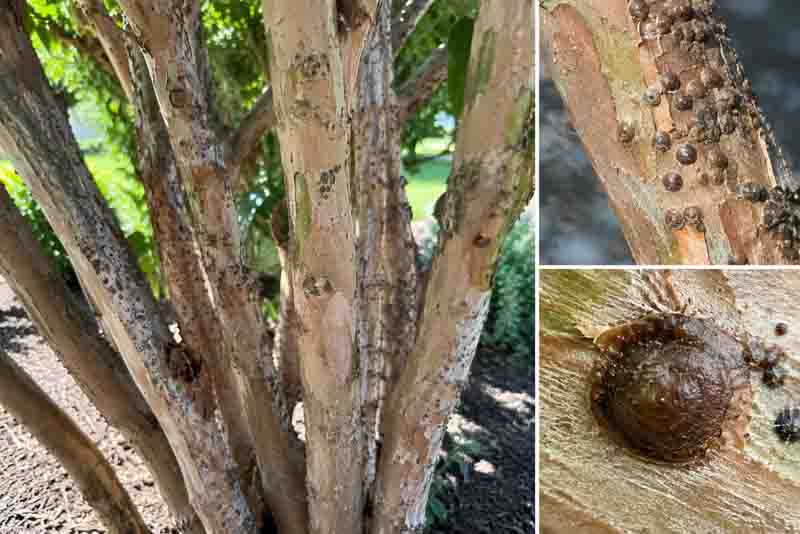
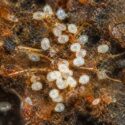
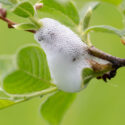
Adult females are tiny – approximately 2 mm long – and covered by rounded or elongated white-to-gray felted wax. They resemble miniature cottony bumps or small pieces of white lint attached firmly to the bark.
Colonies are commonly found around branch unions, old pruning cuts, sheltered bark crevices, and the undersides of limbs. On heavily infested trees, numerous white coverings may extend from the lower trunks into small twigs.
Gently scrape or crush several suspicious scales. A living female may release pink or reddish fluid. An old, dry covering may remain attached long after the insect has died, so visible white material alone does not prove that treatment has failed.
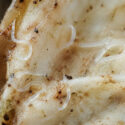
Newly hatched crawlers look very different. They are extremely small, pink, and mobile. Crawlers leave the protection of the female’s covering and move across the bark in search of a feeding site. After settling, they become increasingly difficult to control with contact sprays as their protective wax develops.
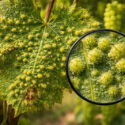
Look for individual white felted bumps attached to the bark. Powdery mildew creates a diffuse white coating on leaves, shoots, buds, and flowers. Bark scale forms separate waxy coverings on trunks, branches, and twigs.
Crape myrtle bark scale is usually more damaging to appearance and vigor than immediately life-threatening. Nevertheless, severe or repeated infestations should not be dismissed as merely cosmetic.
Common symptoms include:
A heavy layer of sooty mold can partially shade the leaf surface and interfere with photosynthesis. More visibly, it obscures the exfoliating bark that makes crape myrtle attractive even when the tree is not blooming.
Black mold may be the first symptom you notice, but the attached white scale insects are the real target. Stop the continuing production of honeydew, and the sooty mold will gradually weather or wash away.
| Problem | Main Clue | Where to Look |
|---|---|---|
| Crape myrtle bark scale | Individual white felted bumps, honeydew, and sooty mold | Trunks, limbs, twig crotches, and pruning wounds |
| Aphids | Clusters of small mobile insects producing honeydew | Tender shoots and undersides of leaves |
| Powdery mildew | White powdery film that spreads across living tissue | Leaves, shoots, flower buds, and panicles |
| Lichens | Crusty, leafy, or branching growth without honeydew | Older bark exposed to light and moisture |
Adult females produce eggs beneath their protective waxy coverings. The eggs hatch into tiny pink crawlers, the only immature stage that moves actively across the tree.
Crawlers settle on new bark, insert their mouthparts, and begin feeding. Females remain attached as they develop. Adult males eventually become small winged insects and no longer feed.
Crape myrtle bark scale produces multiple overlapping generations. Two major crawler peaks are commonly reported, while a third generation may develop or overwinter in some climates.
Crawlers can disperse short distances on air currents. The movement of infested nursery plants is considered the principal route by which the pest spreads over longer distances.
Crawlers are the scale’s most exposed and treatable life stage. Once they settle and develop wax, contact products have much more difficulty reaching them.
Visual inspection alone may not reveal when crawler hatch begins. A simple sticky-tape trap can make treatment timing much more precise.
Wrap a narrow band of double-sided sticky tape around a small infested branch. Examine the tape regularly with a hand lens. Tiny pink crawlers caught on the adhesive indicate that a vulnerable generation is active.
Replace dirty or weathered tape as needed. The first major crawler period often occurs in mid-to-late spring, with another peak possible in late summer. Exact timing varies with climate, so local monitoring is more reliable than treating on a fixed calendar date.
The principal and most conspicuous landscape host is crape myrtle – Lagerstroemia. Both large tree-form cultivars and compact shrub-form crape myrtles can become infested.
Documented or reported landscape and crop hosts also include:
Host importance varies by region, and crape myrtle remains the plant most commonly and visibly affected in United States landscapes. If bark scale is found, inspect nearby beautyberries, pomegranates, persimmons, figs, and other possible hosts for white colonies and sooty mold.
Begin at the lower trunks and work upward. Examine branch crotches, old pruning cuts, bark crevices, shaded surfaces, and the undersides of limbs. A hand lens is useful for distinguishing crawlers and small developing scales.
Crush or scrape several white coverings to determine whether they contain living insects. Pink or reddish fluid suggests a live female. Dry, hollow coverings may remain after natural mortality or successful treatment.
Check the leaves and surfaces below the tree for stickiness. Ants or wasps moving repeatedly along the trunks may also be visiting honeydew produced by scale or aphids.
Winter is an excellent time to inspect because leafless branches expose colonies that were concealed during the growing season.
Use water and a soft brush to loosen accessible scale coverings and sooty mold. If a soap treatment is desired, use a commercial insecticidal soap labeled for ornamental plants rather than household dish detergent.
Physical cleaning can remove many females and egg sacs and immediately improve appearance. It rarely eliminates insects hidden high in the canopy or deep in bark crevices, so continue monitoring afterward.
Several predatory lady beetles, including mealybug destroyers and other scale-feeding species, attack crape myrtle bark scale. Their larvae may be dark, elongated, spiny, or covered with pale waxy filaments and can easily be mistaken for pests.
Avoid unnecessary broad-spectrum insecticide applications that kill predators while leaving protected mature scales behind. Beneficial insects are unlikely to eradicate a severe infestation alone, but they can help suppress populations between treatments.
Contact products work best against newly hatched crawlers before their protective wax develops. Depending on local recommendations and product labels, options may include horticultural oil, insecticidal soap, or another contact insecticide labeled for scale insects on ornamental trees.
Thorough coverage of trunks, branches, and twigs is essential. Overlapping generations may require repeat applications at the interval stated on the label.
Dormant or delayed-dormant horticultural oil can smother overwintering scales and eggs when it thoroughly coats infested bark. A lower summer rate may suppress crawlers and young scales if the product label permits growing-season use.
Do not apply horticultural oil to drought-stressed trees, during freezing weather, or when temperatures exceed the label’s limit. Coverage, concentration, and weather restrictions vary among products.
Regional recommendations differ. Some extension programs identify soil-applied dinotefuran or imidacloprid as effective options for severe infestations, while others discourage neonicotinoid use on crape myrtles because residues may expose bees and other flower-visiting insects.
Systemic treatments are most appropriate for healthy trees that can absorb and distribute the active ingredient. They should not be applied merely because old white coverings remain on the bark. First scrape several scales to determine whether they are alive.
Do not spray a tall canopy from a ladder or when wind may carry pesticide onto people, pollinators, neighboring plants, or property. If safe and thorough coverage cannot be achieved from the ground, hire a qualified tree-care or pest-management professional.
Consult local extension guidance and follow the current label exactly. Consider application timing, proximity to flowering, pollinator activity, nearby water, and whether nonchemical or crawler-targeted methods can provide sufficient control.
No single treatment instantly removes every white covering or patch of black mold. Dead scales can remain attached, while old sooty mold may persist until rain, weathering, and cleaning remove it.
Winter: Inspect leafless trunks and branches, scrape scales to check for living females, scrub accessible colonies, and consider dormant-rate horticultural oil where the label permits.
Spring: Install sticky tape and monitor for the first crawler hatch. Apply any labeled contact treatment while crawlers are exposed. Use systemic products only when justified by local guidance and label directions.
Summer: Continue monitoring for overlapping generations and a possible late-summer crawler peak. Avoid unnecessary treatments during bloom and minimize exposure to pollinators.
Fall: Reassess the infestation, inspect alternative host plants, clean heavy sooty mold where practical, and record which treatments worked.
Removal is rarely necessary solely because bark scale is present. Unlike root-boring or crown-destroying pests, crape myrtle bark scale generally causes gradual loss of vigor and ornamental quality rather than rapid death.
Removal may be reasonable when the tree is structurally unsafe, severely declined from multiple problems, repeatedly reinfested despite appropriate management, or no longer worth the cost and effort of treatment.
Do not move infested nursery plants, live branches, or scale-covered woody debris into uninfested locations. Inspect nearby hosts after removal because the original tree may not be the only infested plant.
Inspect early, confirm that scales are alive, preserve predators, and treat crawlers before they become protected. Waiting until trunks are crowded with mature females and the canopy is coated in mold makes control slower and more expensive.
Crape myrtle bark scale is an invasive felt scale recognized by tiny white coverings on trunks and branches, sticky honeydew, and black sooty mold. Severe infestations can reduce growth and flowering, but a healthy established tree can often be managed successfully.
Confirm the diagnosis before treating. Scrape scales to determine whether they are alive, wash accessible colonies, monitor for pink crawlers with sticky tape, and preserve predatory lady beetles. Use horticultural oil, contact treatments, or systemic insecticides only when their labels and local extension recommendations support the application.
Most importantly, treat the insect rather than the black mold. Once honeydew production stops, the sooty coating will gradually disappear and the crape myrtle’s beautiful bark can become visible again.
Crape myrtle bark scale, Acanthococcus lagerstroemiae, is an invasive sap-feeding felt scale. It forms tiny white or gray waxy coverings on trunks and branches and produces honeydew that supports black sooty mold.
Look for tiny white felted bumps attached to trunks, branches, twig crotches, and pruning wounds. Infested trees often have sticky honeydew and black sooty mold. Crushing a live female may release pink or reddish fluid.
Crape myrtle bark scale rarely kills a healthy established tree by itself. Heavy infestations can delay leaf-out, weaken growth, reduce flowering, and add stress to young, recently planted, or otherwise weakened trees.
The black coating is usually sooty mold growing on sugary honeydew excreted by bark scale, aphids, or another sap-feeding insect. Control the honeydew-producing insect and the mold will gradually weather away.
Wash and gently scrub reachable colonies, preserve predatory lady beetles, monitor pink crawlers with sticky tape, and apply a labeled horticultural oil, contact insecticide, or systemic product when appropriate. Continue monitoring after treatment.
Contact treatments work best when pink crawlers are active and have not developed protective wax. Sticky tape can reveal crawler hatch. Dormant horticultural oil and systemic-treatment timing depend on climate, local guidance, and the product label.
Water and a soft brush can remove many females, egg sacs, and patches of sooty mold from reachable bark. Washing reduces the population and improves appearance but usually does not eliminate every scale insect.
Crape myrtle is the main landscape host. Other documented or reported hosts include beautyberry, pomegranate, persimmon, edible fig, boxwood, cleyera, privet, and raspberry. Host importance varies by region.
No. Bark scale forms separate white felted bumps attached to trunks and branches. Powdery mildew creates a white powdery coating on leaves, tender shoots, flower buds, and flowers.
Updated: July 2026 • Reviewed by Gardenia Editors
Create a membership account to save your garden designs and to view them on any device.
Becoming a contributing member of Gardenia is easy and can be done in just a few minutes. If you provide us with your name, email address and the payment of a modest $25 annual membership fee, you will become a full member, enabling you to design and save up to 25 of your garden design ideas.
Join now and start creating your dream garden!
Create a membership account to save your garden designs and to view them on any device.
Becoming a contributing member of Gardenia is easy and can be done in just a few minutes. If you provide us with your name, email address and the payment of a modest $25 annual membership fee, you will become a full member, enabling you to design and save up to 25 of your garden design ideas.
Join now and start creating your dream garden!