Grape berry moth is a destructive pest of grapevines (Vitis) that targets developing fruit clusters. The larvae feed inside berries, causing webbing, fruit rot, and yield loss. This guide explains identification, life cycle, symptoms, and effective vineyard management strategies to protect both table grapes and wine grape crops.
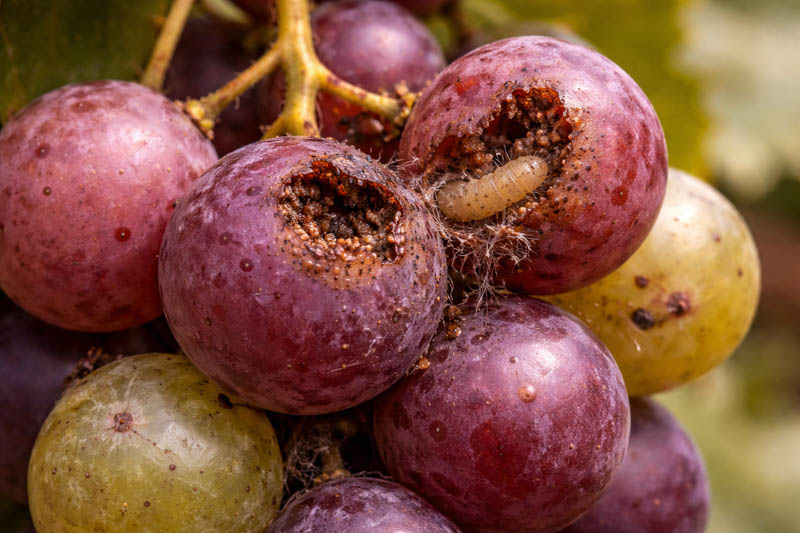


Grape berry moth is one of the most important insect pests of cultivated grapevines in eastern North America. The pest is the small tortricid moth Paralobesia viteana, but the real damage comes from its larvae, which feed on flower clusters and, later, inside developing grape berries. Once larvae enter the fruit, they are protected from many contact treatments and can quickly turn a clean cluster into a webbed, contaminated, rot-prone mess.
That is why grape berry moth matters so much in vineyards. It is not just a cosmetic pest. It causes direct fruit loss, lowers fruit quality, and increases the risk of bunch rot and other late-season cluster problems. In unmanaged or high-pressure sites, the pest can reduce marketable yield and force costly extra passes for scouting and control.
Grape berry moth is native to North America and is especially important in the eastern and Midwestern United States and parts of southern Canada, where wild grapes often grow near commercial vineyards. Those nearby wild hosts act as reservoirs, helping local populations build and move into vineyard edges first before spreading farther into the block.
Grape berry moth is most common in temperate grape-growing regions of eastern North America, especially where commercial vineyards are close to wooded edges, brushy borders, hedgerows, abandoned vineyard sites, or riparian areas containing wild grapes. Those habitats provide both overwintering shelter and a steady source of host plants.
The pest is particularly important in the eastern United States, the Great Lakes region, the Lake Erie belt, and nearby Canadian grape-growing areas. In these regions, vineyards planted next to woods or unmanaged vegetation often experience the earliest and heaviest pressure, especially along border rows.
Grape berry moth damage is caused by larval feeding. Adult moths themselves are not the damaging stage. Females lay eggs on flower clusters or developing berries, and when those eggs hatch, the tiny caterpillars begin feeding immediately on cluster tissue or inside the fruit.
Early in the season, first-generation larvae may feed on blossoms or small berries. Later generations are usually more destructive because they attack larger berries closer to harvest, when clusters are denser and more vulnerable to secondary infections. Larvae tunnel into berries, consume pulp and seeds, and often move through a cluster while binding berries together with silk.
This internal feeding causes direct fruit loss, but the hidden nature of the damage is what makes the pest especially costly. By the time webbing, frass, or shriveled berries are obvious, larvae may already be protected inside the fruit and much harder to control effectively.
Accurate identification matters because grape berry moth is easiest to manage when you recognize the pest before fruit injury becomes widespread. Adults are small, mottled brown moths that are seldom obvious in the canopy unless traps are used. Eggs are tiny and difficult to detect without close inspection.
The larva is the stage growers are really fighting. Young larvae are small and pale at first, then become greenish to purplish as they mature. Full-grown larvae are typically only a fraction of an inch long, but their feeding damage is far larger than their size suggests.
Pupae are usually found in protected places such as leaf litter, bark crevices, or debris around the vineyard. Because overwintering occurs outside the fruit, vineyard edges and nearby habitat are part of the pest problem, not just the clusters themselves.
The grape berry moth life cycle includes egg, larval, pupal, and adult stages. In many vineyards, the insect overwinters as a pupa in leaf litter or other protected debris near the vineyard. Adults emerge in spring and begin the first seasonal flight around the period of wild grape bloom, which is why wild grape phenology is so important for management models.
After mating, females lay eggs on clusters. Eggs hatch into larvae that feed on flowers or berries, depending on the time of season and berry development stage. Once feeding is complete, larvae pupate and produce the next flight of adults. This cycle repeats through the growing season.
Depending on climate, grape berry moth may have two, three, or sometimes four generations per year. Later generations often cause the greatest economic damage because they attack ripening fruit, increase contamination, and sharply raise the risk of bunch rot near harvest.
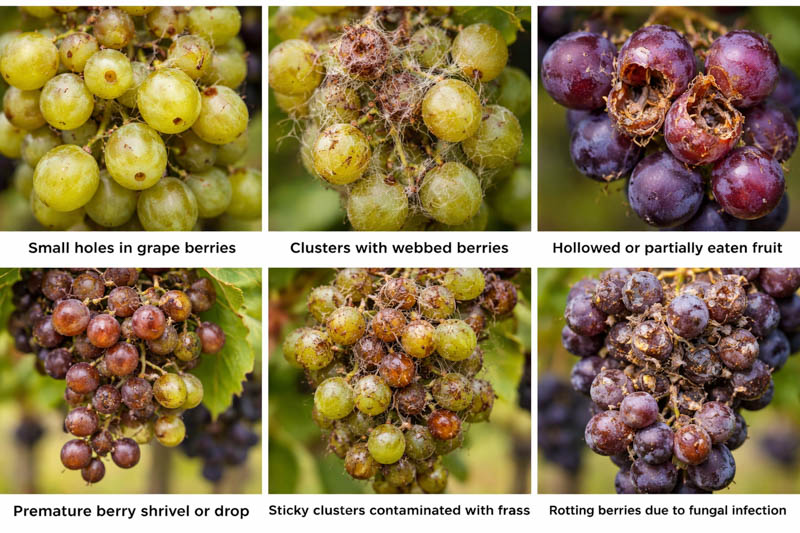
Grape berry moth damage usually becomes most obvious after larvae have entered the fruit. Early infestations can be easy to miss, especially when only a few edge rows are affected. As feeding continues, symptoms become more distinct and more economically important.
Damaged berries may darken, collapse, or dry down. In many cases, the most obvious late symptom is not just feeding injury but the cascade that follows it: wounded berries begin to rot, neighboring berries become contaminated, and the cluster loses marketability fast.
Grape berry moth is often confused with bird injury, wasp feeding, berry splitting, sour rot, or general bunch rot. The difference is that grape berry moth usually starts with internal larval feeding. Birds and wasps typically attack exposed fruit from the outside, while grape berry moth larvae enter berries and feed from within.
That internal feeding pattern explains why clusters may look only lightly damaged at first while hiding hollow berries, webbing, and frass inside. It also explains why rot often follows insect injury rather than appearing as a primary problem on otherwise intact fruit.
When in doubt, cut open damaged berries and inspect several clusters from the vineyard edge inward. A pattern of webbed berries, concealed feeding, and localized border pressure strongly points toward grape berry moth rather than a more general fruit problem.
Monitoring is the foundation of grape berry moth control. Pheromone traps help detect adult flight, while cluster scouting shows whether egg laying and larval feeding are translating into real economic damage. The strongest programs use both.
Scouting should begin early and continue through the season, with special attention to vineyard borders next to woods, hedgerows, and wild grape habitat. These edge rows often show the first injury and can guide whether pressure is localized or expanding deeper into the block.
Many vineyard programs also use degree-day models tied to wild grape bloom to predict key events such as egg laying and egg hatch. That matters because treatments are most effective when aimed at exposed eggs or newly hatched larvae before they bore into berries.
The economic impact of grape berry moth can be severe because the pest attacks the crop directly. Damaged berries are lost outright, and even partially injured clusters may become unmarketable because of webbing, frass, contamination, and rot.
Late-season feeding is especially costly. As berries soften and sugar levels rise, wounded fruit becomes far more vulnerable to bunch rot organisms, including Botrytis and sour rot complexes. That means a relatively small larval infestation can trigger a much larger fruit-quality problem by harvest.
For wine grapes, the consequences can include lower usable yield, off aromas, compromised fruit integrity, and more difficult sorting. For table grapes, visible feeding injury and rot can make clusters unsellable even when only part of the bunch is affected.
Successful grape berry moth control relies on integrated pest management. No single tactic is enough in high-pressure vineyards. The best results come from combining monitoring, habitat awareness, canopy management, and precisely timed interventions.
The most important principle is timing. Once larvae are inside berries, control becomes much more difficult. That is why strong grape berry moth programs focus on prediction and prevention rather than reacting only after visible cluster injury appears.
In many vineyards, the worst injury occurs during the second and third generations. By then, clusters are larger, berries are more attractive to larvae, and feeding injuries are more likely to trigger bunch rot. A light first-generation problem can therefore become a serious late-season outbreak if the block is not monitored carefully.
This is also why growers often see the greatest pressure build from the edge inward over time. Border rows near woods or wild grapes may show the first signs, but repeated generations can spread injury farther into the vineyard if management is delayed or poorly timed.
Natural enemies, including parasitoid wasps, predatory insects, and spiders, can help suppress grape berry moth populations. In vineyards with balanced pest management and good habitat diversity, these beneficial organisms may reduce some egg or larval survival.
Still, biological control should be viewed as a supporting tool rather than a complete solution in commercial production. Because larvae feed in protected locations and later generations can be highly destructive, most vineyards still need active monitoring and threshold-based intervention.
Preventing grape berry moth outbreaks begins with a vineyard system, not a rescue spray. The strongest prevention programs start early, track moth activity, and pay close attention to the surrounding landscape.
Begin with pheromone trapping and regular scouting, especially in border rows. Record wild grape bloom if you use a degree-day model, because that biofix helps predict later egg laying and egg hatch. Keep canopies open enough for good spray penetration and good visibility during scouting. Where practical, identify and manage nearby wild grape sources or unmanaged edge habitat contributing to repeated infestations.
Most of all, do not treat grape berry moth as a once-per-season issue. It is a multi-generation pest, and later generations are often the ones that cause the heaviest fruit and quality losses. Prevention works best when it is continuous, site-specific, and driven by field observations rather than by calendar alone.
Bottom line:
Grape berry moth is a destructive fruit-feeding pest of grapevines caused by the larvae of Paralobesia viteana. It is especially important in eastern North American vineyards near wild grape habitat. Larvae feed on clusters and inside berries, causing webbing, frass, shrivel, direct fruit loss, and increased bunch rot. The best protection comes from early monitoring, border-focused scouting, degree-day timing, and well-timed integrated pest management before larvae enter the fruit.
Create a membership account to save your garden designs and to view them on any device.
Becoming a contributing member of Gardenia is easy and can be done in just a few minutes. If you provide us with your name, email address and the payment of a modest $25 annual membership fee, you will become a full member, enabling you to design and save up to 25 of your garden design ideas.
Join now and start creating your dream garden!
Create a membership account to save your garden designs and to view them on any device.
Becoming a contributing member of Gardenia is easy and can be done in just a few minutes. If you provide us with your name, email address and the payment of a modest $25 annual membership fee, you will become a full member, enabling you to design and save up to 25 of your garden design ideas.
Join now and start creating your dream garden!