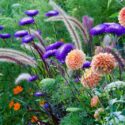
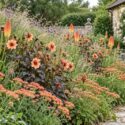
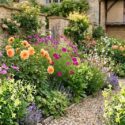
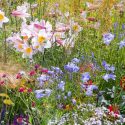
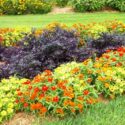
From tiny pompons to enormous dinnerplate blooms, dahlias offer an astonishing variety of flower shapes, colors, and sizes. Discover how to distinguish cactus, decorative, waterlily, ball, collarette, orchid, and other dahlia types. Explore beautiful cultivars, understand their differences, and find the right dahlias for borders, containers, bouquets, and pollinators.


Stand in front of a collection of dahlias, and it’s hard to believe they all belong to the same genus. Some have perfectly rounded flowers no larger than a golf ball. Others produce enormous, ruffled blooms, delicate waterlily shapes, spiky petals, or simple daisy-like flowers with golden centers alive with bees.
With thousands of cultivated varieties, dahlias offer an extraordinary range of flower forms, colors, and sizes. The secret to understanding them is knowing what makes each type different. A cactus dahlia is recognized by its rolled, narrow petals, a collarette by its distinctive inner ring of smaller petals, and a ball dahlia by its tightly arranged, rounded flower.
But flower type is only the beginning. The best dahlia for your garden also depends on mature plant height, available space, flowering habit, and whether you want flowers for bouquets, borders, containers, or pollinators.
This guide explains the main types of dahlias, how to identify them, and which varieties are worth exploring. You’ll also discover how to compare cultivars using Gardenia’s plant profiles and turn your favorites into a practical garden plan.
What are the main types of dahlias?
Dahlias are commonly grouped by flower form, including decorative, cactus, semi-cactus, ball, pompon, waterlily, single, mignon single, collarette, anemone, peony-flowered, orchid, stellar, and laciniated types. There are also additional forms and subdivisions recognized by specialist dahlia societies.
Important: Dinnerplate describes unusually large flowers, not a separate official flower shape. Likewise, a compact plant can produce flowers belonging to several different form groups.
Native to Mexico and neighboring parts of Central America, dahlias are tuberous perennials in the daisy family, Asteraceae. Most familiar garden dahlias are complex hybrids bred over generations for remarkable diversity in flower shape, color, and size.
What looks like one large flower is actually a flower head composed of many smaller florets. The showy outer structures are ray florets, often casually called petals. The central disc, when visible, contains smaller disc florets.
These structures explain the differences between dahlia forms. Some cultivars retain an exposed central disc, while others have densely arranged ray florets that conceal it entirely.
A giant decorative dahlia and a small decorative dahlia belong to the same broad flower-form group. Conversely, two plants of similar height may produce completely different flowers.
| Dahlia type | How to recognize it | Garden appeal |
|---|---|---|
| Decorative | Broad, overlapping petals; full center | Borders and bouquets |
| Cactus | Narrow, strongly rolled petals | Sculptural flower shapes |
| Semi-cactus | Broad petal bases, rolled outer portions | Full flowers with pointed texture |
| Ball and pompon | Rounded flowers, tightly rolled florets | Cutting gardens |
| Waterlily | Broad, slightly cupped petals; shallow bloom | Elegant borders and bouquets |
| Single and mignon | One row of petals, exposed central disc | Pollinators and informal gardens |
| Collarette | Outer petals plus shorter inner collar | Color contrast and pollinators |
| Anemone | Raised cushion of tubular central florets | Unusual flower texture |
| Peony and orchid | Open peony-like blooms or narrow rolled petals | Relaxed, airy planting schemes |
| Stellar and laciniated | Star-like narrow florets or fringed tips | Distinctive collector varieties |
This is a practical recognition guide, not a substitute for formal exhibition classification. Specialist societies distinguish additional forms and size classes.
Cactus dahlias are instantly recognizable by their narrow, pointed-looking petals. The ray florets roll backward along much of their length, creating a lively starburst effect. Some cultivars have straight petals; others twist or curve, giving the flower even more movement.
Semi-cactus dahlias combine a fuller outline with pointed texture. Their petals are broader at the base and less extensively rolled than those of typical cactus forms.
Both groups add striking contrast beside broad-petaled decorative flowers. They are also attractive in arrangements where different flower shapes create depth and variety.
Explore Gardenia’s Cactus and Semi-Cactus Dahlias, including ‘Karma Bon Bini’, for more examples.
How to tell them apart: Look at the petals near the flower’s outer edge. Cactus petals are strongly rolled along much of their length; semi-cactus petals retain a broader, flatter base. The distinction concerns petal structure, not flower color or plant height.
| Hardiness |
8 - 11 |
|---|---|
| Heat Zones |
1 - 11 |
| Climate Zones | 1, 2, 3, 4, 5, 6, 7, 8, 9, 10, 11, 12, 13, 14, 15, 16, 17, 18, 19, 20, 21, 22, 23, 24 |
| Plant Type | Bulbs, Perennials |
| Plant Family | Asteraceae |
| Genus | Dahlia |
| Exposure | Full Sun |
| Season of Interest | Summer (Mid, Late), Fall |
| Height | 1' - 6' (30cm - 180cm) |
| Spread | 1' - 2' (30cm - 60cm) |
| Spacing | 18" - 24" (50cm - 60cm) |
| Maintenance | Average |
| Water Needs | Average |
| Soil Type | Clay, Loam, Sand |
| Soil pH | Acid, Alkaline, Neutral |
| Soil Drainage | Moist but Well-Drained |
| Characteristics | Cut Flowers, Showy |
| Attracts | Butterflies, Bees |
| Landscaping Ideas | Beds And Borders, Patio And Containers |
| Garden Styles | City and Courtyard, Cutting Garden, Informal and Cottage |
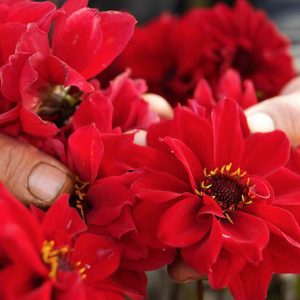
For many gardeners, decorative dahlias are the classic choice: generous, fully double flowers packed with broad petals. Their centers remain hidden, and the petals overlap to create a lush, substantial bloom.
Formal decorative dahlias generally have a regular, balanced arrangement of petals. Informal decorative forms look looser, with petals that may twist, curl, or wave.
The range is enormous, from compact flowering varieties to tall plants carrying exceptionally large blooms. Decorative dahlias are especially popular for dramatic borders and bouquets.
Explore Decorative Dahlias and named cultivars such as ‘Akita’.
Choosing tip: If you love large flowers, check mature plant height as carefully as bloom diameter. Tall, heavy-flowered varieties often benefit from sturdy support.
Few flowers are as satisfyingly symmetrical as ball and pompon dahlias. Their rounded heads consist of tightly arranged ray florets whose edges roll inward, giving the flowers their distinctive geometric appearance.
Ball dahlias are generally larger, with a rounded or slightly flattened face. Pompon dahlias have smaller, more compact, nearly spherical blooms made up of tightly rolled florets.
Both are favorites in cutting gardens because their well-defined forms mix beautifully with airy flowers and foliage. Their modest individual flower size also allows them to complement larger dahlias without overwhelming an arrangement.
Discover Pompon and Ball Dahlias, including ‘Cornel Brons’.
Don’t confuse flower size with plant size. A small pompon flower may be carried on a relatively tall plant, while a compact cultivar may produce larger blooms.
These two flower forms are delightful because they combine contrasting structures within a single bloom.
Anemone dahlias have one or more outer rows of relatively broad ray florets surrounding a raised cluster of elongated tubular disc florets. The center resembles a soft pincushion, sometimes in a contrasting color.
The effect is particularly attractive in mixed borders, where the flowers provide a different texture from the rounded heads of decorative or ball dahlias.
Collarette dahlias have an exposed central disc, a surrounding row of larger outer ray florets, and a distinctive inner ring of smaller petal-like structures. This contrasting collar gives the flowers their name.
Look at ‘Pooh’, whose outer petals and inner collar make the structure especially easy to appreciate.
Explore Anemone and Collarette Dahlias for additional cultivars.
Some collarette dahlias can be useful to pollinating insects because their central disc remains accessible. However, the availability of pollen and nectar varies between cultivars.
Want to find dahlias that actually suit your garden? Explore Gardenia’s Dahlia Comparison Tool to review flower colors, mature sizes, and growing conditions before choosing your favorites.
Single dahlias have a deceptively simple charm. Their flowers resemble brightly colored daisies, with one row of ray florets around an open central disc.
They are particularly appealing in cottage gardens, informal borders, and wildlife-friendly plantings, where their exposed centers may make pollen and nectar more accessible than in densely double flowers.
Mignon single dahlias share the same general structure but produce especially small flowers. Small blooms do not necessarily mean the whole plant is equally tiny, so always check the cultivar’s mature dimensions.
Gardenia’s Mignon and Single Dahlias guide features cultivars including ‘Waltzing Mathilda’.
If you are planting for wildlife, discover Bee-Friendly Dahlia Flowers. Flower form provides a useful starting point, but not every open-centered cultivar supplies the same amount of food.
Peony-flowered dahlias have two or more rows of broad ray florets surrounding a visible central disc. Their relaxed, semi-double appearance brings a softer character to borders than densely packed decorative types.
One famous example is ‘Bishop of Llandaff’, admired for its scarlet-red flowers and richly colored dark foliage.
Orchid dahlias have a very different appearance. Their flowers feature a single row of narrow ray florets that roll inward along much of their length, surrounding a visible central disc.
The result is a striking, star-like form. ‘Honka’ is a familiar example, with narrow petals that create a distinctive pinwheel appearance.
Discover more in Gardenia’s Peony-Flowered and Orchid Dahlias guide.
Identification tip: Orchid dahlias have an exposed center and a single row of rolled petals. They should not be confused with stellar dahlias, whose blooms are fully double.
Waterlily dahlias have broad, slightly cupped ray florets arranged in a symmetrical, relatively shallow flower head. Their gentle, layered appearance recalls the blossoms of a waterlily floating on a pond.
Unlike single dahlias, waterlily dahlias are fully double, with their central disc concealed. Compared with many decorative dahlias, they generally have a flatter, more open-looking outline.
They are beautiful in romantic borders and floral arrangements, especially when paired with airy flowers that contrast with their broad petals.
Explore Waterlily Dahlias and examples such as ‘Café au Lait’ for large-flowered inspiration, while remembering that this particular cultivar is generally classified as decorative rather than waterlily.
Some of the most intriguing dahlias don’t fit neatly into the familiar decorative, ball, or cactus categories.
Stellar dahlias have fully double blooms with narrow, partly rolled ray florets that create a star-like effect. Their petals are arranged in a distinctive three-dimensional structure rather than forming a single flat ring.
Laciniated dahlias are recognized by split or fringed petal tips. The ends often twist or curl, creating a feathery effect that distinguishes them from ordinary cactus dahlias.
Specialist classifications also recognize novelty forms and additional subdivisions that do not fit comfortably into the better-known groups. These include unusual open-centered and fully double forms, as well as other distinctive flower structures.
Classifications are periodically refined, and the terminology used by growers may differ between countries. For formal exhibition identification, consult the American Dahlia Society’s flower-form definitions.
Few dahlias make a more memorable impression than the enormous blooms commonly called dinnerplate dahlias. Their flowers may measure 8-10 inches (20-25 cm) across or considerably more, depending on the variety.
However, dinnerplate is a descriptive gardening term, not an official flower-form classification. A giant decorative dahlia and a giant cactus dahlia can both be described as dinnerplate types, even though their petal structures differ.
Large-flowered cultivars such as ‘Café au Lait’ are especially popular for striking arrangements and focal points in sunny borders.
Browse Gardenia’s Dinnerplate Dahlias for more inspiration.
Before choosing: Large flowers can require sturdy support, and the plants themselves may occupy considerable space. Check the cultivar’s mature height and spread rather than relying on the advertised flower diameter.
Once you can recognize the flower forms, choosing becomes much easier. Rather than asking which type is best overall, begin with how you want to use the plant.
This distinction matters. Two decorative dahlias may have similar flower shapes but very different heights, space requirements, or flowering habits. The right choice depends on the cultivar, not just the category.
Although their flowers look remarkably different, most garden dahlias share similar basic growing requirements. They generally prefer full sun, fertile but well-drained soil, and regular moisture once established.
Planting time depends on local spring conditions, not simply the USDA hardiness zone. Dormant tubers are vulnerable to prolonged cold, waterlogged soil; actively growing shoots are frost-sensitive.
For specific planting windows, consult When to Plant Dahlia Tubers by USDA Zone.
For seasonal care, staking, feeding, and deadheading, follow How to Grow and Care for Dahlias. If you plan to save tubers, read Dahlia Tubers: Planting, Dividing and Winter Storage.
Where dahlias refuse to flower, see Why Are My Dahlias Not Blooming?. For yellow leaves, wilting, and other warning signs, use Gardenia’s Dahlia Problems Guide.
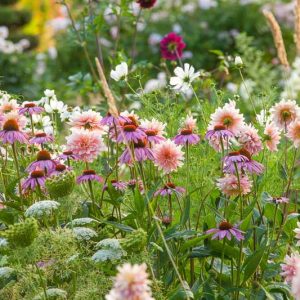
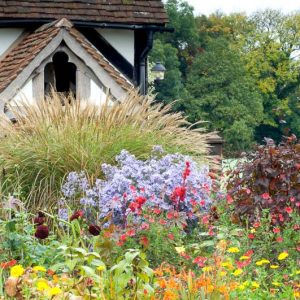
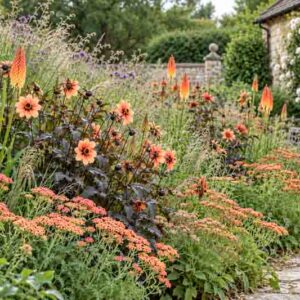
Dahlias are particularly effective when their dramatic flowers are balanced by softer foliage and contrasting bloom shapes. Pair large decorative flowers with delicate perennials, or use ornamental grasses to bring movement to a late-summer border.
Explore perennial companions for dahlias, ornamental grasses for dahlias, and Gardenia’s Dahlia Garden Combinations for inspiration.
But beautiful plant combinations must also work horticulturally. Consider growing conditions, mature dimensions, and whether neighboring plants will compete for sunlight or moisture.
Use Gardenia’s Plant Finder to discover varieties and suitable companions. Then check growing-condition compatibility, mature sizes, seasonal interest, and planting quantities in the Garden Design Tool. You can start with up to five plants for free.
Flower-form terminology follows the American Dahlia Society’s classification guidance, with practical gardening terminology used where appropriate. Gardenia’s individual Dahlia type guides and plant profiles provide further cultivar examples, descriptions, and photographs.
Common dahlia forms include decorative, cactus, semi-cactus, ball, pompon, waterlily, single, mignon single, collarette, anemone, peony-flowered, orchid, stellar, and laciniated dahlias. Specialist classification systems recognize additional forms and subdivisions.
Decorative dahlias have broad, overlapping petals and fully double flowers. Cactus dahlias have narrower ray florets rolled backward along much of their length, producing a pointed, starburst appearance.
Both have tightly arranged, rolled ray florets. Ball dahlias generally produce larger, rounded blooms, while pompons are smaller and more compactly spherical. Plant height varies independently of flower size.
No. Dinnerplate is an informal name for dahlias with exceptionally large blooms, often around 8 inches (20 cm) or more in diameter. They may belong to different formal flower-form categories.
Waterlily dahlias have broad, slightly cupped petals arranged in a symmetrical, relatively shallow, fully double flower. Their appearance resembles the open, graceful shape of a waterlily blossom.
Single-flowered and some other open-centered dahlias generally offer bees better access to pollen and nectar than densely double forms. Food availability varies by cultivar, so open centers are a useful guide rather than a guarantee.
Compact-growing cultivars are generally best for containers, regardless of flower form. Check mature height, spread, branching habit, and pot size rather than choosing solely by whether a dahlia is decorative, single, or another type.
Ball, decorative, waterlily, cactus, and several other forms can make excellent cut flowers. Choose cultivars with suitable stem length, good flower quality, and attractive blooms for your intended arrangements.
Orchid dahlias have a single row of narrow, rolled petals around a visible central disc. Stellar dahlias are fully double, with multiple rows of narrow, partly rolled florets arranged in a three-dimensional, star-like flower.
Most garden dahlias need similar conditions: abundant sunlight, good drainage, and consistent moisture during active growth. Individual cultivars differ in mature size, staking needs, heat response, and flowering performance, so check their specific requirements.
Updated and reviewed by Gardenia: October 2026
WeStudio, Shutterstock
| Hardiness |
8 - 11 |
|---|---|
| Heat Zones |
1 - 11 |
| Climate Zones | 1, 2, 3, 4, 5, 6, 7, 8, 9, 10, 11, 12, 13, 14, 15, 16, 17, 18, 19, 20, 21, 22, 23, 24 |
| Plant Type | Bulbs, Perennials |
| Plant Family | Asteraceae |
| Genus | Dahlia |
| Exposure | Full Sun |
| Season of Interest | Summer (Mid, Late), Fall |
| Height | 1' - 6' (30cm - 180cm) |
| Spread | 1' - 2' (30cm - 60cm) |
| Spacing | 18" - 24" (50cm - 60cm) |
| Maintenance | Average |
| Water Needs | Average |
| Soil Type | Clay, Loam, Sand |
| Soil pH | Acid, Alkaline, Neutral |
| Soil Drainage | Moist but Well-Drained |
| Characteristics | Cut Flowers, Showy |
| Attracts | Butterflies, Bees |
| Landscaping Ideas | Beds And Borders, Patio And Containers |
| Garden Styles | City and Courtyard, Cutting Garden, Informal and Cottage |
Create a membership account to save your garden designs and to view them on any device.
Becoming a contributing member of Gardenia is easy and can be done in just a few minutes. If you provide us with your name, email address and the payment of a modest $25 annual membership fee, you will become a full member, enabling you to design and save up to 25 of your garden design ideas.
Join now and start creating your dream garden!