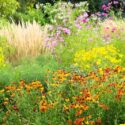
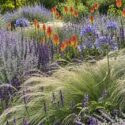
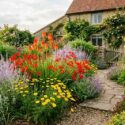
Goldenrods, dark-leaved dahlias, helenium, Alstroemeria, Verbena, and Echinops come together in a border that glows from late summer into fall. Warm yellows, apricots, oranges, and reds are lifted by airy purple and steel-blue accents, creating a planting that feels exuberant, textural, and full of end-of-season energy.
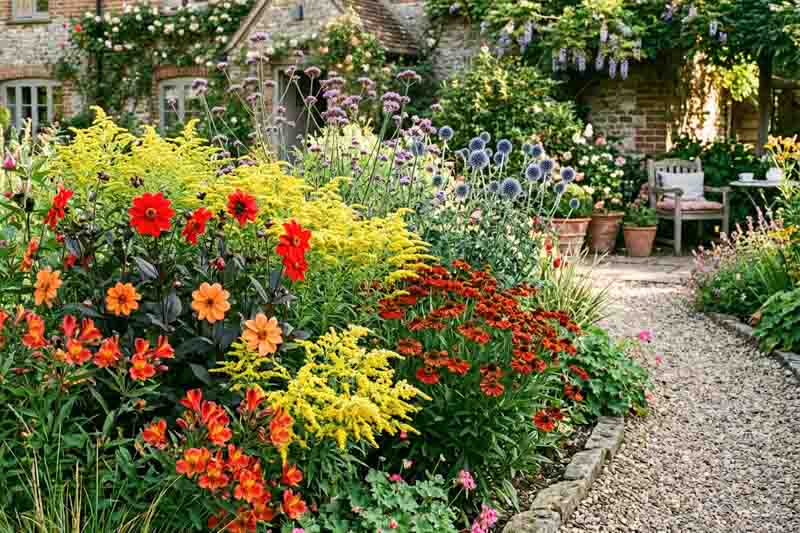


This border comes into its own when many summer plantings are beginning to slow down. Goldenrods, dahlias, heleniums, and Alstroemeria carry the warm side of the palette, while the airy purple stems of Verbena bonariensis and the steel-blue globes of Echinops ritro ‘Veitch’s Blue’ cool it down just enough. The result is bright and energetic, but not harsh.
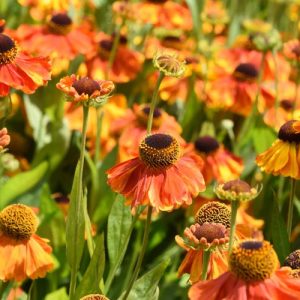
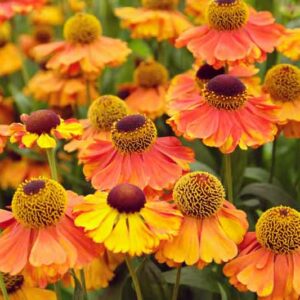
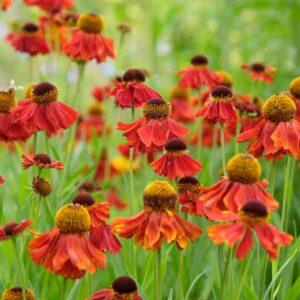
What makes the planting especially effective is the mix of flower forms. The flat daisy-like flowers of Helenium, the rounded blooms of the dark-leaved dahlias, the fine sprays of goldenrod, the open purple heads of Verbena, and the blue thistles of Echinops all read differently. Even though the colors are strong, the border does not blur into one mass.
Main plants used: Solidago ‘Golden Baby’, Solidago ‘Goldenmosa’, dark-leaved Dahlia ‘Bishop of Llandaff’ and ‘Bishop of Oxford’, Helenium ‘Moerheim Beauty’, Alstroemeria ‘Flaming Star’, Verbena bonariensis, and Echinops ritro ‘Veitch’s Blue’
Keep the warm colors dominant, then use Verbena and Echinops as lighter vertical accents so the planting feels airy rather than heavy.
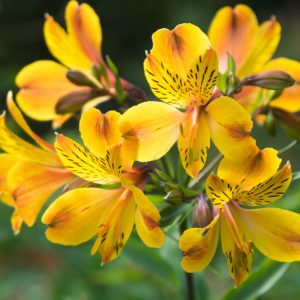
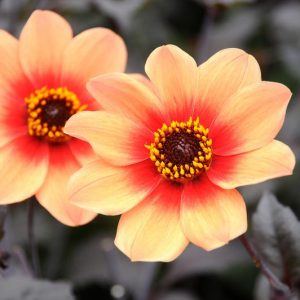
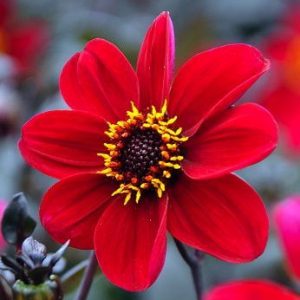
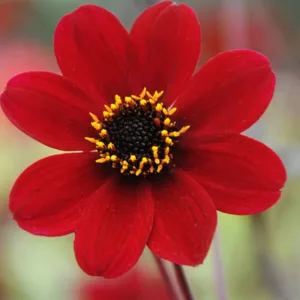
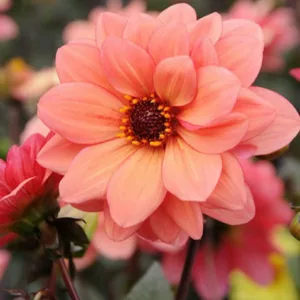
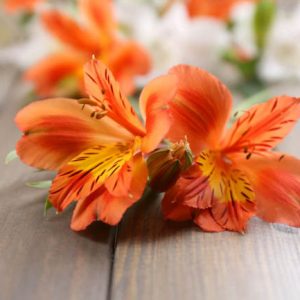
The border is built around warm late-season color, but it avoids looking flat because not all the warm tones are the same. Solidago brings clear yellow and gold, Helenium adds coppery orange-red, the dahlias contribute richer crimson and scarlet notes, and Alstroemeria introduces softer apricot and peach. Those small shifts in tone give the planting depth.
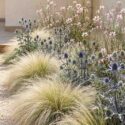
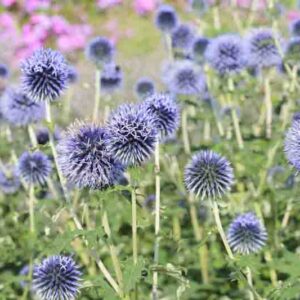
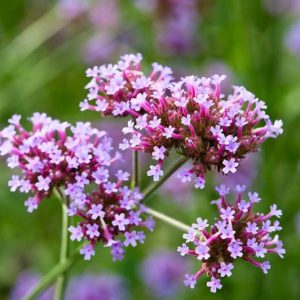
The cooler plants are just as important. Verbena bonariensis threads a transparent lavender-purple veil through the planting, while Echinops adds firm blue globes on upright stems. Both break up the denser warm-colored flowers and stop the border from feeling too solid.
The dark foliage of the Bishop dahlias helps too. It gives the brighter flowers something to play against and makes the golds, oranges, and apricots appear even more vivid.
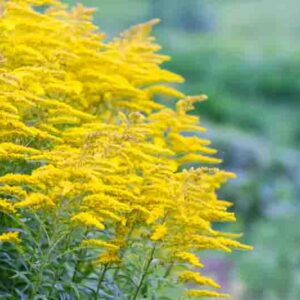
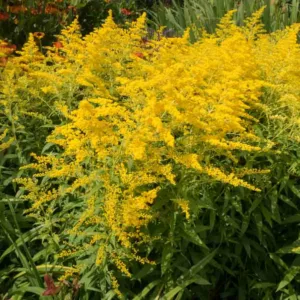
Goldenrods provide the brightest yellow notes. Using Solidago ‘Golden Baby’ and ‘Goldenmosa’ helps prolong the display, and their feathery flower sprays lighten the center of the border.
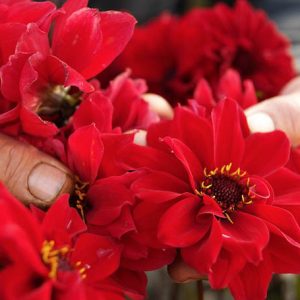
Dahlia ‘Bishop of Llandaff’ and ‘Bishop of Oxford’ add dark foliage and glowing red to apricot flowers. Place them where their bronzed leaves can be seen clearly, not hidden behind taller neighbors.
Helenium ‘Moerheim Beauty’ supplies much of the warm body of the planting. Its daisy-like flowers are especially useful for bridging the yellows of goldenrod and the deeper reds of the dahlias.
Alstroemeria ‘Flaming Star’ softens the palette with apricot and salmon tones and adds a slightly different flower shape close to the middle layer.
Verbena bonariensis and Echinops ‘Veitch’s Blue’ should be used as accents throughout, not isolated at one end. Their job is to lift and cool the composition.
Create a long-performing late-season border with warm flower color at its core and just enough blue and purple to keep the planting light and balanced.
Start with broad drifts of Helenium and Goldenrod through the front and middle.
Repeat the dahlias in small clusters where their dark foliage can contrast with the brighter flowers around them.
Use Alstroemeria to soften transitions between the yellows, oranges, and reds.
Thread Verbena bonariensis and Echinops through the whole border so the purple and blue accents appear at different depths.
This is not really a drought-tolerant planting, even if some of the individual plants cope with short dry spells. Dahlias, Alstroemeria, and Helenium all perform best with reasonable moisture and good soil. It is better described as a sunny, late-season border than a dry-garden combination.
It is also wiser not to call the whole planting deer- and rabbit-resistant without qualification. Some elements are less palatable than others, but browsing pressure varies enormously. What is certain is that this is a lively, high-impact way to finish the garden season.
| Hardiness |
8 |
|---|---|
| Heat Zones |
7 - 8 |
| Climate Zones | 8, 9, 14, 15, 16, 17, 18, 19, 20, 21, 22, 23, 24 |
| Exposure | Full Sun |
| Season of Interest | Summer (Mid, Late), Fall |
| Maintenance | Low, Average |
| Water Needs | Average |
| Soil Type | Loam, Sand |
| Soil pH | Acid, Neutral |
| Soil Drainage | Moist but Well-Drained, Well-Drained |
| Characteristics | Cut Flowers, Plant of Merit, Showy |
| Attracts | Bees, Butterflies, Hummingbirds, Birds |
| Landscaping Ideas | Beds And Borders |
| Garden Styles | Butterfly Garden, Cutting Garden, Informal and Cottage, Pollinator Garden |

| Hardiness |
8 |
|---|---|
| Heat Zones |
7 - 8 |
| Climate Zones | 8, 9, 14, 15, 16, 17, 18, 19, 20, 21, 22, 23, 24 |
| Exposure | Full Sun |
| Season of Interest | Summer (Mid, Late), Fall |
| Maintenance | Low, Average |
| Water Needs | Average |
| Soil Type | Loam, Sand |
| Soil pH | Acid, Neutral |
| Soil Drainage | Moist but Well-Drained, Well-Drained |
| Characteristics | Cut Flowers, Plant of Merit, Showy |
| Attracts | Bees, Butterflies, Hummingbirds, Birds |
| Landscaping Ideas | Beds And Borders |
| Garden Styles | Butterfly Garden, Cutting Garden, Informal and Cottage, Pollinator Garden |
Recreate this garden. Specify the percentages you would like to have of each plant and input the dimensions of your garden space.We'll give you a shopping list so you know how many plants you need.
| Plant | Quantity | |
|---|---|---|
| Dahlia 'Bishop of Llandaff' | N/A | Buy Plants |
| Dahlia 'Bishop of Oxford' | N/A | Buy Plants |
| Alstroemeria 'Flaming Star' (Peruvian Lily) | N/A | Buy Plants |
| Helenium 'Moerheim Beauty' (Sneezeweed) | N/A | Buy Plants |
| Echinops ritro 'Veitch's Blue' (Globe Thistle) | N/A | Buy Plants |
| Solidago 'Goldkind' or 'Golden Baby' (Goldenrod) | N/A | Buy Plants |
| Solidago 'Goldenmosa' (Goldenrod) | N/A | Buy Plants |
| Verbena bonariensis (Purpletop Vervain) | N/A | Buy Plants |
Create a membership account to save your garden designs and to view them on any device.
Becoming a contributing member of Gardenia is easy and can be done in just a few minutes. If you provide us with your name, email address and the payment of a modest $25 annual membership fee, you will become a full member, enabling you to design and save up to 25 of your garden design ideas.
Join now and start creating your dream garden!
Create a membership account to save your garden designs and to view them on any device.
Becoming a contributing member of Gardenia is easy and can be done in just a few minutes. If you provide us with your name, email address and the payment of a modest $25 annual membership fee, you will become a full member, enabling you to design and save up to 25 of your garden design ideas.
Join now and start creating your dream garden!