Dwarf Whitman Fern, Erect Sword Fern, Fishbone Fern, Herringbone Fern, Ladder Fern, Lemon Button Fern, Narrow Sword Fern, Tuber Ladder Fern, Tuberous Sword Fern, Button Sword Fern, Duff's Sword Fern, Nephrolepis duffii, Nephrolepis exaltata 'Duffy'
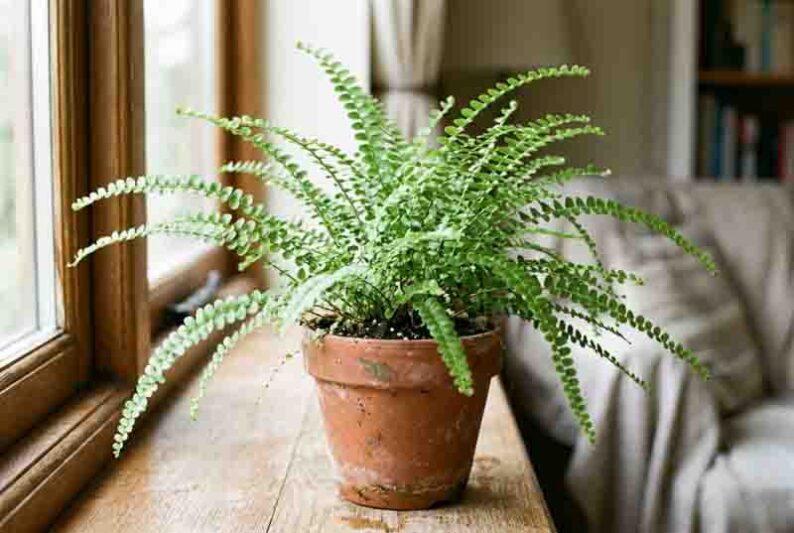


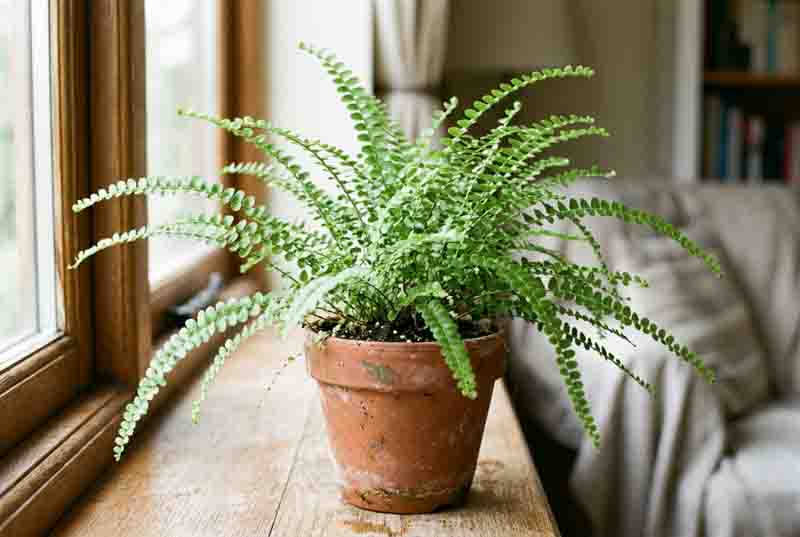
With its tiny, rounded leaflets and slender, arching fronds, Lemon Button Fern looks almost like a miniature version of a traditional sword fern. Nephrolepis cordifolia ‘Duffii’ brings soft green texture to windowsills, shelves, and small containers, sometimes releasing a faint lemon fragrance when its foliage is gently brushed.
It is compact, but not entirely carefree. Dry potting mix can quickly turn the little leaflets brown, while constantly wet soil damages the roots. Once you understand that balance, Lemon Button Fern is a manageable houseplant with plenty of character.
Summary: Compact evergreen fern with slender fronds and small, rounded green leaflets.
Use: Ideal for windowsills, shelves, bright bathrooms, small planters, and terrariums.
Highlight: Fine-textured foliage with a mild lemon fragrance, especially when handled.
Botanical interest: A fern with a complicated naming history, commonly sold as Lemon Button Fern.
| Horticultural Name | Nephrolepis cordifolia ‘Duffii’ |
|---|---|
| Alternative Botanical Names | Nephrolepis duffii (accepted by RHS); Kew places that name under Nephrolepis hirsutula |
| Family | Lomariopsidaceae (RHS); Polypodiaceae (Kew classification) |
| Common Names | Lemon Button Fern, Button Sword Fern, Duff’s Sword Fern |
| Origin | Cultivated ornamental; precise taxonomic placement and cultivar origin are not consistently documented |
| Plant Type and Habit | Evergreen perennial fern; compact, clump-forming, upright to arching |
| Hardiness | USDA Zones 8-10 for Nephrolepis cordifolia; ‘Duffii’ is best grown indoors or protected from frost, as its cultivar-specific hardiness has not been separately established |
| Size | Usually 6-12 in. (15-30 cm) tall and wide indoors; can approach 18 in. (45 cm) or more under favorable conditions |
| Exposure | Medium to bright indirect light; partial shade in sheltered outdoor containers |
| Soil | Humus-rich, moist but well-drained potting mix; acidic to neutral pH |
| Foliage | Dense, small, rounded green leaflets along slender, gently arching fronds; faint lemon fragrance |
| Flowers | None; ferns reproduce by spores rather than flowers or seeds |
| Pet Safety | Non-toxic to cats, dogs, and horses according to the ASPCA |
Lemon Button Fern belongs to the sword fern group, but its naming history is unsettled. RHS recognizes Nephrolepis duffii and lists N. cordifolia ‘Duffii’ as a synonym. Kew instead treats N. duffii as part of N. hirsutula. For gardeners, the familiar name identifies the compact, button-leaved ornamental commonly sold for indoor cultivation.
Short, slender fronds emerge in dense clusters, forming a neat mound rather than the long, cascading growth of a large Boston Fern. Most houseplants remain around 6-12 in. tall, although established specimens can become larger.
Small, green leaflets line each narrow frond, giving the plant its distinctive button-like appearance. The foliage is generally bright to medium green, with a subtle lemon scent that may be noticeable when touched.
Lemon Button Fern never flowers. Like other true ferns, it reproduces through spores formed in specialized structures on fertile fronds. Indoor plants are usually propagated vegetatively to retain their familiar appearance.
North Carolina State Extension lists Nephrolepis cordifolia as hardy in USDA Zones 8-10. However, this rating applies to the species, not to separate cold-hardiness trials of compact ‘Duffii’. RHS recommends protected cultivation of Lemon Button Fern, with sheltered outdoor placement possible during warm weather. For reliable year-round growth, keep this ornamental indoors or in frost-free conditions, where its evergreen foliage provides continuous interest.
As a foliage houseplant, Lemon Button Fern has limited documented wildlife value. It produces no nectar or pollen, and cultivar-specific ecological relationships have not been established.
Reliable browsing-resistance data for this cultivated fern are unavailable. Outdoor container plants should not be considered deer- or rabbit-proof.
North Carolina State Extension lists Nephrolepis cordifolia as drought tolerant, indicating that established plants can withstand periods of reduced moisture. That rating has not been separately confirmed for ‘Duffii’. As a compact potted houseplant, Lemon Button Fern grows best with moderate, regular moisture and good drainage. Slight drying between waterings is acceptable, but prolonged drying of the entire root ball may cause brown, brittle leaflets.
According to the ASPCA, Duffii Fern (Lemon Button Fern), identified as Nephrolepis cordifolia ‘Duffii’, is non-toxic to cats, dogs, and horses. This makes it a suitable choice for households with pets, although chewing large quantities of any plant material may cause digestive upset. The fern is ornamental, not a food plant, and its safety for human consumption has not been established.
UF/IFAS identifies Nephrolepis cordifolia as invasive in Florida. However, this does not establish that plants sold as ‘Duffii’ have identical behavior, particularly given the naming uncertainty. In regions where invasive sword ferns are a concern, keep Lemon Button Fern contained and dispose of unwanted plant material responsibly.
UF/IFAS documents serious ecological impacts from invasive N. cordifolia in Florida. This is species-level evidence, not proof that compact Lemon Button Fern behaves the same way. Confirm plant identity before outdoor planting and avoid releasing ornamental ferns into natural habitats.
Three commonly sold ferns have similar names but noticeably different appearances. Lemon Button Fern is compact, with many small, rounded leaflets. The true Button Fern has more widely spaced, leathery leaflets, while Boston Fern produces much longer fronds.
| Feature | Lemon Button Fern | True Button Fern | Boston Fern |
|---|---|---|---|
| Botanical name | Nephrolepis ‘Duffii’ | Pellaea rotundifolia | Nephrolepis exaltata |
| Leaflets | Tiny, rounded, closely arranged | Rounded, leathery, more widely spaced | Longer and narrower |
| Habit | Small, dense mound | Wiry, arching fronds | Large, arching or cascading |
| Moisture | Lightly, evenly moist | Allows more surface drying | Consistently moist, well-drained |
Tiny, closely arranged buttons suggest Lemon Button Fern. Larger, spaced-out leaflets on dark, wiry stems suggest Pellaea rotundifolia. Long fronds with narrow leaflets suggest Boston Fern. These visible differences are often more useful than a nursery’s common-name label.
Place the fern in medium to bright indirect light, ideally near an east-facing window. It tolerates some shade but becomes sparse in very dim rooms. Avoid intense afternoon sunlight, which can scorch the delicate foliage.
Use a moisture-retentive houseplant mix amended with perlite or fine bark. Water when the surface begins to dry, then let excess drain. A permanently wet pot is just as troublesome as one that repeatedly dries out. Although N. cordifolia tolerates drought once established, a small container holds less moisture, so potted ‘Duffii’ needs more attentive watering than an established outdoor plant.
Temperatures around 65-75°F (18-24°C) suit indoor growth. Moderate to high humidity helps keep the leaflets fresh, particularly during winter heating. A humidifier is preferable to frequent misting in rooms with poor air circulation.
A pot may feel dry on top while remaining wet around the roots. Check just below the surface and lift the container to judge its weight. Water when the mix is beginning to dry, not automatically every few days.
Choose a container with drainage holes, only slightly larger than the root ball. Repot in spring when roots become crowded, keeping the crown at its original depth. Oversized pots retain unnecessary moisture.
Trim dead fronds close to their bases, rotate the container for even growth, and feed lightly during spring and summer. Overfertilizing can damage fine fern roots and contribute to brown leaflets.
Divide established clumps into rooted sections, or separate rooted plantlets if runners develop. Keep divisions warm and lightly moist. Growing from spores is possible, but it may not preserve the distinctive cultivated form.
Start with the potting mix and the newest growth. They usually reveal more than the damaged leaflets alone.
| What You See | Possible Cause | Check First |
|---|---|---|
| Crispy brown leaflets | Dry soil, low humidity, or heat | Root moisture and heat sources |
| Yellow, limp fronds | Waterlogging or root stress | Drainage and roots |
| Pale, bleached foliage | Excess direct sunlight | Window exposure |
| Sparse new growth | Low light or declining roots | Light and potting mix |
| Fine webbing, speckling | Spider mites | Frond undersides |
| Raised bumps, sticky foliage | Possible scale insects | Stems and leaflet undersides |
Scale insects, mealybugs, and spider mites can affect indoor ferns. Isolate infested plants and use treatments labeled for ornamental ferns.
Crispy fronds and a dry, lightweight pot: Water thoroughly and reassess frequency.
Brown tips despite moist soil: Check room humidity, heating vents, and fertilizer buildup.
Yellow fronds in saturated soil: Inspect drainage and roots before watering again.
Pair Lemon Button Fern with foliage plants that appreciate filtered light and moist but well-drained growing media. Use separate containers, as these companions grow considerably larger and may need slightly different watering routines.
Put Lemon Button Fern at the front of a bright, humid plant display, with a larger Bird’s Nest Fern behind it. The contrast between tiny rounded leaflets and broad green fronds makes the little fern stand out. Leave adequate space for the larger plant to mature.
Yes. This is a familiar horticultural name for Lemon Button Fern. RHS accepts Nephrolepis duffii, while Kew places that botanical name under Nephrolepis hirsutula.
Water when the surface of the potting mix begins to dry. Keep the root zone lightly moist but well-drained, adjusting frequency to temperature, light, and pot size.
Brown leaflets may result from dry soil, low humidity, excessive heat, or direct sunlight. Check the potting mix and growing conditions before changing care.
Yes. Its compact size and preference for humidity make it suitable for roomy terrariums with filtered light, good drainage, and some ventilation.
Lemon Button Fern is a compact Nephrolepis with tiny, closely arranged leaflets. True Button Fern, Pellaea rotundifolia, has larger, more widely spaced leaflets and generally tolerates more drying.
Royal Horticultural Society – Nephrolepis duffii: Identification, Synonyms, and Cultivation.
Royal Botanic Gardens, Kew – Nephrolepis hirsutula: Accepted Name and Synonymy.
North Carolina State Extension – Nephrolepis cordifolia: Hardiness and Drought Tolerance.
ASPCA – Duffii Fern: Non-Toxic to Cats, Dogs, and Horses.
University of Florida IFAS – Nephrolepis cordifolia: Invasive Species Information.
UF/IFAS Extension – Distinguishing Native and Non-Native Sword Ferns.
Updated: October 2026
| Hardiness |
8 - 10 |
|---|---|
| Plant Type | Houseplants, Ferns |
| Plant Family | Nephrolepidaceae |
| Common names | Fern |
| Exposure | Partial Sun |
| Season of Interest | Spring (Early, Mid, Late), Summer (Early, Mid, Late), Fall, Winter |
| Height | 6" - 1' (15cm - 30cm) |
| Spread | 6" - 1' (15cm - 30cm) |
| Spacing | 6" - 12" (15cm - 30cm) |
| Maintenance | Average |
| Water Needs | Average |
| Soil Type | Loam, Sand |
| Soil pH | Acid, Neutral |
| Soil Drainage | Moist but Well-Drained |
| Characteristics | Showy, Evergreen, Fragrant |
| Tolerances | Drought, Wind |
| Garden Uses | Banks And Slopes, Beds And Borders, Ground Covers, Patio And Containers |
| Garden Styles | Informal and Cottage, Woodland Garden |
| Toxic to Humans | No known toxicity |
| Toxic to Cats | Not toxic |
| Toxic to Dogs | Not toxic |
| Toxic to Horses | Not toxic |


| Hardiness |
8 - 10 |
|---|---|
| Plant Type | Houseplants, Ferns |
| Plant Family | Nephrolepidaceae |
| Common names | Fern |
| Exposure | Partial Sun |
| Season of Interest | Spring (Early, Mid, Late), Summer (Early, Mid, Late), Fall, Winter |
| Height | 6" - 1' (15cm - 30cm) |
| Spread | 6" - 1' (15cm - 30cm) |
| Spacing | 6" - 12" (15cm - 30cm) |
| Maintenance | Average |
| Water Needs | Average |
| Soil Type | Loam, Sand |
| Soil pH | Acid, Neutral |
| Soil Drainage | Moist but Well-Drained |
| Characteristics | Showy, Evergreen, Fragrant |
| Tolerances | Drought, Wind |
| Garden Uses | Banks And Slopes, Beds And Borders, Ground Covers, Patio And Containers |
| Garden Styles | Informal and Cottage, Woodland Garden |
| Toxic to Humans | No known toxicity |
| Toxic to Cats | Not toxic |
| Toxic to Dogs | Not toxic |
| Toxic to Horses | Not toxic |
How many Nephrolepis cordifolia ‘Duffii’ (Lemon Button Fern) do I need for my garden?
| Plant | Quantity | |
|---|---|---|
| Nephrolepis cordifolia ‘Duffii’ (Lemon Button Fern) | N/A | Buy Plants |
Create a membership account to save your garden designs and to view them on any device.
Becoming a contributing member of Gardenia is easy and can be done in just a few minutes. If you provide us with your name, email address and the payment of a modest $25 annual membership fee, you will become a full member, enabling you to design and save up to 25 of your garden design ideas.
Join now and start creating your dream garden!