This colorful raised bed combines Early Girl, Sungold, and Super Sweet 100 tomatoes with basil, dill, borage, calendula, and sweet alyssum. Tomatoes provide height and harvest, while airy dill, blue borage, bright calendula, and soft alyssum give the bed a relaxed, abundant look all summer long.
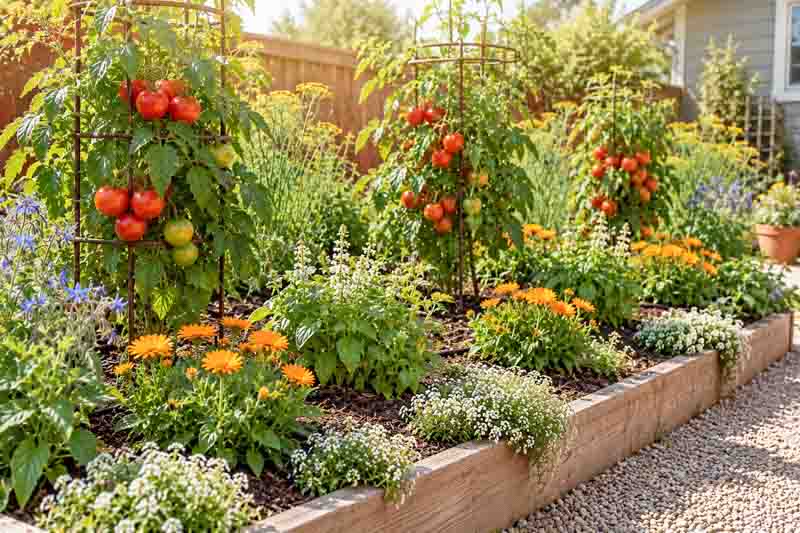


This sunny raised garden brings tomatoes, herbs, and flowers together in a planting that feels generous without becoming difficult to manage. Tall tomato vines provide the main structure, basil fills some of the middle spaces, dill adds an airy vertical accent, and borage, calendula, and sweet alyssum bring blue, orange, and white flowers around the lower layer.
The design is especially well suited to a long, narrow bed. A 3 × 10 ft garden gives three tomato plants enough length to stand apart while leaving room for herbs and flowers between and around them. A smaller 4 × 6 ft bed works well with two tomatoes and a reduced version of the same planting.
Borage, flowering dill, calendula, sweet alyssum, and flowering basil can attract bees, hoverflies, and other beneficial insects. Tomatoes are self-pollinating, but bumblebees can help release pollen by vibrating the flowers, while the companion plants add nectar and additional pollen through the season.
Main plants used: Tomato ‘Early Girl’, Tomato ‘Sungold’, Tomato ‘Super Sweet 100’, Borage (Borago officinalis), Calendula (Calendula officinalis), Sweet Alyssum (Lobularia maritima), Genovese Basil (Ocimum basilicum), and Dill (Anethum graveolens).
The bed may look slightly open when first planted. That is intentional. Tomatoes, basil, dill, and borage all become much larger by midsummer.
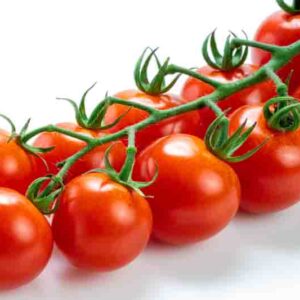
The tomatoes form the backbone of the planting. ‘Early Girl’ brings classic round red fruit, ‘Sungold’ adds golden-orange cherry tomatoes, and ‘Super Sweet 100’ produces long clusters of small red fruit. In a 3 × 10 ft bed, one of each creates plenty of variety without crowding the supports together.
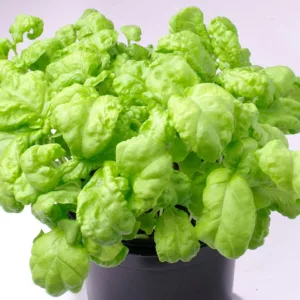
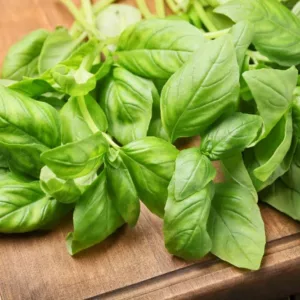
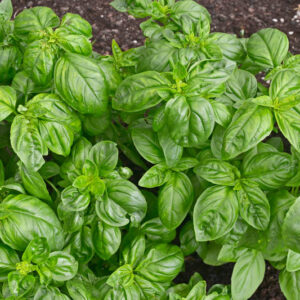
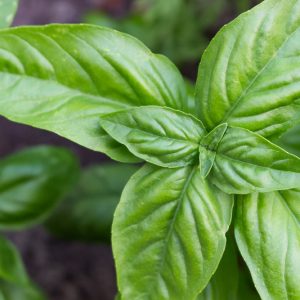
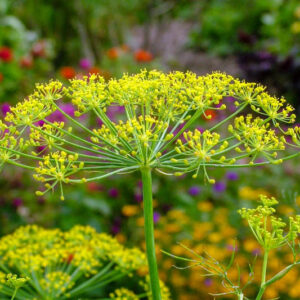
Basil stays lower and creates a lush green layer around selected tomatoes. Dill behaves differently: its fine foliage and flower umbels rise above the lower plants without forming a heavy mass.
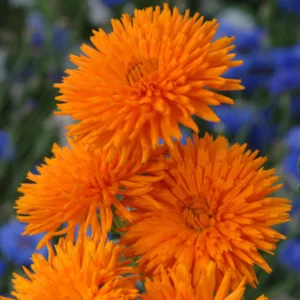
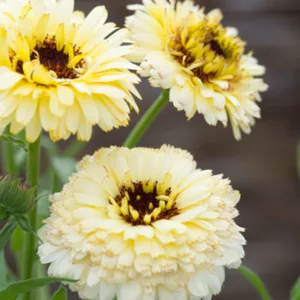
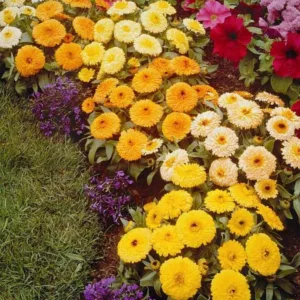
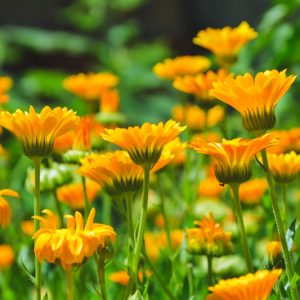
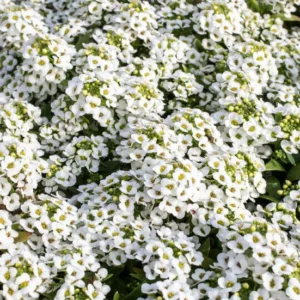
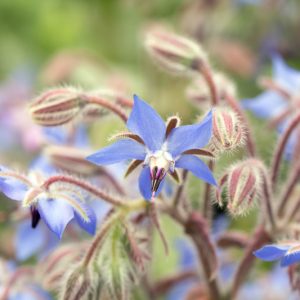
Borage brings broad leaves and vivid blue flowers, so one plant is usually enough. Calendula adds warmer orange and gold tones, while sweet alyssum stays low and helps soften the front edge of the bed.
That mix also spreads flowers through several heights. Borage is especially attractive to bees, flowering dill can draw hoverflies and small beneficial insects, and sweet alyssum provides many tiny flowers close to the ground.
Pollinator note: Tomato flowers provide pollen but essentially no nectar. The surrounding flowers add nectar sources as well as extra pollen, helping support a broader mix of visiting insects.
Use tomatoes as the strong vertical anchors, then weave basil and flowering companions around them in loose groups. Keep the tomato stems easy to reach, give borage enough elbow room, and avoid filling every gap simply because space is visible in spring.
Total quantity allocation: 96%. These percentages should not be read as literal percentages of mature soil coverage, since tomatoes, dill, borage, and low-growing alyssum occupy the garden in very different ways.
Gardenia quantity note: Tomatoes are treated as one planting category when quantities are calculated. ‘Early Girl’, ‘Sungold’, and ‘Super Sweet 100’ are cultivar choices within that allocation. A 4 × 6 ft bed works well with two tomatoes, while a 3 × 10 ft bed has enough length for three.
The quantities below provide a practical starting point rather than a maximum planting density. The 3 × 10 ft row most closely matches the long raised garden shown here.
| Garden Size | Tomatoes | Basil | Dill | Borage | Calendula | Sweet Alyssum |
|---|---|---|---|---|---|---|
| 4 × 4 ft | 1 | 1-2 | 1 | 0-1 | 1 | 1-2 |
| 2 × 6 ft | 1 | 1-2 | 1 | 0-1 | 1 | 1-2 |
| 3 × 6 ft | 2 | 2 | 1 | 1 | 1 | 2 |
| 4 × 6 ft | 2 | 2 | 1 | 1 | 1 | 2 |
| 3 × 10 ft | 3 | 4 | 2 | 1 | 2 | 4 |
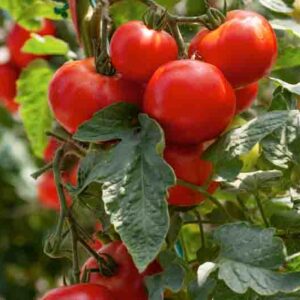
‘Early Girl’ brings a classic round red slicing tomato to the garden. It also provides a useful contrast with the two cherry varieties.
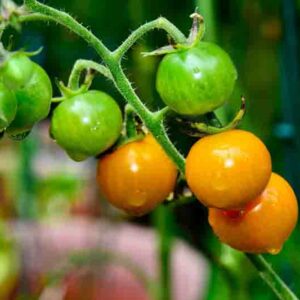
‘Sungold’ produces masses of golden-orange cherry tomatoes on vigorous vines. Give it a substantial cage or stake from the beginning.
‘Super Sweet 100’ carries long clusters of small red cherry tomatoes and can become equally vigorous in good summer conditions.
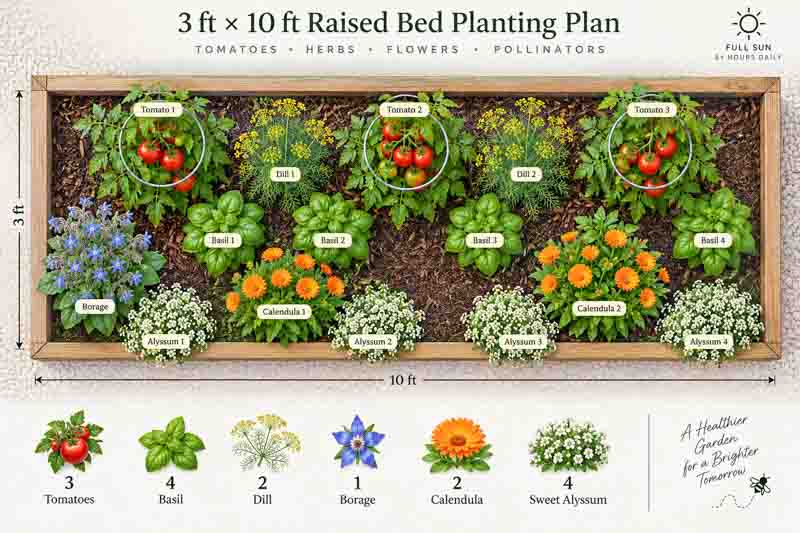
Install the tomato supports before planting. In the 3 × 10 ft version, space the three tomatoes along the rear or central line of the bed rather than bunching them at one end.
Plant basil in loose groups between and slightly in front of the tomatoes. Four basil plants are enough to create a full green middle layer without surrounding every tomato stem.
Place the two dill plants where their fine foliage and flower umbels can rise through the planting without blocking the tomatoes. Keeping them slightly apart looks more natural than planting them side by side.
Use the single borage plant near one end or corner of the bed. It can spread considerably as it matures, so this gives it room to lean outward rather than into the tomatoes.
Repeat calendula in two small pockets, then use sweet alyssum in several low groups along the front edge. The alyssum can spill slightly over the raised-bed edge while leaving clear gaps for access.
The lower layer can look generous without forming a solid carpet. Leave some mulch or open soil around the tomato stems so watering, tying, inspecting foliage, and harvesting remain easy.
Borage is the companion most likely to become bulky. Dill can also become taller and looser than expected once it flowers. If either begins leaning heavily across a tomato, trim it rather than allowing the planting to become tangled.
That kind of editing is normal in an edible garden. The aim is not to preserve a perfectly fixed composition but to keep the bed productive and pleasant to work in.
Early in summer, calendula and sweet alyssum provide much of the color while the tomatoes, basil, and borage are still developing.
By midsummer, the tomatoes dominate the upper layer, basil has filled out below them, blue borage flowers are open, and dill umbels hover lightly above the surrounding plants.
Later, the fruit becomes the strongest visual feature. Red ‘Early Girl’, golden ‘Sungold’, and red ‘Super Sweet 100’ stand above blue borage, orange calendula, and white alyssum, giving the garden plenty of color even before harvest.
| Hardiness |
3 - 11 |
|---|---|
| Climate Zones | 1, 1A, 1B, 2, 2A, 2B, 3, 3A, 3B, 4, 5, 6, 7, 8, 9, 10, 11, 12, 13, 14, 15, 16, 17, 18, 19, 20, 21, 22, 23, 24 |
| Exposure | Full Sun |
| Season of Interest | Summer (Early, Mid, Late), Fall |
| Maintenance | High |
| Water Needs | Average |
| Soil Type | Loam, Sand |
| Soil pH | Acid, Neutral |
| Soil Drainage | Moist but Well-Drained |
| Attracts | Bees, Butterflies |
| Landscaping Ideas | Beds And Borders |
| Garden Styles | City and Courtyard, Informal and Cottage, Mediterranean Garden, Pollinator Garden |


| Hardiness |
3 - 11 |
|---|---|
| Climate Zones | 1, 1A, 1B, 2, 2A, 2B, 3, 3A, 3B, 4, 5, 6, 7, 8, 9, 10, 11, 12, 13, 14, 15, 16, 17, 18, 19, 20, 21, 22, 23, 24 |
| Exposure | Full Sun |
| Season of Interest | Summer (Early, Mid, Late), Fall |
| Maintenance | High |
| Water Needs | Average |
| Soil Type | Loam, Sand |
| Soil pH | Acid, Neutral |
| Soil Drainage | Moist but Well-Drained |
| Attracts | Bees, Butterflies |
| Landscaping Ideas | Beds And Borders |
| Garden Styles | City and Courtyard, Informal and Cottage, Mediterranean Garden, Pollinator Garden |
Recreate this garden. Specify the percentages you would like to have of each plant and input the dimensions of your garden space.We'll give you a shopping list so you know how many plants you need.
| Plant | Quantity | |
|---|---|---|
| Calendula officinalis (Pot Marigold) | N/A | Buy Plants |
| Ocimum basilicum 'Genovese' (Sweet Basil) | N/A | Buy Plants |
| Anethum graveolens (Dill) | N/A | Buy Plants |
| Solanum lycopersicum 'Sungold' (Tomato) | N/A | Buy Plants |
| Solanum lycopersicum 'Early Girl' (Tomato) | N/A | Buy Plants |
| Solanum lycopersicum 'Super Sweet 100' (Tomato) | N/A | Buy Plants |
| Lobularia 'Snow Crystals' (Sweet Alyssum) | N/A | Buy Plants |
| Borago officinalis (Borage) | N/A | Buy Plants |
Create a membership account to save your garden designs and to view them on any device.
Becoming a contributing member of Gardenia is easy and can be done in just a few minutes. If you provide us with your name, email address and the payment of a modest $25 annual membership fee, you will become a full member, enabling you to design and save up to 25 of your garden design ideas.
Join now and start creating your dream garden!
Create a membership account to save your garden designs and to view them on any device.
Becoming a contributing member of Gardenia is easy and can be done in just a few minutes. If you provide us with your name, email address and the payment of a modest $25 annual membership fee, you will become a full member, enabling you to design and save up to 25 of your garden design ideas.
Join now and start creating your dream garden!