Iron Fern, Leatherleaf Fern, Aspidium cunninghamianum

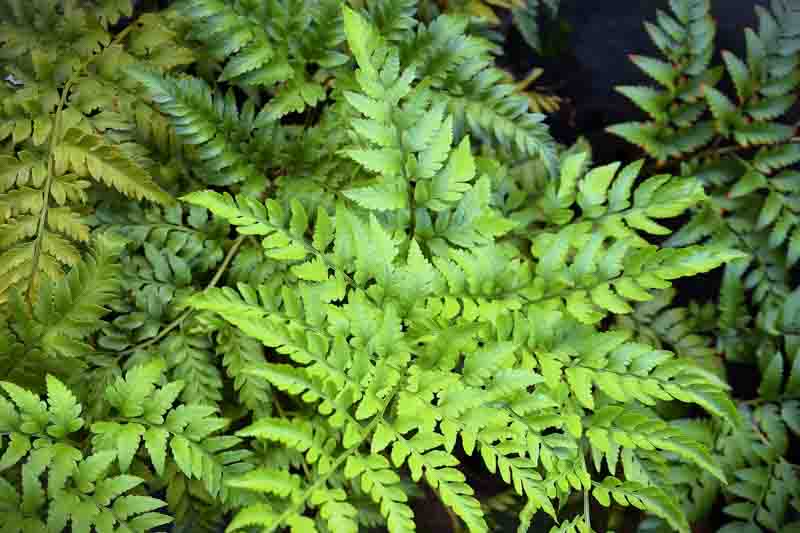


You’ve probably seen Rumohra adiantiformis (Leatherleaf Fern) tucked into a florist’s bouquet. Its glossy, triangular fronds are a favorite for good reason: they have the delicate outline of a woodland fern but a remarkably tough, leathery texture. Properly handled, the cut foliage can remain attractive for nearly two weeks.
Leatherleaf Fern deserves a place beyond the florist’s shop. In warm, shaded gardens, its creeping stems gradually form a handsome green groundcover. It also grows well in sheltered containers. The secret is combining shade and reliable moisture with drainage that keeps its rhizomes healthy.
Summary: Evergreen rhizomatous fern with glossy, triangular, finely divided fronds.
Use: Excellent for shaded borders, groundcovers, sheltered containers, and cut foliage.
Highlight: Durable fronds prized by florists, with a typical vase life of 12-14 days under proper handling.
Botanical interest: Spreads through rhizomes and reproduces by spores rather than flowers.
| Botanical Name | Rumohra adiantiformis (G.Forst.) Ching |
|---|---|
| Family | Polypodiaceae (Kew); Dryopteridaceae in some other classifications |
| Common Names | Leatherleaf Fern, Leather Fern, Seven Weeks Fern |
| Native Range | Tropical and subtropical Americas, including Florida; southern Africa, Indian Ocean islands, New Guinea, eastern and southeastern Australia, and New Zealand |
| Plant Type and Habit | Evergreen perennial fern with creeping rhizomes; spreading, primarily terrestrial |
| Hardiness | USDA Zones 10-11 for conservative outdoor planting; protected Zone 9b sites may also be suitable |
| Size | Typically 1-3 ft. tall (30-90 cm), spreading 4-5 ft. (120-150 cm) |
| Exposure | Partial to full shade outdoors; bright indirect light indoors |
| Soil | Humus-rich, moist but well-drained soil; adaptable to several soil textures |
| Foliage | Glossy, dark green, triangular fronds divided into firm, leathery segments |
| Flowers | None; round, spore-producing sori occur beneath fertile fronds |
Leatherleaf Fern has an unusually broad native distribution, from tropical America to southern Africa, Australia, and New Zealand. Kew also records Florida as native, although regional authorities differ on its origin there. In nature, it occupies sheltered forests, rocky sites, and other humid, shaded habitats.
Rusty-brown, creeping rhizomes produce upright and arching fronds, gradually forming a dense colony. Plants typically reach 2-3 ft. tall and spread several feet. This makes Leatherleaf Fern useful as a groundcover, but potentially too vigorous for a cramped planting.
The triangular fronds are divided repeatedly into smaller, finely toothed segments. Their deep green color, glossy surface, and firm texture distinguish them from softer, more fragile ferns. Healthy mature fronds are especially valuable for floral arrangements.
Leatherleaf Fern produces neither flowers nor seeds. Fertile fronds develop rounded sori beneath their leaflets. Each sorus is protected when young by a shield-like covering, called an indusium, which can make the brown spots look surprisingly like insects.
For conservative outdoor planting, USDA Zones 10-11 are the safest recommendation. UF/IFAS also documents cultivation in protected Zone 9b locations, but a Florida-Friendly Landscaping guide gives a narrower 10b-11 range. Frost exposure and shelter therefore matter more than the zone number alone. In suitable climates, foliage remains evergreen.
Leatherfern has received the prestigious Award of Garden Merit from the Royal Horticultural Society.
Its dense foliage provides shelter for small organisms in natural habitats. As a fern, it produces no nectar or pollen, so it does not serve the same pollinator role as flowering plants.
Reliable species-specific evidence is limited. Its leathery foliage may be less appealing than tender vegetation, but browsing resistance should not be assumed.
Established Leatherleaf Fern tolerates short dry spells, particularly in sheltered shade. Prolonged drought can cause brittle leaflets, brown tips, and reduced growth. Moderate, consistent moisture produces better foliage.
Species-specific toxicity information for cats, dogs, horses, and humans is limited. Leatherleaf Fern is not commonly identified as a poisonous ornamental, but this does not establish that it is safe to eat. Discourage pets from chewing the foliage.
Its creeping rhizomes can form extensive colonies in favorable conditions. UF/IFAS currently assesses Leatherleaf Fern as not a problem species in Florida, but local conditions vary. Prevent unwanted spread into surrounding natural habitats.
Leatherleaf Fern has triangular, repeatedly divided fronds and creeping rhizomes. Nephrolepis obliterata (Kimberley Queen Fern) has longer, upright sword-shaped fronds and a more compact appearance.
Choose Leatherleaf Fern for spreading groundcover or harvesting foliage. Kimberley Queen Fern is better suited to a tall, upright container display.
The Florida Department of Agriculture reports a typical vase life of 12-14 days under proper handling.
Harvest: Select fully developed, healthy fronds without yellow tips. Avoid taking so much foliage that the plant is left weakened.
Prepare: Recut approximately 1 in. (2.5 cm) from the stem base at an angle, then place stems promptly in a clean container with 2-3 in. (5-7.5 cm) of water.
Display: Keep arrangements cool and away from direct sun. Commercial handlers use refrigerated storage; home gardeners can improve freshness by using clean water and avoiding heat. Floral preservatives are not necessary according to the Florida guidance.
Partial to full shade is suitable outdoors, particularly where summers are hot. Indoors, provide bright indirect light near a window. Excessive direct sun may bleach or scorch the fronds; very low light can weaken growth.
Use humus-rich, well-drained soil. For containers, combine quality potting mix with perlite or fine bark. Water when the surface begins to dry, allowing excess to drain. Avoid keeping the rhizomes in saturated compost.
Leatherleaf Fern favors warm, humid conditions. Protect it from frost, cold drafts, and drying heat sources. In indoor collections, good air circulation helps reduce problems where humidity remains high.
Those creeping rhizomes are the reason Leatherleaf Fern makes such effective groundcover. In a small bed, however, they can crowd delicate companions. Allow at least 2-4 ft. of eventual spread and check surrounding plants before establishing a colony.
Plant during mild weather, keeping rhizomes near their original soil level. Space groundcover plants about 18-24 in. apart for gradual coverage. Use broad containers with drainage holes, repotting when growth becomes crowded.
Remove yellow or damaged fronds at their bases. Thin crowded colonies when necessary. Where growth is weak and soil nutrients are depleted, apply a light, balanced fertilizer during active growth.
Divide healthy rhizomes with attached roots and growing points, then replant in moist, well-drained medium. Propagation from spores is possible but slower and requires careful control of moisture and hygiene.
Before changing your watering routine, inspect the soil, rhizomes, and undersides of the fronds. Similar symptoms can have different causes.
| What You See | Possible Cause | Check First |
|---|---|---|
| Dry, brown leaflets | Drought, heat, or low humidity | Root-zone moisture |
| Yellow fronds, wet soil | Waterlogging or root stress | Drainage and rhizome condition |
| Bleached patches | Excess direct sun | Afternoon exposure |
| Sparse new growth | Poor light, cold, or root stress | Growing conditions |
| Sticky leaves, raised bumps | Possible scale insects | Leaflet undersides |
| Round brown dots underneath | Normal sori | Regularity and healthy leaf tissue |
Scale insects and mealybugs can affect cultivated ferns. Isolate infested plants and use appropriately labeled treatments where necessary.
Regular brown circles beneath healthy leaflets: Usually normal sori. No treatment is needed.
Irregular raised insects, sticky residue, or localized yellowing: Check for scale insects.
Collapsing fronds and soft, dark rhizomes: Investigate waterlogging and possible decay before adding more water.
Combine Leatherleaf Fern with other plants that appreciate partial shade, humus-rich soil, and moderate moisture. For outdoor planting, check overlapping hardiness zones and mature spread. Indoor companions can be grown in separate containers.
Place upright Kimberley Queen Ferns at the back, use Leatherleaf Fern in broad middle-ground groups, and position Hen and Chickens Fern near a sheltered edge. The contrasting frond shapes create visual depth. Leave enough room for Leatherleaf’s creeping rhizomes rather than planting every fern at its initial nursery size.
Yes. Rumohra adiantiformis retains its glossy green fronds year-round in suitable mild climates or under appropriate indoor conditions.
Yes. Leatherleaf Fern tolerates full shade, although filtered light or partial shade often encourages fuller growth. Avoid strong direct sunlight.
Regular round brown spots are usually sori, the fern’s spore-producing structures. Sticky residue, irregular bumps, or damaged tissue may indicate pests or other problems.
The Florida Department of Agriculture reports a typical vase life of 12-14 days under proper handling. Recut stems, place them in clean water, and keep arrangements cool.
Divide healthy, rooted rhizomes with growing points and replant them in moist but well-drained growing medium. Propagation from spores is also possible.
Royal Botanic Gardens, Kew – Rumohra adiantiformis: Taxonomy and Distribution.
University of Florida IFAS – Rumohra adiantiformis: Landscape Plant Fact Sheet.
UF/IFAS – Florida-Friendly Landscaping Plant Guide.
UF/IFAS Assessment – Leatherleaf Fern.
Florida Department of Agriculture – Leatherleaf Fern: Vase Life and Handling.
Updated: October 2026
| Hardiness |
9 - 11 |
|---|---|
| Plant Type | Ferns |
| Plant Family | Dryopteridaceae |
| Common names | Fern |
| Exposure | Partial Sun, Shade |
| Season of Interest | Spring (Early, Mid, Late), Summer (Early, Mid, Late), Fall, Winter |
| Height | 1' - 3' (30cm - 90cm) |
| Spread | 4' - 5' (120cm - 150cm) |
| Spacing | 48" - 60" (120cm - 150cm) |
| Maintenance | Low |
| Water Needs | Average |
| Soil Type | Loam, Sand |
| Soil pH | Acid, Neutral |
| Soil Drainage | Moist but Well-Drained, Well-Drained |
| Characteristics | Showy, Evergreen, Plant of Merit |
| Tolerances | Full Shade, Deer |
| Garden Uses | Ground Covers, Patio And Containers |
| Garden Styles | Woodland Garden |
| Toxic to Humans | No known toxicity |
| Toxic to Cats | No known toxicity |
| Toxic to Dogs | No known toxicity |
| Toxic to Horses | No known toxicity |


| Hardiness |
9 - 11 |
|---|---|
| Plant Type | Ferns |
| Plant Family | Dryopteridaceae |
| Common names | Fern |
| Exposure | Partial Sun, Shade |
| Season of Interest | Spring (Early, Mid, Late), Summer (Early, Mid, Late), Fall, Winter |
| Height | 1' - 3' (30cm - 90cm) |
| Spread | 4' - 5' (120cm - 150cm) |
| Spacing | 48" - 60" (120cm - 150cm) |
| Maintenance | Low |
| Water Needs | Average |
| Soil Type | Loam, Sand |
| Soil pH | Acid, Neutral |
| Soil Drainage | Moist but Well-Drained, Well-Drained |
| Characteristics | Showy, Evergreen, Plant of Merit |
| Tolerances | Full Shade, Deer |
| Garden Uses | Ground Covers, Patio And Containers |
| Garden Styles | Woodland Garden |
| Toxic to Humans | No known toxicity |
| Toxic to Cats | No known toxicity |
| Toxic to Dogs | No known toxicity |
| Toxic to Horses | No known toxicity |
How many Rumohra adiantiformis (Leatherleaf Fern) do I need for my garden?
| Plant | Quantity | |
|---|---|---|
| Rumohra adiantiformis (Leatherleaf Fern) | N/A | Buy Plants |
Create a membership account to save your garden designs and to view them on any device.
Becoming a contributing member of Gardenia is easy and can be done in just a few minutes. If you provide us with your name, email address and the payment of a modest $25 annual membership fee, you will become a full member, enabling you to design and save up to 25 of your garden design ideas.
Join now and start creating your dream garden!