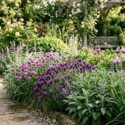
Create an enchanting woodland path with three beautiful perennial groundcovers. Silver-leaved Lamium 'White Nancy' produces white flowers from late spring into summer, while Epimedium 'Roseum' adds delicate pink blooms in spring. Canadian Wild Ginger completes the picture with lush, heart-shaped foliage, creating a wonderfully peaceful retreat beneath mature trees.
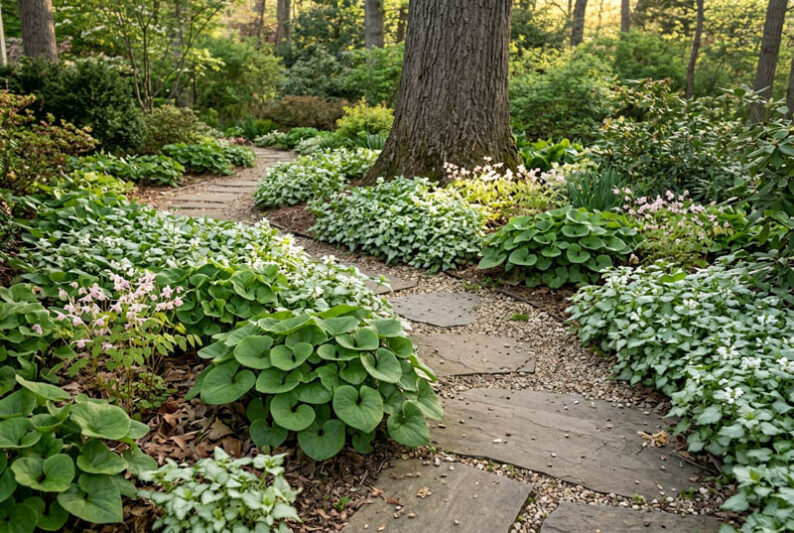


Some of the most beautiful gardens don’t need spectacular flowers to make an impression. This enchanting woodland path proves that a thoughtful mix of foliage, delicate spring blooms, and natural stone can turn a shady corner into something truly special.
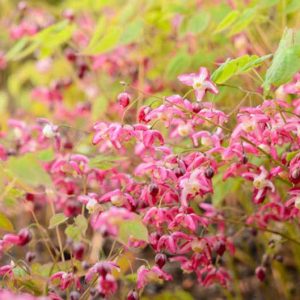
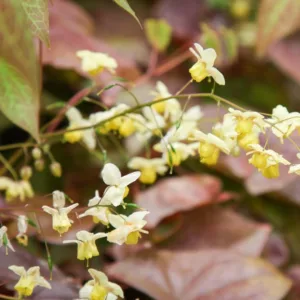
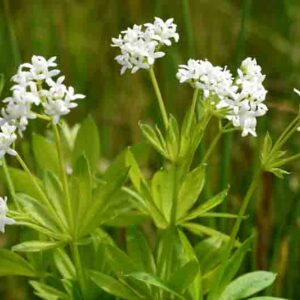
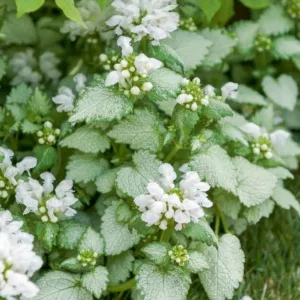
A winding flagstone path leads through generous drifts of Lamium maculatum ‘White Nancy’, whose silver-white leaves brighten the shade. Delicate pink flowers of Epimedium x youngianum ‘Roseum’ rise above soft green foliage, while the large, heart-shaped leaves of Asarum canadense (Wild Ginger) bring a wonderfully lush, woodland character.
Set beneath mature trees, the planting feels relaxed and established, as though it has always belonged there. Best of all, this combination offers a practical way to transform a difficult shaded area into an inviting garden retreat.
Main plants used: Lamium maculatum ‘White Nancy’ (Spotted Dead Nettle), Epimedium x youngianum ‘Roseum’ (Barrenwort), and Asarum canadense (Canadian Wild Ginger).
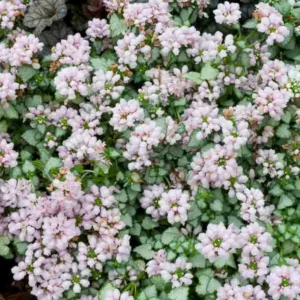
The secret is contrast. ‘White Nancy’ forms a low carpet of silver-centered leaves edged in green, creating a luminous ribbon through the shade. Its small white flowers add another layer of brightness from late spring into summer.
The Epimedium brings a completely different texture. Its delicate, branching stems carry charming pink flowers in spring, followed by attractive leaflets that form a soft, airy groundcover.
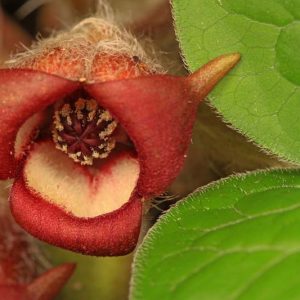
Wild Ginger provides the finishing touch. Its overlapping, heart-shaped leaves create broad green mounds that contrast beautifully with the finer foliage surrounding them. Although its unusual reddish-brown spring flowers are largely hidden beneath the leaves, the foliage is magnificent in its own quiet way.
The winding stepping-stone path ties everything together. Rather than separating the planting into rigid borders, it meanders naturally through the foliage, inviting visitors to explore.
Lamium maculatum ‘White Nancy’ is a vigorous, low-growing perennial that spreads into attractive mats of silver foliage. In late spring and summer, small white flowers appear above the leaves. It performs beautifully in partial shade and appreciates moisture-retentive, well-drained soil. Allow room for its spreading habit.
Epimedium x youngianum ‘Roseum’ is a graceful, deciduous shade perennial with delicate pink flowers in mid to late spring. Once established, it tolerates some dryness, making it valuable beneath trees where moisture can be limited. Its fine foliage offers a beautiful contrast to Wild Ginger.
Asarum canadense, commonly known as Canadian Wild Ginger, is a deciduous North American native that forms colonies of broad, velvety, heart-shaped leaves. It thrives in humus-rich woodland soil with consistent moisture and is particularly effective planted in generous groups.
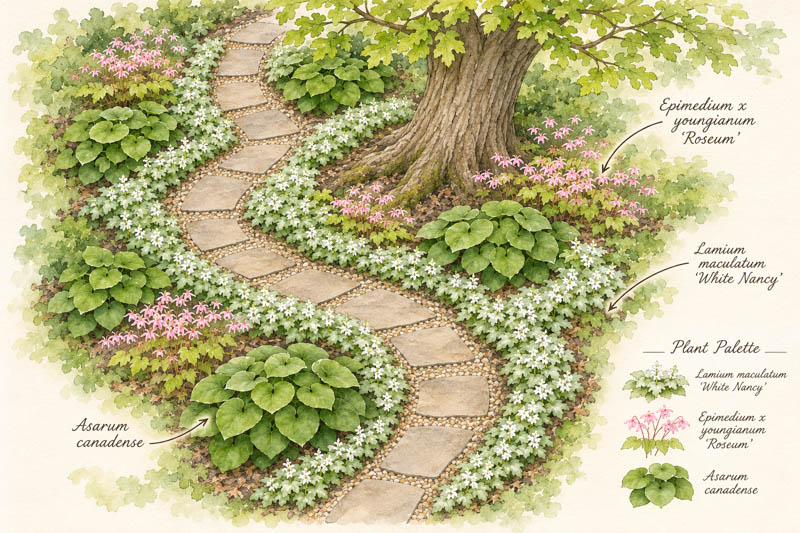
Create a lush, naturalistic woodland path with silver foliage, delicate pink spring flowers, and generous sweeps of heart-shaped green leaves.
Begin with a gently curving flagstone path beneath existing trees. Plant broad ribbons of Lamium along both sides, allowing the foliage to soften the stone edges without covering the walking surface. Position Wild Ginger in substantial, irregular colonies, particularly at the bends in the path. Tuck Epimedium into the spaces between the two, repeating its delicate pink spring flowers at intervals. Leave the immediate base of large trees free of new planting and avoid disturbing major roots.
Spring: Epimedium produces its delicate pink flowers as fresh foliage unfolds. Wild Ginger emerges from the soil, while Lamium begins flowering, bringing silver and white highlights to the garden.
Summer: Wild Ginger forms a lush carpet of green leaves. Lamium continues to brighten the shade, sometimes producing additional white blooms. Epimedium’s foliage provides a softer contrasting texture.
Autumn and winter: The deciduous Wild Ginger and Epimedium gradually die back. Lamium may retain foliage in mild winters, although it can disappear or become sparse in colder conditions.
Although these groundcovers grow well in shade, they do not all tolerate the same degree of dryness. Established Epimedium is relatively adaptable, while Wild Ginger appreciates more consistent moisture. Deep shade beneath mature trees can be surprisingly dry, so enrich suitable planting pockets with organic matter and water during prolonged dry spells.
Lamium can spread enthusiastically in favorable conditions. Keep it from overwhelming the slower-growing Epimedium, and monitor its spread near natural woodland habitats.
Most importantly, resist the temptation to crowd the garden with too many different plants. The beauty of this combination lies in repeating just three distinctive foliage textures, allowing the winding path and mature trees to complete the picture.
| Hardiness |
5 - 7 |
|---|---|
| Exposure | Partial Sun, Shade |
| Season of Interest | Spring (Mid, Late), Summer (Early, Mid, Late), Fall |
| Maintenance | Low |
| Water Needs | Average |
| Soil Type | Loam, Sand |
| Soil pH | Acid, Neutral |
| Soil Drainage | Moist but Well-Drained |
| Tolerances | Full Shade, Deer |
| Landscaping Ideas | Ground Covers, Pathways |
| Garden Styles | Informal and Cottage, Woodland Garden |

| Hardiness |
5 - 7 |
|---|---|
| Exposure | Partial Sun, Shade |
| Season of Interest | Spring (Mid, Late), Summer (Early, Mid, Late), Fall |
| Maintenance | Low |
| Water Needs | Average |
| Soil Type | Loam, Sand |
| Soil pH | Acid, Neutral |
| Soil Drainage | Moist but Well-Drained |
| Tolerances | Full Shade, Deer |
| Landscaping Ideas | Ground Covers, Pathways |
| Garden Styles | Informal and Cottage, Woodland Garden |
Recreate this garden. Specify the percentages you would like to have of each plant and input the dimensions of your garden space.We'll give you a shopping list so you know how many plants you need.
| Plant | Quantity | |
|---|---|---|
| Lamium maculatum 'White Nancy' (Spotted Dead Nettle) | N/A | Buy Plants |
| Epimedium x youngianum 'Roseum' (Barrenwort) | N/A | Buy Plants |
| Asarum canadense (Wild Ginger) | N/A | Buy Plants |
Create a membership account to save your garden designs and to view them on any device.
Becoming a contributing member of Gardenia is easy and can be done in just a few minutes. If you provide us with your name, email address and the payment of a modest $25 annual membership fee, you will become a full member, enabling you to design and save up to 25 of your garden design ideas.
Join now and start creating your dream garden!