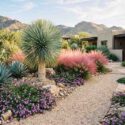
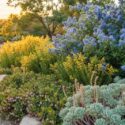
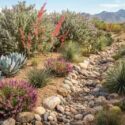
Bold Yucca, trailing Myrtle Spurge, fragrant Lavender, and glowing Gaillardia come together in a dry garden full of structure, texture, and color. Ideal for gravel and rock gardens, this low-water combination offers sculptural foliage, long summer bloom, and a relaxed Mediterranean feel that is both practical and beautiful.
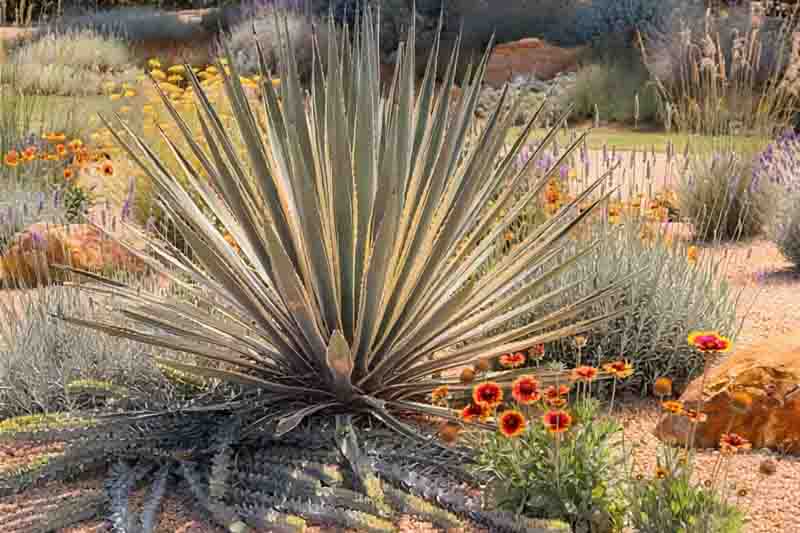


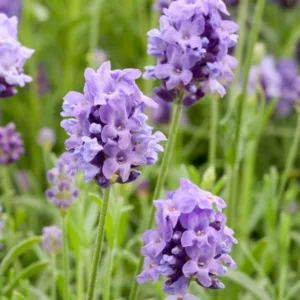
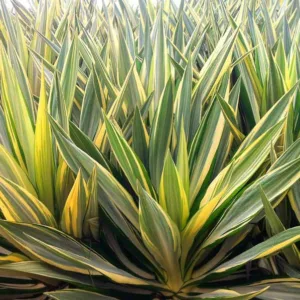
This striking gravel garden is built around bold form, silver foliage, and bright summer color. At its center, Yucca gloriosa provides the strongest architectural presence, its stiff blue-green leaves forming a dramatic spiky rosette. Around it, the trailing stems of Euphorbia myrsinites weave across the gravel, while Lavandula angustifolia ‘Munstead’ contributes neat mounds of silvery foliage and lavender-blue flowers. Bright red-and-gold blooms of Gaillardia ‘Arizona Sun’ complete the picture with cheerful, long-lasting color.
The planting feels bold yet harmonious because each plant brings a different kind of interest. Yucca creates height and permanence, Myrtle Spurge softens the base with a lower, spreading layer, Lavender adds repeated mounds and cool-toned flowers, and Gaillardia introduces warm color in smaller but vivid bursts. Together they create a drought-tolerant combination well suited to gravel gardens, rock gardens, and other sunny, well-drained sites.
Main plants used: Yucca gloriosa (Spanish Dagger), Euphorbia myrsinites (Myrtle Spurge), Gaillardia ‘Arizona Sun’ (Blanket Flower), and Lavandula angustifolia ‘Munstead’ (Lavender)
Use Yucca as the anchor, then repeat Lavender and Gaillardia around it in loose drifts. Let Myrtle Spurge spill naturally through the planting to knit everything together.
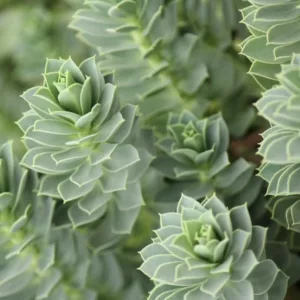
The success of this combination begins with contrast in form. Yucca gloriosa is upright, rigid, and strongly architectural. Euphorbia myrsinites, by contrast, trails and spreads, with fleshy blue-gray stems that soften the ground plane. Lavender forms neat rounded mounds, while Gaillardia rises above the lower foliage with bright, daisy-like flowers. Those contrasting habits keep the planting visually interesting even when not every plant is in bloom.
Color also plays an important role. Most of the planting sits in cool, dry-garden shades – blue-green, silver, and gray-green. Against that quiet backdrop, the red-and-gold flowers of Gaillardia stand out clearly, while the lavender-blue flowers of ‘Munstead’ add a cooler accent. Spring-blooming Myrtle Spurge brings another note with its chartreuse to lime-green flower bracts.
This is also a practical combination for sunny, well-drained sites where lush, thirsty borders would struggle. All four plants are well adapted to leaner soils and bright exposure, making the overall scheme both decorative and resilient.
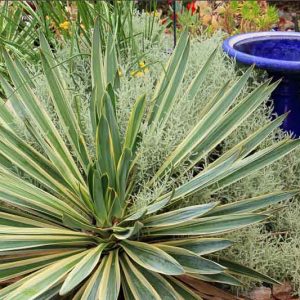
Yucca gloriosa is the focal point. Use it as a specimen in the center or slightly off-center, where its dramatic leaf rosette can dominate the design. It gives the planting a permanent backbone even when the perennials are not flowering.
Euphorbia myrsinites spreads close to the ground, with blue-gray trailing stems and spring flowers in acid yellow-green. It is especially effective near the base of the Yucca or near rocks, where it can spill outward naturally.
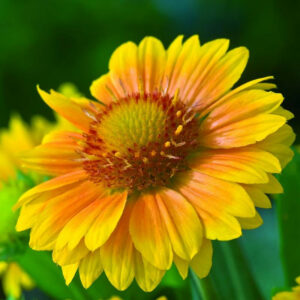
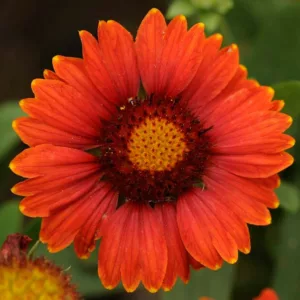
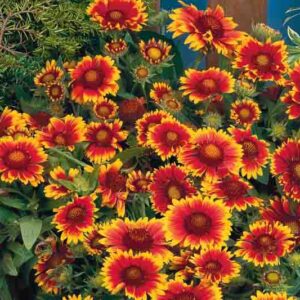
Gaillardia ‘Arizona Sun’ brings the strongest flower color. Its red petals tipped with gold create vivid contrast against the silver foliage nearby. Use it in repeated clumps rather than as a single isolated plant.
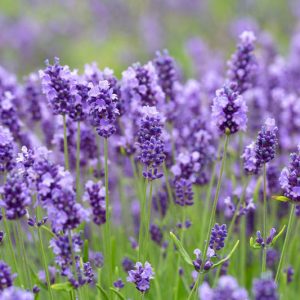
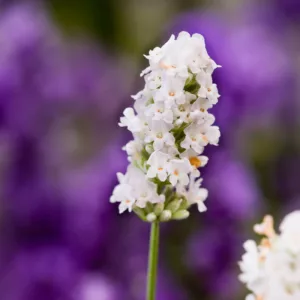
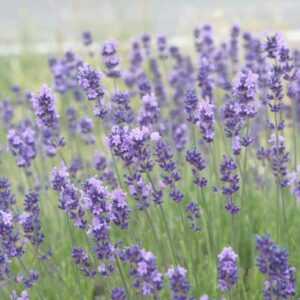
Lavandula angustifolia ‘Munstead’ provides fragrance, silver foliage, and soft purple-blue flowers. Repeat it around the planting to create continuity and to balance the hotter tones of Gaillardia.
Create a low-water gravel garden centered on one strong sculptural plant, then surround it with drought-tolerant companions offering mounding, trailing, and flowering contrast.
In practice, one Yucca may be enough as the main focal point, with the other plants repeated around it in larger numbers.
Let the groups vary in size. A few larger drifts usually look more natural than many identical clumps.
Place Yucca as the main focal point, leaving enough room for its dramatic mature spread.
Use Myrtle Spurge close to the base and around nearby rocks so it can spill outward naturally.
Repeat Lavender in mounds around the middle and outer areas of the planting.
Thread Gaillardia in smaller drifts between the Lavender and Euphorbia so its warm flowers brighten the silver and blue-green foliage.
In spring, Myrtle Spurge provides some of the earliest color with its lime-green bracts, while the Yucca already gives the planting a bold sculptural framework. As the season advances, Lavender begins flowering and Gaillardia starts its long display of red-and-gold daisies.
Through summer, the Gaillardia carries much of the floral color, often flowering over an extended period if deadheaded. Even when individual blooms come and go, the Yucca, Lavender foliage, and trailing Euphorbia continue to give the planting shape and texture.
This combination is best where drainage is excellent and the plants can bask in full sun. In richer or wetter soils, several of these plants may grow less attractively or suffer in winter.
It is also better to describe the planting as relatively low maintenance rather than maintenance-free. Gaillardia benefits from deadheading, Lavender may need shaping, and Euphorbia should be handled carefully. Even so, this is an easy and highly effective way to create a dry garden with strong structure, long color, and year-round presence.
| Hardiness |
7 - 8 |
|---|---|
| Heat Zones |
7 - 8 |
| Climate Zones | 7, 8, 9, 12, 13, 14, 15, 16, 17, 18, 19, 20, 21, 22, 23, 24 |
| Exposure | Full Sun |
| Season of Interest | Spring (Mid, Late), Summer (Early, Mid, Late), Fall |
| Maintenance | Low |
| Water Needs | Low |
| Soil Type | Chalk, Loam, Sand |
| Soil pH | Acid, Neutral, Alkaline |
| Soil Drainage | Well-Drained |
| Characteristics | Dried Arrangements, Cut Flowers, Fragrant, Plant of Merit, Showy |
| Tolerance | Drought, Deer, Rabbit, Dry Soil, Rocky Soil |
| Attracts | Bees, Butterflies |
| Landscaping Ideas | Beds And Borders |
| Garden Styles | Butterfly Garden, Coastal Garden, Gravel and Rock Garden, Mediterranean Garden, Pollinator Garden |


| Hardiness |
7 - 8 |
|---|---|
| Heat Zones |
7 - 8 |
| Climate Zones | 7, 8, 9, 12, 13, 14, 15, 16, 17, 18, 19, 20, 21, 22, 23, 24 |
| Exposure | Full Sun |
| Season of Interest | Spring (Mid, Late), Summer (Early, Mid, Late), Fall |
| Maintenance | Low |
| Water Needs | Low |
| Soil Type | Chalk, Loam, Sand |
| Soil pH | Acid, Neutral, Alkaline |
| Soil Drainage | Well-Drained |
| Characteristics | Dried Arrangements, Cut Flowers, Fragrant, Plant of Merit, Showy |
| Tolerance | Drought, Deer, Rabbit, Dry Soil, Rocky Soil |
| Attracts | Bees, Butterflies |
| Landscaping Ideas | Beds And Borders |
| Garden Styles | Butterfly Garden, Coastal Garden, Gravel and Rock Garden, Mediterranean Garden, Pollinator Garden |
Recreate this garden. Specify the percentages you would like to have of each plant and input the dimensions of your garden space.We'll give you a shopping list so you know how many plants you need.
| Plant | Quantity | |
|---|---|---|
| Euphorbia myrsinites (Myrtle Spurge) | N/A | Buy Plants |
| Gaillardia x grandiflora 'Arizona Sun' (Blanket Flower) | N/A | Buy Plants |
| Lavandula angustifolia 'Munstead' (Lavender) | N/A | Buy Plants |
| Yucca gloriosa 'Variegata' (Spanish Dagger) | N/A | Buy Plants |
Create a membership account to save your garden designs and to view them on any device.
Becoming a contributing member of Gardenia is easy and can be done in just a few minutes. If you provide us with your name, email address and the payment of a modest $25 annual membership fee, you will become a full member, enabling you to design and save up to 25 of your garden design ideas.
Join now and start creating your dream garden!
Create a membership account to save your garden designs and to view them on any device.
Becoming a contributing member of Gardenia is easy and can be done in just a few minutes. If you provide us with your name, email address and the payment of a modest $25 annual membership fee, you will become a full member, enabling you to design and save up to 25 of your garden design ideas.
Join now and start creating your dream garden!