Tired of peonies collapsing after spring rain? Discover 30+ beautiful varieties selected for sturdy stems, upright growth, and strong garden performance. From compact herbaceous peonies to robust Itoh hybrids, these self-supporting favorites deliver spectacular flowers with less staking, while offering choices for different colors, flower forms, and bloom seasons.
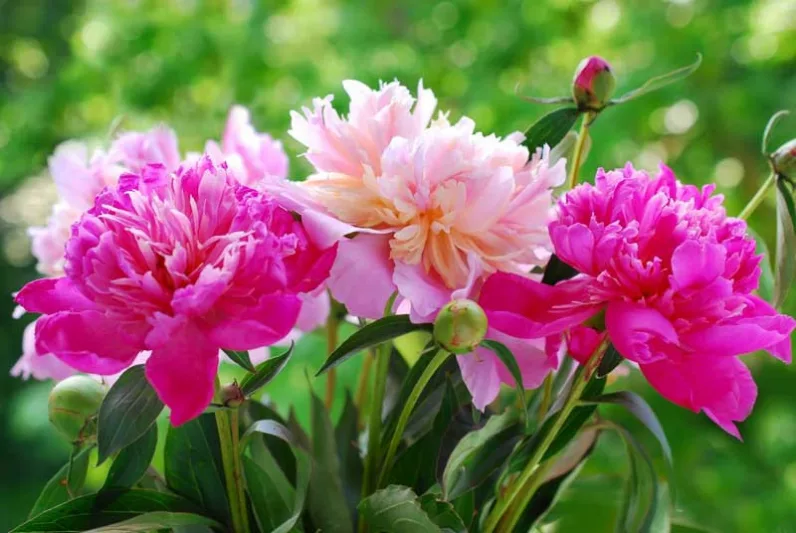


Few sights are more disappointing than a magnificent peony flattened by a spring downpour. One day the plant is carrying a perfect canopy of flowers; the next, heavy blooms are resting on the lawn or leaning into neighboring plants. Peony rings and stakes can help, but they are not the only solution. Choosing cultivars with strong stems, well-proportioned flowers, and naturally upright habits can greatly reduce – and in many gardens eliminate – the need for support.
Not all peonies are equally prone to flopping. Flower form matters, but it is only part of the story. Plant height, stem strength, flower size, the position of the blooms above the foliage, sun exposure, fertility, rain, and cultivar genetics all influence whether a peony remains upright.
Gardenia’s key finding: The best no-staking peonies combine strong stems with a flower load the stems can realistically carry. Compact height helps, but it is not enough by itself. Flower form, bloom size, stem architecture, and weather performance all matter.
A peony stem is essentially a lever carrying a flower at its tip. As the flower becomes larger and heavier, especially after absorbing rainwater, the load on that stem increases. This is why enormous fully double flowers are often more vulnerable than airy single or Japanese-form blooms.
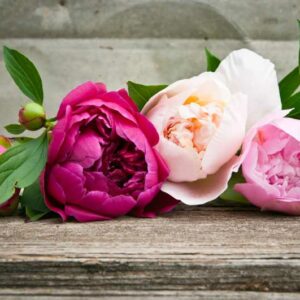
Flower architecture explains much of the difference. The American Peony Society recognizes six principal herbaceous peony flower forms: single, Japanese, anemone, semi-double, bomb, and full double. Single flowers have relatively few petals. Japanese and anemone forms retain an open structure with transformed stamens or petaloids in the center. Full doubles pack considerably more floral tissue into each bloom.
That does not mean every double peony falls over or every single peony stands perfectly. A compact double on thick stems can outperform a tall single grown in shade. Cultivar genetics matter enormously.
The best question is therefore not simply, “Is this peony single or double?” It is “Can this cultivar’s stems carry its flowers under normal garden conditions?”
Stem strength: Strong, erect stems are the most obvious advantage. Some cultivars have been selected specifically for their ability to present flowers above the foliage without mechanical support.
Flower weight: Singles, Japanese forms, anemones, and many semi-doubles usually carry less petal mass than huge doubles. Their flowers also tend to shed rain more readily.
Height: Shorter stems have less leverage working against them. This is one reason compact hybrid peonies such as ‘Buckeye Belle’ can remain exceptionally tidy.
Plant architecture: A broad, well-branched plant can distribute its flowers more effectively than a narrow clump with long stems topped by oversized blooms.
Flower position: Flowers held just above the foliage are often better supported than blooms carried high above the plant.
Weather recovery: Some excellent landscape peonies bend under wind or rain but recover their shape afterward. That is different from a cultivar whose stems permanently lodge or break.
No-staking does not mean storm-proof: A self-supporting peony should normally stand without rings or stakes, but an exceptional downpour can overwhelm almost any flower. Large blooms become dramatically heavier when saturated. Judge a cultivar by its normal landscape performance, not by whether it survives every possible storm untouched.
The following cultivars stand out in Gardenia’s records and cultivar descriptions for their combination of stem strength, flower architecture, manageable height, and landscape presentation.
| Hardiness |
3 - 8 |
|---|---|
| Heat Zones |
1 - 8 |
| Climate Zones | 1, 2, 3, 4, 5, 6, 7, 8, 9, 10, 11, 14, 15, 16, 17, 18, 19, 20, A1, A2, A3 |
| Plant Type | Perennials |
| Genus | Paeonia |
| Exposure | Full Sun, Partial Sun |
| Season of Interest | Spring (Late), Summer (Early) |
| Maintenance | Average |
| Water Needs | Average |
| Soil Type | Chalk, Clay, Loam, Sand |
| Soil pH | Acid, Alkaline, Neutral |
| Soil Drainage | Moist but Well-Drained |
| Characteristics | Cut Flowers, Fragrant, Plant of Merit, Showy |
| Tolerances | Deer, Rabbit |
| Attracts | Butterflies |
| Landscaping Ideas | Beds And Borders |
| Garden Styles | City and Courtyard, Informal and Cottage, Japanese Garden |

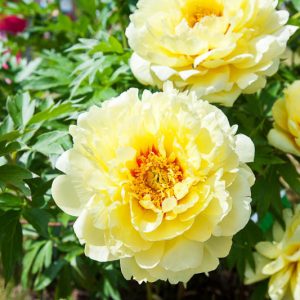
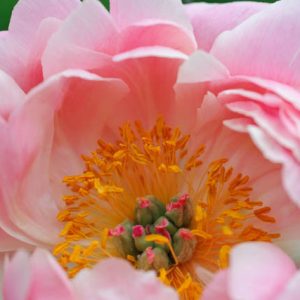
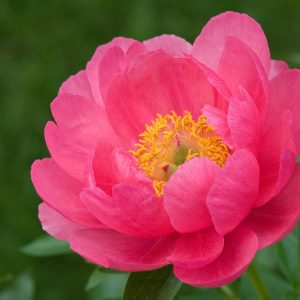
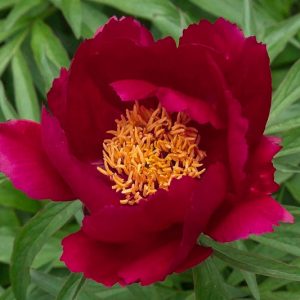
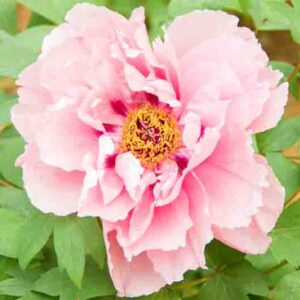
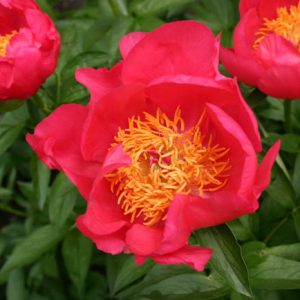
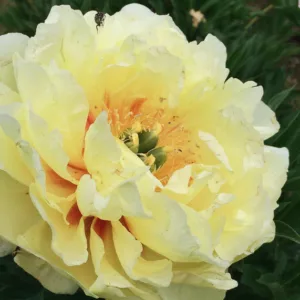
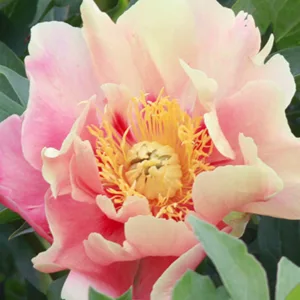
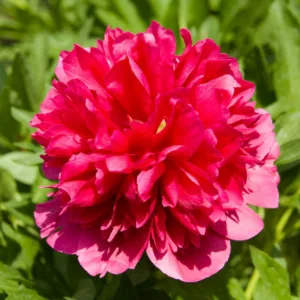
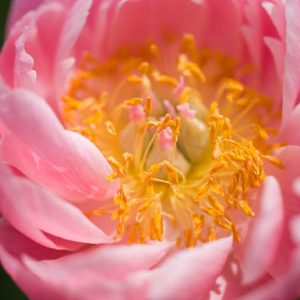
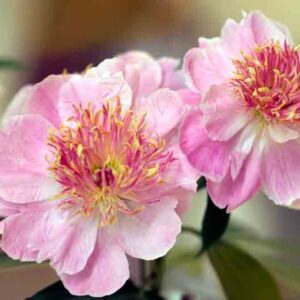
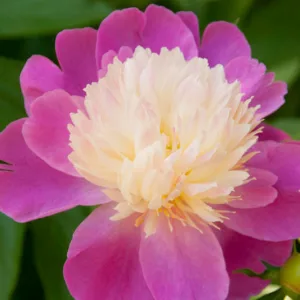
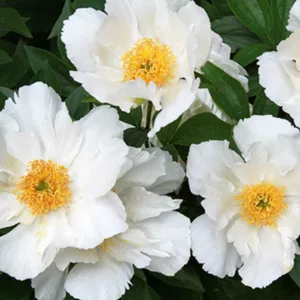
If the goal is maximum flower impact with minimum structural fuss, ‘Bartzella’ deserves a place near the top of the list. This intersectional, or Itoh, peony produces exceptionally large golden-yellow flowers on a broad plant with strong stems. Mature specimens can carry dozens of blooms opening sequentially over a longer period than a typical herbaceous cultivar.
Its advantage comes from architecture rather than small flowers. The blooms can reach 6-8 inches (15-20 cm), yet the plant develops a sturdy, rounded framework capable of presenting them above the foliage.
There is an important caveat. Gardenia’s cultivar profile also notes that very large peony flowers may arch after a hard rain. That is not really a contradiction. ‘Bartzella’ normally grows as a self-supporting plant, but a waterlogged 8-inch flower is an exceptional load. In an exposed garden with frequent violent spring storms, temporary support may still be prudent.
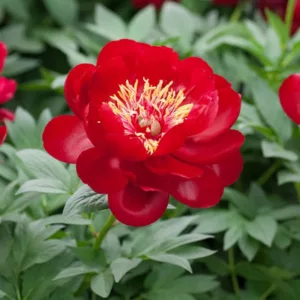
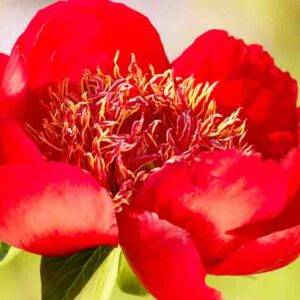
‘Buckeye Belle’ solves the staking problem partly through excellent proportions. At roughly 18-24 inches (45-60 cm), it is much shorter than many traditional lactiflora peonies. Its rich mahogany-red semi-double flowers sit on strong, erect stems, producing a compact plant that looks deliberately composed rather than restrained.
For small gardens, the front of a perennial border, or gardeners who dislike peony hoops, its combination of moderate flower weight and short stature is hard to beat.
A plant can be self-supporting in calm weather yet perform poorly once its flowers are saturated. Gardeners in climates with wet springs should therefore look beyond basic stem strength.
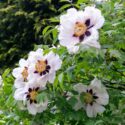
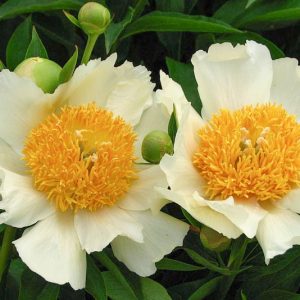
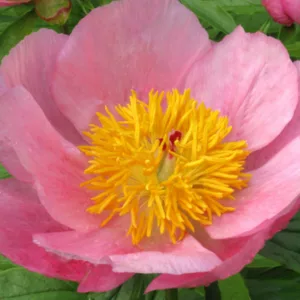
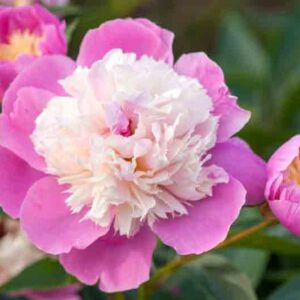
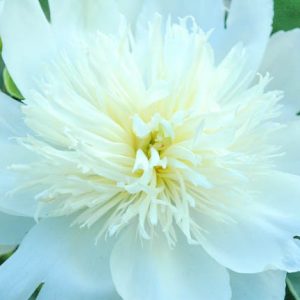
‘Krinkled White’ is particularly valuable. Its large but lightweight single flowers are carried on flexible stems that generally remain self-supporting, and Gardenia’s cultivar record specifically notes good performance in rain.
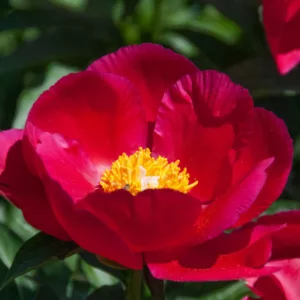
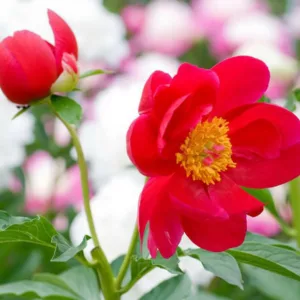
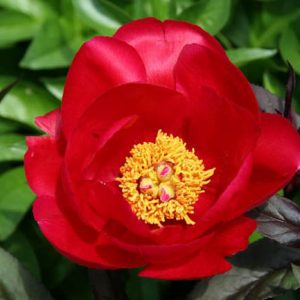
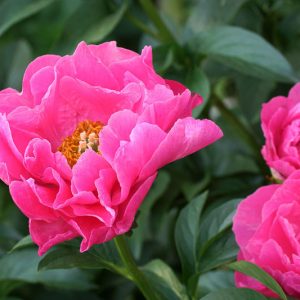
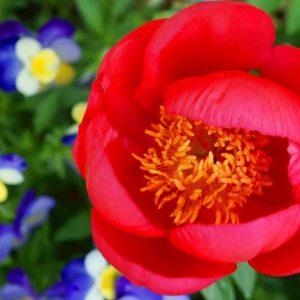
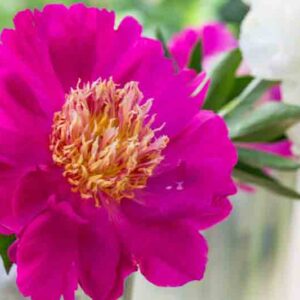
‘Burma Ruby’ is another strong choice. Its brilliant single red flowers are carried on sturdy stems and the cultivar is noted for standing up to bad weather.
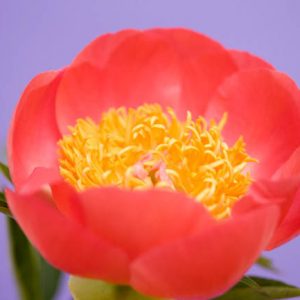
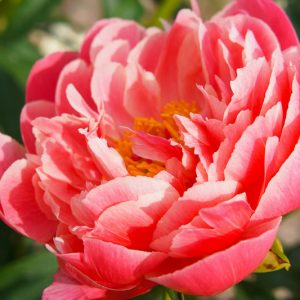
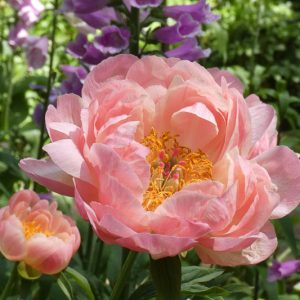
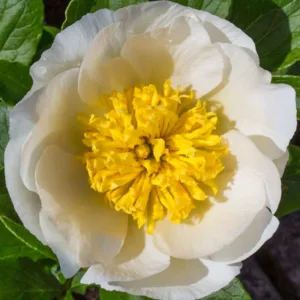
‘Coral n’ Gold’ behaves slightly differently. Its broad bush can be moved by wind and rain but has a useful ability to restore its shape afterward. That recovery is an important landscape quality and one reason it received the American Peony Society Award of Landscape Merit.
Gardeners dealing regularly with wet spring weather should also explore Gardenia’s guide to peonies resistant to rain and heat.
Often, yes. Itoh peonies combine traits inherited from woody and herbaceous peonies, and many develop short, sturdy stems and broad, rounded plants. Their flowers are usually presented clearly above the foliage without the top-heavy appearance associated with some old double herbaceous peonies.
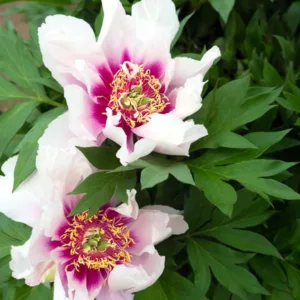
‘First Arrival’, ‘Julia Rose’, and ‘Bartzella’ are good examples.
Their advantage lies primarily in their strong plant architecture, although flower size and individual cultivar habit still matter.
For gardeners choosing without detailed cultivar information, single, Japanese, and anemone forms are generally safer bets than enormous full doubles. They usually contain less petal mass and retain less rainwater.
This explains the strong showing of single-flowered cultivars in Gardenia’s no-staking selections. ‘Blaze’, ‘Burma Ruby’, ‘Krinkled White’, and ‘Coral n’ Gold’ all combine relatively open flowers with plants known to stand well.
Conversely, a single-flowered peony planted in deep shade may develop elongated, weaker stems and lodge despite having relatively light flowers.
A strong-stemmed cultivar can be made weaker by poor growing conditions. Peonies grown with inadequate light tend to stretch toward the sun. Longer, thinner stems are less capable of holding flowers upright.
For the strongest plant structure, give herbaceous and Itoh peonies at least six hours of direct sunlight in most climates. Light afternoon shade can be useful where spring temperatures are high, but dense shade is not a recipe for self-supporting peonies.
Overfeeding creates another problem. Excessive nitrogen stimulates lush, soft growth. The plant may look impressively leafy but its stems can become less resilient. Feed according to soil fertility rather than trying to force rapid growth.
For complete planting, watering, feeding, pruning, and division advice, see Gardenia’s complete peony care guide.
A cultivar cannot express strong stems if the site encourages weak ones. Too much shade, excessive nitrogen, crowding, and competition for light can make even a naturally upright peony lean. Choosing the right cultivar and growing it well are two halves of the same solution.
Not necessarily. A no-staking peony means you should not have to support it routinely under normal conditions. There is nothing wrong with providing temporary protection when an exceptional storm is forecast, particularly for a mature plant carrying dozens of fully open flowers.
The distinction is practical. A cultivar that requires a permanent hoop every year has a different landscape habit from one that only needs help during an unusually violent storm.
If support is required, install it while shoots are still short. The stems can then grow naturally through the grid and hide most of the structure. Trying to cage a plant after its stems have fallen rarely produces an attractive result.
You do not have to sacrifice a long peony season in order to avoid staking. Gardenia’s selections cover several bloom periods.
For the beginning of the season, ‘Claire de Lune’ is very early, while ‘Buckeye Belle’, ‘Burma Ruby’, ‘Coral n’ Gold’, and ‘Salmon Dream’ flower early. ‘Blaze’, ‘Chocolate Soldier’, ‘Do Tell’, and ‘Many Happy Returns’ move the display into early midseason. ‘Krinkled White’, ‘First Arrival’, and ‘Julia Rose’ extend strong-stemmed choices into the middle portion of the peony season, while ‘Bartzella’ continues later.
Combining cultivars from several flowering groups can extend the overall peony display for several weeks. Gardenia’s guide to extending the peony blooming season explains how to build a succession from very early through late cultivars.
One of the most useful shortcuts when shopping for an upright garden peony is the American Peony Society’s Award of Landscape Merit. Unlike an exhibition award that focuses primarily on the perfection of an individual bloom, the landscape award considers the whole plant.
To qualify, a peony must demonstrate superior landscape value, reliable flowering, attractive foliage, and – crucially for this guide – the ability to remain self-supporting and display its flowers successfully under a range of weather conditions.
That makes Award of Landscape Merit cultivars particularly interesting for gardeners who care more about how a peony behaves in a border than how one cut flower looks on a show bench. ‘Burma Ruby’, ‘Coral n’ Gold’, ‘Do Tell’, and ‘Krinkled White’ are among the Gardenia selections associated with strong landscape performance.
Yes. Many hybrid, single-flowered, semi-double, and Itoh peonies have sufficiently strong stems to remain upright without routine staking. Good examples include ‘Buckeye Belle’, ‘Bartzella’, ‘Burma Ruby’, ‘Blaze’, ‘Krinkled White’, ‘First Arrival’, and ‘Julia Rose’.
Single, Japanese, and anemone-flowered peonies are generally less top-heavy than very large doubles because they have fewer petals and retain less rainwater. Many Itoh peonies are also naturally sturdy because they develop strong, relatively short stems and broad plant habits.
Most Itoh peonies are naturally self-supporting and usually do not require staking. Their sturdy stems and rounded growth habit are major landscape advantages. Exceptionally large flowers can still bow temporarily after torrential rain, so no peony should be considered completely storm-proof.
No. Flower form influences flopping, but stem strength, height, flower size, and cultivar genetics matter too. Some double and semi-double cultivars have strong enough stems to remain upright, while a poorly grown single peony can still lean.
‘Buckeye Belle’ is an excellent compact choice. It grows about 18-24 inches tall and carries dark red semi-double flowers on strong, erect stems. Its short, neat habit gives the flowers less leverage to pull the plant toward the ground.
‘Krinkled White’ is noted for good rain performance, while ‘Burma Ruby’ stands up well to bad weather. ‘Coral n’ Gold’ has a broad habit that can restore itself after wind and rain. Open single flowers generally shed water more readily than very full doubles.
Heavy rain, insufficient sunlight, excessive nitrogen, unusually large flowers, overcrowding, or strong wind can cause even a normally self-supporting peony to lean. Check growing conditions before concluding that the cultivar always requires staking.
Adequate sunlight helps peonies develop compact, sturdy growth. Plants grown in excessive shade may stretch toward the light and develop longer, weaker stems. Most herbaceous and Itoh peonies flower and stand best with at least six hours of direct sun.
Excessive nitrogen can encourage lush, soft stem growth and increase the tendency to flop. Fertilize only when soil fertility or plant performance indicates a need rather than feeding heavily in an attempt to produce larger plants.
No. A no-staking cultivar is one that normally supports its own flowers under ordinary garden conditions. Torrential rain or severe wind can temporarily bow or damage almost any peony, particularly when large flowers are fully open and saturated with water.
Updated: August 2026 • Reviewed by Gardenia Editors
Picture courtesy of 123rf
| Hardiness |
3 - 8 |
|---|---|
| Heat Zones |
1 - 8 |
| Climate Zones | 1, 2, 3, 4, 5, 6, 7, 8, 9, 10, 11, 14, 15, 16, 17, 18, 19, 20, A1, A2, A3 |
| Plant Type | Perennials |
| Genus | Paeonia |
| Exposure | Full Sun, Partial Sun |
| Season of Interest | Spring (Late), Summer (Early) |
| Maintenance | Average |
| Water Needs | Average |
| Soil Type | Chalk, Clay, Loam, Sand |
| Soil pH | Acid, Alkaline, Neutral |
| Soil Drainage | Moist but Well-Drained |
| Characteristics | Cut Flowers, Fragrant, Plant of Merit, Showy |
| Tolerances | Deer, Rabbit |
| Attracts | Butterflies |
| Landscaping Ideas | Beds And Borders |
| Garden Styles | City and Courtyard, Informal and Cottage, Japanese Garden |
Create a membership account to save your garden designs and to view them on any device.
Becoming a contributing member of Gardenia is easy and can be done in just a few minutes. If you provide us with your name, email address and the payment of a modest $25 annual membership fee, you will become a full member, enabling you to design and save up to 25 of your garden design ideas.
Join now and start creating your dream garden!
Create a membership account to save your garden designs and to view them on any device.
Becoming a contributing member of Gardenia is easy and can be done in just a few minutes. If you provide us with your name, email address and the payment of a modest $25 annual membership fee, you will become a full member, enabling you to design and save up to 25 of your garden design ideas.
Join now and start creating your dream garden!