Bright red lily beetles may look striking, but their appetite can devastate lilies. Adults and messy, feces-covered larvae chew leaves, buds, flowers, and stems, sometimes stripping plants almost bare. Learn how to identify lily beetles, understand their life cycle, spot damage early, and control infestations before they weaken your lilies.


Few lily pests are as unmistakable as the lily beetle. The glossy scarlet adult stands out dramatically against green foliage, but its larvae are far less attractive – and often far more destructive. Together, adults and larvae can chew through leaves, stems, buds, and flowers, sometimes leaving lilies almost bare.
The scarlet lily beetle, Lilioceris lilii, also called the red lily beetle or lily leaf beetle, reproduces primarily on true lilies (Lilium) and fritillaries (Fritillaria). Once established locally, it may return each year. The good news is that gardeners who recognize the pest early can often keep damage manageable with regular observation and timely removal.
Scientific name: Lilioceris lilii.
Common names: Lily beetle, scarlet lily beetle, red lily beetle, lily leaf beetle.
Main host plants: True lilies (Lilium) and fritillaries (Fritillaria). Giant lilies (Cardiocrinum) may also be damaged.
Not a reproductive host: Daylilies (Hemerocallis) are not true lilies and are not reproductive hosts for lily beetle.
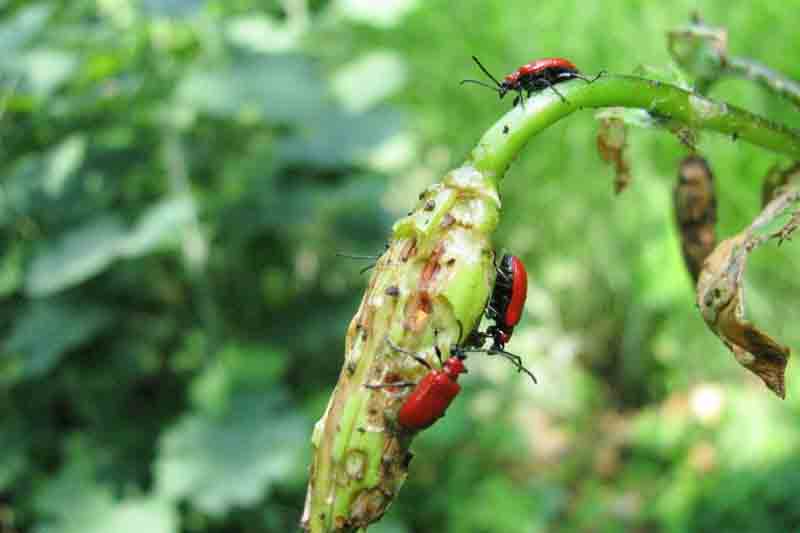
Main damage: Adults and larvae feed on foliage, stems, buds, flowers, and sometimes seed pods. Heavy infestations may cause near-complete defoliation.
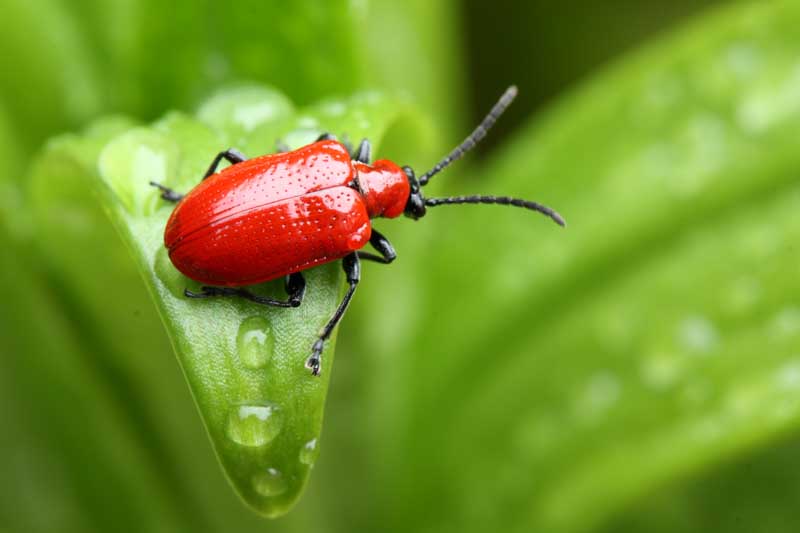
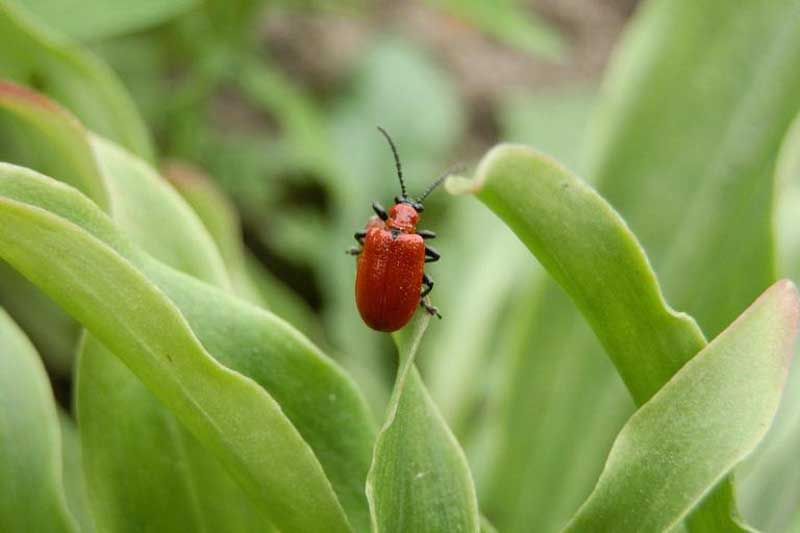
Adults: Brilliant scarlet-red beetles with black heads, antennae, legs, and undersides.
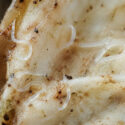
Larvae: Reddish-brown grubs concealed beneath a moist, dark coating of their own excrement.
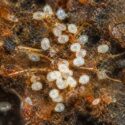
Eggs: Elongated orange to reddish-orange eggs laid in small groups or irregular rows, usually on leaf undersides.
Life cycle: Adults overwinter and emerge in spring. Larvae develop on host plants before entering the soil to pupate. One generation normally develops each year.
Best control: Find infestations early, physically remove beetles, eggs, and larvae, conserve beneficial insects, and use pesticides only when necessary and appropriately labeled.
Quick answer: Lily beetle (Lilioceris lilii) is a bright scarlet leaf beetle that attacks true lilies and fritillaries. Both adults and feces-covered larvae feed on plants, and heavy populations can cause severe defoliation. Early detection is the key to preventing serious damage.
The lily beetle belongs to the leaf beetle family Chrysomelidae. Native to Eurasia, it is now an important ornamental pest across much of Britain and in parts of North America. Adult beetles can fly and readily locate suitable host plants, including newly planted lilies.
True lilies and fritillaries are especially vulnerable because they support the beetle’s complete life cycle. Adults may occasionally feed on other herbaceous plants, but occasional feeding does not mean those plants can support egg laying and larval development.
This distinction matters because many unrelated plants include “lily” in their common names. Daylilies (Hemerocallis), for example, are not true lilies and are not reproductive hosts for lily beetle.
The adult, eggs, and larvae look completely different, so knowing all three stages makes identification much easier.
Turn the leaves over. Orange-red eggs and dark, wet-looking fecal masses on leaf undersides may reveal an infestation even when no adult beetles are visible.
Early feeding often appears as irregular holes, notches, or scraped patches in the leaves. Adult beetles chew foliage directly, while young larvae frequently begin feeding from the underside. As larvae grow, they consume larger portions of the leaf and may move onto stems, flower buds, flowers, and developing seed pods.
Heavy populations can strip lilies almost completely, leaving little more than stems. Although the underground bulb may survive, losing large amounts of foliage early in the growing season reduces photosynthesis and limits the plant’s ability to replenish its stored energy.
A severely defoliated lily may therefore produce weaker growth or fewer flowers the following year. By contrast, a vigorous plant usually tolerates a small amount of late-season feeding without serious long-term consequences.
A few holes are usually cosmetic. Extensive defoliation while the lily is actively growing is much more important. Preserving healthy foliage helps the bulb rebuild its energy reserves for the following season.
Lily beetles normally complete one generation per year, although several life stages may be visible during the same growing season.
Because adults may overwinter some distance from their previous hosts, digging or treating only the soil immediately beneath an infested lily is unlikely to eliminate the problem.
The most important hosts are true lilies (Lilium). Asiatic lilies, Oriental lilies, trumpet lilies, martagon lilies, species lilies, and many other hybrids may all be attacked.
Fritillaries (Fritillaria) are also reproductive hosts. Giant lilies (Cardiocrinum) may suffer feeding damage as well.
Adult beetles have been recorded nibbling other herbaceous plants, but this should not be confused with the much narrower range of plants on which the beetle can reproduce successfully.
Daylilies (Hemerocallis) are not true lilies. The beetle’s association with Lilium does not mean every plant with “lily” in its common name is equally susceptible.
Start looking for beetles when the first lily shoots emerge. The most useful time to intervene is before a small number of overwintered adults has produced a much larger population of feeding larvae.
Adult beetles have an effective escape trick. When disturbed, they frequently drop from the plant and may land upside down. Their black underside blends remarkably well with soil, mulch, and shadows, making the brilliant red beetle suddenly difficult to locate. Holding a container beneath the plant while inspecting it can help catch falling adults.
Small populations are much easier to manage than heavily infested plants. Finding adults and eggs early can prevent the large numbers of larvae responsible for the most conspicuous damage.
Adult lily beetles can fly into gardens, so complete prevention is unrealistic. These simple practices can nevertheless reduce the likelihood of a population building unnoticed:
Lily beetles are attacked by natural enemies, although general predators alone rarely provide reliable control. More important in some regions are specialized parasitoid wasps whose immature stages develop within lily beetle larvae.
Species studied or used in biological control programs include Tetrastichus setifer and Lemophagus errabundus. These tiny parasitoids can suppress lily beetle populations by preventing parasitized larvae from completing normal development.
Parasitoids have become established in some regions, particularly where biological control programs have been conducted, but their distribution is uneven. Gardeners should therefore not assume they are present everywhere the beetle occurs.
This is another reason to avoid unnecessary broad-spectrum insecticides. Such treatments may kill beneficial predators and parasitoids along with the lily beetles they are intended to control.
For a small or moderate planting, physical removal is often preferable to routine spraying. Insecticides may become an option when beetle numbers are too high to manage by hand and plants are at risk of substantial defoliation.
If treatment is necessary, check whether a product is currently registered or labeled for lily beetle, ornamental lilies, and the intended use in your region. Product registrations and approved uses differ between countries and may change over time.
Using an insecticide without addressing a growing population through inspection and monitoring is unlikely to provide a durable management strategy. Integrated control combines early detection, physical removal, conservation of beneficial insects, and chemical treatment only when warranted.
Controlled research indicates that lilies can differ in their susceptibility to lily beetle feeding. RHS trials comparing selected lilies found differences in damage, including lower susceptibility in Lilium regale than in the hybrid lilies included in that particular study.
Lower susceptibility is not the same as resistance. Lilium regale can still be attacked, and results from one comparative trial cannot predict exactly how a lily will perform in every garden. Beetle abundance, climate, available host plants, plant health, and cultivar can all affect feeding pressure.
Where lily beetles are a persistent problem, choosing lilies that appear less attractive to the pest may form one part of an integrated approach, but no commonly grown lily should simply be assumed to be beetle-proof.
Lily beetles can cause serious damage, but they are much easier to manage before populations build. Learn to recognize the scarlet adults, orange-red eggs, and feces-covered larvae, check susceptible lilies during the growing season, and act before extensive defoliation develops.
The lily beetle, Lilioceris lilii, is a bright scarlet leaf beetle whose adults and larvae feed mainly on true lilies and fritillaries. Heavy populations can severely defoliate plants.
Adult lily beetles are about 6-8 mm long with brilliant scarlet-red wing cases and thorax. Their head, antennae, legs, and underside are black.
Lily beetle larvae are reddish-brown grubs with dark heads, but they are usually concealed beneath a moist brown-black covering of their own excrement.
Lily beetles reproduce primarily on true lilies in the genus Lilium and fritillaries in the genus Fritillaria. Giant lilies may also be damaged, while adults occasionally feed on other plants.
Daylilies belong to the genus Hemerocallis and are not true lilies. They are not reproductive hosts for lily beetle, which develops primarily on Lilium and Fritillaria.
Hand-pick adult beetles, remove orange-red egg masses, and destroy larvae before severe feeding develops. Regular inspection is especially useful when lily shoots first emerge and during larval development.
Adult lily beetles overwinter in soil, leaf litter, and other sheltered locations, often away from their host plants. They become active again as conditions warm in spring.
Yes. Healthy lilies can tolerate modest feeding, but severe early defoliation may weaken bulbs and reduce flowering the following year because less foliage remains to replenish energy reserves.
Updated: August 2026 – Reviewed by Gardenia Editors
Create a membership account to save your garden designs and to view them on any device.
Becoming a contributing member of Gardenia is easy and can be done in just a few minutes. If you provide us with your name, email address and the payment of a modest $25 annual membership fee, you will become a full member, enabling you to design and save up to 25 of your garden design ideas.
Join now and start creating your dream garden!
Create a membership account to save your garden designs and to view them on any device.
Becoming a contributing member of Gardenia is easy and can be done in just a few minutes. If you provide us with your name, email address and the payment of a modest $25 annual membership fee, you will become a full member, enabling you to design and save up to 25 of your garden design ideas.
Join now and start creating your dream garden!