Angular brown patches that stop at leaf veins may reveal a hidden foliar nematode infestation. Discover how these microscopic pests damage hostas, peonies, chrysanthemums, hydrangeas, and other plants. Learn the defining symptoms, common lookalikes, host range, life cycle, spread, treatment limitations, sanitation measures, and most effective prevention strategies.
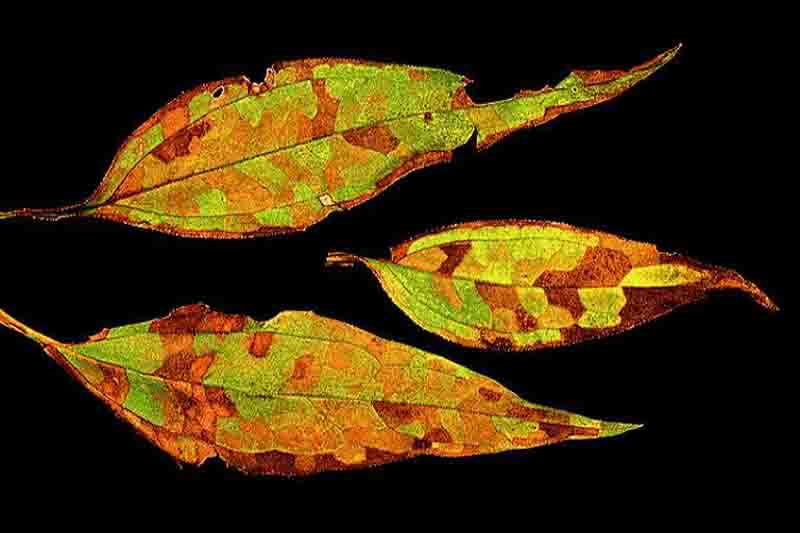


Angular brown patches that stop abruptly at leaf veins can resemble fungal leaf spot, bacterial disease, sun scorch, or ordinary late-season decline. But when the damage repeatedly follows the vein pattern, the hidden culprit may be foliar nematodes – microscopic plant-parasitic roundworms that live and feed inside leaves, buds, growing points, stems, and other above-ground tissues.
Foliar nematodes are also called leaf and bud nematodes, leaf and bud eelworms, or, on chrysanthemums, chrysanthemum eelworms. The principal species associated with ornamental plants include Aphelenchoides fragariae and Aphelenchoides ritzemabosi. Aphelenchoides besseyi is especially important on certain crops but has also been reported from ornamental plants.
These pests are difficult to manage because they are almost impossible to see without magnification, remain protected inside plant tissue, and move across wet foliage in films of water. They may survive in dormant buds, growing points, plant terminals, and dead infested leaves after visible symptoms disappear. Cuttings, seedlings, divisions, and nursery plants can also carry foliar nematodes before obvious damage develops.
Scientific names: Primarily Aphelenchoides fragariae, Aphelenchoides ritzemabosi, and Aphelenchoides besseyi.
Common names: Foliar nematodes, leaf and bud nematodes, leaf and bud eelworms, chrysanthemum eelworms.
Main damage: Microscopic nematodes feed inside leaves, buds, growing points, stems, and occasionally flowers, causing vein-bounded leaf lesions, distorted growth, damaged buds, poor flowering, premature leaf death, and loss of ornamental quality.
Key symptoms: Yellow, tan, brown, reddish, purplish, or nearly black patches limited by major veins; streaks on parallel-veined leaves; distorted new growth; shortened shoots; injured buds; stunting; and reduced flowering.
Important host plants: hostas, chrysanthemums, peonies, phlox, hydrangeas, ferns, begonias, African violets, anemones, lilies, strawberries, and many greenhouse and nursery ornamentals.
Favored conditions: Prolonged leaf wetness, overhead irrigation, splashing rain, persistent dew, high humidity, crowded plants, infected propagation material, and infested dead foliage.
First action: Isolate or mark suspect plants, stop overhead watering, avoid handling them while wet, and seek laboratory confirmation when valuable plants or collections are involved.
Best control strategy: Use clean planting stock, keep foliage dry, remove severely infested plants and debris, prevent water-assisted spread, clean propagation equipment, and never distribute divisions or cuttings from affected plants.
Snippet-ready answer: Foliar nematodes are microscopic Aphelenchoides species that feed inside leaves, buds, and growing points. They often cause yellow or brown angular patches that stop at major leaf veins, along with distorted growth, bud injury, and reduced flowering. Management depends on clean plants, sanitation, dry foliage, removal of infested material, and prevention of water splash.
Foliar nematodes are tiny, unsegmented roundworms that parasitize above-ground plant tissues. Unlike root-knot nematodes, which attack roots, foliar nematodes spend much of their active life inside leaves, buds, growing points, tender stems, and shoots.
They feed with a slender, needle-like mouthpart called a stylet. The stylet punctures plant cells so the nematode can withdraw their contents. Feeding kills cells and disrupts developing tissue, producing discolored lesions, malformed leaves, damaged buds, shortened shoots, and reduced flowering.
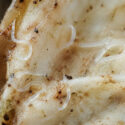
Individual foliar nematodes are approximately 0.4-1.2 mm long. Their narrow, transparent bodies are extremely difficult to see with the naked eye. Confirming an infestation and distinguishing species usually requires microscopic examination or molecular testing by a diagnostic laboratory.
Foliar nematodes are not root-knot nematodes and not stem-and-bulb nematodes. Foliar nematodes mainly damage leaves, buds, and growing points. Root-knot nematodes, or Meloidogyne species, attack roots and commonly produce swollen galls. Stem-and-bulb nematodes, particularly Ditylenchus dipsaci, invade stems, leaves, bulbs, and other fleshy tissues.
The classic sign of foliar nematode damage is an angular or striped leaf lesion bounded by major veins. Nematodes move through moist spaces inside the leaf, but larger veins often restrict their progress. Damaged tissue therefore develops into blocks, wedges, stripes, or sharply defined patches between the veins.
Early lesions may appear water-soaked, pale green, yellow, or unusually dark green. As affected cells die, the patches become tan, reddish brown, chocolate brown, purple, or nearly black, depending on the host plant.
On hostas and other parallel-veined plants, damage often appears as yellow-to-brown streaks or wedges between the veins. The youngest leaves at the center of the clump may initially remain healthy while older foliage becomes progressively discolored.
On plants with branching or netted veins, the lesions usually appear as irregular angular blotches. The restriction imposed by the larger veins is one of the most useful diagnostic clues, although it is not unique to nematode damage.
On peonies, symptoms may begin as water-soaked patches that later become purple and then brown. Infested buds can produce distorted leaves and flowers, shortened stems, and weak growth. Because nematodes may remain hidden in dormant buds and plant terminals, symptoms can return when growth resumes.
Leaf damage that repeatedly stops at major veins deserves closer inspection. Vein-bounded lesions are an important clue, but fungal and bacterial diseases can create similar patterns. Laboratory confirmation is recommended before removing valuable plants or collections.
Foliar nematodes have an exceptionally broad host range. Horticultural references document hundreds of host plants, while broader scientific compilations report more than 700 plant associations worldwide. Not every host report represents the same degree of susceptibility, economic importance, or damage.
The nematode species involved, plant cultivar, climate, moisture, cultivation method, and surrounding host plants all influence whether an infestation becomes serious.
Other hosts include begonias, African violets, anemones, lilies, strawberries, coleus, dahlias, delphiniums, impatiens, irises, orchids, primulas, verbenas, and zinnias.
Some weeds can act as alternative hosts. Cuttings, divisions, seedlings, and nursery plants may also carry foliar nematodes without immediately displaying recognizable symptoms. This makes clean propagation material and careful inspection particularly important.
| Problem | Typical clue |
|---|---|
| Foliar nematodes | Angular or striped lesions commonly restricted by major veins; buds, growing points, and new foliage may also be distorted. |
| Fungal leaf spot | Often circular or irregular spots, sometimes with concentric rings, fuzzy growth, or tiny fungal fruiting structures. |
| Bacterial leaf spot | Water-soaked angular lesions, sometimes accompanied by yellow halos or bacterial ooze. |
| Root-knot nematodes | Swollen galls or knots on roots, with nonspecific stunting, yellowing, or wilting above ground. |
| Stem-and-bulb nematodes | Swollen or distorted stems and leaves, damaged bulbs, or brown internal rings and patches in affected bulbs. |
| Virus disease | Mosaic, mottling, rings, vein clearing, or distorted growth without the characteristic necrotic, vein-bounded lesions. |
Foliar nematodes are identified most reliably through laboratory examination. Angular, vein-bounded lesions are highly suggestive, but symptom overlap is common, particularly with bacterial leaf spots.
Inspect susceptible plants from spring through fall, paying particular attention after prolonged rain, heavy dew, repeated misting, or overhead irrigation.
Frost injury, herbicide damage, nutrient disorders, viruses, fungi, and bacteria can cause overlapping symptoms. A preliminary extraction test sometimes used by diagnosticians involves cutting symptomatic leaves into small pieces and placing them in a shallow dish of clean water.
After several hours, active nematodes may emerge from the cut tissue and appear as tiny moving threads when the water is viewed under strong magnification. Other harmless or fungus-feeding nematodes can also emerge from decaying tissue, however. The presence of a stylet helps distinguish plant-parasitic nematodes, but this feature normally requires microscopic examination.
A negative home test does not rule out an infestation. For valuable plants or a problem spreading through a collection, submit freshly collected symptomatic tissue to a university extension service, plant clinic, or nematology laboratory. Follow the laboratory’s packing and shipping instructions because requirements vary.
Do not destroy a valuable plant collection based only on angular leaf spots. Bacterial disease can closely resemble foliar nematode damage, and accurate diagnosis changes the appropriate management response.
Foliar nematodes hatch from eggs and pass through four juvenile stages before becoming adults. Under favorable conditions, development from egg to adult may take about two weeks, although the exact rate varies with nematode species, temperature, moisture, and host plant.
Females lay eggs inside plant tissue. When foliage remains wet, nematodes can leave infected tissue and travel in a thin film of water over leaves and stems. They enter new leaves mainly through stomata, although some can puncture tender leaf surfaces directly with their stylets.
They do not fly or jump. Their short-distance movement depends heavily on free moisture.
Foliar nematodes are not primarily soil-dwelling plant parasites. They can, however, survive temporarily in moist soil, decomposing organic material, and fungi outside the plant. UC IPM reports that they may persist for several months under these conditions.
Infected living plants, dormant buds, growing points, propagation material, and dead infested foliage are the most important reservoirs. Some foliar nematodes can enter a resistant resting state as leaf tissue slowly dries. In this dehydrated condition, they may survive for years and resume activity when moisture returns.
Inspect plants before dividing or sharing them. A healthy-looking division taken from an affected clump may carry foliar nematodes in buds, growing points, or symptom-free foliage.
Foliar nematodes usually reduce plant vigor and ornamental quality rather than killing established garden plants outright. Hostas, for example, may become badly disfigured but often survive.
Severe or repeated infestations can nevertheless cause extensive leaf loss, damaged growing points, poor flowering, stunting, and progressive decline. Young plants, highly susceptible hosts, greenhouse crops, and intensively propagated nursery stock may suffer more serious damage.
Plants repeatedly deprived of healthy foliage have less capacity to manufacture and store energy. Even if they survive, infested ornamentals may become unsuitable for display, propagation, division, or sale.
There is no dependable curative spray readily available to home gardeners for established foliar nematodes. Because the pests remain protected inside leaves, buds, and growing points, ordinary garden insecticides and fungicides are ineffective.
Specialized nematicides may be registered for certain commercial greenhouse uses, but these products are not general home-garden treatments and must be used only where legally permitted and exactly as directed on the label. For most gardeners, management depends on exclusion, sanitation, moisture control, and removal of heavily infested plants.
Removing only visibly damaged leaves may reduce nematode numbers and slow spread if an infestation is detected early. It will not necessarily eliminate nematodes already present in buds, growing points, terminals, or symptom-free foliage. Repeated defoliation can also weaken the host without eradicating the pest.
Beneficial nematodes do not control foliar nematodes. Entomopathogenic nematodes such as Steinernema attack insects and insect larvae. They are entirely different from plant-parasitic Aphelenchoides species.
Precisely controlled hot-water treatment can reduce foliar nematode populations or disinfest certain cuttings, dormant plants, bulblets, divisions, and propagation materials. It is not a universal treatment, and the correct temperature and exposure time depend on the host species, cultivar, plant tissue, and nematode involved.
UC IPM provides examples of commercial protocols, including short hot-water dips for certain cuttings and lily bulblets, but also documents severe crop injury when treatment time is only slightly extended. Missouri Botanical Garden similarly warns that heat treatment can kill plant crowns and may not provide lasting control where nematodes survive in debris or the surrounding growing environment.
Hot-water treatment should therefore be considered a specialized nursery, research, or professional propagation procedure. Home gardeners should attempt it only when a reliable, plant-specific protocol is available and water temperature and treatment duration can be controlled precisely.
Foliar nematodes can become particularly troublesome in greenhouses, propagation areas, and indoor plant collections because plants are closely spaced, humidity remains high, and foliage may be regularly misted. African violets, begonias, gloxinias, ferns, orchids, and other foliage plants can carry hidden infestations.
Keep valuable new acquisitions separate from an established collection and inspect their developing foliage for several weeks. Because cuttings, seedlings, and nursery stock may remain symptom-free temporarily, quarantine can reduce the risk of introducing foliar nematodes throughout a collection.
In garden beds, concentrate on preventing water-assisted movement and removing the living and dead plant material in which nematodes persist.
Because foliar nematodes can use many ornamental plants and some weeds as hosts, replacing an affected plant with another susceptible species may allow the problem to continue. Choose replacement plants cautiously, inspect surrounding vegetation, and monitor the bed for recurring symptoms.
Foliar nematodes are much easier to exclude than to eradicate. Careful purchasing, quarantine, moisture management, sanitation, and propagation practices provide the most reliable protection.
A foliar nematode infestation rarely announces itself through one dramatic symptom. It usually appears as an expanding pattern of vein-bounded leaf damage, distorted growth, failing buds, and declining ornamental quality. Recognizing the characteristic pattern – and acting before wet foliage carries the pest farther – gives gardeners their best chance of containing the problem.
Watch for angular or striped leaf damage that stops at major veins. Once foliar nematodes are established, successful management depends on accurate diagnosis, removal of severely infested material, dry foliage, sanitation, and protection of healthy plants from infected nursery stock and propagation material.
Foliar nematodes are microscopic plant-parasitic roundworms, primarily Aphelenchoides species, that feed inside leaves, buds, growing points, stems, and other above-ground plant tissues.
Typical symptoms include yellow, tan, brown, purple, or black angular lesions bounded by veins, streaks on parallel-veined foliage, distorted new growth, injured buds, reduced flowering, and premature leaf death.
Important hosts include hostas, chrysanthemums, peonies, phlox, hydrangeas, ferns, anemones, begonias, African violets, lilies, orchids, strawberries, and hundreds of other reported hosts.
Foliar nematodes move across wet plant surfaces in films of water. They spread through splashing rain, overhead irrigation, misting, touching wet foliage, infected plants, cuttings, divisions, dormant buds, and infested debris.
Yes. Infected cuttings, seedlings, divisions, buds, growing points, and nursery plants may temporarily appear healthy, allowing foliar nematodes to enter clean gardens or plant collections.
No. Foliar nematodes mainly damage leaves, buds, and growing points. Root-knot nematodes are Meloidogyne species that attack roots and commonly cause swollen galls.
Remove severely infested plants and foliage, stop overhead watering, keep leaves dry, clean propagation equipment, control host weeds, and never share cuttings or divisions from affected plants.
No. Foliar nematodes are microscopic animals, not fungi. Fungicides do not eliminate nematodes protected inside plant tissue, although they may control a separate fungal disease affecting the same plant.
No. Steinernema species are beneficial entomopathogenic nematodes used to attack insects. Plant-parasitic foliar nematodes belong mainly to the genus Aphelenchoides.
They usually reduce vigor and ornamental quality rather than killing established plants outright. Severe infestations can contribute to decline in young plants, highly susceptible hosts, and intensively grown nursery or greenhouse crops.
Do not place confirmed or suspected infested material in a home compost pile. Incomplete composting may allow nematodes to survive in leaves, stems, buds, and other plant debris.
Precisely controlled hot-water treatment can reduce nematode populations in certain propagation materials, but the safe temperature and treatment time vary by plant. Incorrect treatment can severely damage or kill plants.
Updated: August 2026 – Reviewed by Gardenia Editors
Create a membership account to save your garden designs and to view them on any device.
Becoming a contributing member of Gardenia is easy and can be done in just a few minutes. If you provide us with your name, email address and the payment of a modest $25 annual membership fee, you will become a full member, enabling you to design and save up to 25 of your garden design ideas.
Join now and start creating your dream garden!
Create a membership account to save your garden designs and to view them on any device.
Becoming a contributing member of Gardenia is easy and can be done in just a few minutes. If you provide us with your name, email address and the payment of a modest $25 annual membership fee, you will become a full member, enabling you to design and save up to 25 of your garden design ideas.
Join now and start creating your dream garden!