Hound's Tongue Fern, Kangaroo Fern, Kangaroo Paw Fern, Kangaroo Foot Fern, Phymatosorus diversifolius, Lecanopteris pustulata subp. pustulata, Polypodium diversifolium, Polypodium scandens
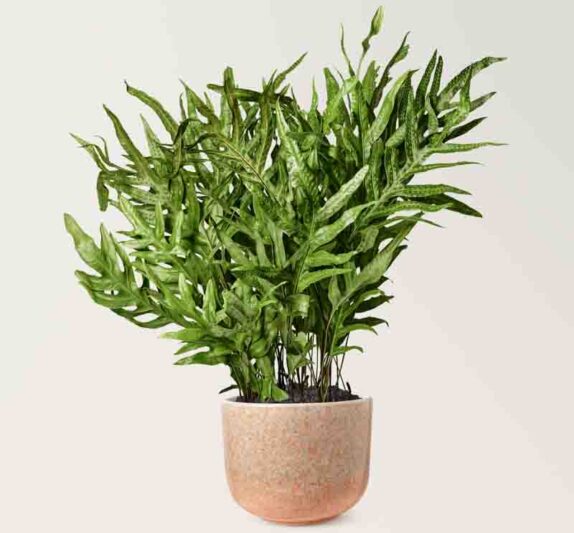


Not all ferns have delicate, feathery foliage. Microsorum diversifolium (Kangaroo Paw Fern) produces glossy, leathery green fronds that may be narrow and undivided or deeply lobed like a kangaroo’s paw. Its unusual leaves give the plant a distinctive, almost tropical sculptural quality.
Look beneath the foliage and you may discover another surprise: thick, creeping rhizomes that travel across the soil and sometimes over the edges of a pot. These are a normal part of the plant, not roots that need burying. With filtered light, an airy potting mix, and sensible watering, Kangaroo Paw Fern makes an attractive houseplant for shelves, hanging baskets, and shaded patios.
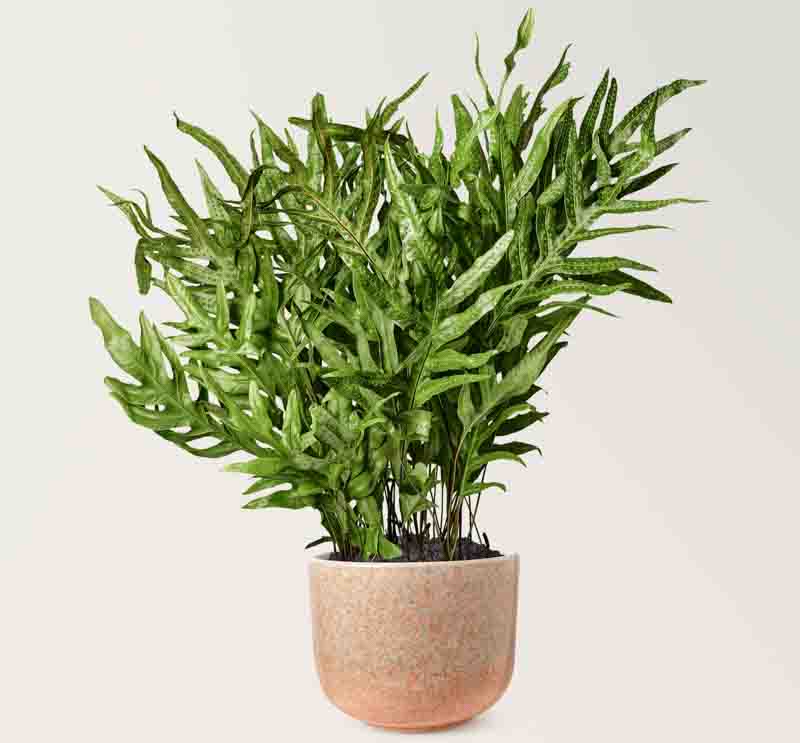
Summary: Evergreen rhizomatous fern with glossy, variably shaped fronds and a spreading habit.
Use: Excellent for indoor containers, hanging baskets, shaded patios, and sheltered woodland gardens.
Highlight: Leathery foliage, creeping rhizomes, and tolerance of occasional dry conditions.
Botanical interest: Produces spores rather than flowers or seeds.
| Botanical Name | Microsorum diversifolium (Willd.) Copel. |
|---|---|
| Accepted Name | Lecanopteris pustulata subsp. pustulata (Kew classification) |
| Family | Polypodiaceae |
| Common Names | Kangaroo Paw Fern, Kangaroo Fern, Kangaroo Foot Fern, Hound’s Tongue Fern |
| Native Range | Eastern and southeastern Australia, Norfolk Island, and New Zealand |
| Plant Type and Habit | Evergreen, creeping, rhizomatous fern; terrestrial, epiphytic, or growing on rocks |
| Hardiness | USDA Zones 9-11 outdoors; protect plants from frost, particularly in Zone 9 |
| Size | Typically 6-12 in. tall (15-30 cm), spreading 3-4 ft. (90-120 cm); individual fronds may reach 1-2 ft. (30-60 cm) |
| Exposure | Bright indirect light indoors; partial to full shade outdoors |
| Soil | Organic-rich, airy, moist but well-drained growing medium; acidic to neutral pH |
| Foliage | Glossy, leathery green fronds with entire, wavy, or irregularly lobed margins |
| Flowers | None; reproduces through spores produced in sori |
Kangaroo Paw Fern belongs to the Polypodiaceae family and originates from Australia, Norfolk Island, and New Zealand. In the wild, it grows on forest floors, rocks, banks, and tree trunks. Kew now treats Microsorum diversifolium as a synonym of Lecanopteris pustulata subsp. pustulata, although the older name remains widely used in horticulture.
Instead of forming a single upright crown, the fern spreads through long, creeping rhizomes. These fleshy stems produce roots and fronds as they travel, gradually creating a low, broad mound. Mature plants may spread several feet, making shallow, wide containers particularly useful.
The bright green fronds are thick, glossy, and remarkably variable. Some remain narrow and undivided; others develop irregular lobes that resemble the outline of a paw. Both types may appear on the same plant. Mature fronds can reach 1-2 ft. long (30-60 cm).
Like other true ferns, Kangaroo Paw Fern never produces flowers or seeds. Instead, fertile fronds develop clusters of spore-producing structures, called sori, on their undersides. These become visible as brown markings when mature.
NCSU lists USDA Zones 9-11 for outdoor cultivation. In cooler parts of Zone 9, choose a sheltered position and protect plants during frost. For reliable year-round growth in colder climates, grow Kangaroo Paw Fern indoors. Its foliage remains evergreen under suitable conditions.
In its native habitats, the fern contributes to vegetation on rocks, trees, and shaded forest floors. Species-specific wildlife relationships are not well documented. Indoor plants are primarily ornamental.
Reliable species-specific browsing data are limited. Outdoor plants should not be assumed to be deer- or rabbit-resistant.
Kangaroo Paw Fern tolerates occasional dry conditions better than many delicate indoor ferns, helped by its thick, leathery fronds and fleshy rhizomes. However, it grows best with moderate, consistent moisture. Repeatedly allowing the potting mix to dry completely can cause brown tips and declining foliage.
Kangaroo Paw Fern is not commonly identified as a poisonous houseplant, but comprehensive species-specific toxicity information for cats, dogs, and humans is limited. Avoid describing it as definitively pet-safe or edible without stronger evidence.
The fern can spread by creeping rhizomes under favorable conditions, but it is not widely documented as an invasive ornamental. For outdoor planting, check regional guidance, particularly near sensitive natural habitats.
Both ferns have glossy, undivided-looking green foliage, but their growth habits differ. Kangaroo Paw Fern spreads horizontally through creeping rhizomes and produces fronds of varying shapes. Asplenium nidus (Bird’s Nest Fern) develops a central rosette of broad, strap-shaped fronds.
Choose Kangaroo Paw Fern for a low, spreading display. Bird’s Nest Fern is better suited to an upright, vase-shaped specimen.
Provide bright, indirect light indoors or partial shade outdoors. An east-facing window often works well. Avoid strong midday sunlight, which can scorch the foliage. Very dim conditions may produce sparse, slow growth.
Use an airy potting mix containing organic material, perlite, and fine orchid bark. Water when the surface begins to dry, allowing excess water to drain away. In larger pots, check moisture beneath the surface before watering again.
Temperatures around 60-75°F (16-24°C) are suitable. Humidity near 50% is beneficial, although established plants often adapt to ordinary household conditions. In particularly dry rooms, a humidifier provides more consistent moisture in the air than occasional misting.
The thick, fuzzy-looking stems creeping across the soil are rhizomes, not exposed roots that need covering. Keep them at or near the surface when repotting. Deep burial in wet compost can encourage decay.
Choose a shallow or broad container with drainage holes. Repot when rhizomes become crowded or the growing medium deteriorates, preferably during active growth. Avoid unnecessarily deep pots that hold excess moisture below the root zone.
Remove dead or badly damaged fronds close to their bases. Leave healthy creeping rhizomes intact, even when they extend beyond the pot. Feed lightly with a diluted balanced fertilizer during spring and summer.
Division is the easiest method. Separate a healthy rhizome section with attached roots and fronds, then position it near the surface of moist, well-drained growing medium. Keep warm and humid while it establishes. Growing from spores is possible but considerably slower.
Brown fronds do not always mean the plant needs more water. Examine the soil, rhizomes, and leaf undersides before deciding what to change.
| What You See | Possible Cause | Check First |
|---|---|---|
| Brown, crispy tips | Dry soil or low humidity | Root-zone moisture and humidity |
| Yellow fronds, wet soil | Overwatering or root stress | Drainage and root condition |
| Pale, scorched patches | Excessive direct sunlight | Window or outdoor sun exposure |
| Soft, dark rhizomes | Possible rhizome decay | Soil saturation and planting depth |
| Fine webbing or stippling | Spider mites | Frond undersides |
| Regular brown spots underneath | Normal spore-producing sori | Pattern and condition of the frond |
Mealybugs and scale insects can also occur. Isolate infested plants and use appropriately labeled treatments when necessary.
Regular brown clusters beneath otherwise healthy fronds: Usually normal spore-producing sori. No treatment is needed.
Raised bumps that can be lifted from the frond: Inspect for scale insects, particularly if nearby foliage is sticky or yellowing.
Irregular brown patches in the leaf tissue: Investigate sun exposure, watering problems, or disease rather than assuming they are spores.
Firm rhizomes in dry compost suggest a different problem from soft, darkened rhizomes in saturated soil. A plant suffering from root or rhizome decay may wilt even when the pot is wet. Diagnose the cause before adding more water.
Pair Kangaroo Paw Fern with other ferns that enjoy filtered light, acidic to neutral growing media, and reliable drainage. Keep indoor companions in separate pots to accommodate different moisture preferences.
Place Kangaroo Paw Fern in a broad container at the front, Kimberley Queen Fern behind it for height, and Hen and Chickens Fern between them for delicate texture. Their contrasting shapes create interest without flowers. In outdoor plantings, check frost exposure and allow enough space for each fern’s mature spread.
Yes. Kew treats Microsorum diversifolium as a synonym of Lecanopteris pustulata subsp. pustulata. Microsorum diversifolium remains common in horticulture.
Water when the surface of the growing medium begins to dry. Maintain moderate moisture and good drainage, reducing watering when growth slows.
Regular brown clusters are usually sori containing spore-producing structures. They are normal. Raised insects, sticky residue, or irregular leaf damage require further inspection.
It tolerates occasional dry conditions better than many delicate ferns, but performs best with moderate, consistent moisture. Repeatedly drying the entire pot can damage its fronds.
Divide healthy creeping rhizomes into sections with roots and fronds. Position each section near the surface of moist, well-drained growing medium and keep warm until established.
Royal Botanic Gardens, Kew – Microsorum diversifolium: Botanical Synonymy.
North Carolina State Extension – Kangaroo Paw Fern: Description, Growing Conditions, and Propagation.
Royal Horticultural Society – Microsorum diversifolium.
Updated: October 2026
| Hardiness |
9 - 11 |
|---|---|
| Plant Type | Houseplants, Ferns |
| Plant Family | Polypodiaceae |
| Exposure | Partial Sun, Shade |
| Season of Interest | Spring (Early, Mid, Late), Summer (Early, Mid, Late), Fall, Winter |
| Height | 6" - 1' (15cm - 30cm) |
| Spread | 3' - 4' (90cm - 120cm) |
| Spacing | 36" - 48" (90cm - 120cm) |
| Maintenance | Low |
| Water Needs | Average |
| Soil Type | Loam, Sand |
| Soil pH | Acid, Neutral |
| Soil Drainage | Moist but Well-Drained, Well-Drained |
| Characteristics | Showy, Evergreen |
| Native Plants | Australia |
| Tolerances | Full Shade, Drought, Humidity |
| Garden Uses | Beds And Borders, Hanging Baskets, Patio And Containers |
| Garden Styles | Woodland Garden |
| Toxic to Humans | No known toxicity |
| Toxic to Cats | No known toxicity |
| Toxic to Dogs | No known toxicity |
| Toxic to Horses | No known toxicity |


| Hardiness |
9 - 11 |
|---|---|
| Plant Type | Houseplants, Ferns |
| Plant Family | Polypodiaceae |
| Exposure | Partial Sun, Shade |
| Season of Interest | Spring (Early, Mid, Late), Summer (Early, Mid, Late), Fall, Winter |
| Height | 6" - 1' (15cm - 30cm) |
| Spread | 3' - 4' (90cm - 120cm) |
| Spacing | 36" - 48" (90cm - 120cm) |
| Maintenance | Low |
| Water Needs | Average |
| Soil Type | Loam, Sand |
| Soil pH | Acid, Neutral |
| Soil Drainage | Moist but Well-Drained, Well-Drained |
| Characteristics | Showy, Evergreen |
| Native Plants | Australia |
| Tolerances | Full Shade, Drought, Humidity |
| Garden Uses | Beds And Borders, Hanging Baskets, Patio And Containers |
| Garden Styles | Woodland Garden |
| Toxic to Humans | No known toxicity |
| Toxic to Cats | No known toxicity |
| Toxic to Dogs | No known toxicity |
| Toxic to Horses | No known toxicity |
How many Microsorum diversifolium (Kangaroo Paw Fern) do I need for my garden?
| Plant | Quantity | |
|---|---|---|
| Microsorum diversifolium (Kangaroo Paw Fern) | N/A | Buy Plants |
Create a membership account to save your garden designs and to view them on any device.
Becoming a contributing member of Gardenia is easy and can be done in just a few minutes. If you provide us with your name, email address and the payment of a modest $25 annual membership fee, you will become a full member, enabling you to design and save up to 25 of your garden design ideas.
Join now and start creating your dream garden!