A pollinator-friendly perennial border that peaks in late spring to early summer. Verbascum adds tall spires, Salvia nemerosa 'Caradonna' repeats purple spikes, iris anchors the design, Aquilegia 'Blue Barlow' softens with ruffles, Camassia brings blue stars, and Geum pops orange along the front.
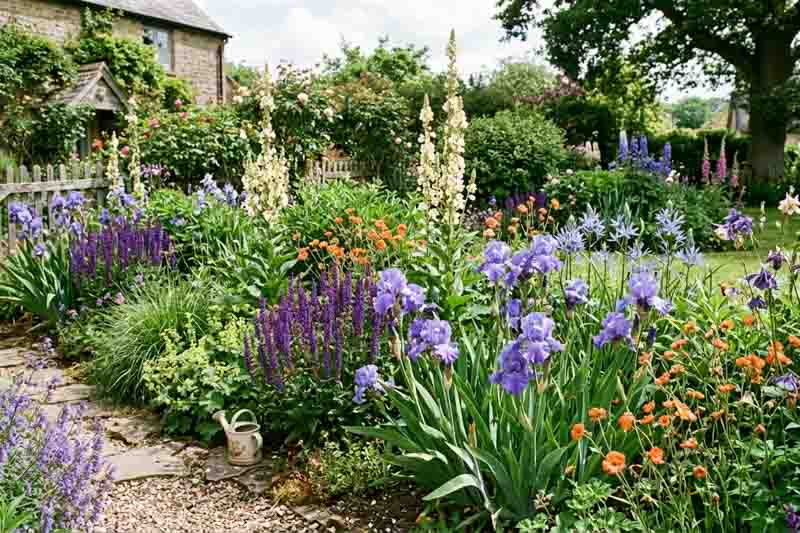


This late-spring border is full, colorful, and strongly vertical. Purple Salvia forms repeated groups through the planting, while tall pale Verbascum rises above it. Large blue-violet Iris flowers stand out in the middle and foreground, and orange Geum adds warmer color between the cooler blues and purples. Camassia and Aquilegia contribute additional blue tones and a lighter texture among the denser clumps.
The border feels informal because the plants overlap and appear at different depths rather than being arranged in neat rows. At the same time, there is enough repetition to keep the planting coherent. Purple, blue, pale cream, and orange recur throughout, so the garden feels varied without becoming confused.
Main plants used: Salvia nemorosa ‘Caradonna’, Verbascum, Iris, Geum, Aquilegia ‘Blue Barlow’, and Camassia leichtlinii
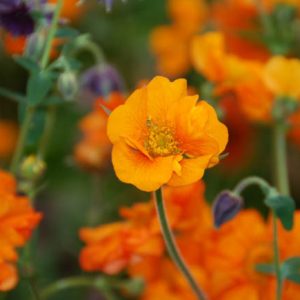
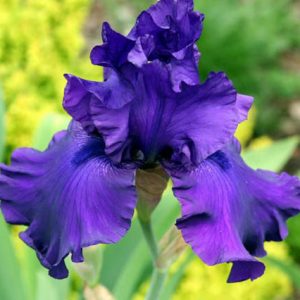
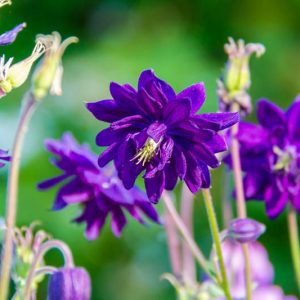
The strongest feature is the contrast in flower shape. Salvia forms narrow upright spikes, Verbascum produces much taller flower stems, Iris has large sculptural blooms, and Geum carries smaller open flowers on slender stems. Aquilegia and Camassia add still more variation without introducing a completely different color story.
The cool colors dominate, but the orange Geum prevents the planting from becoming too uniform. Because the warm color appears in smaller groups, it brightens the border without taking over.
The planting also benefits from unequal heights. Some flowers sit low and close to the foliage, while others rise well above the main body of the border. That change in scale gives the garden depth and keeps the dense planting from looking flat.
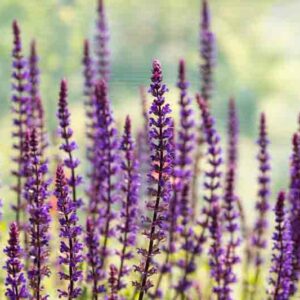
Salvia nemorosa ‘Caradonna’ provides much of the repeated purple color. It works best in several noticeable groups rather than as isolated plants. Repetition helps carry the eye through the border and gives the cooler palette some continuity.
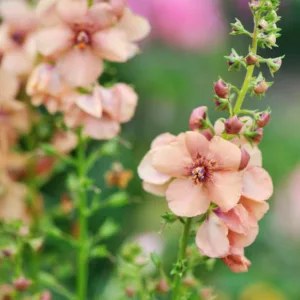
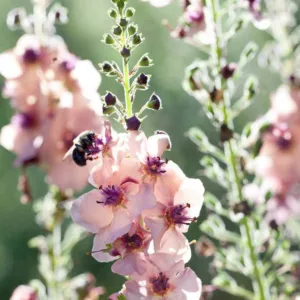
Verbascum supplies the tallest flower spikes. Use it sparingly and place individual plants or small groups at different depths. Too many in a straight line can make the border feel formal.
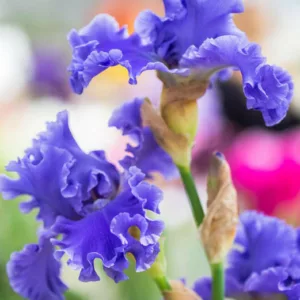
Iris adds large, clearly defined flowers and strong foliage. Position clumps where the blooms can be seen without being hidden by taller neighboring plants.
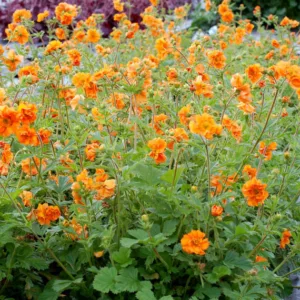
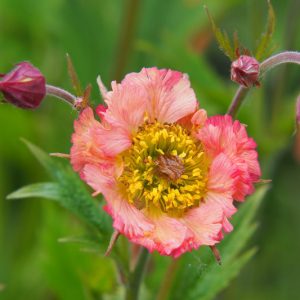
Geum brings the main warm accent. Small groups of orange flowers are enough to break up the blues and purples and give the planting more energy.
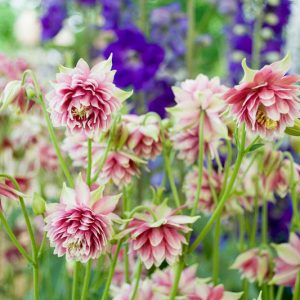
Aquilegia ‘Blue Barlow’ contributes finer foliage and smaller flowers. It works well between denser clumps, where it can soften transitions and fill temporary gaps.
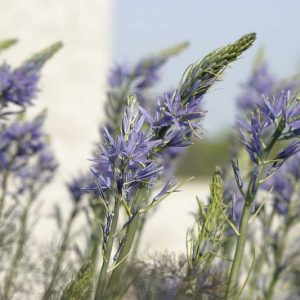
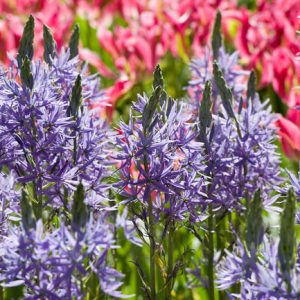
Camassia leichtlinii adds cool blue flower spikes and fits naturally among the Salvia and Iris. Plant the bulbs in groups rather than one at a time so the flowers read clearly when they appear.
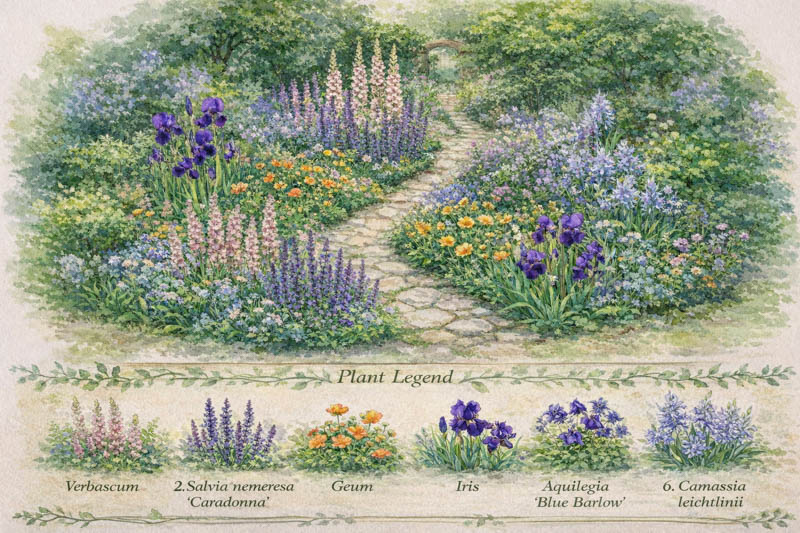
Create a late-spring border with repeated purple and blue flowers, a few taller vertical accents, and enough orange to warm the palette.
Use these proportions as a guide rather than a fixed formula. The effect depends more on repetition and mature plant size than on exact percentages.
Repeat Salvia through the middle and front so the purple color appears in several places.
Place Verbascum at different depths rather than only at the back.
Use Iris in clear clumps where its larger flowers can be seen, and place Geum nearby in smaller groups for warm contrast.
Allow Aquilegia to fill gaps between larger perennials, and plant Camassia in loose bulb groups rather than evenly spaced rows.
This border will be at its richest in late spring and early summer, so it is worth pairing it with later-flowering plants elsewhere in the garden if you want equally strong color through midsummer and fall.
It does not need to be perfectly tidy. A few self-sown Aquilegia, slightly uneven Salvia groups, and Verbascum appearing at different heights can make the planting feel more established. Keep the main colors repeated, but allow some variation in where individual plants settle.
| Hardiness |
5 - 8 |
|---|---|
| Heat Zones |
5 - 8 |
| Climate Zones | 2, 2A, 2B, 3, 3A, 3B, 4, 5, 6, 7, 8, 9, 14, 15, 16, 17 |
| Exposure | Full Sun, Partial Sun |
| Season of Interest | Spring (Late), Summer (Early) |
| Maintenance | Low |
| Water Needs | Average |
| Soil Type | Loam, Sand |
| Soil pH | Neutral |
| Soil Drainage | Well-Drained |
| Characteristics | Showy, Cut Flowers, Dried Arrangements |
| Attracts | Bees, Butterflies, Hummingbirds |
| Landscaping Ideas | Beds And Borders |
| Garden Styles | Butterfly Garden, Informal and Cottage, Pollinator Garden |


| Hardiness |
5 - 8 |
|---|---|
| Heat Zones |
5 - 8 |
| Climate Zones | 2, 2A, 2B, 3, 3A, 3B, 4, 5, 6, 7, 8, 9, 14, 15, 16, 17 |
| Exposure | Full Sun, Partial Sun |
| Season of Interest | Spring (Late), Summer (Early) |
| Maintenance | Low |
| Water Needs | Average |
| Soil Type | Loam, Sand |
| Soil pH | Neutral |
| Soil Drainage | Well-Drained |
| Characteristics | Showy, Cut Flowers, Dried Arrangements |
| Attracts | Bees, Butterflies, Hummingbirds |
| Landscaping Ideas | Beds And Borders |
| Garden Styles | Butterfly Garden, Informal and Cottage, Pollinator Garden |
Recreate this garden. Specify the percentages you would like to have of each plant and input the dimensions of your garden space.We'll give you a shopping list so you know how many plants you need.
| Plant | Quantity | |
|---|---|---|
| Verbascum 'Southern Charm' (Mullein) | N/A | Buy Plants |
| Salvia nemorosa 'Caradonna' (Woodland Sage) | N/A | Buy Plants |
| Camassia leichtlinii 'Blue Danube' (Camas) | N/A | Buy Plants |
| Geum 'Prinses Juliana' (Avens) | N/A | Buy Plants |
| Iris 'Blueberry Bliss' (Bearded Iris) | N/A | Buy Plants |
| Aquilegia vulgaris var. stellata 'Blue Barlow' (Columbine) | N/A | Buy Plants |
Create a membership account to save your garden designs and to view them on any device.
Becoming a contributing member of Gardenia is easy and can be done in just a few minutes. If you provide us with your name, email address and the payment of a modest $25 annual membership fee, you will become a full member, enabling you to design and save up to 25 of your garden design ideas.
Join now and start creating your dream garden!
Create a membership account to save your garden designs and to view them on any device.
Becoming a contributing member of Gardenia is easy and can be done in just a few minutes. If you provide us with your name, email address and the payment of a modest $25 annual membership fee, you will become a full member, enabling you to design and save up to 25 of your garden design ideas.
Join now and start creating your dream garden!