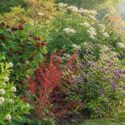
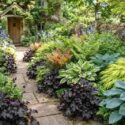
This woodland-style shade perennial border layers bold hostas with flowing Hakonechloa macra and a soft Tiarella cordifolia groundcover. Spring brings airy foamflower blooms, followed by Actaea’s tall white spires in late summer to early fall. The result is a cool, lush, low-maintenance garden rich in texture, structure, and calm elegance.
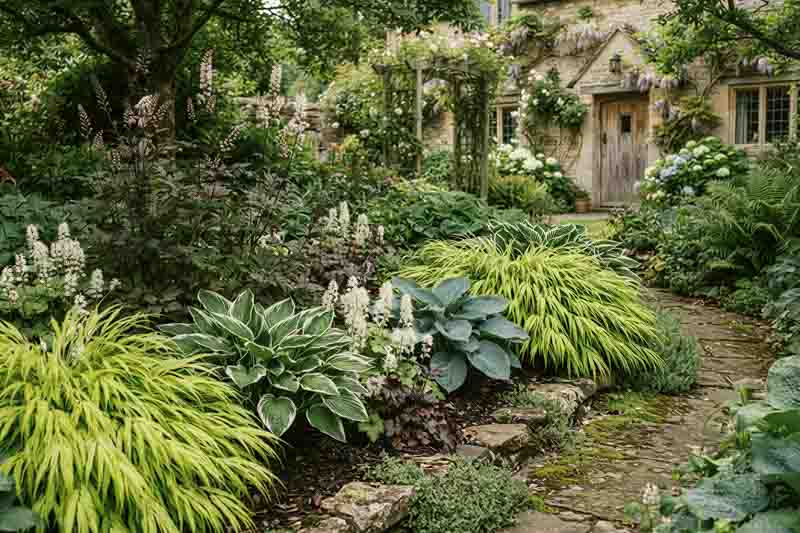


This shade border is built around foliage rather than constant bloom. Broad hosta leaves provide most of the structure, Hakonechloa macra adds a finer, arching texture, Tiarella cordifolia fills the lower layer, and Actaea rises above the planting later in the season with tall white flower spikes.
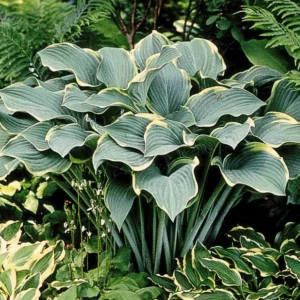
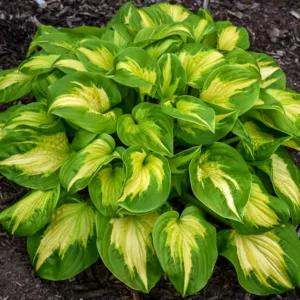
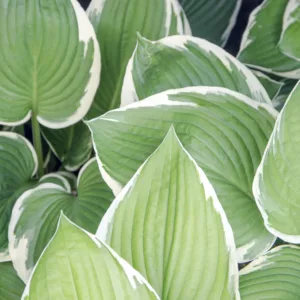
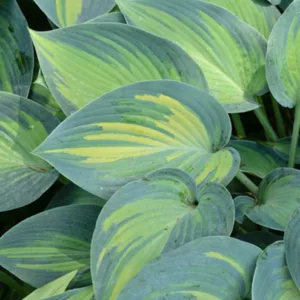
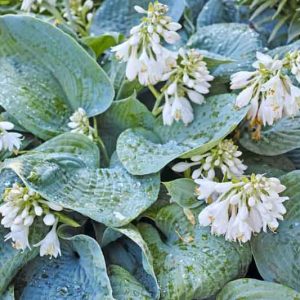
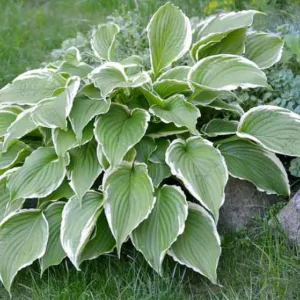
The two hostas bring useful contrast: ‘Francee’ has pale-edged green leaves that brighten darker areas, while ‘Halcyon’ contributes cooler blue-green foliage. Together with the softer movement of Hakonechloa and the lower-growing Tiarella, they create a planting that remains interesting even when few flowers are open.
Main plants used:
Hakonechloa macra (Japanese Forest Grass), Hosta ‘Francee’, Hosta ‘Halcyon’, Tiarella cordifolia (Foamflower), Actaea (Bugbane / Black Cohosh)
Shade borders can look flat when too many plants have similar leaves and heights. This combination avoids that by using distinct forms at several levels. Hostas form substantial middle-sized clumps, Hakonechloa arches outward near the front, Tiarella spreads low between larger plants, and Actaea provides the tallest element.
Repetition keeps the planting coherent. The two hostas differ in color but share a similar habit, while Tiarella and Hakonechloa soften the spaces around them. The result feels layered without needing a large number of different plants.
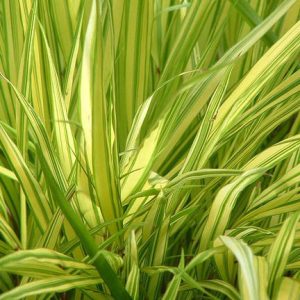
Hakonechloa macra is especially effective toward the front or along paths, where its arching habit can be seen clearly. Give it enough space to form a loose mound rather than squeezing it between larger perennials.
Hosta ‘Francee’ is useful in darker parts of the border because its pale leaf margins catch the light. Repeat it in two or three places rather than relying on a single specimen.
Hosta ‘Halcyon’ brings cooler blue-green foliage and a heavier leaf texture. It performs best with protection from harsh afternoon sun and enough moisture to keep the leaves in good condition through summer.
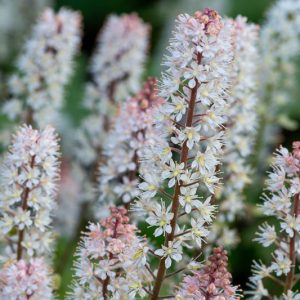
Tiarella cordifolia fills gaps between larger plants and contributes spring flowers on slender stems. Use it in small sweeps rather than as isolated plants, but leave some space around hosta crowns for easier maintenance.
Actaea provides the late-season height. Place it toward the back or rear-middle of the border where its flower stems can rise above the foliage. Avoid planting it in a straight row; slightly offset groups look more natural.

Create a shade border that remains attractive primarily through foliage, with spring and late-season flowers adding shorter periods of extra interest.
These proportions are a guide rather than a rule. In a narrow border, reduce the number of Actaea plants first rather than crowding the rest.
Repeat loose groups rather than alternating plants one by one. Unequal group sizes generally look more relaxed.
Place the hostas first, since they form the largest, most permanent clumps.
Set Actaea toward the back, leaving gaps rather than creating a continuous row.
Use Hakonechloa near the front and along paths, where its arching foliage can soften the edge.
Fill lower spaces with Tiarella, allowing it to spread between larger plants without forming a rigid carpet.
In spring, Tiarella provides the first noticeable flowers while hostas and Hakonechloa are developing fresh foliage. By early summer, foliage becomes the main feature, with the broad hosta leaves contrasting strongly with the finer grass.
Later in the season, Actaea takes over as the principal flowering plant, sending white spikes above the rest of the border. Between these flowering periods, the planting remains attractive because the foliage itself provides enough variation.
Do not overplant simply to make a new border look full. Hostas, Hakonechloa, and Actaea all become larger with age, and some open ground in the first season is preferable to overcrowding later.
The border also does not need to be perfectly symmetrical. Slightly unequal hosta groups, irregular pockets of Hakonechloa, and Actaea appearing at different intervals will usually look more natural than identical spacing throughout.
| Hardiness |
5 - 8 |
|---|---|
| Heat Zones |
5 - 7 |
| Exposure | Partial Sun, Shade |
| Season of Interest | Spring (Late), Summer (Early, Mid, Late), Fall |
| Maintenance | Low |
| Water Needs | Average |
| Soil Type | Clay, Loam |
| Soil pH | Acid, Neutral |
| Soil Drainage | Moist but Well-Drained |
| Characteristics | Showy |
| Attracts | Bees, Butterflies, Birds |
| Landscaping Ideas | Beds And Borders |
| Garden Styles | Informal and Cottage, Woodland Garden |




| Hardiness |
5 - 8 |
|---|---|
| Heat Zones |
5 - 7 |
| Exposure | Partial Sun, Shade |
| Season of Interest | Spring (Late), Summer (Early, Mid, Late), Fall |
| Maintenance | Low |
| Water Needs | Average |
| Soil Type | Clay, Loam |
| Soil pH | Acid, Neutral |
| Soil Drainage | Moist but Well-Drained |
| Characteristics | Showy |
| Attracts | Bees, Butterflies, Birds |
| Landscaping Ideas | Beds And Borders |
| Garden Styles | Informal and Cottage, Woodland Garden |
Recreate this garden. Specify the percentages you would like to have of each plant and input the dimensions of your garden space.We'll give you a shopping list so you know how many plants you need.
| Plant | Quantity | |
|---|---|---|
| Hosta (Tardiana Group) 'Halcyon' (Plantain Lily) | N/A | Buy Plants |
| Hosta 'Francee' (fortunei) (Plantain Lily) | N/A | Buy Plants |
| Hakonechloa macra 'All Gold' (Hakone Grass) | N/A | Buy Plants |
| Tiarella cordifolia (Foam Flower) | N/A | Buy Plants |
| Actaea simplex (Atropurpurea Group) 'Brunette' (Baneberry) | N/A | Buy Plants |
Create a membership account to save your garden designs and to view them on any device.
Becoming a contributing member of Gardenia is easy and can be done in just a few minutes. If you provide us with your name, email address and the payment of a modest $25 annual membership fee, you will become a full member, enabling you to design and save up to 25 of your garden design ideas.
Join now and start creating your dream garden!