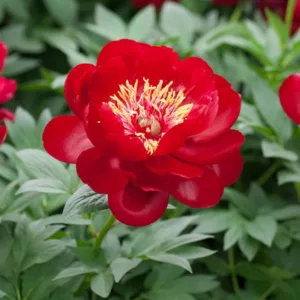
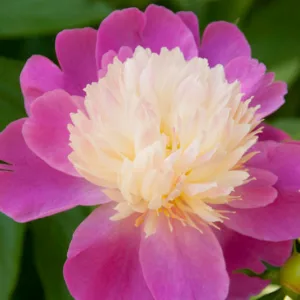
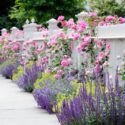
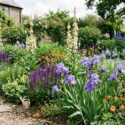
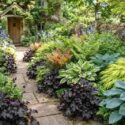
Build a late-spring cottage border with herbaceous peonies (Paeonia lactiflora) ‘Alexander Fleming’ and ‘Duchesse de Nemours’, topped with Allium ‘Purple Sensation’. Alchemilla mollis glows at the front, while Geranium magnificum carries violet-blue bloom into early summer. Big drifts create instant, photo-ready structure.


This late-spring border combines pink and white peonies with purple alliums, lady’s mantle, and hardy geranium. It is a simple plant palette, but the contrast in height, flower shape, and foliage gives the planting plenty of interest without making it feel complicated.
The peonies provide the main display, with large, fragrant flowers held above substantial mounds of foliage. Allium ‘Purple Sensation’ rises through and behind them on much finer stems, so the border gains height without becoming visually heavy. At ground level, Alchemilla mollis and Geranium magnificum fill the spaces between the larger plants and soften the front of the bed.
One of the strengths of this combination is that it does not depend entirely on the peony flowers. Once the peonies have finished blooming, their foliage remains as a green backdrop while the geranium and Alchemilla continue to carry the lower part of the border into early summer.
Use this combination where you want the generous look of a cottage border but still want the planting to feel organized and easy to maintain.
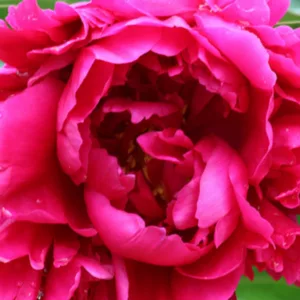
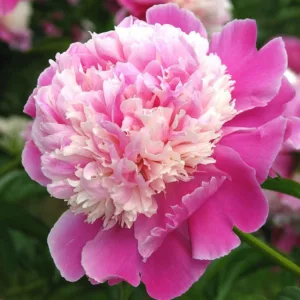
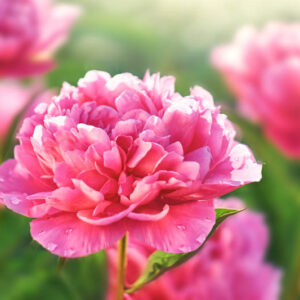
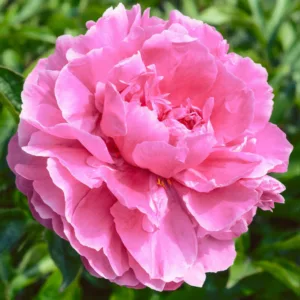
Paeonia lactiflora ‘Alexander Fleming’
This peony supplies the richest pink in the border. Its large, fragrant double flowers are most effective when several plants are grouped together rather than dotted individually through the bed. A group of three or more creates a stronger block of color and gives the planting a more settled appearance.
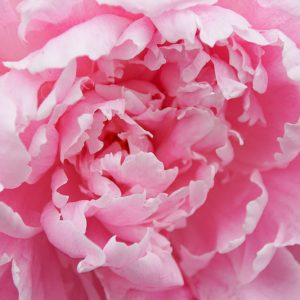
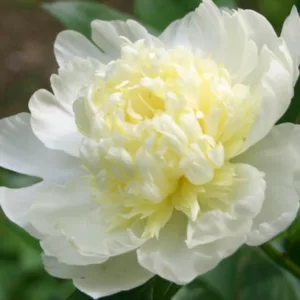
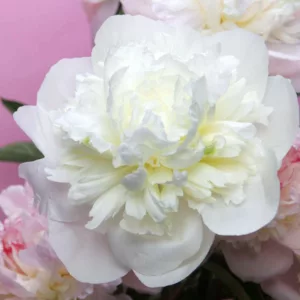
Paeonia lactiflora ‘Duchesse de Nemours’
The white flowers of ‘Duchesse de Nemours’ break up the pink and purple tones and keep the planting from becoming too dense in color. White is especially useful here because it catches the eye without introducing another competing hue. Repeating a few white peonies among the pink groups also gives the border a more natural rhythm.
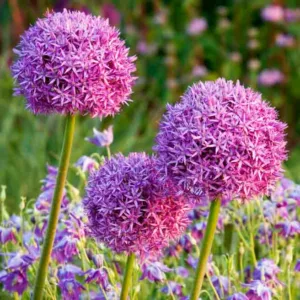
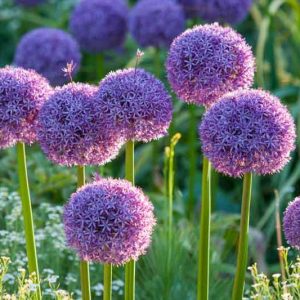
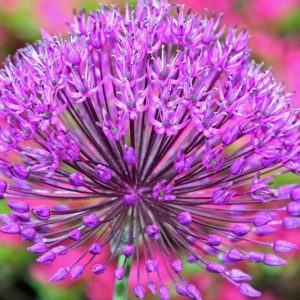
Allium ‘Purple Sensation’
Alliums are useful among peonies because they occupy a completely different layer of the planting. Their narrow stems rise above the heavier peony foliage, carrying rounded purple flower heads well above the main mass of the border. Plant them in loose groups rather than equally spaced rows; slight irregularity looks much more natural.
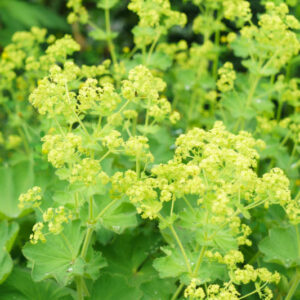
Alchemilla mollis
Lady’s mantle works well at the front of the bed, where its rounded, pleated leaves can spill slightly toward the edge. Its yellow-green flowers are softer than the stronger pinks and purples behind them and help link those colors to the surrounding foliage. After flowering, it can be cut back if the plant begins to look untidy or if you want to limit self-seeding.
Geranium magnificum
This hardy geranium fills the gaps between the larger plants and gives the border a continuous lower layer. Its violet-blue flowers relate naturally to the alliums without repeating them exactly. Just as importantly, the foliage remains useful after the main peony display is over, helping the bed avoid the bare or disjointed look that can follow a short burst of spring flowering.

Build the border around generous groups of peonies, then weave alliums through the middle and back. Use geranium and Alchemilla lower down to cover soil, soften the edges, and extend the season after the peony flowers are gone.
For a balanced planting, use approximately:
These percentages are a guide rather than a rule. The important point is to give the peonies enough presence while keeping plenty of lower planting around them.
Allow enough room for the plants to develop, but let neighboring foliage meet lightly once the border matures.
Avoid alternating one plant at a time. Repeated groups usually look more natural and are easier to read from a distance.
Start with the peonies, since they are the largest and longest-lived plants in the combination. Arrange them in broad groups rather than a straight row.
Place Alchemilla toward the front, but do not make the edge perfectly continuous. A few breaks will keep it from looking too formal.
Scatter groups of Allium behind and between the peonies. They should appear to rise through the planting rather than form a separate band at the back.
Use Geranium magnificum wherever the planting needs a lower connecting layer, particularly between peony clumps and around their outer edges.
In late spring, the peonies and alliums flower at roughly the same time and provide the strongest display. The difference in flower size is part of what makes the combination work: the peonies are broad and substantial, while the alliums are smaller and held much higher.
As the peonies finish, their flowers disappear but their foliage remains. Geranium magnificum and Alchemilla mollis then become more noticeable at the front and between the larger plants. The result is a border that changes emphasis rather than simply finishing when the peonies do.
Later in summer, the planting becomes quieter and more foliage-driven. That is worth considering when positioning the border. If you want strong color well into midsummer, this scheme is best combined with later-flowering perennials elsewhere in the bed.
Peonies (Paeonia lactiflora)
Grow in full sun to light shade. Support heavy flowers if necessary and remove spent blooms after flowering. Avoid planting too deeply; the eyes should sit just below the soil surface.
Allium ‘Purple Sensation’
Plant bulbs in fall in a sunny position. Allow the foliage to yellow naturally after flowering before removing it. The dry seedheads can be left standing if you like their shape.
Alchemilla mollis
Cut back the spent flowers and tired foliage after bloom if the plants begin to look untidy. This can also reduce unwanted seedlings.
Geranium magnificum
Cut the plant back after its main flowering period if the foliage becomes loose or tired. Fresh growth usually follows, and some plants may produce a lighter second flush of bloom.
This is not a combination that needs to look perfectly arranged. In fact, it is better if it does not. Keep the peonies in clear groups, but allow the alliums to appear in slightly irregular clusters and let the lower-growing plants mingle at their edges.
Give the peonies enough space from the beginning. Geranium and Alchemilla are much easier to move or divide later if they become too crowded, while established peonies are best left undisturbed whenever possible.
And do not worry if the border looks a little open in its first season. Peonies in particular take time to settle and develop into substantial clumps. This is a planting that improves as the plants mature and begin to overlap naturally.
| Hardiness |
5 - 8 |
|---|---|
| Heat Zones |
1 - 7 |
| Climate Zones | 1, 2, 3, 4, 5, 6, 7, 8, 9, 14, 15, 16, 17, 18, 19, 20 |
| Exposure | Full Sun, Partial Sun |
| Season of Interest | Spring (Late), Summer (Early) |
| Maintenance | Average |
| Water Needs | Average |
| Soil Type | Chalk, Clay, Loam, Sand |
| Soil pH | Acid, Alkaline, Neutral |
| Soil Drainage | Moist but Well-Drained |
| Characteristics | Cut Flowers, Fragrant, Plant of Merit, Showy |
| Tolerances | Deer, Rabbit |
| Attracts | Butterflies |
| Landscaping Ideas | Beds And Borders |
| Garden Styles | City and Courtyard, Informal and Cottage |


| Hardiness |
5 - 8 |
|---|---|
| Heat Zones |
1 - 7 |
| Climate Zones | 1, 2, 3, 4, 5, 6, 7, 8, 9, 14, 15, 16, 17, 18, 19, 20 |
| Exposure | Full Sun, Partial Sun |
| Season of Interest | Spring (Late), Summer (Early) |
| Maintenance | Average |
| Water Needs | Average |
| Soil Type | Chalk, Clay, Loam, Sand |
| Soil pH | Acid, Alkaline, Neutral |
| Soil Drainage | Moist but Well-Drained |
| Characteristics | Cut Flowers, Fragrant, Plant of Merit, Showy |
| Tolerances | Deer, Rabbit |
| Attracts | Butterflies |
| Landscaping Ideas | Beds And Borders |
| Garden Styles | City and Courtyard, Informal and Cottage |
Recreate this garden. Specify the percentages you would like to have of each plant and input the dimensions of your garden space.We'll give you a shopping list so you know how many plants you need.
| Plant | Quantity | |
|---|---|---|
| Paeonia lactiflora 'Dr. Alexander Fleming' (Peony) | N/A | Buy Plants |
| Paeonia lactiflora 'Duchesse de Nemours' (Peony) | N/A | Buy Plants |
| Geranium x magnificum (Purple Cranesbill) | N/A | Buy Plants |
| Alchemilla mollis (Lady's Mantle) | N/A | Buy Plants |
| Allium hollandicum 'Purple Sensation' (Ornamental Onion) | N/A | Buy Plants |
Create a membership account to save your garden designs and to view them on any device.
Becoming a contributing member of Gardenia is easy and can be done in just a few minutes. If you provide us with your name, email address and the payment of a modest $25 annual membership fee, you will become a full member, enabling you to design and save up to 25 of your garden design ideas.
Join now and start creating your dream garden!